

 Français (France)
  Nederlands (nl-NL)
 Of Hindu tradition, (with additional Buddhist and Jain influence), the Suryavamsi dynasty ruled for approximately 133 years, ± between 1435 and 1568 over all or part of Central India, East India and South India, during the Medieval Period.
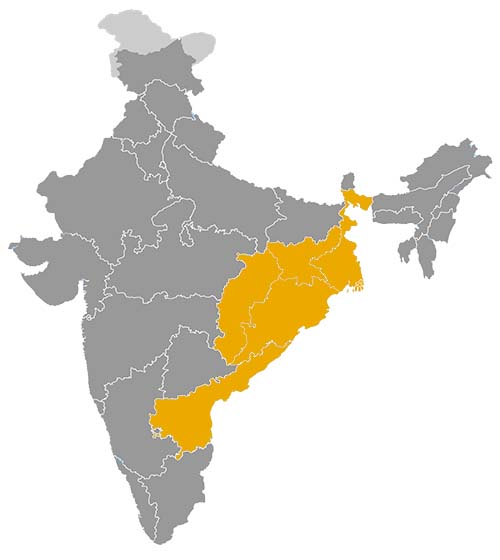
This map illustrates the maximum territory that the Suryavamsi Dynasty had reached at its height, covering the current regions of Andhra Pradesh, Chhattisgarh, Jharkand and Odisha in India. Its main purpose is to provide a visual aid to understand the geographical extent of this dynasty. However, it's important to note that the contemporary borders of these regions may not necessarily coincide with the historical territories.
The Suryavamsi dynasty and its role in the history of eastern India
A regional power centred on medieval Odisha
The Suryavamsi dynasty, also known as the Suryavamsi Gajapati dynasty, played an important role in the history of eastern India during the fifteenth and early sixteenth centuries. It ruled mainly over Odisha, succeeding the Eastern Ganga dynasty and preserving the political importance of the region after the decline of earlier royal authority. The dynasty is especially associated with the title Gajapati, a royal designation that expressed sovereignty, military strength and the prestige of the Odishan monarchy.
The rise of the Suryavamsi marked one of the last major phases of independent Hindu kingship in Odisha before the increasing pressure of the Bengal Sultanate, the Deccan sultanates, Vijayanagara and later the Mughals. Under Kapilendra Deva, the dynasty expanded far beyond its core territory and turned Odisha into one of the most powerful regional states of the eastern subcontinent.
Kapilendra Deva and the assertion of Gajapati authority
The founder of the dynasty, Kapilendra Deva, came to power in a period of transition after the weakening of the Eastern Gangas. His reign transformed the political position of Odisha. He did not merely inherit a regional kingdom, but reorganised it as an expansive and militarised state with ambitions in the eastern coast, Andhra and the borderlands of the Deccan.
Kapilendra Deva’s authority rested on conquest, royal legitimacy and control over key religious centres. His campaigns extended Gajapati influence toward the south and brought the dynasty into contact and conflict with other major powers. The kingdom became an active participant in the politics of the Bay of Bengal, the Telugu regions and the eastern Deccan.
His successors, especially Purushottama Deva and Prataparudra Deva, inherited both the prestige and the difficulties of this expansion. They had to defend a large and diverse realm whose frontiers were exposed to powerful neighbours. This made the Suryavamsi state influential, but also vulnerable to military pressure and internal instability.
The political role of Odisha between Bengal, Vijayanagara and the Deccan
The Suryavamsi dynasty occupied a strategic position between northern and southern India. To the north, Odisha bordered the Bengal Sultanate, a powerful Muslim state that competed for influence in eastern India. To the south, the Gajapati rulers confronted Vijayanagara, especially in Andhra and the Telugu speaking regions. To the west and southwest, the rise of the Deccan sultanates gradually altered the balance of power.
This geography gave the dynasty a central role in regional politics. Odisha was not an isolated coastal kingdom. It was a military and diplomatic actor whose alliances and conflicts influenced the relations between eastern India, the Deccan and the southern peninsula.
Under Prataparudra Deva, the kingdom faced increasing pressure from several directions. The loss of southern territories to Vijayanagara and the rise of new Muslim powers weakened the expansive position established by Kapilendra Deva. Yet even during its decline, the Suryavamsi dynasty remained important because it represented the political resilience of Odisha in a competitive regional environment.
Jagannath at Puri as a foundation of royal legitimacy
The cultural role of the Suryavamsi dynasty was closely connected with the cult of Jagannath at Puri. The temple had already been a major religious centre under the Eastern Gangas, but the Suryavamsi rulers continued to use it as a central pillar of royal legitimacy. The king was presented as a protector of Jagannath, and the prestige of the shrine strengthened the authority of the monarchy.
This relationship between kingship and temple culture was essential to the identity of Odisha. Puri was not only a religious centre, but also a political symbol. The control and patronage of the Jagannath temple helped the Gajapati rulers present themselves as guardians of a sacred regional order.
The dynasty also contributed to the continuity of Odia cultural life. Court patronage, temple networks, ritual practices and regional literary traditions developed within a political framework that gave Odisha a strong and recognisable identity. The Suryavamsi period therefore helped preserve and reinforce the cultural distinctiveness of the region.
Agricultural wealth, coastal routes and temple economy
The economic foundation of the Suryavamsi kingdom rested on the agricultural resources of Odisha, especially the coastal plains and river valleys. These lands provided the revenues needed to maintain the army, support the court, finance religious institutions and sustain administrative structures.
The kingdom also benefited from its position on the eastern coast of India. Ports and coastal routes connected Odisha with the Bay of Bengal and with wider commercial networks. Trade linked the region to Bengal, Andhra, South India and maritime routes across the Indian Ocean.
The temple economy was another important element. The Jagannath temple possessed lands, received donations, attracted pilgrims and supported a wide range of ritual, artisanal and service activities. This religious economy reinforced the link between political authority, agricultural production and regional identity.
A durable legacy in the history of eastern India
The Suryavamsi dynasty declined after Prataparudra Deva, and the short reigns of Kalua Deva and Kakharua Deva were followed by the rise of the Bhoi dynasty. The political unity and military reach created by Kapilendra Deva did not survive the combined effects of succession problems and external pressure.
Nevertheless, the historical importance of the Suryavamsi dynasty remained considerable. It made Odisha a major regional power, defended and expanded the Gajapati tradition, strengthened the connection between monarchy and the Jagannath cult, and contributed to the cultural identity of eastern India.
In the broader history of India, the Suryavamsi dynasty represents a powerful example of regional state formation. Its rulers combined military ambition, religious legitimacy, agricultural resources and coastal connections. Their role was not limited to Odisha alone, but extended to the political and cultural history of eastern and southern India.
The geographical expansion of the Suryavamsi dynasty in eastern India
A kingdom rooted in medieval Odisha
The Suryavamsi dynasty, also known as the Suryavamsi Gajapati dynasty, was centred on Odisha, the historical region formerly known as Orissa. Its core territory included the coastal plains, river valleys, religious centres and inland approaches of eastern India. The dynasty succeeded the Eastern Gangas and inherited a kingdom already shaped by the political and religious prestige of Puri, Bhubaneswar and the wider Odishan cultural zone.
The heartland of Suryavamsi power lay between the Bay of Bengal and the eastern highlands. This position gave the dynasty access to agricultural wealth, temple networks, coastal trade and routes leading toward Bengal, Andhra and the Deccan. The cult of Jagannath at Puri was central to this territorial identity. Control over Puri reinforced the legitimacy of the Gajapati rulers and helped define Odisha as a sacred and political centre.
The consolidation of Odisha under Gajapati authority
The founder of the dynasty, Kapilendra Deva, transformed Odisha from a regional kingdom into a major power of eastern India. His rule was based first on the consolidation of the Odishan heartland. This included the coastal belt, the lower river valleys and the administrative centres inherited from earlier royal traditions.
This consolidation was essential because Odisha was not a compact inland kingdom. It was a territory of plains, rivers, forests, coastal routes and temple estates. The Suryavamsi rulers had to maintain authority over local chiefs, religious institutions, military officers and agrarian communities. Their control of the core region allowed them to finance campaigns, support temples and maintain a strong royal court.
The centrality of Odisha also shaped the dynasty’s political outlook. The Gajapati rulers presented themselves not merely as local kings, but as sovereigns of a wider eastern realm. This ambition led to expansion beyond the traditional boundaries of Odisha.
Expansion toward Andhra and the southern coast
The most significant territorial expansion took place under Kapilendra Deva, whose campaigns extended Suryavamsi influence southward into the Andhra region. These territories were strategically valuable because they connected Odisha with the eastern coast of the Deccan and the Telugu speaking regions. They also contained fertile lands, coastal towns and routes linking northern and southern India.
Control over Andhra strengthened the Gajapati state and brought it into direct contact with the kingdom of Vijayanagara. The southern expansion of the Suryavamsi was therefore both a military achievement and a geopolitical challenge. By advancing into Andhra, the dynasty entered a zone contested by one of the most powerful states of South India.
The Suryavamsi hold over these southern territories was not always uniform. In some areas, their authority depended on military occupation, local alliances, governors and tribute arrangements. Even so, the expansion gave Odisha a level of regional influence that extended far beyond its coastal heartland.
The northern frontier and relations with the Bengal Sultanate
To the north, the Suryavamsi kingdom bordered the Bengal Sultanate. This frontier was politically sensitive because both Odisha and Bengal were powerful regional states with ambitions in eastern India. The northern borderlands included routes, riverine zones and fertile areas that could become objects of conflict or negotiation.
The Bengal Sultanate represented both a threat and a diplomatic counterpart. The Gajapati rulers had to defend the northern approaches to Odisha, while Bengal watched any Odishan expansion toward its southern margins. The relationship between the two powers was therefore shaped by rivalry, frontier defence and competition for influence.
This northern boundary also reinforced the political identity of the Suryavamsi rulers. By defending Odisha against pressure from Bengal, they strengthened their image as protectors of the Odishan realm and guardians of the Jagannath centre at Puri.
Western and south western contacts with the Deccan
The western and south western margins of the Suryavamsi realm connected Odisha with the interior regions and the Deccan. These areas were more difficult to control than the coastal plains. Forest zones, uplands, local chiefs and military corridors made royal authority variable and often dependent on negotiated power.
The rise of the Deccan sultanates, especially Golconda, changed the political situation in these regions. As these powers expanded, the Gajapati state faced increasing pressure over Andhra and the eastern Deccan. The territories that had once represented Suryavamsi expansion became contested spaces between Odisha, Vijayanagara and the Muslim sultanates of the Deccan.
This competition weakened the long term stability of Suryavamsi control outside Odisha. The dynasty could project power into the Deccan frontier, but maintaining permanent authority there required resources and military strength that became harder to sustain over time.
Rivalry with Vijayanagara over the southern territories
Relations with Vijayanagara were strongly shaped by geography. The Andhra coast and the Telugu regions formed a zone of strategic rivalry between the Gajapati rulers and the kings of Vijayanagara. For the Suryavamsi, these lands represented access to southern routes, agricultural wealth and political prestige. For Vijayanagara, they were essential to eastern expansion and control over the Deccan’s coastal connections.
Under Prataparudra Deva, the pressure from Vijayanagara increased. The gradual loss of southern territories reduced the wider influence created under Kapilendra Deva. This shift marked the beginning of a contraction of Suryavamsi power toward its Odishan core.
A wide but vulnerable regional dominion
At its height, the Suryavamsi dynasty controlled Odisha and extended influence into Andhra, the eastern Deccan and frontier zones facing Bengal. Its power was based on the combination of a strong coastal heartland, sacred kingship centred on Puri, agricultural resources and military expansion.
Its geography, however, also created vulnerability. The kingdom stood between Bengal, Vijayanagara and the Deccan sultanates. Expansion gave the dynasty prestige, but it also exposed it to pressure from several directions. After Prataparudra Deva, succession problems and external attacks weakened the state, leading to the rise of the Bhoi dynasty.
The geographical history of the Suryavamsi dynasty therefore explains both its greatness and its decline. It made Odisha a major regional power, but placed it in direct competition with some of the strongest states of late medieval India.
The Suryavamsi dynasty, also known as the Suryavamsi Gajapati dynasty, ruled mainly over Odisha and succeeded the Eastern Gangas. Its rulers bore the title of Gajapati, a royal title associated with sovereign power in Odisha. The regnal dates vary slightly between historical traditions and should be regarded as indicative.
- Kapilendra Deva (c. 1434–1467) • Founder of the Suryavamsi Gajapati dynasty, he overthrew the last Eastern Gangas and turned Odisha into a major regional power.
- Purushottama Deva (c. 1467–1497) • He consolidated his father’s territorial legacy and strengthened royal authority around the cult of Jagannath at Puri.
- Prataparudra Deva (1497–1540) • The last great ruler of the dynasty, he faced growing pressure from the Vijayanagara kingdom, the Golconda Sultanate and the powers of Bengal.
- Kalua Deva (1540–1541) • He ruled briefly during a period of dynastic crisis and political decline of the Gajapati state.
- Kakharua Deva (1541) • Generally listed as the last Suryavamsi ruler, he was overthrown during the rise of Govinda Vidyadhara and the Bhoi dynasty.