Français (France)
  Nederlands (nl-NL)
 Of Hindu tradition, the Gajapati dynasty ruled for approximately 116 years, ± between 1434 and 1550 over all or part of Central India, East India and South India, during the Medieval Period.
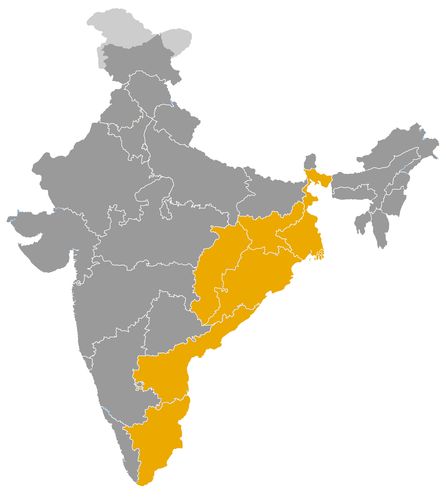
This map illustrates the maximum territory that the Gajapati Dynasty had reached at its height, covering the current regions of Andhra Pradesh, Chhattisgarh, Jharkand, Odisha, Tamil Nadu and West Bengal in India. Its main purpose is to provide a visual aid to understand the geographical extent of this dynasty. However, it's important to note that the contemporary borders of these regions may not necessarily coincide with the historical territories.
The Gajapati Dynasty and Its Role in the History of Medieval Eastern India
A major royal power rooted in Odisha
The Gajapati dynasty played a prominent role in the history of eastern India during the fifteenth and early sixteenth centuries. Its main power base lay in Odisha, the historical region associated with ancient Kalinga and with the religious centre of Puri. The title Gajapati, meaning “lord of elephants”, expressed royal prestige, military strength and the ability to command large armies. The dynasty is also known as the Suryavamsa Gajapati line, reflecting a royal ideology that linked its rulers with solar descent.
The rise of the dynasty began with Kapilendra Deva, who came to power around 1434. He transformed Odisha from a strong regional kingdom into a major imperial power on the eastern coast of the subcontinent. Under him, Gajapati authority expanded far beyond the Odia heartland, reaching into Andhra and influencing the politics of the Deccan and South India. His successors, Purushottama Deva and Prataparudra Deva, inherited a large but difficult kingdom, whose territorial reach brought both prestige and instability.
A political force between the eastern coast, the Deccan and South India
Politically, the Gajapati dynasty was important because it made Odisha one of the leading powers of late medieval India. The kingdom occupied a strategic position between Bengal in the north, the Deccan in the west and the Telugu and Tamil regions in the south. This location allowed the Gajapati rulers to intervene in several political zones at once.
Kapilendra Deva’s campaigns gave the dynasty control or influence over large parts of the eastern coast, especially in Andhra. These conquests brought the Gajapatis into direct rivalry with the Vijayanagara Empire, which also sought to dominate the Telugu-speaking regions and the routes between the Deccan and the coast. The Gajapati kingdom therefore became a central participant in the balance of power between eastern India and southern India.
The dynasty did not create a stable empire across all these regions for a long period. Its authority was strongest in Odisha and more contested in distant southern territories. Nevertheless, for much of the fifteenth century, the Gajapatis were among the most powerful rulers in the subcontinent, capable of challenging both Hindu and Muslim states in neighbouring regions.
The Jagannath cult as a foundation of royal legitimacy
The cultural role of the Gajapati dynasty was closely linked to the temple of Jagannath at Puri. This sanctuary had already become one of the most important religious centres of eastern India, but the Gajapati rulers made it a central pillar of royal identity. The king presented himself as the servant, protector and earthly representative of Jagannath, giving his monarchy a strong sacred dimension.
This relationship between kingship and religion helped integrate the kingdom. The cult of Jagannath was able to unite different social, linguistic and regional groups under a shared sacred authority. Through temple patronage, land grants, rituals and festivals, the Gajapati rulers strengthened both their political legitimacy and the cultural identity of Odisha.
Puri was not only a place of worship. It was also a symbolic capital of the kingdom, complementing the administrative and military functions of centres such as Cuttack. The prestige of Jagannath allowed the dynasty to present its power as more than military conquest. It became a form of sacred kingship rooted in Odia religious tradition and recognized beyond Odisha.
Patronage of religious and literary traditions
The Gajapati period contributed to the cultural development of Odisha through temple patronage, Sanskritic court culture and vernacular religious expression. The dynasty supported Brahmins, temples and religious institutions, while also participating in the wider literary and devotional movements of medieval India.
The reign of Prataparudra Deva is particularly associated with the growing importance of bhakti traditions. Puri became linked with major currents of Vaishnava devotion, especially through traditions connected with Chaitanya. Although the relationship between court, temple and devotional movements was complex, the Gajapati period helped reinforce Puri’s reputation as a major sacred centre of the subcontinent.
The dynasty’s cultural significance also lies in the consolidation of Odia identity. By supporting Jagannath, temple institutions and regional forms of expression, the Gajapatis contributed to the development of Odisha as a distinct historical and cultural region. Their rule connected local traditions with broader Sanskritic, Vaishnava and political cultures.
Economic strength based on agriculture, ports and temple networks
The economy of the Gajapati kingdom rested on fertile agricultural lands, coastal routes, temple institutions and control of strategic corridors. Odisha’s river valleys and coastal plains produced agricultural surplus, which supported the army, court, administration and religious establishments. Land revenue was an essential foundation of royal power.
The long coastline on the Bay of Bengal gave the kingdom access to maritime and coastal trade. Ports and coastal routes linked Odisha with Bengal, Andhra, South India and wider Indian Ocean circuits. While the Gajapatis were not primarily a naval empire, their control of the coast strengthened their economic position and allowed commercial movement along the eastern seaboard.
Temple institutions also played a major economic role. The Jagannath temple received donations, land grants and revenues, and its rituals attracted pilgrims, artisans, merchants and service communities. Religious patronage therefore helped organize economic life by redistributing wealth, supporting local production and linking sacred centres with rural and urban resources.
A dynasty shaped by expansion, rivalry and decline
The Gajapati dynasty’s power brought it into conflict with several major neighbours. To the south, the Vijayanagara Empire was its principal rival for control of Andhra and the eastern coastal routes. To the west and southwest, the Deccan sultanates, especially Golconda, challenged Gajapati authority in the Telugu regions. To the north, the Bengal Sultanate posed a threat to the northern frontier of Odisha.
These rivalries gradually weakened the kingdom. The southern territories were difficult to hold from the Odia heartland, and local loyalties could shift according to military circumstances. Under Prataparudra Deva, the dynasty still retained prestige, but its territorial position became increasingly vulnerable. After his reign, internal instability and external pressure led to the fall of the direct Gajapati line and the rise of the Bhoi dynasty under Govinda Vidyadhara.
The place of the Gajapati dynasty in Indian history is therefore that of a major eastern power at the end of the medieval period. It strengthened Odisha politically, elevated Puri as a centre of sacred kingship, controlled important agricultural and coastal resources, and participated in the great rivalries between Bengal, the Deccan, Andhra and South India. Its legacy remains central to the historical identity of Odisha and to the political history of India’s eastern coast.
The Geographic Extent of the Gajapati Dynasty along the Eastern Coast of India
A kingdom rooted in the historical region of Odisha
The Gajapati dynasty emerged in the fifteenth century as one of the major powers of eastern India. Its territorial base lay in Odisha, the historical region associated with ancient Kalinga, between the Bay of Bengal, the coastal plains, the river valleys and the inland plateaus. From this core, the dynasty expanded into neighbouring regions and became a decisive actor in the politics of the eastern coast, Andhra and the wider Deccan.
The title Gajapati, meaning “lord of elephants”, reflected the military prestige of the rulers and their claim to sovereign authority. The dynasty’s principal centres were Cuttack, which functioned as an administrative and military capital, and Puri, which provided religious legitimacy through the cult of Jagannath. This combination of political control and sacred authority helped the Gajapati rulers govern a territory that extended well beyond the Odia heartland.
The Odia heartland as the stable centre of power
The most stable part of the Gajapati realm was Odisha itself. This region included fertile coastal plains, river basins, temple centres, market towns and fortified administrative locations. Its geography gave the dynasty access to agricultural surplus, inland routes and maritime connections. The Mahanadi delta and other river systems supported settlement and revenue collection, while the coast opened the kingdom toward the Bay of Bengal.
Within Odisha, the Gajapati rulers were able to combine direct royal authority with religious patronage and local administrative networks. Puri was central to this system. The Jagannath temple was not only a sacred institution, but also a major economic and social centre. It helped connect royal power with land grants, ritual obligations, pilgrimage and regional identity.
This Odia core remained the foundation of the dynasty even when its rulers expanded far to the south. When distant territories became difficult to hold, Odisha continued to provide the symbolic, military and economic base of Gajapati power.
Southern expansion into Andhra and the Telugu regions
The most important phase of Gajapati expansion occurred under Kapilendra Deva in the fifteenth century. His campaigns extended the kingdom southward along the eastern coast into Andhra and the Telugu-speaking regions. This expansion transformed the dynasty from a regional Odia power into an imperial force with influence across a large part of eastern and southeastern India.
Control over Andhra was strategically important. The region connected Odisha with the Deccan and South India, and it contained fertile lands, ports, forts and major communication routes. By holding or influencing parts of the Telugu country, the Gajapati rulers gained access to valuable agricultural districts and commercial corridors linking the coast with the interior.
However, the southern territories were more difficult to retain than the Odia heartland. Their distance from Cuttack, the strength of local elites and the ambitions of neighbouring powers made Gajapati control unstable. Some areas were directly administered for periods, while others were held through military pressure, alliances or temporary submission.
Rivalry with Vijayanagara over the eastern coastal corridor
The expansion into Andhra brought the Gajapati dynasty into direct conflict with the Vijayanagara Empire. Both powers sought influence over the Telugu regions, which formed a crucial corridor between the eastern coast, the Deccan and the south of the peninsula. Control of these areas meant access to agricultural resources, ports, military routes and political prestige.
The rivalry with Vijayanagara became one of the defining features of Gajapati territorial history. Under Kapilendra Deva, the Gajapatis reached the height of their power and challenged Vijayanagara influence in the southeast. Under Purushottama Deva and Prataparudra Deva, the struggle continued, but the balance gradually shifted. Vijayanagara recovered important territories and reduced Gajapati authority in parts of Andhra.
This rivalry shows that the Gajapati kingdom was not merely an eastern coastal state. At its height, it was deeply involved in the politics of South India. Its southern expansion gave it prestige, but also exposed it to prolonged military pressure from one of the strongest empires of the period.
Northern limits and relations with the Bengal Sultanate
To the north, the Gajapati realm bordered the political zone of Bengal. The Bengal Sultanate was a major power in eastern India and represented a significant threat to the northern frontier of Odisha. The territories between northern Odisha and Bengal were important for defense, trade and access to the lower Ganges region.
Relations between the Gajapatis and the Bengal Sultanate were shaped by frontier rivalry and strategic caution. The Gajapati rulers needed to protect northern Odisha while maintaining their attention on the southern conflicts with Vijayanagara. This made the kingdom’s geography difficult to manage, as threats could arise from both north and south.
The northern frontier also reinforced the importance of Odisha as a buffer region between Bengal, the Deccan and the eastern coast. The Gajapati state therefore stood at the intersection of several political worlds, each with distinct military and economic interests.
Western contacts with the Deccan and Golconda
To the west and southwest, Gajapati influence reached toward the Deccan through the inland routes of Andhra and Telangana. These regions were contested by the Deccan sultanates, especially Golconda, which became increasingly important in the sixteenth century. The competition concerned forts, inland corridors, Telugu-speaking districts and access between the plateau and the coast.
The Deccan frontier was difficult to control because it combined military strongholds, local chieftains and shifting alliances. As Gajapati power weakened after Prataparudra Deva, pressure from Golconda and other Deccan forces contributed to the reduction of Gajapati authority outside Odisha.
A wide but fragile territorial structure
The geographic extent of the Gajapati dynasty was remarkable. From its Odia centre, it controlled or influenced territories along the eastern coast and deep into Andhra, with political connections toward the Deccan and South India. This expansion gave the dynasty agricultural wealth, access to coastal trade, military prestige and influence over several cultural regions.
Yet this same geography also made the kingdom vulnerable. The southern provinces were distant, the western frontier was contested, and the northern boundary faced pressure from Bengal. The Gajapati dynasty became powerful because it controlled one of the great corridors of eastern India, but its position between Bengal, the Deccan, Andhra and Vijayanagara made long-term domination difficult.
The territorial history of the Gajapatis therefore explains both their rise and their decline. They were among the great regional powers of late medieval India, but the breadth of their ambitions exceeded the capacity of the dynasty to hold all its conquered lands permanently.
The rulers of this line are often called Gajapati, a royal title meaning “lord of elephants”, associated with the military prestige of medieval Odisha. The dynasty is also known as the Suryavamsa Gajapati line; the reign dates are indicative and may vary slightly according to historical traditions.
- Kapilendra Deva (c. 1434–1467) • Founder of Gajapati power, he established major rule from Odisha and extended his authority toward Andhra and southern India.
- Purushottama Deva (c. 1467–1497) • He consolidated the kingdom after succession tensions and maintained the prestige of Puri and the cult of Jagannath.
- Prataparudra Deva (c. 1497–1540) • The last great Gajapati ruler, he faced pressure from Vijayanagara, the Golconda Sultanate and the Bengal Sultanate.
- Kalua Deva (c. 1540–1541) • Successor of Prataparudra, he ruled briefly during a period of instability and dynastic weakening.
- Kakharua Deva (c. 1541) • The last ruler generally associated with the direct line, he was overthrown during the rise of Govinda Vidyadhara and the Bhoi dynasty.
 Links to the main sections of the site