Français (France)
  Nederlands (nl-NL)
 Of Islamic tradition, the Lodi dynasty ruled for approximately 75 years, ± between 1451 and 1526 over all or part of North India, during the Medieval Period.
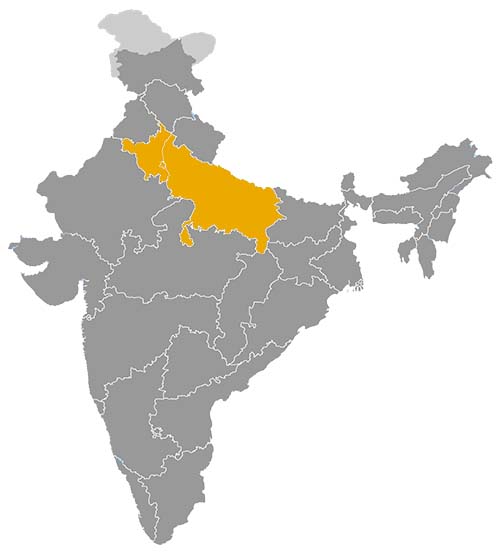
This map illustrates the maximum territory that the Lodi Dynasty had reached at its height, covering the current regions of Delhi (NTC), Haryana and Uttar Pradesh in India. Its main purpose is to provide a visual aid to understand the geographical extent of this dynasty. However, it's important to note that the contemporary borders of these regions may not necessarily coincide with the historical territories.
The Lodi Dynasty and the Final Phase of the Delhi Sultanate
An Afghan ruling house at the end of the Delhi Sultanate
The Lodi dynasty occupies an important place in the history of northern India because it was the last ruling dynasty of the Delhi Sultanate before the rise of the Mughal Empire. It ruled from 1451 to 1526, following the weakened Sayyid dynasty. Its three principal rulers were Bahlul Lodi, Sikandar Lodi and Ibrahim Lodi. They belonged to an Afghan elite whose influence had grown within the political and military structures of the late Delhi Sultanate.
The rise of the Lodis marked a change in the social basis of power in Delhi. Earlier dynasties had often been dominated by Turkish, Central Asian or Persianized military elites. The Lodis, by contrast, relied heavily on Afghan nobles and clan networks. This support gave them a strong military base, but it also limited their ability to impose a highly centralized monarchy. The sultan had to govern through negotiation, personal loyalty and the careful management of powerful Afghan chiefs.
The restoration of political authority in northern India
When Bahlul Lodi came to power in 1451, the Delhi Sultanate was no longer the great imperial state it had been under the Khaljis or the early Tughlaqs. The invasion of Timur in 1398 had severely damaged the prestige of Delhi, and several regions had become independent or semi-independent. Gujarat, Malwa, Bengal, Jaunpur and the Deccan sultanates had developed as strong regional powers.
Bahlul Lodi’s main political achievement was the partial restoration of Delhi’s authority in northern India. He used military campaigns, alliances and Afghan noble support to rebuild the sultanate’s position. His conquest of Jaunpur was especially important because it removed a major rival in the eastern Ganges plain and restored Delhi’s influence over a wider part of the Indo-Gangetic region.
Sikandar Lodi continued this policy of consolidation. His reign was marked by more active administration, stronger provincial control and the development of Agra as a political and strategic centre. Agra’s location on the Yamuna made it useful for supervising the Doab, eastern routes and revenue-rich agricultural territories. This development would later become highly significant under the Mughals.
A political system shaped by Afghan noble power
The Lodi state was based on a delicate balance between the authority of the sultan and the autonomy of Afghan nobles. These nobles did not always behave as ordinary servants of the central government. Many saw themselves as partners in power, with their own followers, territories and military resources. This political culture strengthened the dynasty when cooperation was maintained, but weakened it when the ruler tried to centralize authority too forcefully.
Under Ibrahim Lodi, these tensions became acute. He attempted to strengthen royal authority and reduce the independence of leading nobles. This policy provoked opposition among sections of the Afghan aristocracy and contributed to serious internal instability. Some nobles turned against him, and his political isolation created the conditions for outside intervention.
The defeat of Ibrahim Lodi by Babur at the First Battle of Panipat in 1526 ended the dynasty. The event was not only a military defeat. It revealed the structural weakness of a political system that depended on unstable relations between the sultan and the Afghan nobility.
Economic foundations in agriculture, taxation and urban centres
The economy of the Lodi dynasty depended mainly on agricultural revenue from the Indo-Gangetic plain. The fertile lands around Delhi, the Doab, parts of present-day Uttar Pradesh and areas toward Bihar provided the fiscal base of the state. These revenues supported the army, the court and the administrative apparatus.
The restoration of territorial control helped revive taxation and trade in parts of northern India. Cities served as centres of administration, revenue collection, military organization and commercial exchange. Delhi retained its political prestige, but Agra became increasingly important under Sikandar Lodi. Its development shows the dynasty’s attempt to manage a broader regional space more effectively.
The Lodi period did not produce economic reforms as famous as those of Ala al-Din Khalji, but it contributed to stabilizing parts of northern India after a long phase of fragmentation. This stability supported agricultural production, urban activity and the movement of goods along major routes.
Cultural continuity within the Indo-Islamic tradition
The cultural role of the Lodi dynasty belongs to the broader Indo-Islamic tradition of the Delhi Sultanate. Persian remained important as a language of administration, court culture and learned expression. Although the ruling elite was Afghan in origin, it operated within a political environment already shaped by Persianate institutions and Islamic courtly practices.
Architecture is one of the most visible cultural legacies of the Lodis. Their tombs, mosques and funerary complexes in Delhi show a distinctive late sultanate style. Lodi architecture often used balanced proportions, domes, arches, octagonal tomb plans and garden settings. These monuments form an important bridge between earlier Delhi Sultanate architecture and later Mughal architectural forms.
The period also maintained the role of religious scholars, Sufi networks and urban cultural institutions. Delhi and Agra remained centres of Islamic learning, political patronage and social interaction. The Lodis did not create a cultural rupture, but they preserved and developed traditions that had been formed over several centuries of sultanate rule.
A transitional dynasty before the Mughal Empire
The Lodi dynasty was both a restoration and an ending. It restored part of Delhi’s authority after the decline of the Tughlaqs and Sayyids, but it did not recreate a stable imperial system across northern India. Its power remained limited by Afghan noble autonomy, regional rivalries and the political fragmentation of the late medieval period.
Its historical importance lies in this transitional position. The Lodis were the last rulers of the Delhi Sultanate and the immediate predecessors of the Mughals. They preserved Delhi’s political legacy, developed Agra, strengthened parts of the Indo-Gangetic heartland and transmitted to Babur a region already shaped by centuries of sultanate rule. Their fall in 1526 closed one major chapter of Indian history and opened another.
The Geographic Expansion of the Lodi Dynasty and the Political Balance of Northern India
A Delhi-centred power in a fragmented political landscape
The Lodi dynasty ruled the Delhi Sultanate from 1451 to 1526. It was the last dynasty of the sultanate before Babur’s victory at Panipat and the rise of the Mughal Empire. Its territory was more limited than the vast domains once claimed by the Khaljis and the early Tughlaqs. By the time the Lodis came to power, Delhi had been weakened by the invasion of Timur in 1398, by internal decline and by the rise of several independent regional states.
The geographic history of the Lodi dynasty should therefore be understood as a partial restoration rather than a vast imperial expansion. The Lodis sought to rebuild Delhi’s authority in the Indo-Gangetic plain, to control the strategic routes linking Delhi with the Punjab, the Doab, Jaunpur and Bihar, and to contain neighbouring powers that had emerged from the decline of the earlier Delhi Sultanate.
The core territories around Delhi, the Punjab and the Doab
The most stable centre of Lodi authority lay around Delhi. The city retained its symbolic and political prestige, even though it no longer dominated the subcontinent as it had during the strongest phases of the sultanate. The surrounding regions, including parts of present-day Haryana, the Doab between the Ganges and Yamuna rivers, and parts of the Punjab, formed the military and fiscal base of Lodi rule.
The Doab was especially important. Its fertile agricultural lands provided revenue for the army, the court and the administration. It was also crossed by major routes connecting Delhi to eastern cities. Control of this region allowed the Lodis to project power beyond the capital and to maintain a degree of administrative continuity.
The Punjab had a different but equally strategic function. It linked Delhi with Afghan territories and with the routes leading from Kabul and Central Asia. This connection was useful for a dynasty of Afghan origin, because it strengthened political and military ties with Afghan groups. At the same time, it exposed the sultanate to pressure from the northwest. Babur’s later intervention would make this vulnerability decisive.
Jaunpur and the restoration of eastern authority
One of the most important territorial achievements of the Lodi dynasty was the incorporation of Jaunpur. After the weakening of Delhi, the Jaunpur Sultanate had become a powerful regional state in the eastern Ganges plain. It was both a rival and an obstacle to the restoration of Delhi’s influence in northern India.
Bahlul Lodi pursued a gradual policy of military pressure, negotiation and alliance-building to reduce Jaunpur’s independence. Its eventual integration restored Delhi’s authority over a larger part of present-day Uttar Pradesh and extended Lodi influence toward Bihar. This did not recreate a pan-Indian empire, but it gave the dynasty a more substantial territorial base and strengthened its standing among Afghan nobles.
Under Sikandar Lodi, this eastern orientation continued. The development of Agra as a political and administrative centre was closely linked to this strategy. Situated on the Yamuna, Agra was better placed than Delhi for supervising the Doab, controlling routes toward Jaunpur and managing agricultural revenues in the eastern regions. Its rise under the Lodis foreshadowed its later importance under the Mughals.
Relations with Rajput powers and central Indian states
The expansion of the Lodi dynasty also brought it into contact and conflict with Rajput powers and the states of central India. Rajasthan and Gwalior remained difficult regions to dominate permanently. Their forts, warrior lineages and local alliances limited the capacity of Delhi to impose direct rule.
The Lodis attempted to extend their influence over the western and southern margins of their territory, but their control remained uneven. Relations with Rajput chiefs alternated between warfare, negotiation, local accommodation and temporary submission. Fortified centres such as Gwalior were strategically important because they guarded routes toward central India and protected the southern approaches to the Indo-Gangetic heartland.
These frontier zones reveal the limits of Lodi power. The sultanate could apply military pressure, but it did not always possess the resources or political cohesion needed to integrate strongly rooted regional powers. The Rajputs therefore remained neighbours, rivals and occasional political partners rather than fully subordinated subjects.
Boundaries with rival regional sultanates
The Lodis also had to deal with powerful regional sultanates that had benefited from the decline of Delhi. Gujarat, Malwa and Bengal were not peripheral territories waiting to be reconquered. They were established states with their own armies, capitals, elites and commercial networks.
The Lodi dynasty did not succeed in absorbing these states. Its policy was instead to preserve Delhi’s authority in the Ganges plain and prevent neighbouring powers from threatening its core territory. Bengal remained outside effective Lodi control, although areas toward Bihar could be contested. Malwa and Gujarat limited expansion toward western and central India. This political landscape forced the Lodis to act as one major northern Indian power among several, rather than as uncontested masters of the subcontinent.
The existence of these neighbouring states shaped Lodi diplomacy and warfare. Delhi had to balance military campaigns with alliances and internal management. The dynasty’s Afghan nobility also affected these relations, since regional ambitions and factional rivalries could weaken central strategy.
A limited expansion with decisive historical consequences
The Lodi dynasty did not reach the geographic scale of the Khalji or Tughlaq empires. Its importance lies in the reconstruction of a coherent northern Indian power centred on Delhi, the Doab, the Punjab, Jaunpur and parts of the eastern Ganges plain. This restoration gave the late Delhi Sultanate a renewed territorial base after decades of decline.
The Lodi expansion influenced relations with neighbouring dynasties by forcing Rajput rulers, the sultanates of Gujarat, Malwa and Bengal, and Afghan power groups to respond to the revived authority of Delhi. Yet the dynasty remained vulnerable. Its territory was more solid than that of the late Sayyids, but its political structure was weakened by noble rivalries and limited centralization. In 1526, Babur’s intervention exposed these weaknesses and brought the last phase of the Delhi Sultanate to an end.
The Lodi dynasty was the last dynasty of the Delhi Sultanate. Its rulers bore the title of sultan and belonged to an Afghan elite. The reign dates are generally accepted; the dynasty ended in 1526 when Ibrahim Lodi was defeated by Babur at the First Battle of Panipat.
- Bahlul Lodi (1451–1489) • Founder of the Lodi dynasty, he partially restored Delhi’s authority after the Sayyid period and strengthened the role of Afghan nobles.
- Sikandar Lodi (1489–1517) • He consolidated the administration, developed Agra and extended the sultanate’s influence in the Indo-Gangetic plain.
- Ibrahim Lodi (1517–1526) • The last Lodi sultan, he faced internal rebellions and was defeated by Babur, paving the way for the Mughal Empire.
 Links to the main sections of the site