

 Français (France)
  Nederlands (nl-NL)
 Jainism is a religious tradition that emerged in India during the 6th century BCE, in a period of philosophical and spiritual questioning of Vedic authority. It was systematized through the teachings of Mahāvīra, recognized as the 24th Tīrthankara, a spiritual teacher who achieved liberation. Jain doctrine is founded on strict ethical principles, particularly ahimsa (absolute non-violence), material renunciation, and the pursuit of spiritual liberation through asceticism.
Although Jainism remains a minority religion, mainly practiced in India, its cultural impact is considerable. It has shaped Indian thought, inspired movements centered on non-violence, and produced an artistic heritage of finely crafted temples.
While its global spread remains limited, Jainism occupies a central place in the religious and philosophical landscape of South Asia. It continues to influence architecture, ethics, and cultural identity in the regions where it took root.
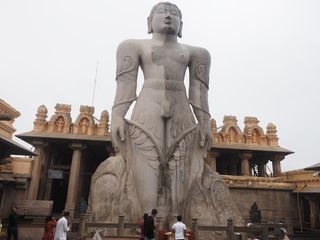
Shravanabelagola, Gomateshwara statue, Karnataka
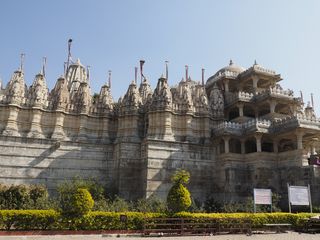
Ranakpur, Adinath temple, Rajasthan
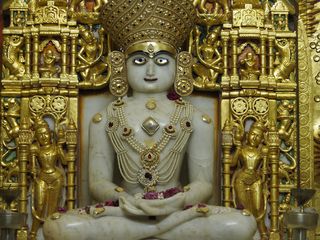
Mandu, Mandavgarh Suparshvnat, Madhya Pradesh
Jainism: Origins, Doctrinal Foundations, and Historical Role
Historical Origins and Context of Emergence
Jainism is an ancient religious tradition that emerged in the Indian subcontinent around the 6th century BCE, in a period of intense philosophical and spiritual transformation. This era, often referred to as the śramaṇa movement, saw the rise of several heterodox schools that questioned the authority of the Vedic tradition and the dominance of Brahmanical ritualism.
Although Mahāvīra (circa 599–527 BCE) is commonly regarded as the historical founder of Jainism, the tradition views him as the 24th and last Tīrthankara — enlightened teachers who appear in each cosmic cycle to guide beings toward liberation. His predecessor, Pārśva, is also historically attested, indicating a continuity of ascetic teachings that predate Mahāvīra by at least two centuries.
Mahāvīra’s teachings systematized a strict ethical and ascetic discipline rooted in non-violence, renunciation, and personal responsibility. These ideas set Jainism apart from both the Vedic orthodoxy and other śramaṇa traditions such as Buddhism.
Geographical Spread and Historical Presence
Initially concentrated in the Gangetic plains of northern India, Jainism gradually spread westward and southward. During the early centuries of the Common Era, the religion gained significant footholds in regions such as Gujarat, Rajasthan, Maharashtra, Madhya Pradesh, and Karnataka.
The spread of Jainism was facilitated by itinerant teachers, royal patronage from various regional dynasties, and the establishment of monastic centers. In southern India, Jainism thrived under dynasties like the Kadambas, Gangas, and Rashtrakutas. In the western regions, wealthy merchant communities embraced Jain values, particularly non-violence and ethical commerce.
Although Jainism never became the religion of a dominant pan-Indian empire, it remained influential across various regional cultures. Its decline in some areas, particularly in the north, was due in part to the rise of devotional Hinduism and the expansion of Islam during the medieval period. Nonetheless, Jain communities remained resilient, especially in urban and trade-oriented contexts.
Today, Jainism is predominantly practiced in India, with notable diasporic communities in East Africa, the United Kingdom, North America, and Southeast Asia. Despite being a numerical minority (less than 1% of India’s population), Jains maintain significant cultural, intellectual, and economic influence.
Major Currents and Internal Divisions
Jainism comprises two principal sects:
- Digambara (“sky-clad”): This tradition advocates extreme asceticism, including the complete renunciation of clothing for male monks, symbolizing absolute detachment. Digambaras believe that women cannot attain liberation (moksha) in their current life and must be reborn as men to do so.
- Śvetāmbara (“white-clad”): This sect allows monks and nuns to wear white robes and recognizes the spiritual capacity of women to achieve liberation. Śvetāmbaras preserve a different scriptural canon than the Digambaras and interpret Mahāvīra’s life and teachings less literally.
Within the Śvetāmbara branch, further subdivisions include:
- Mūrtipūjaka: Worshippers of images of the Tīrthankaras.
- Sthānakavāsī: Opposed to image worship, emphasizing internal meditation.
- Terāpanthī: A reformist subsect focused on discipline and central authority.
Despite doctrinal and ritual differences, all Jain traditions share a common philosophical foundation and ethical code.
Core Beliefs and Ethical Practices
At the heart of Jain doctrine lies the dualistic worldview distinguishing between jīva (soul, conscious life) and ajīva (non-conscious matter). The soul is considered inherently pure and omniscient but is bound by karma — conceived not as metaphysical judgment but as a form of subtle material substance that adheres to the soul due to actions driven by passion and attachment.
The spiritual goal in Jainism is moksha, or liberation from the cycle of birth and death (saṃsāra), achieved through the elimination of all karmic matter. To this end, Jainism prescribes an ethical path rooted in five major vows (mahāvrata) for ascetics and five lesser vows (anuvrata) for laypeople:
- Ahimsā – Absolute non-violence toward all living beings.
- Satya – Truthfulness in thought, speech, and deed.
- Asteya – Non-stealing; taking nothing that is not freely given.
- Brahmacharya – Chastity; celibacy for ascetics, sexual restraint for laypersons.
- Aparigraha – Non-possessiveness; detachment from material and emotional attachments.
Jain ethics extend beyond behavior to include intention and mental discipline. For example, causing harm unknowingly or through negligence is still considered a violation of ahimsā. Consequently, Jain monks and nuns often carry feather dusters to avoid harming insects and filter water to prevent ingesting microscopic life.
Rituals, fasting, meditation, confession (pratikramana), and scriptural study are essential elements of Jain spiritual life. Major festivals include Paryushana, a time of intense reflection, and Mahāvīra Jayanti, commemorating the birth of the 24th Tīrthankara.
Political and Social Role
Jainism has never functioned as a state religion in the strict sense, but it has often benefitted from elite patronage, particularly from regional rulers and merchant guilds. Jain principles of non-violence and ethical commerce made the religion attractive among trading communities, who supported temples, scholars, and monks.
Throughout history, Jain thinkers have participated in philosophical debates, legal councils, and ethical discourses that shaped regional cultures. In the modern era, Jain identity has been protected under India’s constitutional framework as one of the recognized minority religions.
Prominent Jain figures have also contributed to the promotion of non-violence and social reform in modern India. Mahatma Gandhi acknowledged the influence of Jain ahimsā on his philosophy of nonviolent resistance.
Death, Afterlife, and Commemorative Practices
In Jainism, death is not an end but a transition in the endless cycle of saṃsāra. The ultimate aspiration is to end this cycle by achieving moksha, which frees the soul from all karmic matter and leads to a state of pure, formless existence.
For highly advanced ascetics, sallekhanā — a voluntary and gradual fast unto death — is regarded as a dignified and spiritually meaningful act, signifying the final renunciation of desire and attachment. This practice, though rare and controversial, remains legally and ethically recognized within Jain circles.
Funerary practices vary but generally avoid elaborate rituals. Cremation is common, though some traditions opt for burial. Jain memorials may include steles, commemorative pillars, or small shrines dedicated to deceased monks or revered teachers, particularly those who achieved samādhi-maran (conscious and peaceful death).
The Influence of Jainism on Architecture: Forms, Functions, and Symbolism
Religious Foundations of Jain Architectural Forms
Jainism, a religious tradition rooted in non-violence (ahimsa), spiritual liberation (moksha), and asceticism, has shaped a distinctive architectural legacy in the Indian subcontinent. The core values of purity, detachment, and ethical self-discipline are reflected in the spatial organization, aesthetics, and function of Jain religious structures.
Jain architecture was never intended as a medium for ritual sacrifice or communal worship in the Vedic sense. Instead, it serves primarily as a space for personal contemplation, the veneration of the Tīrthankara (enlightened spiritual teachers), and the transmission of ethical principles. As such, Jain temples and commemorative structures are designed to support spiritual introspection and symbolic purification.
Typologies and Functions of Religious and Commemorative Structures
Places of Worship: Temples and Shrines
The central architectural type in Jain religious practice is the temple, often referred to as a derasar or basadi depending on the region. These temples are typically dedicated to one of the twenty-four Tīrthankara and follow a standardized spatial plan. The core of the temple is the sanctum (garbhagriha), housing a meditative or standing image of the Tīrthankara. Adjacent spaces include a prayer hall (mandapa), circumambulatory paths, and entry pavilions.
These temples serve multiple functions: they are places for silent worship, ritual fasting, confession, and celebration of religious festivals. Larger complexes often integrate meditation halls, lecture rooms, and pilgrims’ lodgings, establishing them as multifunctional centers of spiritual activity.
Ritual and Ceremonial Spaces
In addition to temples, Jain communities make use of communal gathering spaces, such as the upāśraya, where lay practitioners receive instruction, engage in collective meditation, or participate in ethical discourses. Within temple precincts, ritual circuits are often incorporated for circumambulation (pradakṣiṇā) around the sanctum, symbolizing reverence and inner purification through controlled physical movement.
These spaces are typically arranged to minimize distraction and to promote clarity of mind, reflecting the Jain emphasis on discipline and self-awareness.
Funerary and Commemorative Architecture
Jainism places little emphasis on bodily remains or traditional funerary rites. However, it recognizes commemorative structures dedicated to ascetics or spiritually accomplished individuals. These are typically symbolic rather than funerary and do not house physical relics. Forms include memorial stones, steles, and stūpa-like markers that honor the exemplary life or conscious death (samādhi-maraṇa) of a Jain renunciant.
Such structures are designed not for worship, but as ethical reminders and locations for reflection. Their architectural features prioritize symbolic resonance over monumental scale or ritual utility.
Symbolic and Spatial Principles
Forms and Orientation
Jain temples adhere to traditional architectural treatises (śilpaśāstra), which prescribe sacred geometry, symmetry, and axial alignment. The central axis often represents the ascent of the soul toward liberation. Orientation toward the east is standard, reinforcing associations with illumination and spiritual awakening.
The shikhara (tower) rising above the sanctum embodies vertical aspiration and metaphysical elevation. Complexes may contain multiple sanctums arranged around a courtyard, signifying diverse yet converging paths to spiritual emancipation.
Decorative Programs and Iconography
Jain iconography is rich in technique but restrained in narrative. Images of the Tīrthankara are central—always presented in meditative posture, devoid of individualizing traits or mythological contexts. This absence of ornamentation in the figure emphasizes universality and detachment.
Decorative motifs such as lotuses, celestial beings, wheels of dharma, and water elements reinforce ideals of purity and transcendence. Ceilings often feature cosmic mandalas or rosettes, while walls may display ethical parables or cosmological diagrams through low-relief carvings.
The aesthetic vocabulary aims to foster contemplation, not distraction, aligning with the Jain principle of non-attachment.
Materials and Construction Techniques
Jain architecture favors durable, high-quality materials such as white marble, sandstone, and granite, chosen based on regional availability. The preference for light-colored stone, particularly white marble, is both aesthetic and symbolic, reflecting the ideal of inner and outer purity.
Construction involves meticulous craftsmanship: intricately carved columns, ornamental ceilings, pierced screens (jālī), and balanced spatial layouts. Interiors are often adorned with geometric patterns and sculptural pillars, while natural light is modulated to create a serene and reflective atmosphere.
Larger complexes are frequently built using modular systems, allowing for the incremental expansion of galleries, sanctums, and courtyards without disrupting overall spatial harmony.
Geographical Spread and Local Adaptations
Though Jainism remains largely confined to the Indian subcontinent, its architecture exhibits significant regional variation. In western India, temples often employ white marble and emphasize elaborate sculptural programs. In the south, temples tend to be more compact and massive, with a greater use of granite and restrained ornamentation.
In certain areas, rock-cut architecture developed as a means of integrating spiritual retreats into natural landscapes. These include sanctuaries carved directly into cliffs, complete with stairways, columns, and porticoes. Such adaptations reflect both ascetic ideals and geographic pragmatism.
Climate, local traditions, and material resources influenced roof types, ventilation systems, and surface finishes. Yet the core architectural principles—symmetry, orientation, and spiritual intentionality—remain consistently applied across regions.
Intercultural Interactions and Shared Aesthetics
Despite its doctrinal separation, Jain architecture shares formal and conceptual elements with neighboring religious traditions, especially Hinduism and Buddhism. Common features include the temple plan, the use of mandalas in layout, and shared decorative motifs.
Many artisans and builders worked across sectarian lines, contributing to architectural cross-pollination. However, Jain architecture remains distinguishable by its emphasis on geometric rigor, minimal narrative content, and the meditative function of its spaces.
Where Hindu temples often depict dynamic mythological scenes and Buddhist structures house relics, Jain temples are marked by serenity, repetition, and iconographic restraint, focusing entirely on personal spiritual discipline.
Conclusion
Jain architecture encapsulates the religion’s ethical and metaphysical core in built form. Through its deliberate spatial layouts, symbolic clarity, and high-quality craftsmanship, it serves as a vehicle for moral introspection and spiritual aspiration. Its contribution to the religious and cultural landscape of South Asia is defined not by scale or political assertion, but by its coherence, restraint, and enduring symbolic precision.