Français (France)
  Nederlands (nl-NL)
 Sikhism is a monotheistic religion founded in the late 15th century in the Punjab region, which is today divided between India and Pakistan. It was initiated by Guru Nanak (1469–1539) and developed by a succession of ten Gurus. Sikhism advocates faith in one God, equality of all human beings, social justice, and the rejection of caste distinctions. Its sacred text, the Guru Granth Sahib, holds supreme spiritual authority. While primarily concentrated in Indian Punjab, Sikhism has spread throughout the South Asian diaspora and beyond. The religion has played a significant role in Indian political and military history, especially during the 19th century. Architecturally, its influence is visible in the construction of gurdwaras—distinct places of worship—characterized by a blend of simplicity, monumentality, and symbolic ornamentation.

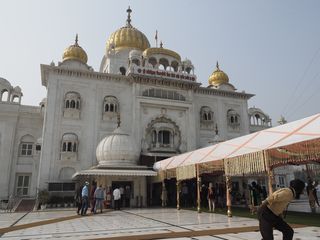
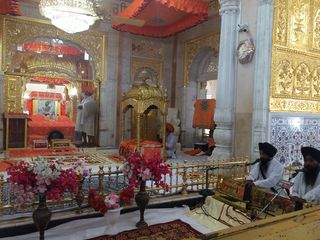
Sikhism: Origins, Expansion, Major Currents, and Core Principles
Historical Context of Emergence
Sikhism emerged in the late 15th century in the Punjab region, an area now divided between India and Pakistan. At that time, the region was characterized by a complex interplay of Islamic and Hindu influences, marked by rigid caste structures and social hierarchies. The founder of Sikhism, Guru Nanak (1469–1539), was born into a Hindu merchant family and developed a spiritual path that sought to transcend sectarian boundaries. He preached belief in one formless God, emphasized the equality of all human beings, and rejected both caste divisions and ritual formalism. After his death, his teachings were carried forward by nine successive Gurus. The tenth, Guru Gobind Singh (1666–1708), institutionalized the Khalsa—a spiritual and martial brotherhood—and ended the human line of Gurus by declaring the sacred scripture, the Guru Granth Sahib, as the eternal spiritual guide.
Geographical Distribution
Sikhism has historically been centered in the Punjab region, where it first developed and where the majority of adherents still reside. Following the 1947 partition of India, most Sikhs remained in Indian Punjab, where they now form a majority population. Smaller but significant communities exist in neighboring Indian states such as Haryana, Rajasthan, Delhi, and Jammu and Kashmir.
In the 20th century, Sikhism expanded globally due to labor migration and political upheaval. Large Sikh diasporas have formed in countries such as the United Kingdom, Canada, the United States, Malaysia, and Kenya. These communities maintain religious cohesion through the establishment of gurdwaras (places of worship), community kitchens (langar), and cultural associations. The Punjabi language continues to be used in religious contexts and community events.
Major Currents and Internal Diversity
While Sikhism is generally unified around the Guru Granth Sahib and the teachings of the ten Gurus, it includes a number of interpretive and social currents:
- The Khalsa tradition, established by Guru Gobind Singh, represents the orthodox path. Initiated Khalsa members undergo a baptismal ritual (amrit sanskar) and are required to adhere to the Five Ks—symbols of spiritual discipline and commitment.
- Sahajdhari Sikhs follow Sikh teachings without undergoing formal initiation or wearing the Five Ks, representing a more flexible approach.
- Minority sects such as the Namdhari, Nirmala, and Udasi incorporate mystical, ascetic, or even syncretic elements and may differ in liturgical emphasis. Some of these groups are not officially recognized by orthodox Sikh institutions.
While there is no centralized clergy, religious authority is often mediated through institutions like the Akal Takht in Amritsar, which serves as the highest temporal seat of Sikhism.
Core Beliefs and Practices
Sikhism is based on a concise set of theological and ethical principles:
- Monotheism: Belief in one, formless, timeless God who transcends human comprehension. God is often referred to as Waheguru, meaning “Wondrous Enlightener.”
- Equality and social justice: The religion explicitly rejects the caste system and upholds the equality of all human beings, regardless of gender, background, or status.
- Community service (seva): Voluntary service, particularly in social and communal settings, is a key virtue. This is embodied in the langar, a communal kitchen open to all.
- Daily devotion and honest living: Adherents are encouraged to earn their living honestly (kirat karni), meditate on God’s name (naam simran), and accept divine will (hukam).
Worship involves reading, listening to, and singing hymns from the Guru Granth Sahib, which includes verses not only from Sikh Gurus but also from Hindu and Muslim saints. Rituals are minimal; emphasis is placed on ethical conduct and spiritual reflection.
Important observances include the birth anniversaries of the Gurus, especially Guru Nanak Jayanti, and community celebrations of Khalsa founding (Vaisakhi). The Five Ks—kesh (uncut hair), kara (steel bracelet), kanga (wooden comb), kacchera (cotton undergarment), and kirpan (small sword)—are observed as physical symbols of faith by Khalsa initiates.
Political Involvement and Institutional Role
From its inception, Sikhism developed a political dimension, particularly in resistance to Mughal rule and the oppressive caste system. Under the sixth Guru, Guru Hargobind, the community adopted a dual emphasis on spiritual and temporal sovereignty. This culminated in the formation of the Khalsa by Guru Gobind Singh, which formalized the community’s martial responsibilities.
In the 19th century, Sikhs established an independent state under Maharaja Ranjit Singh, known as the Sikh Empire (1799–1849), with Lahore as its capital. This polity was characterized by religious tolerance and military strength until its annexation by the British.
During British colonial rule, Sikhs were recognized as a distinct religious group and heavily recruited into the colonial military. Their strategic importance increased, and Sikh regiments played major roles in British imperial campaigns.
In post-independence India, Sikhism is not a state religion, but remains a central cultural and political identity in Punjab. Political movements have at times called for greater autonomy or even a separate Sikh state (Khalistan), though such aspirations are marginal today.
Death, Afterlife, and Commemorative Practices
Sikhism does not teach the existence of a conventional heaven or hell. Instead, it follows the principle of reincarnation: the soul undergoes multiple cycles of birth and death, and ultimate liberation (mukti) is achieved through divine grace, ethical living, and spiritual discipline.
Death rituals involve cremation, accompanied by the recitation of appropriate hymns and prayers from the Guru Granth Sahib. Burial is not practiced. Commemoration often includes a continuous reading (akhand path) of the scripture, charity in the name of the deceased, and communal meals.
While monumental tombs or shrines for individuals are not part of Sikh religious practice—consistent with the belief in equality and humility—certain memorials have been erected to honor martyrs, historical leaders, or victims of conflict. These structures serve a civic and symbolic function rather than a doctrinal one.
The Influence of Sikhism on Architecture
Forms, Functions, and Symbolism of Sacred and Funerary Structures
Origins and Religious Foundations of Architectural Forms
Sikhism emerged in the late 15th century in the Punjab region, now divided between India and Pakistan. Rooted in a monotheistic vision and emphasizing equality, social justice, and devotion through service (seva), Sikhism introduced unique architectural principles aligned with its doctrinal values.
Unlike traditions that focus on divine iconography, Sikhism revolves around the Guru Granth Sahib, the sacred scripture considered the eternal guru. Consequently, architectural space is not built to enshrine deities, but rather to honor and centralize the sacred text and promote communal worship, reflection, and hospitality.
The absence of priestly hierarchy and the inclusive nature of Sikh practice influence the openness and accessibility of Sikh religious structures. Architecture is not designed for exclusivity or mysticism but as a vessel for collective spiritual and social engagement.
Typologies and Functional Uses of Sikh Structures
The principal architectural form in Sikhism is the gurdwara, meaning “gateway to the guru.” A gurdwara is not merely a temple; it serves simultaneously as a religious, educational, charitable, and community center.
Its primary functions include:
- Liturgical: Daily recitation and musical chanting of scriptures (kirtan), prayers, and congregational readings;
- Educational: Instruction in Sikh teachings, language (Gurmukhi), and ethics;
- Social: Communal kitchens (langar) offering free meals to all visitors regardless of background;
- Ceremonial: Hosting rites such as births, marriages, baptisms (Amrit Sanskar), and commemorations.
Gurdwaras often include lodging for pilgrims, libraries, classrooms, or medical dispensaries, making them multifunctional civic spaces.
In terms of funerary architecture, Sikhism prescribes cremation as the preferred method for bodily disposition, viewing it as a return to nature’s elements. Cemeteries or tombs are not central to the tradition. However, cenotaphs, memorial markers, and commemorative monuments are sometimes constructed in honor of martyrs or revered individuals, typically in symbolic rather than sepulchral form.
Symbolism in Architectural Design
Sikh architecture integrates specific symbolic features that express theological principles and community values.
Key symbolic elements include:
- Four entrances to the main hall of a gurdwara, representing openness to all people regardless of caste, religion, gender, or ethnicity;
- Central platform: The Guru Granth Sahib is placed on a raised platform (takht), under a canopy (chanani), emphasizing its spiritual authority;
- Non-hierarchical spatial arrangement: Devotees sit on the floor as equals, without distinction or barriers;
- Nishan Sahib: A tall flagpole bearing a saffron triangular flag adorned with the Khanda (the Sikh emblem) is typically erected near each gurdwara as a visual marker of Sikh presence;
- Absence of iconography: Decorative elements avoid anthropomorphic depictions, favoring sacred calligraphy, floral motifs, or abstract geometry.
Some gurdwaras include sarovars (water tanks or pools), offering symbolic purification but not intended for ritual absolution or baptism in a doctrinal sense.
Materials and Construction Techniques
Construction materials and techniques in Sikh architecture vary by historical period, regional availability, and community resources, yet some preferences are recurring.
- Brick and lime plaster are commonly used in vernacular buildings;
- Marble is favored for large or historically significant gurdwaras, particularly for flooring, walls, and structural supports;
- Wood carving may embellish entryways, balconies, or ceiling elements;
- Gilded metal or copper sheets often cover domes or spires in prominent structures.
Architectural volumes emphasize symmetry and balance. Domes, though not theologically prescribed, are frequently adopted as visual elements borrowed from Islamic or Mughal forms. Interiors are typically uncluttered and flooded with natural light to promote reflection and egalitarian gathering.
Geographic Spread and Local Adaptations
Although Sikhism remains centered in the Indian Punjab, global Sikh migration—especially in the 19th and 20th centuries—has led to the proliferation of gurdwaras in various cultural and architectural contexts.
- In India, gurdwaras vary from simple rural structures to elaborate urban complexes, depending on historical and financial factors. Local materials and climatic adaptations (e.g., ventilation, shaded courtyards) shape their design.
- In the diaspora (United Kingdom, Canada, United States, Australia), gurdwaras are often constructed in repurposed buildings such as warehouses or former churches, modified with added domes, entrances, and the Nishan Sahib.
- In Africa and Southeast Asia, gurdwaras adapt to tropical climates using wide eaves, raised foundations, or natural ventilation systems.
Despite architectural variability, certain spatial elements remain consistent: the central placement of the Guru Granth Sahib, the communal dining hall, and the emphasis on inclusive access.
Intercultural Interactions
Sikh architecture developed in a region long influenced by Hindu, Islamic, and colonial British architectural traditions. This interaction has yielded a distinctive syncretic style, combining regional and historical influences with Sikh religious principles.
- Domes and arches are drawn from Indo-Islamic traditions, but without associated ritual meanings such as directional orientation toward Mecca;
- Calligraphic and floral ornamentation echoes Mughal design while expressing Sikh scriptural themes in Gurmukhi;
- Horizontal and radial plans reflect the non-hierarchical and accessible ethos of Sikhism, contrasting with the axial or tiered layouts of Hindu temples or churches.
This process of architectural borrowing is selective and functional rather than doctrinal. The adaptation of external forms serves the expressive needs of the Sikh community without compromising core religious meanings.
The Role of Sikhism in the History of Indian Dynasties
Sikhism, founded in the 15th century in Punjab by Guru Nanak and developed by his successors, became in the 18th century the religious and identity foundation of the political power of the Khalsa and the Sikh Empire under Maharaja Ranjit Singh. This monotheistic faith, advocating equality, justice, and the defence of the community, was used to legitimise Sikh rulers’ authority and to unify a multi-ethnic territory.
While focused on the protection and promotion of its own tradition, Sikh rule maintained varying relations with other religions, notably Hinduism and Islam. At times there was cooperation and mutual respect, while at others, political rivalries or territorial disputes led to tensions, armed conflict, and repression.
The wars fought by the Sikh Empire—against Afghan invaders, neighbouring states, or the British Empire—often had a defensive dimension, aimed at preserving sovereignty and faith. Although Sikhism never dominated the entire subcontinent, it played a major political and military role in north-western India, leaving a lasting legacy in the region’s history and identity.
This page organises the dynasties related to Sikh religion, according to a chronological structure based on millennia and centuries. The associated maps indicate the present-day location of the relevant states and link to the detailed pages.







 Links to the main sections of the site