Français (France)
  Nederlands (nl-NL)
 Zoroastrianism is a monotheistic religion that emerged in ancient Persia, founded by the prophet Zoroaster (or Zarathustra), likely between the 10th and 6th centuries BCE. It centers on a cosmic dualism between good, represented by the god Ahura Mazda, and evil, personified by Angra Mainyu. Individuals are called to pursue good through thought, speech, and action.
The religion was officially adopted by several Persian empires, including the Achaemenids and Sassanids, but declined after the Islamic conquest. It survived in smaller communities in Iran and India, where Zoroastrian refugees (Parsis) settled mainly in Gujarat.
Despite its limited number of adherents today, Zoroastrianism has influenced later religious concepts such as judgment and resurrection, and has played a role in the cultural and architectural history of Western and Central Asia.
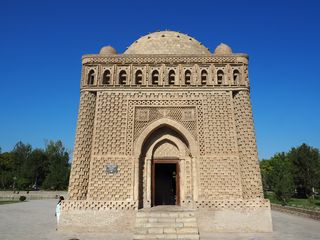
Samanid Mausoleum, Bukhara, Uzbekistan. Although Islamic in style, this mausoleum was built on a former Zoroastrian cemetery. Its symmetrical structure, unadorned brickwork, and geometric motifs reflect the enduring influence of Zoroastrianism on funerary architecture in Central Asia.
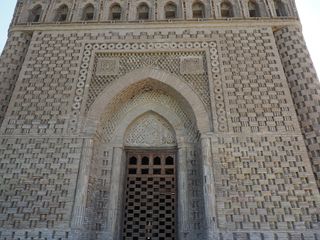
Samanid Mausoleum, Bukhara, Uzbekistan. (see note under the first photo)
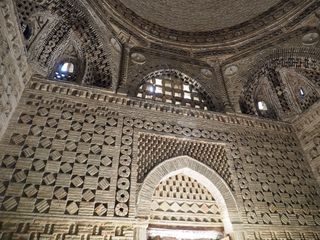
Samanid Mausoleum, Bukhara, Uzbekistan. (see note under the first photo)
Zoroastrianism: Origins, Beliefs, and Historical Role
Historical Context of Emergence
Zoroastrianism is one of the world’s oldest known monotheistic religions. It originated in ancient Persia, likely between the 10th and 6th centuries BCE, though its exact chronology and geographical birthplace remain subjects of scholarly debate. The religion is attributed to the prophet Zoroaster (also known as Zarathustra), who composed a series of hymns known as the Gathas, which form the core of the Avesta, the Zoroastrian sacred text.
Zoroastrian doctrine is based on the dualistic cosmology of Ahura Mazda, the supreme deity of wisdom and light, in constant opposition to Angra Mainyu (or Ahriman), the destructive spirit. This struggle between good and evil, truth and falsehood, order and chaos is central to Zoroastrian thought and places individual ethical responsibility at the heart of religious practice.
Geographical Spread
Zoroastrianism first spread across the Iranian plateau and was progressively adopted by major empires in the region. Under the Achaemenid Empire (550–330 BCE), the religion coexisted with other cults but was influential in imperial ideology. Its doctrines were likely practiced or at least respected by kings such as Cyrus the Great and Darius I.
The religion continued to evolve during the Parthian period (247 BCE – 224 CE) and reached its greatest formalization under the Sasanian Empire (224–651 CE), where it became a state religion, complete with a structured priesthood and codified rituals.
Following the Islamic conquest of Persia in the 7th century CE, Zoroastrianism declined significantly. A portion of its adherents converted to Islam, while others maintained their traditions in more isolated areas. One notable migration occurred to the western coast of India, where Zoroastrian refugees—later known as the Parsis—established new religious communities, particularly in Gujarat.
Today, the principal centers of Zoroastrianism are:
- Iran, notably in Yazd and Kerman,
- India, mainly in Mumbai, Navsari, and Udvada,
- and diaspora communities in North America, the United Kingdom, and Australia.
Major Currents and Traditions
While Zoroastrianism has remained relatively unified compared to other major religions, certain distinctions exist between its historical and regional expressions. The two main traditions are:
- Iranian Zoroastrianism, practiced by the remaining communities in Iran, often adapted to coexist with the dominant Islamic culture.
- Parsi Zoroastrianism, dominant in India, based on texts transmitted and codified by exiled Iranian priests, particularly the Vendidad, which outlines ritual and moral rules.
Within these communities, debates exist on issues such as:
- acceptance of converts,
- recognition of interfaith marriages,
- and adherence to different ritual calendars.
However, these differences are generally sociocultural rather than theological in nature and do not represent formal schisms.
Core Beliefs and Practices
Zoroastrianism emphasizes a dualistic worldview in which good and evil coexist, and each individual is morally responsible for choosing their path. The religion upholds the principle of “Good Thoughts, Good Words, Good Deeds” (Humata, Hukhta, Hvarshta), which guides daily behavior.
The central figure of worship is Ahura Mazda, often invoked through fire, a symbol of divine light and truth. Fire temples serve as places of ritual purity and communal gathering. Contrary to popular belief, fire is not worshipped but rather serves as a medium of connection to the divine.
Daily religious practices may include:
- prayer recitations from the Avesta,
- ritual washings for purity,
- and avoidance of pollutants considered spiritually harmful.
Zoroastrian festivals are seasonal and linked to natural cycles, including:
- Nowruz (New Year, celebrated at the spring equinox),
- Mehregan (autumnal festival of light and friendship),
- and Sadeh (celebration of fire and the defeat of darkness in winter).
Political Role and State Integration
Under the Sasanian Empire, Zoroastrianism was fully institutionalized as a state religion. The state sponsored temples, employed priests (mobeds), and enforced moral laws based on religious doctrine. The king was seen as divinely sanctioned, a protector of cosmic order (asha), and a representative of Ahura Mazda on earth.
This union of religion and state involved:
- a clerical hierarchy with judicial and educational roles,
- religious courts and regulations on social conduct,
- and strong links between royal legitimacy and religious authority.
After the Arab-Muslim conquest, Zoroastrian institutions lost official support. In Iran, the religion became a tolerated minority faith. In India, however, Parsis found relative freedom under Hindu and later British colonial rule. The community flourished economically and culturally, especially in Mumbai, and played a notable role in India’s industrial and civic development.
Although no longer a state religion, Zoroastrianism continues to serve as a marker of identity for its adherents, particularly within diasporic contexts.
Death, Afterlife, and Commemorative Practices
Zoroastrian eschatology is dual in nature—both individual and cosmic. Upon death, the soul faces judgment at the Chinvat Bridge (“Bridge of the Separator”), where its deeds are weighed. If the soul’s good actions outweigh the bad, it crosses safely into a realm of light; if not, it falls into darkness. This concept reflects an early formulation of moral accountability and afterlife reward or punishment.
At the end of time, a savior figure—the Saoshyant—will appear, resurrect the dead, and purify the world in a final battle against evil. The righteous will enjoy eternal renewal, while evil will be destroyed permanently.
Traditionally, Zoroastrians have been strict environmental dualists, believing that the elements (earth, fire, water) must remain pure. For this reason, burial and cremation are avoided. The deceased are traditionally placed in Towers of Silence (dakhmas), circular stone platforms where bodies are exposed to scavenging birds, especially vultures. This practice, now discontinued or restricted due to environmental and legal concerns, remains a defining feature of Zoroastrian funerary ethics.
Commemorative rituals include prayers and offerings held on the third, seventh, and thirtieth days after death, as well as annual remembrance ceremonies (Fravardigan), in honor of departed souls.
Conclusion
Zoroastrianism has played a crucial role in the religious, political, and ethical history of ancient and medieval Asia. Although now a small and geographically limited faith, it remains a living tradition with a rich doctrinal system, distinct rituals, and a historical legacy that continues to influence concepts of morality, identity, and eschatology. Its communities in Iran and India, as well as in diaspora, maintain practices rooted in centuries of continuity, adapting to modern contexts while preserving essential tenets.
Zoroastrianism and Architecture: Forms, Functions, and Symbolic Expressions
Religious Foundations and Architectural Origins
Zoroastrian architecture is shaped by the religious tenets of a dualistic worldview centered on purity, cosmic order, and the centrality of fire. The foundational belief in the eternal struggle between good (associated with light, order, and truth) and evil (associated with chaos and impurity) has direct implications for spatial organization, material usage, and ritual accessibility in architectural forms.
The sacred element of fire, representing divine wisdom and truth, is not deified but treated as a physical embodiment of Ahura Mazda’s spiritual presence. As such, fire becomes the focal point of worship and determines the configuration of Zoroastrian religious spaces. The preservation of ritual purity is also essential, leading to strict separations between sacred, semi-sacred, and profane areas, particularly in both temple and funerary contexts.
Funerary architecture likewise stems from theological concerns about the contamination of natural elements by the dead, shaping the design of mortuary spaces in accordance with the religion’s prescriptions against burial and cremation.
Typologies and Ritual Uses of Structures
Temples and Fire Altars
The central religious structure in Zoroastrianism is the fire temple, which houses a continuously burning sacred flame. These temples are not gathering places for communal worship in the conventional sense but function instead as controlled environments for maintaining and ritually tending to the fire by ordained priests.
A typical fire temple is organized into three main areas:
- an outer hall or vestibule, used for entrance and transition,
- a middle space for ritual purification or preparation,
- and an inner sanctum, where the sacred fire is kept, often inaccessible to the laity.
The sanctum is designed to minimize air flow and light penetration to protect the fire. The space is austere, devoid of images or elaborate ornamentation, emphasizing ritual precision over visual spectacle.
Ritual and Ceremonial Spaces
In addition to temples, open-air spaces are used for seasonal or communal ceremonies such as Nowruz (New Year) or other fire-related festivals. These areas may include raised platforms, gardens, or paved courtyards, and are sometimes aligned with cardinal directions, particularly the east, which symbolizes the rise of light.
Associated buildings may include:
- auxiliary rooms for ritual washing and preparation,
- educational halls for religious instruction,
- or private prayer rooms for families or community use.
These spaces are often situated near, but separate from, the fire sanctum, respecting the hierarchical structure of access and purity.
Funerary Structures
Zoroastrian funerary practices prohibit burial and cremation, both viewed as contaminating to earth, water, and fire. As a result, the religion developed a unique form of mortuary architecture: the Tower of Silence (dakhma). These are circular, roofless structures, often located on elevated ground or isolated hills, where bodies of the deceased are exposed to the sun and scavenging birds, particularly vultures.
The internal layout of a tower is typically concentric, with separate rings for men, women, and children. No rituals take place inside the tower itself; prayers and commemorative rites are held in adjacent buildings or open spaces nearby.
This system reflects a theological concern with containing the physical impurity of death while allowing for the return of the body to nature without polluting the elements.
Symbolic Elements in Architectural Form
Zoroastrian architectural symbolism is rooted in concepts of light, spatial order, and ritual segregation. The most prominent symbol is fire, placed at the center of religious structures, often within a metal or stone vessel on a raised platform.
Spatially, fire temples are oriented to avoid external distraction. In some traditions, they face east to align with the morning sun, reinforcing the association between light and divinity.
Decorative symbolism is minimal. Zoroastrianism traditionally discourages anthropomorphic or iconographic representation in sacred spaces. Instead, symbolism is embedded in form, orientation, and the purity of function.
In funerary settings, the symbolic isolation of the dead is achieved through remote placement of towers, plain exterior surfaces, and a complete absence of inscriptions, icons, or monuments within the structures themselves.
Materials and Construction Techniques
Zoroastrian architecture favors materials that are considered ritually neutral or pure. Stone, fired brick, lime plaster, and occasionally wood are common. These materials are selected for their durability and their non-contaminating properties.
In temples, the area around the sacred fire must be able to withstand heat without degrading or generating smoke. Construction methods ensure insulation from external impurities and limit airflow to maintain the flame’s stability.
Towers of Silence are typically built with thick stone walls or solid brick, designed to prevent runoff or leakage, thereby preserving the purity of the surrounding environment. These structures are functional and minimal, avoiding unnecessary ornamentation.
Water is never incorporated into temple architecture, and drainage systems are carefully designed to ensure that waste water from ablutions or purification does not pollute natural sources.
Geographic Distribution and Local Adaptations
Zoroastrian architectural forms originated in ancient Persia and spread across regions that now include Iran, parts of Central Asia, and western India. As the religion migrated and encountered new environments, certain adaptations occurred, particularly among the Parsi communities in India.
In Iran, temples and Towers of Silence are often constructed in accordance with ancient spatial and ritual guidelines, using local stone or earth-based materials and following desert architectural models suited to dry climates.
In India, fire temples incorporated regional stylistic elements such as porches, domes, and walled compounds. While the core internal layout remains consistent, decorative features and materials sometimes reflect local influences. Public visibility of such buildings is often limited; Parsi fire temples typically have plain exteriors and are closed to non-Zoroastrians.
The construction of new towers of silence has become rare in India due to urban encroachment and environmental regulations. Some communities have shifted to modified funeral practices, using solar reflectors or enclosed facilities to approximate traditional exposure methods while complying with modern health and legal standards.
Intercultural Interactions and Architectural Exchange
Zoroastrian architecture, while distinct, has interacted with other traditions through proximity and historical encounters. While its strict focus on ritual purity limited the adoption of certain external forms, its non-anthropomorphic aesthetic, focus on light, and emphasis on sacred fire find echoes in later architectural traditions in West and Central Asia.
Its avoidance of icons and imagery parallels certain early Christian and Islamic architectural principles. The axial layout and elevation of the fire altar may have informed or paralleled developments in sanctified space across various religious systems.
Conversely, Zoroastrian architecture also absorbed influences from local building customs, especially in India, where colonial, Hindu, and Islamic styles coexisted. Despite these visual adaptations, the essential ritual logic and spatial hierarchy of Zoroastrian structures have remained remarkably consistent over time.
Conclusion
Zoroastrian architecture embodies a coherent and highly functional expression of religious values centered on purity, fire, and cosmic order. Its temples and funerary structures are shaped less by monumentality than by strict adherence to ritual requirements. Through consistent spatial logic, symbolic restraint, and adaptability to local conditions, Zoroastrian built forms have preserved a distinct identity across centuries and regions. Their modest appearance belies a rich spiritual and cultural significance embedded in the relationship between architecture, belief, and the natural world.
The Role of Zoroastrianism in the History of Indian Dynasties
Zoroastrianism, the ancient Persian religion founded by Zoroaster, was never the dominant faith of a major indigenous empire in India, yet it exerted significant influence through the Parsi community, which settled along India’s west coast from the 8th century onwards to escape persecution in Persia.
Although never an official state religion, Zoroastrianism occasionally received support from local authorities in regions such as Gujarat and Bombay due to the Parsis’ strong role in trade, shipping, and industry. These communities generally maintained peaceful relations with the dominant religions while preserving their distinct traditions.
Zoroastrianism played no direct role in wars between Indian dynasties, but its followers sometimes acted as political or financial intermediaries. Their loyalty to ruling powers—whether Hindu, Muslim, or British—enabled them to retain a degree of communal autonomy.
While politically marginal compared to Hinduism, Islam, or Christianity, Zoroastrianism left a lasting mark on India’s cultural and economic history, notably through industrial development and sustained philanthropic work.
 Links to the main sections of the site