

 Français (France)
  Nederlands (nl-NL)
 Of Sikh tradition, (with additional Hindu and Islamic influence), the Sukerchakia dynasty ruled for approximately 97 years, ± between 1752 and 1849 over all or part of North India and the Himalayan region, during the Colonial Period.
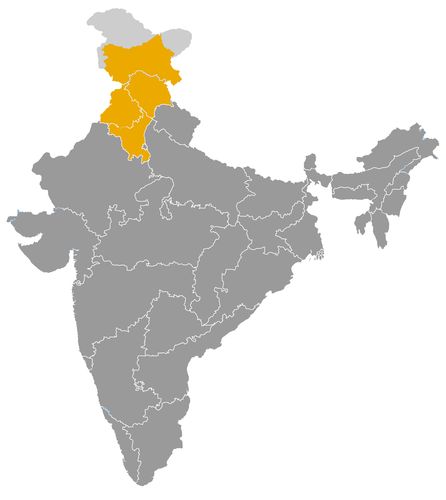
This map illustrates the maximum territory that the Sukerchakia Dynasty had reached at its height, covering the current regions of Haryana, Himachal Pradesh, Jammu & Kashmir, Ladakh and Punjab in India. Its main purpose is to provide a visual aid to understand the geographical extent of this dynasty. However, it's important to note that the contemporary borders of these regions may not necessarily coincide with the historical territories.
The Sukerchakia Dynasty and the Making of the Sikh Empire
A Sikh Lineage Emerging from the Misl Confederacies
The Sukerchakia dynasty holds an important place in the history of northern India because it produced the ruling house of the Sikh Empire, one of the most powerful regional states of the early nineteenth century. Before becoming a sovereign dynasty, the Sukerchakias were leaders of the Sukerchakia misl, one of the Sikh military confederacies that emerged in Punjab after the decline of Mughal authority and the weakening of Afghan control.
The early chiefs of the line, especially Charat Singh and Mahan Singh, built their power around Gujranwala. Their authority was initially regional and military rather than imperial. Like other Sikh misl leaders, they relied on armed followers, territorial influence, revenue collection, alliances, and control of strategic centres. Their rise reflected a wider transformation in Punjab, where local Sikh military houses gradually replaced older imperial structures.
The historical importance of the Sukerchakias lies in their ability to move beyond the fragmented world of the misls. Under Ranjit Singh, the family’s regional authority became the foundation of a centralized monarchy based in Lahore. This transition made the Sukerchakias not merely one aristocratic family among many, but the sovereign line of the Sikh Empire.
Ranjit Singh and the Creation of a Sovereign State
Ranjit Singh was the decisive figure in the history of the Sukerchakia dynasty. After inheriting the leadership of the misl, he consolidated his position in Punjab and took Lahore as the political centre of his rule. In 1801, he assumed the title of maharaja, marking the transformation of Sukerchakia power into a recognized kingship.
This shift was politically significant. Ranjit Singh did not simply expand a family domain; he created a territorial state with a capital, court, army, fiscal system, and diplomatic presence. His authority brought together former Sikh confederacies, local chiefs, Muslim administrators, Hindu officials, European officers, and Punjabi landed elites. The result was a state that combined Sikh legitimacy with pragmatic governance.
In the history of India, the Sukerchakia achievement is especially notable because the Sikh Empire became one of the last major independent powers in the subcontinent before the consolidation of British colonial rule. Its existence altered the political balance of northwestern India and created a strong barrier between British power and the Afghan frontier for several decades.
Cultural Impact in Sikh and Punjabi Society
The cultural role of the Sukerchakias was closely connected with the consolidation of Sikh identity in Punjab. Ranjit Singh’s rule strengthened the association between political power and Sikh institutions, especially through the symbolic importance of Amritsar and the patronage of religious centres. At the same time, the Sikh Empire was not governed as an exclusively religious state. Its administration included people of different communities, and its political culture drew from Sikh, Punjabi, Persianate, Mughal, and regional Indian traditions.
The court of Lahore became a centre of royal display, diplomacy, military organization, artistic patronage, and symbolic authority. The Sukerchakia rulers used titles, ceremonies, gifts, architecture, and religious patronage to present themselves as legitimate sovereigns. Their rule contributed to the memory of a distinct Sikh political order, while also participating in the broader courtly traditions of northern India.
This cultural environment also included aristocratic clans such as the Sandhawalia. The Sandhawalias were not the ruling dynasty, but they belonged to the noble world that surrounded the Sukerchakia court. Their role helps clarify the difference between sovereign power and aristocratic influence. The Sukerchakias represented kingship; the Sandhawalias illustrate the noble networks that supported, contested, and sometimes destabilized that kingship.
Economic Foundations of Sukerchakia Power
The economic strength of the Sukerchakia dynasty rested on the fertile lands of Punjab, control of revenue, military organization, and access to trade routes. Punjab’s agricultural wealth made it possible to support a large army and an expanding administration. Control over Lahore, Multan, Kashmir, and other strategic regions gave the Sikh Empire access to diverse resources, including land revenue, urban wealth, and frontier trade.
Ranjit Singh’s state depended on a combination of direct administration and negotiated authority. Local chiefs, jagirdars, military commanders, and noble families retained importance within the imperial structure. Revenue assignments, land grants, and military service linked the central court with provincial and rural elites. This system allowed the empire to expand rapidly, but it also made the stability of the state dependent on personal authority and elite cooperation.
The Sandhawalia clan belonged to this broader aristocratic economy. Its members were part of the landed and military elite that operated around Lahore. Their presence shows that Sukerchakia power was not exercised in isolation. It relied on a network of families, commanders, and administrators whose interests could strengthen the state under a powerful ruler, but could become destabilizing after a succession crisis.
The Fragility of the Dynasty after Ranjit Singh
The death of Ranjit Singh in 1839 exposed the vulnerability of the Sukerchakia political system. His successors, including Kharak Singh, Nau Nihal Singh, Chand Kaur, Sher Singh, and Duleep Singh, ruled or claimed authority during a period of instability. Court factions, military groups, Dogra influence, Sandhawalia involvement, and British pressure all contributed to the weakening of Lahore’s authority.
This phase does not diminish the importance of the dynasty, but it reveals the limits of a state built around an exceptional ruler. The Sukerchakias had created a powerful empire, yet the succession after Ranjit Singh lacked the cohesion needed to preserve it. In 1849, after conflict with the British, Punjab was annexed, and the independent sovereignty of the Sikh Empire came to an end.
The Sukerchakia dynasty remains central to Indian history because it transformed a regional misl into a major state. Its political impact lay in the unification of Punjab and the creation of a strong northwestern kingdom. Its cultural impact shaped Sikh memory and Punjabi identity. Its economic impact rested on the organization of land, revenue, military service, and trade. Around it, clans such as the Sandhawalia help explain the aristocratic world of Lahore, but the sovereign centre of that world was Sukerchakia.
The Geographic Expansion of the Sukerchakia Dynasty in Northern India
From a Regional Sikh Misl to a Territorial Power
The Sukerchakia dynasty emerged in the political landscape of eighteenth century Punjab as the leading family of the Sukerchakia misl. Its original power base lay around Gujranwala, in the western part of historical Punjab. At this stage, the Sukerchakias did not rule a large kingdom. They controlled a regional military and landed domain, similar to other Sikh misl leaders who had gained authority after the decline of Mughal power and the weakening of Afghan dominance.
Under Charat Singh and Mahan Singh, the Sukerchakia chiefs expanded their local influence through military campaigns, alliances, control of forts, and access to agrarian revenues. Their position was strategic because Gujranwala lay within the wider Punjabi plain, close to routes linking Lahore, the Indus region, and the northern approaches. This location gave the family the ability to intervene in the rivalries between Sikh confederacies and to build a territorial base strong enough for later expansion.
Lahore as the Centre of Imperial Expansion
The decisive transformation occurred under Ranjit Singh. By taking control of Lahore and making it the centre of his authority, he changed the Sukerchakia lineage from a regional misl house into the ruling dynasty of a territorial state. In 1801, his assumption of the title of maharaja gave political form to what became the Sikh Empire.
Lahore was essential to this expansion. It was not only a historic city with symbolic importance, but also a centre of administration, commerce, military organization, and diplomacy. From Lahore, Ranjit Singh was able to bring other Sikh chiefs under his authority and to reduce the autonomy of rival misls. The city also allowed close control over central Punjab while maintaining access to Amritsar, a major religious and social centre of Sikh life.
The move from Gujranwala to Lahore therefore marked a geographic and political shift. The Sukerchakias ceased to be one power among several regional Sikh houses and became the centre of a kingdom that claimed authority over much of Punjab.
Control of Punjab and the Frontier Regions
The territorial reach of the Sukerchakia state extended across large parts of historical Punjab. It included fertile agricultural plains, important towns, strategic forts, and communication routes linking northern India with Central Asian and Afghan regions. This control gave the Sikh Empire a strong economic and military base.
The dynasty’s expansion did not stop at the Punjabi heartland. Toward the south west, the conquest of Multan strengthened control over a commercially and strategically important region. Toward the north, the incorporation of Kashmir brought mountain territory, economic resources, and prestige. Toward the west, influence over Peshawar placed the Sikh Empire in direct contact with Afghan power and with one of the most sensitive frontier zones of the subcontinent.
These regions were diverse in geography and population. The Sukerchakia rulers had to govern plains, mountain valleys, frontier districts, and urban centres. Their empire was therefore not a simple ethnic or local kingdom, but a multi regional state held together by military strength, negotiated authority, revenue extraction, and the personal prestige of Ranjit Singh.
Relations with Afghan, Dogra, and Punjabi Powers
The geographic expansion of the Sukerchakias shaped their relations with neighbouring powers. In the west, the advance toward Peshawar and the Indus frontier brought the Sikh Empire into conflict with Afghan rulers and tribal forces. This frontier had long been linked to invasions, trade, and shifting military control. Holding it required constant vigilance and strong commanders.
In the north, the extension toward Kashmir strengthened the role of the Dogras of Jammu. The Dogras served the Lahore state and became essential in the administration and military control of northern regions. Their rise shows that Sukerchakia expansion depended not only on the ruling dynasty, but also on powerful noble and military families capable of managing difficult territories.
Within central Punjab, the Sukerchakias also had to manage relations with Sikh aristocratic clans. The Sandhawalia clan belonged to this world. It did not represent the sovereign line, but it formed part of the landed and political aristocracy that surrounded Lahore. Its later involvement in court politics illustrates how territorial expansion created a wider elite environment that could support the dynasty during stability and challenge it during succession crises.
Territorial Fragility after Ranjit Singh
The empire built by Ranjit Singh was large and strategically powerful, but its cohesion depended heavily on central authority. After his death in 1839, the succession became unstable. The reigns or claims of Kharak Singh, Nau Nihal Singh, Chand Kaur, Sher Singh, and Duleep Singh unfolded amid court rivalry, military pressure, aristocratic factionalism, and increasing British intervention.
The diversity of the territories controlled by the Sukerchakias made strong leadership essential. Punjab, Multan, Kashmir, Peshawar, and the Himalayan margins required different forms of administration and military control. Once the authority of Lahore weakened, noble families, provincial commanders, court factions, and external powers gained greater influence. The Sandhawalia, Dogra, and other groups became part of this broader crisis of imperial cohesion.
A Regional Empire with Lasting Historical Significance
The geographic expansion of the Sukerchakia dynasty transformed the political history of northern India. From a regional Sikh misl centred on Gujranwala, the family created an empire based in Lahore that controlled much of historical Punjab and extended toward key frontier regions. This expansion made the Sikh Empire one of the last major independent powers in the subcontinent before British annexation.
The Sukerchakia territorial achievement was both a source of strength and a source of vulnerability. It gave the dynasty access to agricultural wealth, strategic cities, mountain regions, frontier routes, and military manpower. At the same time, it required a political balance that became difficult to maintain after Ranjit Singh. Their geographic legacy remains central to understanding the history of Punjab, the Sikh Empire, and the transition from regional sovereignty to colonial rule in northern India.
The Sukerchakia line first led one of the Sikh misls of Punjab under the title of sardar or misldar, before Ranjit Singh founded the Sikh Empire and assumed the title of maharaja in 1801. The dates of the early chiefs are approximate, and the political geography concerned belongs to historical Punjab, now divided between India and Pakistan.
- Charat Singh (c. 1752–1770) • Founder sardar of the Sukerchakia misl, he established the family’s power around Gujranwala and took part in the rise of the Sikh confederacies.
- Mahan Singh (c. 1770–1792) • Son of Charat Singh, he strengthened the Sukerchakia misl, expanded its territorial influence and made Gujranwala an important centre of power.
- Ranjit Singh (1792–1801 as misl chief, 1801–1839 as maharaja) • Heir of Mahan Singh, he transformed Sukerchakia power into the Sikh Empire and was crowned maharaja at Lahore in 1801.
- Kharak Singh (1839–1840) • Son of Ranjit Singh, he succeeded him as maharaja, but his authority was quickly weakened by court rivalries.
- Nau Nihal Singh (1840) • Grandson of Ranjit Singh, he was recognized as heir after Kharak Singh’s death, but died shortly afterwards in controversial circumstances.
- Chand Kaur (1840–1841, contested rule) • Widow of Kharak Singh and mother of Nau Nihal Singh, she claimed the regency or sovereignty of Lahore during the succession crisis.
- Sher Singh (1841–1843) • Son of Ranjit Singh, he became maharaja after the succession crisis, but his reign was marked by political instability and his assassination.
- Duleep Singh (1843–1849, nominal rule under regency) • The last maharaja of the Sikh Empire, he ruled as a child under regency until the British annexation of Punjab in 1849.