

 Français (France)
  Nederlands (nl-NL)
 Of Buddhist tradition, (with additional Hindu influence), the Bhaumakara dynasty ruled for approximately 204 years, ± between 736 and 940 over all or part of East India, during the Medieval Period.
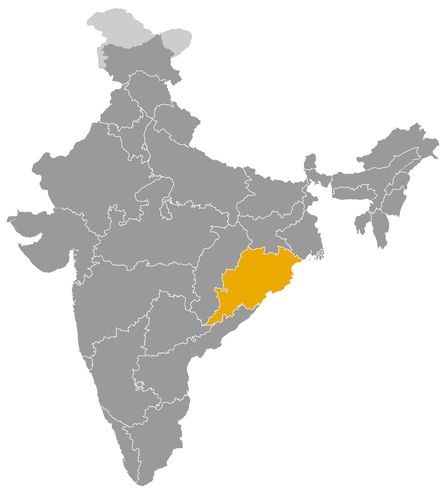
This map illustrates the maximum territory that the Bhaumakara Dynasty had reached at its height, covering the current regions of Odisha in India. Its main purpose is to provide a visual aid to understand the geographical extent of this dynasty. However, it's important to note that the contemporary borders of these regions may not necessarily coincide with the historical territories.
The Bhaumakara Dynasty and Its Role in the History of Eastern India
A regional power in early medieval Odisha
The Bhaumakara dynasty occupies an important place in the history of early medieval India, especially in the political and cultural development of present day Odisha. The dynasty ruled mainly between the eighth and tenth centuries, with its authority centred on the historical region of Toshala, also known as Tosali. This area, located between the coastal plains of the Bay of Bengal and the inland zones of eastern India, gave the Bhaumakaras access to fertile agricultural lands, religious networks and maritime routes.
The Bhaumakaras were not an imperial dynasty on the scale of the Guptas, the Palas or the Rashtrakutas. Their importance lies instead in their role as a durable regional power. They helped consolidate Odisha as a coherent political and cultural region during a period when many parts of the Indian subcontinent were divided among competing kingdoms. Their rule shows how regional dynasties contributed to the formation of local identities, administrative systems and religious landscapes in medieval India.
The consolidation of royal authority in Odisha
The rise of the Bhaumakaras occurred after the decline of earlier political formations in eastern India. The region of Odisha was strategically placed between Bengal, central India and the Deccan, and it was exposed to the ambitions of larger powers. In this setting, the early Bhaumakara rulers established a kingdom that was sufficiently stable to last for nearly two centuries.
The first rulers, including Kshemankara-deva and Shivakara-deva I, appear to have laid the foundations of dynastic authority. Their inscriptions suggest a structured monarchy able to issue land grants, support religious institutions and maintain relations with local elites. The dynasty’s political system depended not only on royal power, but also on a network of officials, landholders, religious beneficiaries and aristocratic families.
The Bhaumakara kingdom did not always enjoy internal stability. Succession disputes, external pressure and the increasing role of powerful families affected the later history of the dynasty. Yet its long survival indicates that the rulers were able to adapt to changing political conditions and preserve a recognizable regional authority.
The exceptional role of ruling queens
One of the most distinctive features of the Bhaumakara dynasty is the number of women who exercised sovereign power. Several queens, including Tribhuvana Mahadevi I, Dandi Mahadevi, Vakula Mahadevi and Dharma Mahadevi, are associated with effective rule. This makes the dynasty particularly significant in the study of gender and kingship in medieval India.
These women were not merely royal consorts preserving dynastic titles. Some issued inscriptions, made land grants and acted as independent rulers. Tribhuvana Mahadevi I is often regarded as a major figure in the restoration of royal authority after a period of disorder. Dandi Mahadevi also appears in inscriptions as a ruler with a functioning administration and recognized legitimacy.
The prominence of these queens suggests that dynastic continuity could sometimes outweigh conventional male succession. It also shows the importance of aristocratic alliances, maternal lineage and religious legitimacy in sustaining royal power. In this respect, the Bhaumakaras provide an important example of political flexibility within the broader framework of Indian kingship.
A cultural landscape shaped by religious plurality
The Bhaumakara period is notable for its religious diversity. The early rulers are often associated with Buddhism, especially Mahayana Buddhism and possibly tantric traditions that were active in eastern India. Odisha was a region where Buddhist monasteries, Brahmanical institutions and local cults existed side by side, and the dynasty’s patronage reflects this complex environment.
Over time, Hindu traditions became increasingly prominent in Bhaumakara political culture. Shaivism and Vaishnavism appear more clearly in inscriptions and royal religious language. Some later rulers and queens adopted Hindu devotional identities while still governing within a region marked by multiple religious traditions.
The cultural importance of the dynasty therefore lies in its support for a plural religious environment. Rather than representing a sharp replacement of Buddhism by Hinduism, the Bhaumakara period illustrates gradual interaction between traditions. Their rule contributed to the religious and cultural foundations of Odisha before the later rise of major temple building under subsequent dynasties.
Economic power based on land and regional exchange
The economic base of the Bhaumakara kingdom was primarily agrarian. Land grants recorded in copper plate inscriptions show that the rulers redistributed villages and agricultural revenues to religious institutions, Brahmins and other beneficiaries. These grants were both religious acts and instruments of administration. They helped incorporate local territories into the kingdom and strengthened ties between the court and regional elites.
Agriculture in the coastal and riverine plains of Odisha provided the material foundation of royal authority. Rice cultivation, village organization and control over taxable resources were essential to the functioning of the state. The ability to grant land also reinforced the symbolic authority of the ruler as protector and benefactor.
The dynasty’s position on the eastern coast probably also connected it to maritime and regional trade networks in the Bay of Bengal. Although the surviving evidence focuses more on land and religious patronage than on commerce, Odisha’s coastal location would have facilitated exchanges with Bengal, Andhra, Sri Lanka and Southeast Asia. These networks contributed to the movement of goods, people and religious ideas.
A lasting contribution to the formation of medieval Odisha
The Bhaumakara dynasty helped prepare the political and cultural landscape later developed by the Somavamshis and the Eastern Gangas. After the decline of Bhaumakara power, these later dynasties expanded and consolidated Odisha more fully, but they inherited a region already shaped by earlier administrative structures, religious patronage and regional identity.
The historical role of the Bhaumakaras is therefore best understood at the regional level. They did not dominate the whole of India, but they contributed significantly to the evolution of eastern India. Their political endurance, their remarkable ruling queens, their religious patronage and their economic reliance on land grants make them an important dynasty in the history of Odisha and a valuable example of regional state formation in early medieval India.
The Geographic Expansion of the Bhaumakara Dynasty in Eastern India
A regional kingdom rooted in Odisha
The Bhaumakara dynasty ruled mainly over the region corresponding to present day Odisha in eastern India, between the eighth and tenth centuries. Its power was centred on the historical area known as Toshala or Tosali, a zone that included parts of the coastal plain, river valleys and inland territories between the Bay of Bengal and the eastern uplands. The dynasty did not create a vast empire extending across the subcontinent, but it established a durable regional kingdom in a strategically important part of India.
The geographical importance of the Bhaumakaras lay in their ability to control a coherent territory linking the coast with the interior. This position allowed them to benefit from agricultural resources, religious centres, local trade routes and maritime connections. Their kingdom formed a bridge between Bengal to the north, Andhra and the Deccan to the south and southwest, and the inland regions of central India.
The coastal plain as the core of royal authority
The heartland of Bhaumakara power was the fertile coastal and subcoastal plain of Odisha. This area was crossed by important rivers and supported intensive agriculture, especially rice cultivation. The control of villages, cultivated land and irrigation zones formed the economic foundation of the dynasty.
Copper plate inscriptions associated with the Bhaumakaras frequently record grants of land to religious institutions, Brahmins and other beneficiaries. These documents show that the rulers had enough administrative authority to define village boundaries, transfer revenues and confirm rights over land. Such grants were not only religious acts. They were also political instruments that helped integrate local communities into the royal order.
The coastal plain also provided access to routes running along the Bay of Bengal. This gave the Bhaumakara kingdom an outward looking dimension, even if the surviving evidence is stronger for land administration than for maritime commerce. Its position on the eastern coast placed it within wider circuits of movement connecting Odisha with Bengal, Andhra, Sri Lanka and Southeast Asia.
Inland territories and indirect forms of control
Bhaumakara influence also extended inland, into areas connected to river valleys and routes leading toward the eastern highlands. These inland zones were important because they linked the coastal kingdom to forested regions, mineral areas and local chiefdoms. They also helped protect the core territory from pressure coming from the west and southwest.
However, the authority of the dynasty in these regions was probably uneven. Like many early medieval Indian kingdoms, the Bhaumakara state depended on a combination of direct rule and local intermediaries. Chiefs, landed elites, religious beneficiaries and allied families may have exercised authority on behalf of the crown or in association with it.
This pattern of control explains both the strength and the fragility of the kingdom. The dynasty could extend its influence beyond its immediate centre, but peripheral areas were more vulnerable during periods of weak succession. When the royal court was stable, these zones reinforced the territorial reach of the state. When the dynasty became divided, they could become arenas of rivalry or shift toward neighbouring powers.
Northern relations with the Pala sphere
To the north, the Bhaumakaras faced the powerful Pala dynasty of Bengal and Bihar. The Palas were one of the major powers of eastern India and maintained strong political and religious influence across the region. Their proximity made the northern frontier of the Bhaumakara kingdom particularly significant.
Relations between the two dynasties probably combined rivalry, pressure and cultural contact. Both ruling houses were associated, at least in part, with Buddhist patronage, but shared religious tendencies did not remove political competition. The Palas had the capacity to intervene in neighbouring regions, while the Bhaumakaras sought to preserve their autonomy in Odisha.
The survival of Bhaumakara rule for nearly two centuries shows that the dynasty was not simply absorbed by the Pala sphere. Its territory remained distinct, and its rulers maintained their own administrative and religious identity. The northern boundary of the kingdom therefore became a zone where regional autonomy was defended against a larger neighbouring power.
Southern and western contacts with the Deccan powers
To the south and southwest, the Bhaumakaras were linked to the wider political world of the Deccan. The Rashtrakutas, one of the great powers of medieval India, influenced large areas of the peninsula and sometimes intervened in eastern and central India. Their military and diplomatic reach affected the balance of power around Odisha.
For the Bhaumakaras, this meant that territorial control could not be understood only in local terms. Their kingdom stood between several political spheres. The rulers had to protect the coastal heartland while managing relations with powers that could approach through inland routes or through alliances with neighbouring chiefs.
The dynasty’s geographical position therefore encouraged a cautious political strategy. Expansion was limited, but the maintenance of a stable regional kingdom required continuous negotiation with stronger or more expansive neighbours.
The decline of Bhaumakara territory and the rise of the Somavamshis
By the tenth century, the territorial cohesion of the Bhaumakara kingdom weakened. Succession disputes, the growing role of ruling queens, and the influence of allied aristocratic families contributed to political instability. These internal changes reduced the dynasty’s ability to maintain firm control over all parts of its domain.
The Somavamshis gradually became the dominant power in the region and absorbed much of the former Bhaumakara sphere. This transition marked a new phase in the political consolidation of Odisha. The Bhaumakaras had not created a vast empire, but they had organized a regional space that later dynasties could inherit and expand.
Their geographical legacy lies in the formation of Odisha as a coherent political region. By controlling the coastal plain, maintaining links with inland territories and resisting absorption by larger neighbours, the Bhaumakaras helped define the territorial framework of medieval eastern India.
The Bhaumakara rulers are known mainly from copper-plate inscriptions and from dates that remain partly debated. The dates below are indicative, since several reigns are attested only by isolated references and the final phase of the dynasty was marked by disputed successions, regencies and several ruling queens.
- Kshemankara-deva (c. 736–756) • Probable founder of the Bhaumakara line in Odisha. His reign opened the dynasty’s rule in the region of Toshala.
- Shivakara-deva I (c. 756–790) • Also known as Unmattasimha, he consolidated dynastic authority. The chronology of his accession remains debated.
- Shubhakara-deva I (c. 790–809) • He faced internal unrest and external threats. His reign belongs to the early Buddhist phase of the dynasty.
- Shivakara-deva II (c. 809–810) • Son of Shubhakara-deva I, he is only sparsely attested. His reign appears to have been short and occurred in a context of political weakening.
- Shantikara-deva I (c. 810–835) • He ruled after the first crises linked to Pala and Rashtrakuta incursions. His wife Tribhuvana Mahadevi I later played a major role in restoring the kingdom.
- Shubhakara-deva II (c. 836–839) • His reign is poorly documented. It belongs to a transitional period between the early Buddhist kings and the political restoration led by Queen Tribhuvana Mahadevi I.
- Shubhakara-deva III (c. 839–845) • Son of Shantikara-deva I and Tribhuvana Mahadevi I, he ruled briefly. His death opened the way for his mother’s accession to power.
- Tribhuvana Mahadevi I (c. 845–850 or 863) • The first major ruling queen of the dynasty, she restored Bhaumakara authority after a period of disorder. Her reign is associated with religious patronage across several traditions.
- Shantikara-deva II (c. 850 or 863–881) • Grandson of Tribhuvana Mahadevi I, he seems to have taken the throne after her abdication. His reign remains imperfectly dated.
- Shubhakara-deva IV (c. 881–884) • The first Bhaumakara ruler clearly presented as a devotee of Shiva, he ruled for only a short time. His reign marks the strengthening of Shaivism within the dynasty.
- Shivakara-deva III (c. 885–894) • He succeeded Shubhakara-deva IV during a period of internal tension. His death was followed by a succession crisis.
- Tribhuvana Mahadevi II (c. 890 or 894–896) • Also known as Prithivi Mahadevi, she claimed the throne with probable outside support. Her legitimacy was contested by other branches of the family.
- Tribhuvana Mahadevi III (c. 896–905) • Widow of Shivakara-deva III, she ruled during the unstable phase of the dynasty. Her power belongs to a sequence of female reigns.
- Shantikara-deva III (early 10th century) • Son of Shivakara-deva III, he was one of the claimants or rulers of the troubled period. The exact length of his reign remains uncertain.
- Shubhakara-deva V (early 10th century) • The last important male ruler of the line, he reigned before the final series of queens. His death deepened the succession instability.
- Gauri Mahadevi (early 10th century, probably regency) • Wife of Shubhakara-deva V, she probably controlled the kingdom as regent for her daughter Dandi Mahadevi. Her exact status as an effective sovereign should be treated with caution.
- Dandi Mahadevi (c. 916 or 923–mid-10th century) • Daughter of Shubhakara-deva V and Gauri Mahadevi, she exercised power as a ruling queen. Her inscriptions still show a structured royal authority.
- Vakula Mahadevi (mid-10th century) • Stepmother of Dandi Mahadevi, she came to power after her. Her reign reflects the growing influence of allied families, especially the Bhanjas.
- Dharma Mahadevi (c. 940–950) • The last ruler generally associated with the Bhaumakara dynasty. After her reign, the territory gradually passed under Somavamshi influence.