Français (France)
  Nederlands (nl-NL)
 Of Hindu tradition, (with additional Jain influence), the Sisodia dynasty ruled for approximately 621 years, ± between 1326 and 1947 over all or part of North India, during the Medieval Period and the Colonial Period.
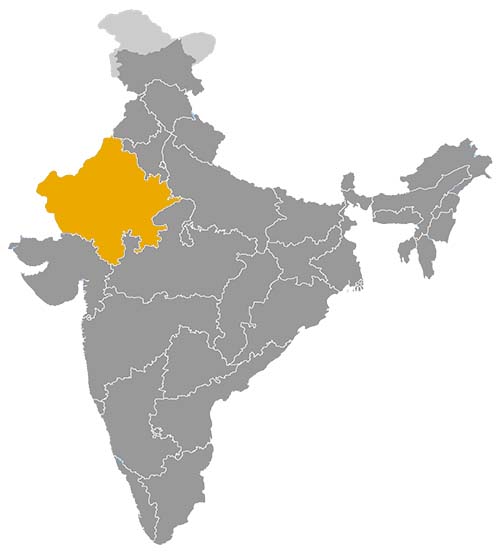
This map illustrates the maximum territory that the Sisodia Dynasty had reached at its height, covering the current regions of Rajasthan in India. Its main purpose is to provide a visual aid to understand the geographical extent of this dynasty. However, it's important to note that the contemporary borders of these regions may not necessarily coincide with the historical territories.
The Sisodia Dynasty and Its Role in the History of Mewar and Rajput India
A Rajput house rooted in the legacy of the Guhilots
The Sisodia dynasty occupies a major place in the history of Rajasthan and western India. It emerged from the wider Guhilot tradition of Mewar and became the ruling house associated with the restoration of Rajput authority after the political crisis caused by the fall of Chittor in the early fourteenth century. Its history is closely linked to Mewar, a rugged region in southern Rajasthan where fortresses, agricultural valleys, hill ranges and strategic routes shaped the formation of a durable regional kingdom.
The Sisodias were not an imperial dynasty ruling over most of India. Their importance lies instead in their continuity, political prestige, military resistance, cultural patronage and role in the construction of Rajput identity. Their power was centred first on Chittor and later on Udaipur, but their legitimacy remained tied to the defence of Mewar, the memory of earlier rulers and the title of Maharana, which gave the house of Mewar a distinctive position among the princely families of India.
A political authority built around Chittor and Udaipur
The political role of the Sisodias began with Hammir Singh, who restored Rajput rule in Mewar during the fourteenth century. This restoration allowed the dynasty to inherit the prestige of the older Guhilot line while opening a new political phase. Chittor became the central symbol of this authority. Its vast hilltop fort served as a capital, military refuge, administrative centre and dynastic memory site.
Under rulers such as Kumbha and Sanga, Mewar became one of the leading Rajput powers of north-western India. Kumbha strengthened fortifications, supported religious and courtly culture, and consolidated the kingdom against neighbouring sultanates. Sanga raised the military power of Mewar to a high point, intervening in the politics of Rajasthan, Gujarat and Malwa before confronting Babur in the early Mughal period.
The later foundation of Udaipur by Udai Singh II marked an important reorganization of Sisodia power. Udaipur, protected by hills and lakes, offered a more secure setting after Chittor had become vulnerable to large imperial sieges. The new capital became the administrative and cultural centre of the dynasty while preserving the symbolic memory of Chittor.
A dynasty associated with Rajput resistance
The Sisodias became strongly associated with the idea of Rajput resistance. This reputation was based on historical conflicts, but it was also reinforced by later memory, literature and regional tradition. The dynasty faced the sultanates of Gujarat and Malwa, then the Mughal Empire, in a political environment where Rajput rulers had to choose between resistance, alliance, service or negotiated autonomy.
Maharana Pratap became the most famous figure of this tradition. After Mughal expansion into Rajasthan, he refused complete submission to Akbar and continued resistance from the hills and forests of Mewar. The Battle of Haldighati did not produce a decisive strategic victory for the Sisodias, but it became a major event in Rajput political memory. It symbolized the defence of honour, autonomy and dynastic legitimacy.
Under Amar Singh I, Mewar eventually reached an agreement with the Mughals. This settlement preserved the dynasty’s rank and internal autonomy while acknowledging the realities of imperial power. Sisodia politics therefore cannot be reduced to warfare alone. It combined resistance, negotiation and adaptation.
Cultural patronage in forts, temples and courtly traditions
The cultural impact of the Sisodia dynasty was considerable within Mewar and Rajasthan. The rulers supported fortresses, temples, palaces, inscriptions, court rituals, genealogical traditions and religious institutions. Their patronage helped connect political authority with sacred legitimacy and dynastic prestige.
The reign of Kumbha was especially important in this respect. He was associated with the strengthening of forts, the construction of religious monuments and the development of a courtly culture that linked kingship, learning and military authority. Chittor remained a major centre of memory even after Udaipur became the effective capital.
Udaipur later grew into one of the most recognizable princely centres of India. Its palaces, lakes, temples and court institutions reflected the continuing prestige of the Sisodia house. Mewar painting, court chronicles, royal ceremonies and religious patronage contributed to a distinctive regional culture. Through these traditions, the Sisodias became one of the most visible symbols of Rajput political and cultural identity.
Economic foundations in land, routes and princely administration
The economic base of the Sisodia kingdom rested primarily on land. Agricultural villages, local revenues, fiscal rights and control over fertile valleys provided the material foundation of royal authority. In a region shaped by the Aravalli hills, the control of passes, water sources, cultivated zones and defensive sites was especially important.
Mewar also benefited from its position between Rajasthan, Gujarat, Malwa and northern India. Routes crossing the region carried goods, armies, pilgrims and political influence. The ability to supervise these passages strengthened the kingdom’s strategic and economic position, although the terrain limited the development of a large, open agrarian empire.
During the princely period under British paramountcy, the state of Udaipur retained internal administration while gradually adapting to modern forms of government. Revenue management, public works, education and court administration became increasingly important. The economy remained regional, but the dynasty’s ability to preserve a functioning state helped maintain its prestige into the modern period.
Relations with neighbouring Rajput states and larger empires
Sisodia power was shaped by constant interaction with neighbouring houses and larger states. Relations with Marwar, Amber, Bundi, Kota, Gujarat and Malwa alternated between alliance, rivalry, marriage diplomacy and war. The dynasty’s location made Mewar a key participant in the politics of western and north-western India.
The rise of the Mughals changed the scale of these relationships. Mewar had to negotiate its survival within an imperial order that included many Rajput houses. Later, Maratha pressure and British paramountcy transformed the political landscape again. Under British rule, Udaipur preserved princely status but lost full diplomatic independence.
A regional dynasty with enduring historical prestige
The effective sovereignty of the Sisodia dynasty ended with the integration of Udaipur State into independent India in 1948. Yet the dynasty’s historical role extends far beyond that political endpoint. It represented one of the most prestigious Rajput houses, closely associated with Mewar, Chittor, Udaipur and the memory of regional resistance.
The Sisodias did not create a vast empire, but they shaped a durable political culture based on local sovereignty, fortress defence, lineage prestige, religious patronage and adaptation to changing powers. Their history illustrates the importance of regional kingdoms in the political and cultural formation of medieval, early modern and princely India.
The Geographic Extent of the Sisodia Dynasty between Chittor, Udaipur and Mewar
A regional kingdom centred on southern Rajasthan
The Sisodia dynasty developed its power in Mewar, a region located in the southern part of present-day Rajasthan. Its geographic extent was not that of a vast, continuous empire, but of a regional kingdom organized around hill forts, agricultural valleys, wooded zones, trade routes and defensive landscapes. This geography shaped both the strength and the limits of Sisodia rule.
Mewar occupied a strategic position between Rajasthan, Gujarat, Malwa and northern India. The Aravalli hills formed one of the most important features of this landscape. They offered protection, made military campaigns difficult and provided refuge during periods of invasion or political crisis. The Sisodias used this terrain to preserve autonomy against stronger powers, including the sultanates of Gujarat and Malwa, the Mughal Empire, the Marathas and later the British.
Chittor as the first great centre of territorial authority
The earliest major centre of Sisodia power was Chittor, or Chittorgarh. The great hill fort had already been important in the earlier history of Mewar, but under the Sisodias it became the principal symbol of dynastic sovereignty. Its location allowed control over surrounding plains, routes and agricultural lands, while its fortified plateau gave the kingdom a powerful defensive and symbolic centre.
After Hammir Singh restored Rajput power in Mewar in the fourteenth century, Chittor became the focal point of territorial reconstruction. From this stronghold, the Sisodias strengthened their authority over the surrounding region, secured the loyalty of local chiefs and reaffirmed their claim to the political inheritance of the older Guhilot line.
Possession of Chittor also shaped relations with neighbouring powers. The fort was not merely a residence or military site. It was a statement of legitimacy. Control of Chittor meant control of the symbolic heart of Mewar, which explains why it attracted the attention of the sultanates of Gujarat and Malwa and later the Mughal emperors.
Expansion and influence under Kumbha and Sanga
The geographic influence of the Sisodias reached a high point under Kumbha and Sanga. Kumbha strengthened Mewar through the construction and reinforcement of forts across strategic zones. His rule extended the effective reach of the kingdom into key areas between Mewar, Marwar, Malwa and Gujarat. Fortified sites, passes, villages and regional roads gave the dynasty both military security and political influence.
Under Sanga, Sisodia power expanded further in military and diplomatic terms. His authority reached beyond the immediate territory of Mewar through campaigns, alliances and intervention in the politics of Rajasthan, Malwa and Gujarat. This did not always mean direct administration of all territories involved. In many cases, it meant military leadership, overlordship, alliance networks or temporary influence.
This expansion brought the Sisodias into close contact and frequent rivalry with other ruling houses. They interacted with the Rathores of Marwar, the Kachwahas of Amber, the Hadas of Bundi and Kota, and the sultanates of Gujarat and Malwa. Warfare, marriage alliances and coalitions were all part of this regional system. Mewar’s geography placed it at the centre of competing political zones.
Mountain zones as defensive territory under Mughal pressure
The Mughal advance in the sixteenth century changed the geography of Sisodia power. After the Mughal conquest of Chittor, the dynasty could no longer rely on the fort as its main effective capital. The focus of resistance shifted toward the hills, forests and valleys of the Aravalli region.
This defensive geography was especially important under Maharana Pratap. His resistance to Mughal authority depended on the difficult terrain of Mewar, including areas around Gogunda, Kumbhalgarh and the rugged interior. These places served as refuges, military bases and centres of renewed control. In this period, Sisodia territory was not a peaceful continuous domain, but a contested landscape of zones held, lost and recovered according to military conditions.
The terrain allowed the dynasty to survive despite Mughal superiority in manpower and resources. At the same time, it limited wider expansion. The Sisodias preserved their political identity, but their external influence became more defensive than expansionist.
Udaipur and the reorganization of Mewar
The foundation of Udaipur by Udai Singh II marked a major geographic reorientation. Located among lakes and hills, Udaipur offered a more secure and adaptable capital after Chittor had become vulnerable to large imperial sieges. It gradually became the administrative, cultural and dynastic centre of the kingdom.
From Udaipur, the Sisodias continued to control the core of Mewar. Their territory included cultivated valleys, villages, internal routes, forts, hill zones and dependent estates. The kingdom was smaller in effective reach than during the most ambitious phases of expansion, but it retained a strong territorial coherence.
The settlement reached under Amar Singh I with the Mughal Empire helped stabilize this situation. Mewar accepted certain political realities of imperial power while preserving internal autonomy and dynastic prestige. This compromise allowed the Sisodias to retain their essential lands and avoid complete absorption into the Mughal system.
Relations with Rajput states, Marathas and the British
The territorial position of Mewar shaped its relations with neighbouring states throughout the early modern period. The Sisodias dealt with Marwar, Amber, Bundi, Kota and other Rajput houses through alliance, rivalry, marriage diplomacy and occasional conflict. Control of routes, border forts and villages remained central to these relationships.
In the eighteenth century, Maratha incursions and financial demands weakened many Rajput states, including Mewar. The Sisodia kingdom faced pressure from outside forces while also managing internal difficulties. Later, British paramountcy transformed the political framework. The princely state of Udaipur retained internal administration, but its external relations were increasingly controlled by the British.
This new order stabilized some borders while reducing diplomatic independence. The Sisodias remained rulers of a recognized princely state, but their territorial expansion ended. Their role became one of preservation, administration and ceremonial prestige within princely India.
A strategic territory more influential than its size
The Sisodia dynasty mainly controlled Mewar, with Chittor and later Udaipur as its principal centres. Its territory was regional rather than imperial, but it occupied a strategic position between Rajasthan, Gujarat and Malwa. This location determined its relations with neighbouring Rajput houses, regional sultanates, the Mughals, the Marathas and the British.
The historical importance of Sisodia territory lay in its defensibility, continuity and symbolic force. Through forts, valleys, hill routes and successive capitals, the dynasty maintained a coherent political space across centuries of pressure. Mewar’s influence therefore exceeded its geographic size, making the Sisodias one of the most enduring regional powers in the history of western India.
This chronology follows the Sisodia house of Mewar from the restoration of power by Hammir Singh in the fourteenth century. The title Maharana dominates the political tradition of Mewar; purely titular rulers after the integration of the princely state into independent India are not included.
- Hammir Singh (1326–1364) • He restored Rajput power in Mewar after the crisis caused by the fall of Chittor in 1303.
- Kshetra Singh (1364–1382) • He continued the consolidation of Mewar and strengthened Sisodia authority in southern Rajasthan.
- Lakha Singh (1382–1421) • He developed the kingdom’s resources and supported the rebuilding of shrines and local institutions.
- Mokal Singh (1421–1433) • He asserted Mewar’s authority against neighbouring powers before being assassinated in an internal conflict.
- Kumbha (1433–1468) • One of the greatest Maharanas of Mewar, he strengthened forts and dominated a major part of Rajasthan.
- Udai Singh I (1468–1473) • His reign was marked by the assassination of Kumbha and by a contested succession.
- Raimal Singh (1473–1508) • He restored dynastic stability and faced regional rivalries involving Malwa and Gujarat.
- Sanga (1508–1528) • He brought Mewar’s military power to its height and fought neighbouring sultanates and later Babur.
- Ratan Singh II (1528–1531) • He succeeded Sanga in a context of pressure from Gujarat and political fragility.
- Vikramaditya Singh (1531–1536) • His reign was unstable and ended with his assassination during succession struggles.
- Vanvir Singh (1536–1540, usurper) • He seized power after the assassination of Vikramaditya, but was removed by Udai Singh II.
- Udai Singh II (1540–1572) • He founded Udaipur and faced the increasing pressure of the Mughal Empire.
- Pratap Singh (1572–1597) • Maharana Pratap became a major figure of Rajput resistance against Mughal expansion.
- Amar Singh I (1597–1620) • He continued the struggle against the Mughals before reaching an agreement with Emperor Jahangir.
- Karan Singh II (1620–1628) • He ruled in a context of more peaceful relations with the Mughal court.
- Jagat Singh I (1628–1652) • He developed religious and princely constructions in Udaipur and Mewar.
- Raj Singh I (1652–1680) • He opposed Aurangzeb’s policy and reinforced the political identity of Mewar.
- Jai Singh (1680–1698) • He sought to preserve Mewar’s territories against late Mughal pressure.
- Amar Singh II (1698–1710) • He took part in Rajput alliances during the weakening and later pressure of Mughal power.
- Sangram Singh II (1710–1734) • He maintained Mewar’s political balance during the transition from Mughal power to regional influences.
- Jagat Singh II (1734–1751) • His reign was marked by intervention in Jaipur affairs and increasing financial pressure.
- Pratap Singh II (1751–1754) • He ruled briefly during a period of growing dependence on external powers.
- Raj Singh II (1754–1762) • He governed while Maratha demands weighed heavily on Mewar’s finances.
- Ari Singh II (1762–1772) • His reign was troubled by Maratha incursions and internal difficulties.
- Hamir Singh II (1772–1778) • He came to the throne young and his reign remained short and fragile.
- Bhim Singh (1778–1828) • He ruled during a long period of crisis marked by raids, Rajput rivalries and alliance with the British.
- Jawan Singh (1828–1838) • His reign took place under British influence and amid administrative difficulties.
- Sardar Singh (1838–1842) • He ruled briefly before the accession of Swarup Singh.
- Swarup Singh (1842–1861) • He governed during the Indian Rebellion of 1857 and kept the state within the British princely framework.
- Shambhu Singh (1861–1874) • He encouraged administrative, educational and social reforms in the state of Udaipur.
- Sajjan Singh (1874–1884) • He continued the modernization of the state and developed public works in Udaipur.
- Fateh Singh (1884–1930) • He ruled during the British Raj and preserved the ceremonial prestige of the house of Mewar.
- Bhupal Singh (1930–1948) • The last effective ruler, he oversaw the integration of Udaipur State into independent India.
 Links to the main sections of the site