Français (France)
  Nederlands (nl-NL)
 Of Hindu tradition, (with additional Buddhist and Jain influence), the Pratihara dynasty ruled for approximately 306 years, ± between 730 and 1036 over all or part of Central India and North India, during the Classical Period.
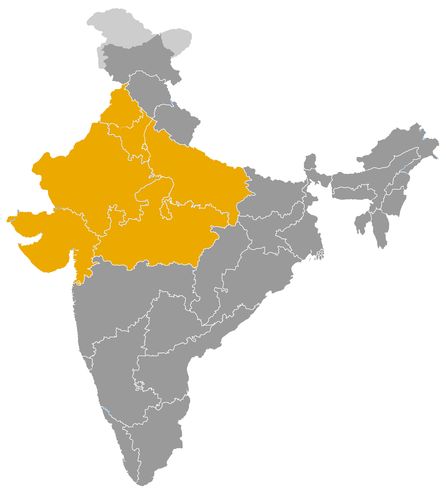
This map illustrates the maximum territory that the Pratihara Dynasty had reached at its height, covering the current regions of Delhi (NTC), Haryana, Madhya Pradesh, Punjab, Rajasthan and Uttar Pradesh in India. Its main purpose is to provide a visual aid to understand the geographical extent of this dynasty. However, it's important to note that the contemporary borders of these regions may not necessarily coincide with the historical territories.
The Pratihara Dynasty and Its Role in the History of Medieval India
A Northern Indian Power Between Regional Rule and Imperial Ambition
The Pratihara dynasty, more precisely known in its imperial phase as the Gurjara-Pratiharas, played a central role in the political history of northern India between the eighth and eleventh centuries. Emerging from western India, probably within the broad region of Rajasthan and adjoining areas, the dynasty gradually expanded into the Gangetic plain and made Kannauj one of its principal centres of power. Its rise occurred during a period when the older imperial structures of ancient India had disappeared and several regional powers were competing to shape the political order of the early medieval subcontinent.
The Pratiharas are particularly important because they helped stabilise large parts of northern India after a period of fragmentation. Their rulers did not create a centralised state in the modern sense, but they established a wide network of authority, tributary relationships and military alliances. At their height, especially under Mihira Bhoja and Mahendrapala I, they controlled or influenced territories stretching from western India toward the middle Ganges valley.
Political Authority Centred on Kannauj
The political importance of the Pratiharas is closely linked to their control of Kannauj. This city had already acquired great prestige in earlier centuries, especially under Harsha, and remained a symbolic centre for claims to supremacy in northern India. By occupying and defending Kannauj, the Pratiharas positioned themselves as one of the dominant powers of the region.
Their control of the city brought them into direct rivalry with the Pala dynasty of Bengal and the Rashtrakuta dynasty of the Deccan. This long competition, often described as the tripartite struggle, was one of the defining political dynamics of early medieval India. The conflict was not simply a sequence of military campaigns. It represented a wider contest for prestige, access to fertile lands, control of trade routes and the right to claim superior status among regional kings.
The Pratihara state depended on a hierarchy of rulers, feudatories and local chiefs. This arrangement allowed the dynasty to project power over large distances without directly administering every territory. It also created weaknesses. When central authority declined, many subordinate lineages became increasingly independent, contributing to the later political fragmentation of northern and central India.
Military Role and Frontier Defence
One of the early foundations of Pratihara prestige was their association with resistance to Arab expansion from Sindh. Nagabhata I is often credited with opposing Arab incursions into western India. Whether the details are fully recoverable or not, this memory gave the dynasty a strong defensive identity. It allowed later Pratihara rulers to present themselves as protectors of northern India and defenders of established political and religious order.
Their military system relied on cavalry, fortified centres and alliances with regional commanders. Control over western India gave them access to zones connected with horse trade and military movement, while possession of the Gangetic plain provided agricultural wealth and manpower. This combination helped the dynasty maintain long periods of military resilience, even while facing pressure from both the east and the south.
Cultural Patronage and Temple Architecture
The Pratiharas had a lasting cultural impact, especially through their support of Hindu religious institutions and temple construction. Their period coincided with the development and refinement of the Nagara style of temple architecture in northern India. Temples associated with their sphere of influence often show curvilinear towers, sculpted façades, elaborate iconographic programmes and carefully planned sacred spaces.
The dynasty’s cultural patronage was closely tied to royal legitimacy. By supporting temples, Brahmanical institutions and religious communities, Pratihara rulers strengthened their status as protectors of dharma and patrons of sacred order. Their religious world was predominantly Hindu, with devotion to major deities such as Vishnu, Shiva and the Goddess present in different regions of their influence.
This patronage also had social and economic dimensions. Temples were not only ritual buildings. They held land, received donations, supported artisans and helped organise local communities. Through religious endowments, the Pratihara period contributed to the growth of temple centred social and economic networks that became increasingly important in medieval India.
Economic Foundations of Pratihara Power
The economic strength of the Pratihara dynasty rested on its access to fertile agricultural regions, especially after its expansion toward the Ganges valley. Land revenue formed a crucial basis of royal authority. The productivity of the plains supported armies, courts, religious grants and administrative structures.
Western India also gave the dynasty access to important routes linking the subcontinent with Sindh, Gujarat, Rajasthan and further commercial networks. Although the surviving evidence does not allow a complete reconstruction of Pratihara economic life, their ability to maintain large military forces and monumental patronage indicates a substantial fiscal base.
The granting of land to Brahmins, temples and officials was an important feature of this economy. Such grants helped integrate local elites into the political order, but they also contributed to the decentralisation of power. Over time, regional authorities gained stronger local roots, which weakened the ability of the centre to maintain uniform control.
A Dynasty That Shaped the Medieval Political Landscape
The Pratihara dynasty stands as one of the major powers of early medieval India. Its rulers defended western and northern India, controlled Kannauj, competed with the Palas and Rashtrakutas, and supported religious and artistic developments that shaped the cultural landscape of the region.
Their decline in the tenth and eleventh centuries did not erase their influence. The political world that followed, marked by strong regional dynasties such as the Chandelas, Paramaras and Kalachuris, developed partly within the structures created or influenced by Pratihara rule. The dynasty therefore represents a key transition between the post Gupta world and the more regionally organised medieval order of northern India.
The Geographic Expansion of the Pratihara Dynasty and Its Impact on Northern India
A Western Indian Power Expanding Toward the Ganges Plain
The Pratihara dynasty, often identified in its imperial phase as the Gurjara-Pratiharas, developed from a western Indian power into one of the dominant political forces of early medieval northern India. Its rise took place between the eighth and eleventh centuries, when the subcontinent was divided among several ambitious regional dynasties. From an initial base in western India, probably connected with Rajasthan and adjoining areas of Gujarat and Malwa, the Pratiharas extended their authority eastward and became major contenders for control of the Gangetic plain.
Their early territory lay in a strategically important zone between the desert regions of Rajasthan, the routes toward Sindh, and the fertile lands of central and northern India. This location gave the dynasty both military and economic advantages. It allowed the Pratiharas to defend the western approaches of India, control inland routes, and gradually expand toward more productive agricultural regions.
Rajasthan, Gujarat and Malwa as the Early Territorial Base
The first phase of Pratihara power was rooted in western India. Rajasthan provided a strong political and military base, with fortified centres and access to warrior lineages that could support expansion. The dynasty also exercised influence over parts of Gujarat and Malwa, although the extent of direct control varied over time.
This western base was significant because it placed the Pratiharas close to the frontier regions affected by Arab expansion from Sindh. Nagabhata I is traditionally associated with resistance to these incursions, a role that helped strengthen the dynasty’s reputation. Control of western India also gave the Pratiharas access to trade corridors linking the Indian interior with the north-west and western seaboard. These connections helped support their military and political growth.
Malwa and central India formed another important zone of expansion. These regions linked Rajasthan with the upper Ganges basin and the Deccan. Holding influence there allowed the Pratiharas to project power in several directions, but it also brought them into contact and conflict with southern powers, especially the Rashtrakutas.
Kannauj and the Transformation Into an Imperial Dynasty
The most decisive stage in Pratihara expansion was the acquisition of Kannauj. Situated in the Ganges plain, Kannauj had immense political prestige. Since the time of Harsha, it had been associated with imperial authority in northern India. For any dynasty seeking dominance over the north, control of Kannauj was both a strategic objective and a symbolic claim.
Under rulers such as Vatsaraja, Nagabhata II, Mihira Bhoja and Mahendrapala I, the Pratiharas established themselves as major rulers of Kannauj. This shifted the centre of gravity of the dynasty from the west toward the middle Ganges plain. The region offered fertile agricultural land, dense settlement, revenue resources and access to major routes across northern India.
At their height, the Pratiharas controlled or influenced a broad zone extending from Rajasthan and parts of Gujarat in the west to the Ganges valley in the east. Their authority also reached into parts of Madhya Pradesh, Bundelkhand and central India. However, this territory was not uniformly administered. Some areas were directly controlled, while others were governed by subordinate chiefs or allied lineages.
A Layered Empire With Uneven Territorial Control
The Pratihara realm should not be imagined as a modern state with fixed borders and uniform administration. Like many early medieval Indian polities, it functioned through layered sovereignty. The ruler at Kannauj exercised superior authority over a network of regional rulers, feudatories, military chiefs and local elites.
This arrangement made territorial expansion possible across a wide area. Local rulers could retain authority over their own lands while acknowledging Pratihara supremacy, paying tribute, providing military support or accepting symbolic subordination. Such a system allowed flexibility, but it also created instability. When the central dynasty weakened, regional powers could detach themselves and become independent.
The geographic scale of the Pratihara domain therefore depended not only on conquest, but also on the maintenance of political relationships. Their empire was strongest when the centre could command loyalty from distant regions. It declined when those relationships became fragile.
Rivalry With the Palas and Rashtrakutas
The territorial ambitions of the Pratiharas shaped their relations with neighbouring dynasties. Their eastward expansion brought them into direct competition with the Pala dynasty of Bengal and Bihar. Both powers sought influence over the Ganges plain, and Kannauj became the central prize in this contest. The rivalry between Pratiharas and Palas was not only territorial. It also concerned prestige, access to agricultural wealth and control of important religious and urban centres.
To the south, the Rashtrakutas of the Deccan posed an equally serious challenge. They launched campaigns into northern India and at times weakened Pratihara authority. Their pressure prevented the Pratiharas from securing uncontested control over central India. The result was a long geopolitical struggle in which the Pratiharas had to defend their western and central territories while also maintaining their position in the Ganges basin.
This triangular rivalry between Pratiharas, Palas and Rashtrakutas became one of the defining features of early medieval Indian politics. It connected northern, eastern and southern India in a prolonged contest for supremacy.
Regional Powers Emerging From the Pratihara Sphere
As Pratihara authority declined in the tenth and eleventh centuries, several regional dynasties gained strength in territories once linked to their sphere of influence. The Chandelas in Bundelkhand, the Paramaras in Malwa, the Kalachuris in central India and other lineages asserted increasing autonomy.
This fragmentation was partly a consequence of the Pratihara system itself. The dynasty had governed through regional intermediaries, and these local powers became more independent when the centre weakened. External pressures, including raids from the north-west, further reduced the prestige and capacity of the rulers of Kannauj.
A Territorial Legacy in the Making of Medieval North India
The geographic expansion of the Pratihara dynasty helped shape the political map of early medieval India. By linking western India, central India and the Ganges plain, the Pratiharas created a broad zone of political interaction centred on Kannauj. Their expansion influenced military strategy, diplomatic relations and the rise of regional powers.
Although their empire eventually fragmented, its territorial structure left a lasting mark. The political world that followed was not a simple collapse, but a transformation. Former subordinate regions became centres of new dynasties, while Kannauj remained a symbol of northern Indian sovereignty. The Pratiharas therefore played a decisive role in connecting and reshaping the regions of medieval northern India.
The Pratiharas, often called the Gurjara-Pratiharas, began as regional rulers before controlling much of northern India from Kannauj. The early reign dates are approximate and may vary according to scholarly chronology.
- Nagabhata I (c. 730–760) • He is generally regarded as the founder of Pratihara power. He resisted Arab incursions in western India.
- Kakkuka (c. 760–780) • His reign is poorly documented. He belongs to the regional consolidation phase of the dynasty.
- Devaraja (c. 780–800) • He continued the assertion of Pratihara power in Rajasthan and neighbouring regions. His reign prepared the expansion under Vatsaraja.
- Vatsaraja (c. 775–805) • He turned the Pratiharas into a major power in northern India. He took part in the tripartite struggle for control of Kannauj.
- Nagabhata II (c. 805–833) • He strengthened Pratihara authority and captured Kannauj. His reign marks a decisive stage in the imperial rise of the dynasty.
- Ramabhadra (c. 833–836) • His reign was brief and remains poorly known. He provided the transition between Nagabhata II and Mihira Bhoja.
- Mihira Bhoja (c. 836–885) • He was one of the most powerful Pratihara rulers. His reign extended Kannauj’s influence over much of northern India.
- Mahendrapala I (c. 885–910) • He preserved much of the empire inherited from Mihira Bhoja. His reign is associated with stability and cultural patronage.
- Bhoja II (c. 910–913) • His reign was short and probably contested. He preceded the accession of Mahipala I.
- Mahipala I (c. 913–944) • He attempted to restore Pratihara authority under external pressure. His reign marked the beginning of gradual decline.
- Mahendrapala II (c. 944–948) • He ruled during a phase of political fragmentation. The effective control of the dynasty was gradually reduced.
- Devapala (c. 948–954) • His reign belongs to the late period of the Pratihara empire. Central authority became increasingly limited.
- Vinayakapala (c. 954–955) • He is listed among the late rulers of the dynasty. His effective power appears to have been restricted.
- Mahipala II (c. 955) • His reign was very brief and remains uncertain. It reflects the dynastic instability of this period.
- Vijayapala (c. 955–989) • He ruled over a reduced Pratihara kingdom. Rival regional powers gained increasing autonomy.
- Rajyapala (c. 990–1018) • He ruled at Kannauj during a period of strong external pressure. His retreat before Mahmud of Ghazni seriously weakened Pratihara prestige.
- Trilochanapala (c. 1018–1027) • He attempted to preserve dynastic authority after the fall of Rajyapala. His power was limited by emerging regional powers.
- Yashahpala (c. 1027–1036) • He is often regarded as one of the last Pratihara rulers of Kannauj. After him, the dynasty lost its major political role.
 Links to the main sections of the site