

 Français (France)
  Nederlands (nl-NL)
 The Sas Bahu Temple, located in Nagda in the state of Rajasthan, is a notable religious complex recognized for its refined sculptural decoration and balanced monumental design. Despite its popular name, it does not refer to a family story, but to two distinct shrines connected to the same spiritual tradition. The site stands out for the elegance of its forms, the richness of its details, and its significance within regional heritage. Today, it remains an important testimony to the artistic skill of medieval India and to the cultural history of Rajasthan.
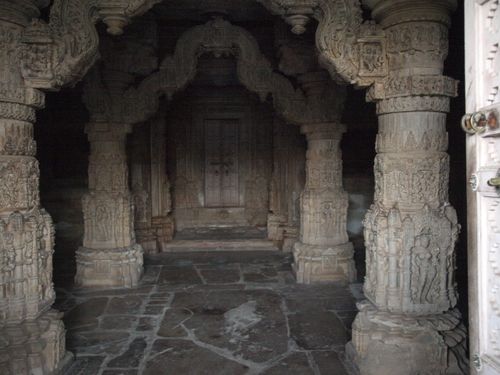
Nagda • Sas Bahu Temple
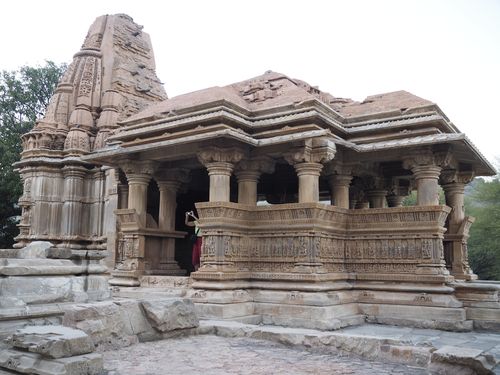
Nagda • Sas Bahu Temple

Nagda • Sas Bahu Temple
Monument profile
Sas Bahu Temple
Monument category: Hindu Temple
Monument family: Temple
Monument genre: Religious
Cultural heritage: Hindu
Geographic location: Nagda • Rajasthan • India
Construction period: 10th century AD
• Links to •
• Dynasties that contributed to the construction of the monument •


• List of videos about Nagda on this site •
Nagda Sas Bahu temple • Rajasthan, India
Sas Bahu Temples of Nagda: Rise, Decline and Survival of a Medieval Sanctuary Complex
Foundation of the Complex and the Political Role of Nagda
The Sas Bahu Temples stand at Nagda, an early historic settlement near present-day Udaipur in Rajasthan. Before later capitals such as Chittorgarh and Udaipur became dominant, Nagda was one of the principal centres of the Guhila dynasty, the ruling house that would later shape the history of Mewar. Its position near water resources and regional routes gave it both strategic and ceremonial importance.
The temple complex was constructed in the eleventh century, usually associated with the reign of King Mahipala or with patrons connected to his court. The monuments were dedicated to Vishnu, specifically to a form known as Sahasra-Bahu, meaning “the thousand-armed one,” a title expressing divine power and cosmic protection. Over time, the original name evolved in local usage into Sas Bahu, now commonly interpreted as “mother-in-law and daughter-in-law.”
The site consists of two adjoining temples of unequal scale. The larger structure served as the principal sanctuary, while the smaller one appears to have complemented it within a unified sacred programme. Their simultaneous conception suggests deliberate planning rather than accidental proximity.
Their construction reflected royal ambition. Monumental temples in stone proclaimed legitimacy, wealth and continuity. For a regional dynasty consolidating authority, a refined Vishnu sanctuary carried both religious prestige and political meaning.
Religious Function and Dynastic Patronage
The Sas Bahu Temples were active ritual institutions, not merely symbolic monuments. Priests, donors, craftsmen and pilgrims would have been involved in their daily and seasonal functioning. Ceremonies dedicated to Vishnu likely included offerings, festival observances, recitation and processional activity linked to the temple calendar.
Royal patronage of such a complex strengthened ties between rulers and Brahmanical institutions. Donations of land, revenue or maintenance rights were common means through which temples became economically stable centres. In return, sanctuaries enhanced dynastic reputation and embedded political authority within sacred geography.
The dual arrangement of the complex may indicate differentiated ritual use. The larger temple probably hosted principal ceremonies, while the smaller one may have served subsidiary worship, private devotion or associated household patronage. Even if exact liturgical functions are no longer fully documented, the paired layout implies coordinated religious planning.
Nagda itself was not an isolated religious enclave. It belonged to a wider landscape of shrines, settlements and power centres in early medieval Rajasthan. The temples therefore formed part of a broader network in which sacred architecture helped organize territory and identity.
Conflict, Decline and the Abandonment of Nagda
The later history of Nagda was shaped by political instability. From the twelfth century onward, western India experienced shifting rivalries among Rajput houses as well as external military pressures from northern powers. Older capitals often lost prominence when defensive priorities changed.
Tradition connects the decline of Nagda with attacks in the late twelfth or early thirteenth century, especially within the era of campaigns associated with Muhammad Ghori and subsequent realignments of power. Whether destruction occurred in a single episode or through repeated disturbances, the results were lasting: patronage weakened, populations moved, and the old urban centre diminished.
The Sas Bahu Temples did not vanish immediately. Like many medieval sacred sites, they entered a gradual phase of deterioration. Damage to upper structures, loss of sculptural elements, collapse of masonry sections and declining ritual support likely accumulated over generations.
As the political focus of Mewar shifted first toward Chittorgarh and later toward Udaipur, Nagda ceased to function as a major capital. Its temples survived as remnants of an earlier phase of regional state formation, preserving memory after urban decline.
Rediscovery, Archaeological Interest and Present Status
In the modern period, Nagda attracted the attention of travellers, administrators and scholars interested in the architectural history of Rajasthan. The Sas Bahu Temples were recognized as major examples of eleventh-century temple design and stone carving.
Archaeological efforts focused on clearing vegetation, documenting the surviving plan and stabilizing damaged portions. Conservation generally aimed to preserve authentic remains rather than reconstruct the monuments completely. This approach allows the surviving fabric to remain legible while acknowledging historical loss.
Today the site is protected under Indian heritage management and is visited for both historical and artistic reasons. Although not on the UNESCO World Heritage List, it holds high regional importance as one of the finest surviving monuments connected with early Mewar.
The temples also have interpretive value. They demonstrate that before the later palaces and hill forts commonly associated with Rajasthan, the region already possessed sophisticated temple centres supported by organized political authority and advanced craftsmanship.
Their partially ruined condition is historically meaningful. Missing towers, fractured carvings and open structural joints reveal the passage of centuries, warfare, neglect and preservation alike.
Global Historical Context at the Time of Construction
When the Sas Bahu Temples were built in the eleventh century, the Byzantine Empire remained a major eastern Mediterranean power. In Western Europe, Romanesque churches and monasteries were being constructed in stone on a large scale. In China, the Song dynasty oversaw strong urban growth and commercial expansion. Across the Islamic world, several regional states competed from North Africa to Central Asia. In India itself, multiple dynasties were simultaneously sponsoring temples, cities and long-distance trade networks.
Monumental Composition and Sculptural Architecture of the Sas Bahu Temples at Nagda
Setting, Site Planning and Overall Spatial Arrangement
The Sas Bahu Temples stand at Nagda in Rajasthan within a landscape shaped by water bodies, low hills and traces of an earlier settlement. Their placement is deliberate. The complex occupies a slightly raised platform that gives the temples visual authority while separating sacred space from the surrounding ground. This elevation also improves drainage and strengthens the ceremonial approach.
The ensemble consists of two neighbouring temples of unequal size. The larger shrine dominates the site as the principal architectural focus, while the smaller temple repeats many of the same formal principles on a reduced scale. Their proximity suggests coordinated planning and proportional dialogue rather than simple duplication.
Each temple is organized along a linear sacred axis. A visitor moves from an exterior stair and platform into entrance zones, then through pillared halls before reaching the innermost sanctuary. This sequence creates increasing spatial concentration. Open and accessible areas gradually lead toward enclosed and symbolically charged interiors.
The raised plinths around the temples create circumambulatory paths and clear viewing lines toward the sculpted exterior walls. Even in partial ruin, the site remains legible as a carefully composed sacred precinct where circulation, visibility and hierarchy were integrated into the design.
The relationship between the two temples is one of contrast and complement. The principal monument asserts ceremonial scale and sculptural abundance, while the smaller structure introduces balance within the broader composition.
Structural Form, Masonry and Vertical Massing
The temples are built of carefully dressed stone blocks assembled with high precision. The masonry shows accurate cutting and close-fitting joints that allowed both structural stability and elaborate carving. Stone was chosen not only for durability but also for its capacity to receive fine relief work across columns, doorframes and wall surfaces.
The architectural masses are articulated in successive components rather than treated as a single block. Entrance porches, mandapas, vestibules and sanctum volumes each possess distinct external expression. This segmentation creates rhythm along the longitudinal axis and helps the observer read interior functions from the exterior silhouette.
The sanctum of the larger temple originally supported a curvilinear shikhara tower, now partially lost. Surviving lower sections indicate a strongly vertical composition made of clustered projections, recessed bands and miniature aedicules. These devices intensified height while breaking the wall plane into animated surfaces. The smaller temple likely carried a comparable but less imposing superstructure.
Lower halls were roofed through horizontal stone systems supported by dense column grids. Load transfer from slabs to pillars and perimeter walls permitted relatively open internal spaces without requiring heavy uninterrupted masonry masses.
The contrast between horizontal plinth lines and rising tower forms is fundamental to the complex. Broad stepped bases anchor the buildings visually, while the superstructures once concentrated upward emphasis above the sanctum core.
Even where upper portions have collapsed, the remaining geometry still communicates a design based on ascending hierarchy: low approach spaces, intermediate halls and dominant sacred towers.
Pillared Halls, Interior Sequencing and Ceiling Design
The interiors of the Sas Bahu Temples are among their most sophisticated architectural features. The mandapas are organized through multiple carved columns arranged in measured bays. These supports define circulation routes, frame sightlines and subdivide space without fully enclosing it.
Columns display varied profiles. Bases are moulded, shafts may alternate circular, faceted or fluted sections, and capitals expand into bracket-like transitions supporting beams and ceiling slabs. Ornament often includes vegetal motifs, miniature figures and layered bands. Despite decorative richness, structural clarity remains evident.
The halls create a calibrated experience of movement. One enters through relatively open zones, then advances through increasingly articulated interiors where columns compress and release space. The sanctuary threshold marks the culmination of this sequence.
Ceilings are especially elaborate. Many bays use concentric recessed rings, pendant-like central bosses or carved geometric patterns. These ceiling compositions visually centre each structural bay while drawing the eye upward. They transform the engineering necessity of spanning space into an ornamental focal point.
Doorways between halls and sanctum chambers are heavily framed with multiple mouldings and carved jambs. Thresholds are architecturally emphatic, announcing each spatial transition. The sanctum itself is smaller, darker and more enclosed than the preceding halls, intensifying contrast between communal approach areas and the sacred core.
The smaller temple reproduces this logic in condensed form, showing how the same planning principles could be adapted to a compact program.
Exterior Sculpture, Surface Articulation and Decorative Hierarchy
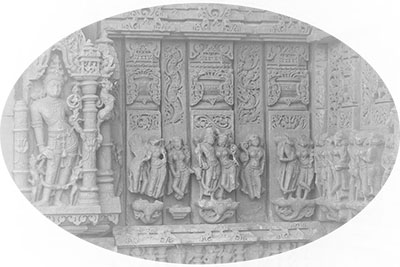
The outer walls of the Sas Bahu Temples are treated as sculptural façades rather than plain enclosures. Vertical projections and recesses generate alternating shadow bands across the surfaces. This modulation is amplified by niches, mouldings and superimposed registers of carving.
Wall niches contain divine figures, attendants or symbolic imagery. Between them appear floral scrolls, geometric bands, miniature shrine forms and repeating decorative courses. The density of carving gives the façades a changing visual texture under shifting daylight.
Doorframes rank among the most refined elements of the complex. Multiple concentric bands surround the entrances, often combining figurative sculpture with vegetal ornament and sharply cut mouldings. These frames transform access points into autonomous architectural compositions.
Parapets, pierced stone elements and subsidiary moulded members add further depth. Even secondary zones receive careful treatment, indicating a design philosophy in which no visible surface was considered neutral.
Decoration is not distributed randomly. The most elaborate carving concentrates on ritual thresholds, principal wall faces and zones aligned with sacred movement. Less prominent surfaces are comparatively restrained. This hierarchy helps organize visual attention while reinforcing the importance of processional and symbolic axes.
The interplay of sculpture and structure is central to the monument. Ornament does not conceal the building system; instead, it follows and emphasizes projections, corners, lintels and load-bearing members.
Damage, Conservation and Architectural Reading Today
The temples have suffered substantial loss, especially in upper towers, sculptural figures and exposed edge zones. Weathering, historical violence, stone displacement and long periods without systematic maintenance contributed to the present condition. Several parts survive only in fragmentary form, while others remain remarkably clear.
Modern conservation has generally focused on stabilization rather than full reconstruction. Loose blocks have been secured, collapsed sections consolidated and site clearance improved. This approach preserves historical authenticity while allowing the surviving structure to remain understandable.
Stone surfaces continue to face erosion from climate variation, biological growth and visitor wear. Fine carving is especially vulnerable because shallow relief details can disappear through gradual abrasion.
Yet the partial ruin state also assists architectural interpretation. Missing upper masses reveal construction joints and internal layering, while incomplete towers clarify the relationship between plinth, hall and superstructure.
Today the Sas Bahu Temples can be read as a highly accomplished medieval design system combining precise planning, axial movement, sculptural masonry and proportional dialogue between two adjacent shrines. Their significance lies not only in decorative richness but in the disciplined coordination of structure, ritual space and visual rhythm across the complex.