Français (France)
  Nederlands (nl-NL)
 Of Hindu tradition, the Chahamana of Abhaneri dynasty ruled for approximately 150 years, ± between 0750 and 0900 over all or part of North India, during the Classical Period and the Medieval Period.
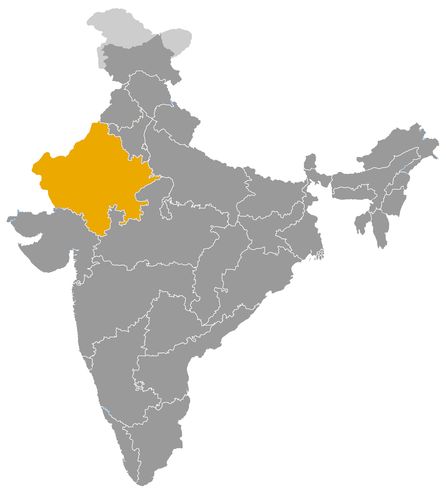
This map illustrates the maximum territory that the Chahamana of Abhaneri Dynasty had reached at its height, covering the current regions of Rajasthan in India. Its main purpose is to provide a visual aid to understand the geographical extent of this dynasty. However, it's important to note that the contemporary borders of these regions may not necessarily coincide with the historical territories.
The Chahamanas of Abhaneri and the Associated Nikumbha Lineage in Medieval Rajasthan
A local tradition connected with the Chahamana world
The Chahamanas of Abhaneri occupy a distinctive place in the history of medieval India, mainly because their importance is linked to a major heritage site rather than to a large territorial kingdom. In this article, the expression “Chahamanas of Abhaneri” refers to the local power associated with Abhaneri, Chand Baori and the Harshat Mata Temple. The local tradition presents King Chand or Chandra as a Nikumbha ruler connected with the Chahamana world. The term Nikumbha should therefore be understood here as a local lineage or associated branch, not as a separate dynasty treated independently.
This distinction is important because Abhaneri cannot be compared directly with the major Chahamana branches of Shakambhari, Naddula, Jalor or Ranastambhapura. Those branches are better documented through dynastic sequences, inscriptions, territorial expansion and political conflict. Abhaneri, by contrast, is known above all through the memory of monumental patronage in eastern Rajasthan.
Abhaneri within the regional politics of early medieval Rajasthan
Abhaneri lies in present day eastern Rajasthan, in a zone that was historically connected with local chiefs, emerging Rajput lineages and larger regional powers. During the eighth and ninth centuries, this part of Rajasthan was not organized through fixed frontiers comparable to modern states. Authority often operated at several levels, from local rulers and landed elites to wider dynastic powers whose influence could be direct, indirect or symbolic.
The Chahamanas of Abhaneri should therefore be understood as a local or subregional authority. Their political role was probably limited to Abhaneri and its surrounding area, possibly within the broader influence of stronger powers in north western India. Their historical value does not lie in military conquest or imperial ambition, but in the ability of a local ruling group to organize resources, patronize monuments and shape a sacred and civic landscape.
Chand Baori as the principal cultural achievement
The most important cultural legacy associated with the Chahamanas of Abhaneri is Chand Baori. This monumental stepwell is one of the most remarkable hydraulic structures in Rajasthan. Its depth, geometric design and architectural scale reflect a sophisticated response to environmental conditions in a region where water storage was essential.
Chand Baori was not merely a practical reservoir. In medieval India, stepwells often combined utilitarian, social, religious and political functions. They provided water for residents, travellers and possibly pilgrims. They also offered a place of rest, gathering and local interaction. The construction of such a monument expressed the authority and prestige of its patron, who appeared as a provider of welfare and stability.
The association between Chand Baori and a ruler named Chand or Chandra gives the Abhaneri tradition its main historical significance. Even if the exact dynastic identity of the patron remains cautious, the monument proves the presence of a local authority capable of mobilizing labour, technical expertise and economic resources.
The Harshat Mata Temple and the sacred dimension of the site
The Harshat Mata Temple, located near Chand Baori, adds an important religious dimension to Abhaneri. Dedicated to a goddess associated with joy or prosperity, the temple suggests that the site functioned as more than a water management centre. It was also a place of worship and communal identity.
The proximity of the temple and the stepwell is historically meaningful. In medieval India, sacred architecture and water architecture often reinforced one another. A temple required water for ritual use, while a stepwell gained additional symbolic importance through its association with a sacred landscape. Together, these monuments created a local centre where religion, public utility and political memory were closely connected.
Through this architectural setting, the Chahamanas of Abhaneri appear as patrons of both material welfare and religious order. Their power may have been limited in territorial scale, but it was expressed in forms that gave the site long lasting cultural importance.
Limited political power with broader historical relevance
Politically, the Chahamanas of Abhaneri should not be presented as rulers of a major kingdom. There is no evidence that Abhaneri controlled a wide region comparable to Ajmer, Ranthambore or Jalor. Its authority was most likely local, connected with the management of a settlement, nearby villages, religious institutions and water resources.
This limited scale is still historically significant. Abhaneri shows how smaller political centres contributed to the structure of medieval India. Large dynasties shaped military and diplomatic history, but local powers organized daily life, maintained religious sites, controlled resources and supported infrastructure. The history of Abhaneri therefore reveals a more grounded aspect of medieval state formation.
Economic influence through water management and patronage
The economic role of the Chahamanas of Abhaneri was closely tied to water. In semi arid Rajasthan, a major stepwell could support settlement stability, agriculture, travel and pilgrimage. Chand Baori increased the practical value of Abhaneri as a stopping point and a local service centre.
The construction of such a monument also required considerable economic organization. Artisans, stonecutters, labourers and planners had to be mobilized, and resources had to be directed toward a complex architectural project. Even if the territory was small, this investment indicates a local authority with sufficient means to transform its environment.
A heritage legacy stronger than dynastic power
The Chahamanas of Abhaneri are best understood as a local power whose memory survives through architecture rather than through conquest. Their role in Indian history lies in the connection between water management, religious patronage and regional authority.
This cautious interpretation preserves the link with the wider Chahamana tradition while also acknowledging the Nikumbha lineage mentioned in the local memory of the site. Abhaneri therefore stands as an important example of how modest regional powers could leave durable traces in the cultural, economic and religious landscape of medieval Rajasthan.
The Geographical Reach of the Chahamanas of Abhaneri in Medieval Rajasthan
A local power centred on Abhaneri rather than a broad kingdom
The Chahamanas of Abhaneri must be discussed with caution when their geographical extension is considered. Unlike the major Chahamana branches of Shakambhari, Naddula, Jalor or Ranastambhapura, the Abhaneri line is not known as a dynasty that controlled a large, clearly defined kingdom. Its historical importance is mainly connected with Abhaneri itself, especially Chand Baori and the Harshat Mata Temple, rather than with extensive territorial conquest.
Abhaneri lies in eastern Rajasthan, in the present day Dausa district. In the early medieval period, this area occupied an intermediate position between the older political zones of north western India, the emerging Rajput lineages of Rajasthan and the routes leading toward the northern plains. The territory associated with the Chahamanas of Abhaneri was therefore probably modest, centred on the settlement, its water resources, nearby villages and local routes. It should not be imagined as a state with fixed borders, but as a local domain within a wider and shifting political landscape.
Abhaneri as a territorial centre shaped by water and worship
The most important geographical marker of Abhaneri is Chand Baori. The construction or patronage of such a monumental stepwell indicates the existence of a local authority able to organize labour, command resources and manage a vital environmental need. In semi arid Rajasthan, water was not only a practical resource; it was also a foundation of settlement, agriculture, social life and political legitimacy.
The territory directly influenced from Abhaneri likely included the immediate settlement, surrounding agricultural land and routes used by villagers, pilgrims, traders and travellers. A large stepwell could serve multiple communities and make the site more important than an ordinary rural locality. It provided water security, encouraged human movement and helped anchor the authority of its patron in the landscape.
The nearby Harshat Mata Temple reinforces this interpretation. The association of a temple and a stepwell suggests that Abhaneri functioned as a combined religious, civic and hydraulic centre. The controlled territory may have been small, but it was organized around essential institutions: water storage, worship, local gathering and patronage.
Eastern Rajasthan within larger regional networks
The political geography of Abhaneri was shaped by its location in eastern Rajasthan. During the eighth and ninth centuries, this area was not controlled through rigid boundaries. It was part of a wider network of local chiefs, regional lineages and larger powers whose authority could vary from direct rule to loose overlordship.
The Gurjara Pratiharas were one of the dominant powers in northern and western India during this period. Local authorities in eastern Rajasthan may have operated within their political sphere, either as subordinate chiefs, allies or semi autonomous rulers. If the Abhaneri tradition is connected with the Chahamanas, this connection should probably be understood within this type of layered authority rather than as proof of a fully independent territorial kingdom.
Such a structure was common in early medieval India. A local ruler could control a limited area, sponsor major monuments and hold regional prestige while still existing within the orbit of a more powerful dynasty. In this context, the geographical reach of Abhaneri was less important than its position within a network of influence.
Relations with the wider Chahamana world
The Chahamanas of Abhaneri should also be distinguished from the better documented Chahamanas of Shakambhari, whose centre lay farther west around Sambhar and later Ajmer. The Shakambhari branch became the principal Chahamana line and eventually played a major role in the politics of Rajasthan and northern India. Abhaneri, by contrast, appears as a local or traditional attribution within the wider Rajput and Chahamana milieu.
The relationship between Abhaneri and the broader Chahamana world was probably one of cultural or genealogical association rather than clearly demonstrated political integration. There is no secure evidence that Abhaneri ruled over the major Chahamana branches, nor that it functioned as a major territorial capital. The name Chahamana may reflect later memory, regional affiliation or a local lineage connected to the same broad Rajput tradition.
This distinction matters because it prevents the territory of Abhaneri from being artificially enlarged. Its importance lies not in domination over Rajasthan, but in the presence of a monumental centre linked to local authority and regional identity.
The Nikumbha attribution and overlapping dynastic memories
The geographical history of Abhaneri is further complicated by the attribution of Chand Baori to the Nikumbha lineage in some traditions. This does not necessarily invalidate the Chahamana association, but it shows that the memory of Abhaneri is shared between different dynastic or regional narratives.
Such overlapping attributions are common in the history of early medieval Rajasthan, where local powers, later genealogies and heritage traditions often intersect. A prestigious monument could be claimed or remembered through more than one lineage. For this reason, the territory of Abhaneri should be presented as a local political and cultural zone associated with Chahamana and Nikumbha traditions, rather than as the centre of an unquestioned dynastic state.
This also influenced relations with neighbouring powers. A small local authority needed to maintain balance with stronger lineages, broader regional powers and nearby religious institutions. Its survival depended less on conquest than on patronage, local legitimacy and the ability to serve the needs of the surrounding population.
Economic influence through a compact regional territory
The economic reach of the Chahamanas of Abhaneri was probably limited but meaningful. Chand Baori indicates a strong concern with water management, which was essential in Rajasthan. Control of water improved agricultural stability, supported settlement and encouraged movement through the region. A large stepwell could also increase the importance of local routes by providing a reliable stopping point for travellers and traders.
The construction of such a monument required skilled labour, stone resources, planning and economic surplus. Even if the political territory was small, the project shows that Abhaneri was connected to networks of artisans, religious specialists and local revenue. Its economy was therefore rooted in water, agriculture, worship and passage.
A modest territorial reach with lasting heritage value
The Chahamanas of Abhaneri should not be described as rulers of a large expanding kingdom. Their geographical extension was probably centred on Abhaneri and its surrounding region in eastern Rajasthan. Their influence came from the ability of a local power to organize water, religion and settlement around a durable monumental complex.
Their relations with neighbouring dynasties were shaped by this limited but strategic position. They likely existed within broader political networks, possibly under the influence of larger powers such as the Gurjara Pratiharas, while remaining connected to the wider Rajput and Chahamana world. The historical value of Abhaneri therefore lies in its role as a local centre whose architecture preserved the memory of regional authority long after the political structure itself had faded.
The local line of Abhaneri is very poorly documented and should not be confused with the major Chahamana branch of Shakambhari, Ajmer and Delhi. Only one ruler is generally associated with Abhaneri in the historical tradition of the site; his affiliation is sometimes linked to the Nikumbhas or to a local Chahamana branch, probably within a framework of dependence on the Gurjara-Pratiharas. The dates are therefore indicative.
- Chandra or Chand (c. 800–825 CE) • A local raja traditionally associated with Abhaneri, he is linked to the construction or patronage of Chand Baori and, in some attributions, to the monumental context of the Harshat Mata Temple.
 Links to the main sections of the site