

 Français (France)
  Nederlands (nl-NL)
 Of Hindu tradition, the Eastern Ganga dynasty ruled for approximately 938 years, ± between 496 and 1434 over all or part of East India and South India, during the Ancient Period and the Classical Period.
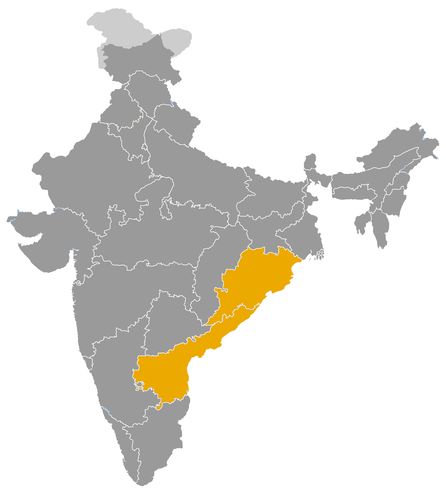
This map illustrates the maximum territory that the Eastern Ganga Dynasty had reached at its height, covering the current regions of Andhra Pradesh and Odisha in India. Its main purpose is to provide a visual aid to understand the geographical extent of this dynasty. However, it's important to note that the contemporary borders of these regions may not necessarily coincide with the historical territories.
The Eastern Ganga Dynasty and Its Role in the History of Eastern India
A long lasting line between ancient Kalinga and medieval Odisha
The Eastern Ganga dynasty occupies an important place in the history of India because of the duration of its rule and the gradual transformation of its political base. Originating in the historical region of Kalinga, the dynasty first developed as a regional power on the eastern coast of the subcontinent before becoming one of the major monarchies of medieval Odisha. Its chronology is long and partly complex, with an earlier phase that is less fully documented and a later imperial phase that is much better known from inscriptions, temples and political developments.
The importance of the Eastern Gangas lies in this continuity between ancient Kalinga and medieval Odisha. They did not merely preserve a ruling line; they helped shape a durable regional state. Their history connects coastal power, royal ideology, temple patronage, agricultural wealth and maritime exchange. Through their political organization and religious policy, they played a decisive role in the formation of Odisha as a major historical and cultural region.
A political power built along the Bay of Bengal
The political role of the Eastern Gangas was shaped by the geography of the eastern coast. Kalinga and Odisha stood between Bengal to the north, Andhra to the south, the Deccan to the west and the Bay of Bengal to the east. This position exposed the dynasty to military pressures, but also gave it access to important trade routes, fertile plains and religious centres.
During the earlier phase, the Eastern Gangas consolidated their authority in parts of Kalinga, especially in coastal and inland areas linking present day southern Odisha and northern Andhra. Their power was regional and sometimes difficult to reconstruct, but their inscriptions show a clear effort to express royal legitimacy through elevated Sanskrit titles and dynastic claims.
The imperial phase transformed the scale of the dynasty. Under rulers such as Vajrahasta V, Rajaraja Deva I and especially Anantavarman Chodaganga, the monarchy was reorganized and expanded. The kingdom became more closely associated with Odisha, where it developed stronger political institutions and a more coherent territorial identity. Later rulers, including Anangabhima Deva III and Narasimhadeva I, strengthened this structure and defended the kingdom against neighbouring powers.
The Jagannath cult as a foundation of royal legitimacy
One of the most important contributions of the Eastern Ganga dynasty was its close association with the cult of Jagannath at Puri. Under their patronage, Puri became one of the great sacred centres of India. The dynasty connected royal authority with the service of Jagannath, turning the deity into a central symbol of kingship and regional unity.
This relationship became especially significant under Anangabhima Deva III. The king was presented not simply as an independent ruler, but as the servant or representative of Jagannath. This idea gave the monarchy a strong sacred dimension. It also helped integrate different communities, territories and social groups under a shared religious framework.
The temple of Jagannath was not only a place of worship. It was also a major economic and social institution. It received land grants, organized rituals, attracted pilgrims, employed many service communities and redistributed resources. By supporting this temple, the Eastern Gangas strengthened the connection between kingship, religious authority and the regional identity of Odisha.
A major contribution to the architecture of Odisha
The cultural impact of the Eastern Gangas was especially visible in temple architecture. Their patronage contributed to the maturity of the Odishan temple style, known for its monumental towers, sculptural decoration and carefully organized ritual spaces. Architecture became a means of expressing devotion, royal prestige and control over resources.
The great temple of Jagannath at Puri is closely associated with the religious and political rise of the dynasty. It became a symbol of royal legitimacy and regional cohesion. Later, the Sun Temple at Konark, built under Narasimhadeva I, represented one of the most remarkable achievements of medieval Indian architecture. Its scale, sculptural programme and symbolic design reflected the ambition and wealth of the kingdom.
These monuments were not isolated artistic creations. They formed part of a broader system of patronage that included inscriptions, land grants, images, temple servants, ritual specialists and local communities. Through this system, the Eastern Gangas transformed religious centres into enduring markers of political authority.
Economic foundations in agriculture, temples and coastal exchange
The economy of the Eastern Ganga kingdom was based primarily on agriculture. The coastal plains, river valleys and inland zones of Kalinga and Odisha produced the surplus needed to support the court, the army, administrative officials and religious institutions. Land revenue was a central element of royal power.
Land grants played a major role in organizing the kingdom. Villages, revenues and rights were assigned to temples, Brahmins and religious establishments. These grants were both religious and political. They linked rural society to royal authority, rewarded elites and helped structure local administration.
The dynasty’s coastal position added a commercial dimension to its economy. The Bay of Bengal connected Odisha with Bengal, Andhra, South India and wider Indian Ocean networks. Ports and coastal routes encouraged the movement of goods, pilgrims, merchants and cultural influences. The Eastern Gangas were not exclusively a maritime power, but their access to the sea strengthened their economic and strategic position.
A dynasty central to the historical identity of Odisha
The Eastern Gangas were central to the formation of medieval Odisha. They transformed a regional power rooted in Kalinga into a kingdom with strong political institutions, a sacred centre at Puri and a distinctive architectural tradition. Their rule connected agriculture, temple economy, royal ideology and coastal exchange into a durable regional system.
Their later decline opened the way for the Gajapati dynasty, which inherited much of the political and religious framework shaped by the Eastern Gangas. The legacy of the dynasty is therefore visible not only in monuments such as Puri and Konark, but also in the historical identity of Odisha itself. Through their long rule, cultural patronage and territorial organization, the Eastern Gangas became one of the essential dynasties for understanding the history of eastern India.
The Geographic Extent of the Eastern Ganga Dynasty between Kalinga and Medieval Odisha
A coastal power formed in eastern India
The Eastern Ganga dynasty developed its power in the eastern part of the Indian subcontinent, mainly in the historical region of Kalinga and later in medieval Odisha. Its geographic history must be understood over a long period, because the dynasty first appeared as a regional line in Kalinga before becoming a more powerful and better documented monarchy in Odisha. This long development explains why its territorial extent was not fixed throughout its history.
The core of Eastern Ganga power lay along the coast of the Bay of Bengal, in a region connecting coastal plains, river valleys, inland plateaus and routes toward Andhra, the Deccan and Bengal. The dynasty’s authority varied according to military strength, dynastic succession, local alliances and pressure from neighbouring powers. At its height, the Eastern Ganga kingdom became one of the major political formations of eastern India.
The early territorial base in Kalinga
During their early phase, the Eastern Gangas were rooted in Kalinga, a historical region stretching across parts of present day southern Odisha and northern Andhra Pradesh. This area was strategically important because it lay between several cultural and political zones. It linked eastern India with the Telugu regions, the Deccan interior and the maritime routes of the Bay of Bengal.
Kalinga was not only a coastal land. It also included river valleys, forested zones, inland routes and plateau margins. These varied landscapes gave the early Eastern Gangas access to agricultural resources, local chiefs, trade routes and military corridors. Their control was probably strongest around dynastic centres and more flexible in frontier areas, as was common in early medieval Indian polities.
This first territorial base allowed the dynasty to survive in a complex political environment. The Eastern Gangas had to deal with neighbouring lineages, southern powers, Deccan states and local authorities. Their geographic position gave them opportunities for expansion, but also exposed them to repeated competition.
The shift toward Odisha as the main centre of power
Over time, the centre of gravity of the dynasty moved northward toward Odisha. This shift became especially important during the period leading to the imperial phase of the kingdom. The dynasty expanded beyond its earlier Kalinga base and gradually organized a broader political space around the fertile coastal plains, river systems, religious centres, ports and administrative networks of medieval Odisha.
Under Anantavarman Chodaganga, the Eastern Ganga monarchy acquired a new scale. The kingdom extended its authority more firmly over Odisha and became more closely linked with Puri and the cult of Jagannath. This territorial consolidation gave the dynasty a stronger political identity and a more durable regional base.
Odisha offered several advantages. Its coastal plains produced agricultural surplus, its rivers supported settlement and communication, and its religious centres strengthened royal legitimacy. The integration of these elements allowed the Eastern Gangas to transform a regional Kalinga power into a major kingdom of eastern India.
Puri and Konark as markers of territorial authority
The geographic expansion of the Eastern Gangas cannot be separated from their religious and monumental policy. Puri became one of the central places of the kingdom because of the temple of Jagannath. Control over Puri gave the dynasty more than religious prestige. It provided a sacred centre around which territory, kingship, pilgrimage and redistribution could be organized.
The Jagannath temple attracted pilgrims, donations, service communities and ritual specialists. By supporting this sanctuary, the Eastern Ganga rulers gave their kingdom a powerful symbolic centre. Puri helped integrate different regions of Odisha under a common sacred authority and reinforced the idea that royal power was linked to divine protection.
Konark later added another major territorial symbol. The Sun Temple, built under Narasimhadeva I near the coast, expressed royal power, artistic ambition and control over resources. Its coastal location also reflected the importance of the Bay of Bengal in the political imagination and economic geography of the kingdom.
Northern frontiers and rivalry with Bengal
To the north, the Eastern Ganga kingdom came into contact with the political powers of Bengal. This frontier became increasingly important during the imperial phase, when the rulers of Odisha sought to protect their northern boundary and assert their military prestige. The campaigns of Narasimhadeva I against forces connected with Bengal illustrate the strategic value of this region.
The northern frontier controlled access between Odisha and the lower Ganges basin. It involved coastal routes, river corridors, border settlements and zones of military movement. Relations with Bengal were therefore shaped by both defence and competition. The Eastern Gangas had to prevent northern pressure from threatening the Odishan heartland, while also asserting themselves as a major power of eastern India.
This frontier strengthened the military role of the dynasty. Protecting northern Odisha became part of the royal image, especially when kings presented themselves as defenders of the realm and guardians of the sacred order centred on Jagannath.
Southern relations with Andhra, the Cholas and Deccan powers
To the south, the Eastern Gangas were linked with Andhra and the Telugu speaking regions. This southern zone connected Kalinga and Odisha with the Deccan and with the wider political world of South India. It was also an area where dynastic alliances, military competition and cultural exchanges were especially important.
Relations with the Cholas were significant, particularly because Anantavarman Chodaganga had genealogical and political connections with the Chola world. These links show that the Eastern Gangas were not isolated rulers of the east coast. They participated in the political networks of South India through marriage, diplomacy, warfare and shared royal traditions.
The southern frontier remained a zone of interaction rather than a permanently fixed boundary. Areas between Kalinga and Andhra could be contested, influenced or temporarily controlled by different powers. The Eastern Gangas had to maintain both military capacity and political alliances to preserve their position in this region.
A coastal kingdom that shaped medieval Odisha
The territorial expansion of the Eastern Ganga dynasty was the history of a kingdom that moved from a Kalinga base toward the formation of medieval Odisha. Its lands included coastal plains, river valleys, inland routes, sacred centres and maritime connections. This geography shaped its relations with Bengal, Andhra, the Cholas, Deccan powers and local lineages.
The strength of the dynasty came from its ability to organize this strategic region into a durable political and religious space. By controlling Kalinga, Odisha, Puri, Konark and the routes of the Bay of Bengal, the Eastern Gangas created one of the major regional states of medieval eastern India. Their territorial legacy also prepared the rise of the later Gajapati dynasty, which inherited much of the political and sacred framework built by the Eastern Gangas.
The chronology of the Eastern Gangas is long and sometimes complex. It includes an early phase centred on Kalinga, followed by a better documented imperial period associated with medieval Odisha, Puri and the cult of Jagannath; the early dates remain indicative and may vary according to reconstructions.
Early Kalinga phase
- Mittavarman (c. 480–498) • A local chief or king in a context of regional dependence, he preceded the independent rise of the dynasty.
- Indravarman I (c. 498–537) • The first well-attested independent ruler, he established Eastern Ganga authority in Kalinga.
- Samantavarman (c. 537–562) • He continued the consolidation of the line in southern Kalinga.
- Hastivarman (c. 562–578) • An important early ruler, he strengthened dynastic prestige through inscriptions and royal titles.
- Indravarman II (c. 578–589) • He maintained the continuity of Ganga rule in a still poorly documented regional context.
- Danarnava (c. 589–652) • His long reign is associated with the gradual stabilization of dynastic authority in Kalinga.
- Indravarman III (c. 652–682) • He preserved the authority of the line during a phase of regional political continuity.
- Gunarnava (c. 682–730) • He maintained the dynasty amid rivalries between powers of eastern and southern India.
- Devendravarman I (c. 730–780) • He ruled during a period of regional consolidation and fragmentary documentation.
- Anantavarman III (c. 780–812) • He belongs to the early phase preceding the medieval reorganization of the Ganga monarchy.
- Rajendravarman II (c. 812–840) • He preserved dynastic authority in the coastal and inland regions of Kalinga.
- Devendravarman V (c. 840–895) • His reign falls within a period of continuity before the clearer assertion of later rulers.
- Gunamaharnava I (c. 895–910) • He ruled during a still imperfectly known dynastic transition.
- Vajrahasta II (c. 910–939) • Also associated with the name Anangabhimadeva I, he strengthened the dynasty’s position in Kalinga.
- Gundama I (c. 939–942) • His brief reign belongs to a period of unstable succession.
- Kamarnava I (c. 942–977) • He maintained the continuity of the line before the reorganization of the late tenth century.
- Vinayaditya (c. 977–980) • He ruled briefly before the rise of Vajrahasta IV.
- Vajrahasta IV (c. 980–1015) • He contributed to the restoration of Ganga power after a phase of decline.
- Kamarnava II (c. 1015, brief reign) • He ruled for only a few months during a difficult succession.
- Gundama II (c. 1015–1018) • He briefly held power before Madhukamarnava.
- Madhukamarnava (c. 1018–1038) • He preceded the rise of Vajrahasta V and the strengthening of the dynasty.
- Vajrahasta V (c. 1038–1070) • He reorganized the Ganga monarchy, asserted elevated sovereign titles and prepared the imperial rise.
- Rajaraja Deva I (c. 1070–1077) • He strengthened ties with the Cholas through marriage alliance and dynastic transmission.
Imperial phase of Trikalinga and Odisha
- Anantavarman Chodaganga (c. 1077–1150) • A great imperial ruler, he expanded the kingdom, asserted his authority over Odisha and was associated with the monumental rise of Puri.
- Kamarnava Deva (c. 1150–1156) • He succeeded Anantavarman Chodaganga and faced tensions on the western margins of the kingdom.
- Raghava Deva (c. 1156–1170) • He preserved imperial authority in medieval Odisha.
- Rajaraja Deva II (c. 1170–1190) • He ruled during a phase of relative stability before the tensions of the thirteenth century.
- Anangabhima Deva II (c. 1190–1198) • His reign belongs to the transition toward a monarchy more strongly centred on the cult of Jagannath.
- Rajaraja Deva III (c. 1198–1211) • He maintained dynastic continuity in the face of early Muslim pressure toward Odisha.
- Anangabhima Deva III (c. 1211–1238) • He strengthened royal ideology linked to Jagannath and consolidated the kingdom of Odisha.
- Narasimhadeva I (1238–1264) • A major ruler, he campaigned against Bengal and built the Sun Temple at Konark.
- Bhanudeva I (1264–1278) • He maintained imperial Ganga authority after the reign of Narasimhadeva I.
- Narasimhadeva II (1279–1306) • He ruled during a period of increasing pressure on the kingdom’s frontiers.
- Bhanudeva II (1306–1328) • He preserved the kingdom amid political transformations in eastern India.
- Narasimhadeva III (1328–1352) • His reign marks a phase of gradual weakening of Ganga power.
- Bhanudeva III (1352–1378) • He faced external pressures and the weakening of central authority.
- Narasimhadeva IV (1378–1425) • He ruled during the advanced decline of the imperial dynasty.
- Bhanudeva IV (1425–1434) • The last important ruler of the line, he was displaced by Kapilendra Deva and the Gajapati dynasty.