

 Français (France)
  Nederlands (nl-NL)
 The Sun Temple of Konârak, located in the Indian state of Odisha, is one of the country’s most iconic Hindu monuments. Built in the 13th century, it is dedicated to the sun god Sūrya and reflects the enduring importance of solar worship in Indian spirituality. Listed as a UNESCO World Heritage Site, the monument illustrates the cultural and religious vitality of medieval eastern India. Its position near the Bay of Bengal highlights the historical significance of coastal trade and pilgrimage routes. Today, the Sun Temple stands as a powerful symbol of Odisha’s heritage, valued for its historic and artistic importance and its universal cultural resonance.
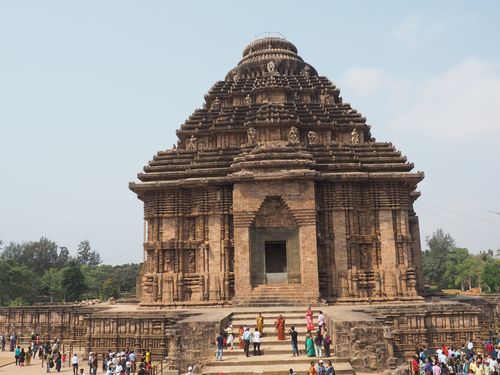
Konark • Sun temple: overview
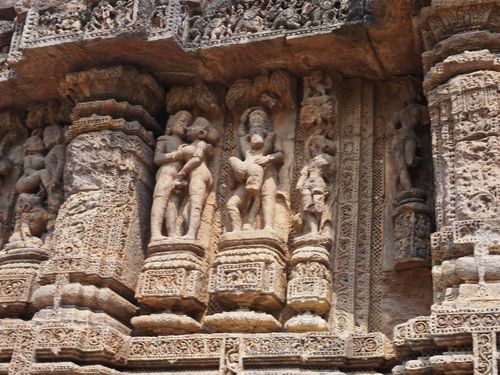
Konark • Sun temple: statues on the facade

Konark • Sun temple: chariot wheels
Monument profile
Sun temple
Monument category: Hindu Temple
Monument family: Temple
Monument genre: Religious
Cultural heritage: Hindu
Geographic location: Konark • Odisha •
Construction period: 13th century AD
This monument in Konark is inscribed on the UNESCO World Heritage List under the name Sun Temple, Konârak since 1984.See the UNESCO monuments featured on this site
• Links to •
• Dynasties that contributed to the construction of the monument •

• List of videos about Konark on this site •
Konark • Sun Temple, medieval heritage on India’s east coast
Konark • Chandrabhaga Beach, fishermen’s coast in Odisha
History of the Sun Temple of Konark
The Sun Temple of Konrk, located on the eastern coast of India in the present-day state of Odisha, is one of the most celebrated monuments of medieval India. Constructed in the 13th century, it reflects the political ambition of a powerful dynasty, the endurance of solar worship within Hinduism, and the maritime vitality of the Bay of Bengal region. Its story is not only architectural but deeply connected to the cultural, military, and economic transformations of its time.
Political and Social Context of Construction
The temple was commissioned by King Narasimhadeva I, who ruled from 1238 to 1264 and belonged to the Eastern Ganga dynasty. This dynasty controlled a prosperous realm stretching across coastal Odisha and parts of modern Andhra Pradesh. Its wealth derived from fertile river deltas, trade in rice, textiles, and forest products, and maritime links with Southeast Asia. During Narasimhadeva’s reign, Odisha stood at a political crossroads. To the north and west, the Delhi Sultanate was expanding into Bengal, threatening Hindu kingdoms with invasion and tribute demands.
Narasimhadeva launched successful military campaigns against the Muslim rulers of Bengal, notably defeating forces that sought to extend their influence southwards. Building an immense temple dedicated to the sun god Sūrya was both an act of devotion and a proclamation of victory. It signaled that the Ganga kings were defenders of dharma and capable of rivaling the power of their northern adversaries. The project mobilized an enormous workforce: architects, sculptors, and artisans from across eastern India. It also demonstrated the administrative capacity and economic prosperity of the dynasty at its height.
Choosing Sūrya as the temple’s presiding deity had symbolic weight. The sun had long represented power, renewal, and invincibility. By linking his kingship to this cosmic force, Narasimhadeva projected his authority as both divinely sanctioned and militarily proven.
Solar Worship within Hindu Tradition
Solar worship in India predates organized Hindu sects. Hymns to the sun abound in the Rig Veda, one of the oldest sacred texts, where Sūrya is praised as the eye of the universe and the guarantor of cosmic order (ṛta). This veneration stems from ancient religious layers, including animistic traditions centered on natural forces, later integrated into mainstream Hinduism.
By the medieval period, Sūrya worship persisted alongside the dominant cults of Viṣṇu and Śiva. Kings sometimes embraced the solar deity to emphasize prosperity, healing power, and royal legitimacy. The Sun Temple of Konârak represents the culmination of this tradition: a monumental celebration of Sūrya at a time when Odisha sought to assert cultural and military independence. Other Indian temples to the sun exist, such as those at Modhera in Gujarat, but Konârak surpassed them in scale and ambition.
Major Historical Events and Dynastic Change
After its completion, the temple became a major pilgrimage site and a symbol of Eastern Ganga pride. However, political conditions soon shifted. By the late 14th century, the dynasty weakened due to succession struggles and external pressures. Muslim rulers from Bengal are reported to have raided parts of Odisha, although historical evidence for large-scale destruction at Konârak remains debated. Natural forces also contributed to its decline: shifting sands, coastal storms, and humidity destabilized the structure.
Under subsequent rulers of Odisha, including the Gajapati kings, the temple’s religious importance diminished as state priorities changed. When the region later fell under the influence of the Mughal Empire in the 16th century, Konârak was no longer a major royal sanctuary. European sailors, particularly the Portuguese, began to use the towering ruins as a navigational landmark on the Bay of Bengal. They noted its partial collapse and the reuse of its stones in local building projects.
Global Context in the 13th Century
The building of the Sun Temple was part of a worldwide trend of monumental religious architecture during the High Middle Ages. In Southeast Asia, the Khmer kings had recently completed the great complexes of Angkor Thom. In Burma, the city of Bagan was filled with thousands of Buddhist temples. In Europe, cathedrals such as Chartres and Amiens soared skyward as symbols of faith and power. Across cultures, rulers used spectacular sacred buildings to assert legitimacy and unite their realms. Konârak mirrors this global pattern but expresses it in a distinctly Hindu and maritime-oriented context, combining cosmic symbolism with royal ambition.
Transformations, Decline, and Restorations
Over centuries, the temple endured natural decay. Its main sanctum, once crowned by a colossal tower (śikhara), collapsed—possibly as early as the 15th or 16th century. Coastal winds, high salinity, and cyclones accelerated structural failure. Without royal patronage, local communities sometimes quarried stones from the abandoned complex for other uses.
During the British colonial period, the ruins attracted the attention of scholars and engineers. Nineteenth-century surveys documented the remains in detail, while initial conservation work sought to prevent further collapse. British authorities cleared sand, stabilized outer walls, and built support structures to preserve sculptures. This marked the beginning of systematic preservation.
In the 20th century, the Archaeological Survey of India (ASI) assumed responsibility. Extensive measures were taken to consolidate the jagamohana (audience hall) and safeguard the surviving carvings. Restoration projects aimed to slow salt damage and manage water infiltration. The temple’s inclusion on the UNESCO World Heritage List in 1984 further raised awareness and funding for its protection.
Contemporary Role and Cultural Significance
Today, the Sun Temple of Konârak stands as a national symbol of India’s cultural heritage and Odisha’s regional pride. It is celebrated not only as an architectural masterpiece but also as a spiritual monument, even though large-scale worship of Sūrya has diminished. Rituals connected to the sun persist nearby, particularly on Chandrabhaga Beach, where devotees still honor the dawn and seasonal cycles.
The temple plays a role in education, tourism, and national identity. It appears in textbooks, artistic works, and official imagery such as postage stamps. For Odisha, it is a cornerstone of cultural tourism, drawing both domestic travelers and international visitors interested in India’s medieval art.
State of Preservation and Modern Challenges
Despite significant conservation work, the monument remains fragile. Its coastal location exposes it to humidity, saline air, and cyclonic storms. Rising visitor numbers and nearby urban development add to the pressure. Authorities have implemented measures such as controlled visitor access, barriers to protect delicate carvings, and ongoing structural monitoring. Climate change, with its potential to intensify storms and alter groundwater levels, poses a new threat to long-term stability.
UNESCO status has encouraged sustained investment in protection, but maintaining the balance between access and preservation remains complex. The temple’s future depends on careful management that respects both its cultural resonance and its physical vulnerability.
Architecture of the Sun Temple of Konârak
The Sun Temple of Konârak in Odisha, eastern India, stands among the most sophisticated achievements of medieval South Asian architecture. Built in the 13th century under the Eastern Ganga dynasty, it presents a complete architectural “argument” in stone: structure, symbolism, technology, urban siting, and sculptural program are fused into a single idea—the cosmic chariot of Sūrya, the sun. Although the main tower (śikhara) has collapsed, the surviving components and the archaeological record allow a precise reading of its design and construction logic.
Technological and architectural innovations
Konârak’s plan manifests a rare union of concept and engineering. The entire complex was conceived as a colossal stone chariot drawn by seven horses and resting on twenty-four carved wheels. Each wheel, roughly three meters in diameter, carries eight principal spokes; beyond their emblematic value, their calibrated shadows function as approximate time markers, aligning the building with diurnal solar movement. Translating so abstract a diagram into load-bearing masonry required an advanced grasp of massing, thrust, and sequencing.
The core ensemble comprised three principal volumes along an east–west axis: the sanctum or rekha deul (now lost), the pyramidal audience hall or jagamohana (standing), and the natamaṇḍira (dance pavilion), whose plinth and lower walls survive. The jagamohana’s roofing is formed not by true arches or domes but by corbelled horizontal courses stepping inward—an established technology in the Kalinga school that allows large covered spaces without centering or voussoirs. The stability of these vast corbelled stacks depended on precise weight distribution, thick wall sections, and carefully managed dead loads at the corners.
Environmentally, the designers anticipated the site’s coastal climate. Carefully placed apertures and lattice stone windows temper interior airflow and daylight while preserving wall integrity. Rainwater was managed by drip mouldings, projecting cornices, and concealed run-off channels that evacuate water from terraces and ledges—crucial on a saline, storm-exposed littoral. The east–west alignment was more than ritual: it optimized early morning insolation for the inner sequence and anchored the temple visually to the coastline, where it long served as a landmark for sailors.
Materials and construction methods
The structure is predominantly built in khondalite (a feldspathic sandstone local to Odisha), chosen for its workability and warm tonality. Laterite appears in cores and concealed foundations, where its porosity is an advantage for drainage but requires protection from persistent moisture. Select architectural members—doorjambs, thresholds, some sculptural panels—use denser, darker chlorite stone to resist abrasion and to sharpen carving profiles at points of high tactile or visual impact.
Masonry was laid largely dry, with finely drafted beds and vertical joints. Stability was enhanced by iron cramps and dowels inserted into mortised sockets and sometimes fixed with lead infill. This metalwork, invisible in normal viewing, was structurally decisive: it bound large monoliths and cornice blocks against uplift and sliding, and it tied sculptural veneers to mass walls. The long-term conservation problem so characteristic of Konârak—the corrosion of iron in a marine environment—stems from this very ingenuity, for expanding oxides exert pressure that can jack slabs apart when not regularly mitigated.
Fabrication relied on a distributed workshop system. Components were roughed out near the quarries and finished on site, where sculptors “stitched” narrative registers seamlessly across joints. The precision visible in the wheel hubs, spoke fillets, and moulding returns implies master templates and strict dimensional canons. Logistics—riverine transport, road haulage, erection scaffolds, and lifting gear—were no less innovative than the carving itself.
Influences and artistic language
Formally, Konârak belongs to the Nagara tradition of northern Indian temples, with a curvilinear rekha deul over the sanctum and a pyramidal pidha roof over the jagamohana. Yet it is unmistakably Kalinga in its vertical proportions, moulding sequences (khura, kumbha, pata, basanta), and the dense figural occupation of wall fields. Maritime connectivity left its trace: motifs of aquatic creatures, processions, and musicians sit beside pan-Indian deities, and the monumental scale resonates with the contemporaneous taste for grand sacred complexes across the Bay of Bengal world. Still, unlike the arcuated and domed vocabularies that would later accompany Indo-Islamic patronage, Konârak’s grammar is resolutely trabeated and corbelled—an eloquent statement of regional continuity.
The ornament is structurally literate: bands thicken where loads increase; heavier figural groups often coincide with mass above; light filigree appears where walls are relieved. Erotic scenes, frequently noted by visitors, belong to a broader iconographic program about fertility, auspiciousness, and cosmic union; they also mark thresholds and liminal zones, functioning apotropaically as well as didactically.
Organization and spatial structure
The approach from the east unfolds a canonical sequence. A broad stair and platform lead to the jagamohana, a high, nearly square hall that mediated between the outer world and the sanctum. Its interior once housed massive monolithic pillars and a corbelled ceiling rising in stepped tiers. The sanctum to the west, now lost, was the vertical climax, its towering śikhara formerly dominating the coast; three celebrated images of Sūrya in dark stone were placed on exterior walls aligned to morning, noon, and afternoon light. South of the axis lies the natamaṇḍira, an open pavilion for ritual dance; its low, wide plinth and orthogonal column grid establish a contrasting horizon to the temple’s vertical accents.
Unlike Islamic complexes of later centuries, there are no minarets, true arches, or domes. Instead, Konârak achieves monumentality through massed piling of stone courses, repetitive mouldings, and the cumulative force of hundreds of sculptural panels. Balustrades, railings, and parapet courses are carved as integral masonry rather than as applied metalwork, underscoring the “total stone” ethos of the school.
Metrics, facts, and lore
The deul’s original height is commonly estimated at about 70 meters, which would have placed it among the tallest Indian temples of its era. The jagamohana rises to roughly 30 meters. The chariot base displays twenty-four wheels, each around three meters across, with hubs, tyres, and spokes rendered in working detail. Seven rearing horses animate the eastern plinth. Traditional accounts speak of a brilliant finial or a magnetic lodestone at the summit that guided ships—plausible as legend, meaningful as testimony to the temple’s coastal presence. Another popular tale, that of the prodigy Dharmpad who solved an engineering impasse, captures the social memory of a project whose technical demands surpassed ordinary experience.
International recognition and conservation challenges
Konârak’s architecture underpins its international standing. It encapsulates the Kalinga school at peak maturity, demonstrates a rare synthesis of structural daring and iconographic density, and translates a cosmological idea into navigable space. Its listing as a World Heritage Site recognizes these values and has galvanized sustained conservation.
The same features that make Konârak exceptional complicate its preservation. Khondalite is workable but susceptible to granular disintegration under salt-laden winds; iron cramps are structurally essential yet liable to corrosive expansion; the low, sandy site is exposed to cyclones and seasonal inundation. Conservation strategies therefore combine desalination and consolidation of stone, cathodic protection or selective replacement of ferrous ties, improved drainage, and tight visitor management around vulnerable sculptures and joints. Because the main tower is lost, current policy prioritizes stabilizing extant fabric rather than conjectural rebuilding, allowing the monument to speak through authentic remnants—jagamohana, natamaṇḍira, plinth, and relief cycles—backed by rigorous documentation.
In global perspective, the Sun Temple of Konârak is a touchstone of medieval temple engineering: a trabeated, corbel-roofed system pushed to its spatial limits; a material palette tuned to structure and imagery; a layout that synchronizes ritual, light, and coastal geography. Its architecture is not merely a container for sculpture; it is an instrument that renders cosmic motion—time, sun, season—legible in stone.