Français (France)
  Nederlands (nl-NL)
 Of Hindu tradition, (with additional Buddhist influence), the Shunga dynasty ruled for approximately 110 years, ± between -185 and -75 over all or part of Central India, East India and North India, during the Ancient Period.
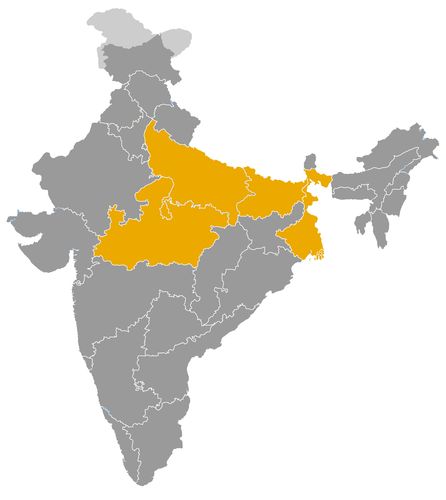
This map illustrates the maximum territory that the Shunga Dynasty had reached at its height, covering the current regions of Bihar, Madhya Pradesh, Odisha and Uttar Pradesh in India. Its main purpose is to provide a visual aid to understand the geographical extent of this dynasty. However, it's important to note that the contemporary borders of these regions may not necessarily coincide with the historical territories.
The Place and Role of the Shunga Dynasty in Indian History
A Dynasty Born from the Collapse of Mauryan Authority
The Shunga dynasty occupies a significant position in the history of ancient India because it emerged directly from the decline of the Mauryan Empire. It was founded around 185 BCE by Pushyamitra Shunga, a former Mauryan general, after the overthrow of the last Mauryan ruler, Brihadratha. This event marked the end of one of the largest imperial formations in early Indian history and the beginning of a more fragmented political landscape.
The Shungas inherited part of the prestige of Magadha, the old political heartland of the Mauryas, but they did not maintain the full extent of Mauryan imperial control. Their kingdom was smaller, more regional and more vulnerable to rival powers. Yet their role was not marginal. They preserved a form of royal authority in northern India, defended important centres of power and participated in the reorganization of the subcontinent after Mauryan decline.
Political Continuity in the Gangetic Plain
The main political role of the Shungas was to maintain a royal state in the middle Ganges region after the collapse of Mauryan centralization. Magadha retained great importance because of its fertile land, river routes, urban centres and association with earlier imperial dynasties. By controlling this region, the Shungas could present themselves as heirs to a major political tradition.
Pushyamitra Shunga appears as the strongest ruler of the dynasty. He had to secure power after a military coup and to defend the kingdom against both internal fragmentation and external pressure. Later traditions associate him with royal Vedic sacrifices, especially the ashvamedha, which was used to affirm sovereign legitimacy and political authority.
Agnimitra, his successor, is linked with Vidisha and with conflicts involving Vidarbha. This indicates that early Shunga power extended or sought to extend beyond the Magadhan core into central India. However, after the first rulers, the authority of the dynasty seems to have diminished. The later Shunga kings are less clearly documented and may have ruled over a more limited territory.
Relations with Indo-Greeks and Regional Powers
The Shunga period was marked by intense interaction with neighbouring powers. To the north-west, the Indo-Greek kingdoms represented one of the main external forces of the age. Established in areas such as Gandhara and the Punjab, Indo-Greek rulers sometimes advanced toward the interior of northern India. Shunga traditions concerning Pushyamitra and Vasumitra reflect this pressure, especially in accounts connected with the defence of the sacrificial horse during an ashvamedha ritual.
These contacts were not exclusively military. The period also saw diplomatic and cultural exchanges between Indian and Hellenistic political worlds. The Heliodorus pillar, associated with the court of the Shunga king Bhagabhadra, illustrates the complexity of these relations. It shows that rivalry, diplomacy and religious interaction could coexist.
In central India, the Shungas were connected with regions such as Malwa, Vidisha and Vidarbha. These areas were strategically important because they linked the Ganges basin with western India and the Deccan. The dynasty’s influence there placed it in contact with emerging or expanding regional powers, including the Satavahanas in the Deccan.
Brahmanical Assertion and Religious Complexity
The Shungas are often associated with a revival or assertion of Brahmanical traditions after the Mauryan period, especially after the Buddhist patronage of Ashoka. Pushyamitra is traditionally portrayed as a ruler who supported Vedic rites and Brahmanical ritual authority. The performance of royal sacrifices reinforced the image of kingship rooted in older ritual models.
However, the religious history of the Shunga period should not be reduced to a simple opposition between Brahmanism and Buddhism. Some Buddhist traditions portray Pushyamitra negatively, but material and artistic evidence from the broader period shows continued Buddhist activity. Major Buddhist sites such as Sanchi and Bharhut developed or received important artistic additions during the Shunga age or in its cultural environment.
The dynasty therefore belongs to a plural religious landscape. Brahmanical kingship became more visible, but Buddhist institutions, lay donors, merchants and local communities continued to support religious monuments. This complexity is essential for understanding the cultural role of the Shungas.
Artistic and Architectural Developments in the Shunga Age
The cultural importance of the Shunga period is especially visible in art and architecture. The age is associated with the development of stone railings, gateways, narrative reliefs and decorative sculpture at Buddhist sites. Bharhut and Sanchi are particularly important examples of this artistic environment.
Shunga art is often characterized by lively narrative scenes, symbolic representations of the Buddha, vegetal motifs, yakshas, yakshis and scenes from popular religious traditions. These works show the participation of many donors, including merchants, monks, nuns, guilds and local elites. Royal patronage was not the only force behind artistic production.
This artistic activity reflects a broader social transformation. Urban centres, trade networks and religious institutions created conditions for visual culture to flourish. The Shungas contributed to this environment by maintaining political structures in regions where artistic and religious patronage remained active.
Economic Foundations of Regional Power
The Shunga economy rested on the agricultural wealth of the Ganges plain and on trade routes linking northern India with central India and the Deccan. Cities such as Pataliputra and Vidisha were important nodes of administration, commerce and cultural exchange.
Control of routes through Malwa and central India gave the dynasty access to commercial networks used by merchants, artisans and religious communities. Donations recorded at religious sites suggest an active economy in which urban groups and guilds played a significant role. The Shunga state therefore functioned within a wider economic system that was no longer as centralized as the Mauryan one, but still dynamic and interconnected.
A Transitional Power with Lasting Historical Significance
The Shunga dynasty did not restore the Mauryan Empire, nor did it create a state of comparable scale. Its importance lies in its transitional role. It preserved political authority in part of northern India, defended key regions against external pressures, supported or reflected Brahmanical royal ideology and existed within a period of remarkable artistic production.
The Shungas helped shape the post-Mauryan world, an age defined by regional kingdoms, religious plurality, commercial activity and cultural innovation. Their legacy is therefore not measured only by territorial extent, but by their role in maintaining continuity after imperial collapse and in contributing to the political and cultural landscape of ancient India.
The Geographical Expansion of the Shunga Dynasty in India
A Post-Mauryan Kingdom Centred on Northern India
The geographical expansion of the Shunga dynasty must be understood in the context of the fragmentation that followed the decline of the Mauryan Empire. Founded around 185 BCE by Pushyamitra Shunga, a former Mauryan general, the dynasty inherited part of the political prestige of Magadha but not the vast imperial territory once ruled by Ashoka and his successors. The Shunga kingdom was therefore more limited in scale, more regional in structure and more dependent on strategic centres than the Mauryan Empire had been.
The core of Shunga authority lay in northern India, especially in the Magadhan and Gangetic regions. However, the dynasty also maintained an important presence in central India, particularly around Vidisha and the Malwa region. This dual orientation, toward both the Ganges plain and central India, shaped the political geography of the Shunga state and its relations with neighbouring powers.
Magadha and the Middle Ganges Basin as the Dynastic Core
Magadha remained the historical foundation of Shunga power. Located mainly in present-day Bihar, this region had been the political heartland of several earlier dynasties, including the Haryankas, Shishunagas, Nandas and Mauryas. Its importance derived from fertile agricultural land, river communications, urban centres and long-standing administrative traditions.
By controlling Magadha, the Shungas could claim continuity with earlier imperial rule. Pataliputra, although perhaps less dominant than under the Mauryas, retained symbolic and strategic importance. The Ganges basin allowed the movement of troops, officials, goods and religious communities across a broad area of northern India.
Yet Shunga control over the former Mauryan territories was far from complete. Many regions that had once acknowledged Mauryan authority became independent or semi-independent after the collapse of imperial centralization. The Shungas therefore ruled a reduced but still significant kingdom centred on the middle Ganges plain.
Vidisha and Malwa as Western Strategic Centres
One of the most important geographical features of the Shunga realm was its connection with Vidisha, in present-day Madhya Pradesh. Vidisha appears prominently in traditions connected with Agnimitra, Pushyamitra’s successor. Its location made it a crucial centre between the Ganges basin, Malwa, western India and the northern Deccan.
Control or influence over Vidisha gave the Shungas access to routes leading toward Ujjain, the Deccan and the western trade networks. This region was economically and militarily important, because it connected several major zones of the subcontinent. Unlike Magadha, which represented dynastic continuity, Vidisha and Malwa represented strategic outreach into central India.
The Shunga presence in Malwa also placed the dynasty in contact with artistic and religious centres. Sites such as Sanchi and Bharhut developed in or near areas affected by Shunga-period political and cultural networks. The dynasty’s geographical position therefore contributed to the flourishing of religious patronage and regional artistic traditions.
Vidarbha and the Southern Limits of Shunga Influence
The Vidarbha region, in present-day eastern Maharashtra, marks one of the southern limits of Shunga influence. It is known especially through literary traditions connected with Agnimitra, where conflicts involving Vidarbha reflect the political complexity of central India after the Mauryan collapse.
The Shungas do not appear to have controlled Vidarbha as a stable province for a long period. Their involvement was probably based on military intervention, dynastic alliance, influence over local rulers or attempts to manage rival factions. This distinction is important: Shunga power could extend through political influence without necessarily resulting in direct administration.
Vidarbha was valuable because it linked Malwa with the Deccan. Its control affected access to routes toward the Satavahana sphere and other emerging powers of peninsular India. The Shunga relationship with Vidarbha thus reveals the limits of their expansion and the difficulty of maintaining authority across the transitional zone between northern India and the Deccan.
Pressure from the Indo-Greek Kingdoms
The Shunga geographical position brought them into conflict and contact with the Indo-Greek kingdoms of the north-west. After the weakening of Mauryan authority, Indo-Greek rulers based in regions such as Gandhara and the Punjab expanded their influence into parts of northern India. The Shungas, whose authority lay in the Ganges and central Indian zones, had to respond to this pressure.
Traditions concerning Pushyamitra and Vasumitra refer to encounters with Yavana forces, often understood as Indo-Greek groups. These accounts show that the Shungas were remembered as defenders of the Gangetic and central Indian regions against north-western incursions. The historical details remain debated, but the broader geopolitical situation is clear: the fall of Mauryan unity opened the subcontinent to competing regional and transregional powers.
Relations with Indo-Greek rulers were not limited to warfare. The period also saw diplomatic and religious exchanges, as suggested by the Heliodorus pillar associated with the Shunga king Bhagabhadra. This indicates that Shunga geography created zones of both rivalry and communication between Indian and Hellenistic political worlds.
Relations with the Satavahanas and the Deccan
To the south, the rise of the Satavahanas in the Deccan reshaped the limits of Shunga expansion. The Satavahanas developed their own regional power in the Deccan during the post-Mauryan period, while the Shungas remained stronger in the north and central zones. Between them lay regions such as Malwa, Vidarbha and the routes through central India.
The Shungas could influence these transitional areas, but they did not permanently dominate the Deccan. Their relations with southern powers were therefore shaped by frontier politics, local conflicts and shifting alliances rather than by stable imperial control. The rise of the Satavahanas helped prevent any Shunga restoration of Mauryan-style authority over peninsular India.
A Limited Expansion with Broad Historical Effects
The Shunga dynasty did not recreate the Mauryan Empire. Its territory was smaller, its control more uneven and its frontier zones more contested. Nevertheless, its geographical position was highly significant. By controlling Magadha, maintaining influence in the Ganges basin and projecting power toward Vidisha, Malwa and Vidarbha, the Shungas preserved a political link between northern and central India.
Their expansion shaped relations with Indo-Greek rulers, regional powers of central India and emerging dynasties of the Deccan. The Shunga kingdom therefore represents a transitional territorial order: reduced compared with the Mauryan Empire, but important in organizing the political geography of post-Mauryan India. Its legacy lies in the maintenance of regional power, the defence of strategic corridors and the emergence of a more fragmented but culturally dynamic subcontinent.
The Shunga dynasty ruled mainly over Magadha and part of northern India after the end of the Mauryan Empire. Its rulers bore royal status, but their effective authority appears to have declined after the early reigns. The dates are indicative and vary according to Puranic traditions and historical reconstructions.
- Pushyamitra Shunga (c. 185–149 BCE) • A former Mauryan general, he founded the dynasty after overthrowing Brihadratha Maurya and defended his kingdom against Indo-Greek pressure.
- Agnimitra (c. 149–141 BCE) • Son and successor of Pushyamitra, he is known especially from the play Malavikagnimitra and from conflicts connected with Vidarbha.
- Vasujyeshtha (c. 141–131 BCE) • A poorly documented ruler, he belongs to the phase in which Shunga authority probably began to contract.
- Vasumitra (c. 131–124 BCE) • Traditionally described as a grandson of Pushyamitra, he is associated with defending the sacrificial horse during an ashvamedha against Yavana forces.
- Andhraka (c. 124–122 BCE) • A little-known Shunga king, he ruled briefly during a period of increasing political fragmentation.
- Pulindaka (c. 122–119 BCE) • A poorly attested ruler, he is mainly known from traditional dynastic lists.
- Ghosha (c. 119–108 BCE) • A later Shunga king, he ruled when the central power of the dynasty was probably weakened.
- Vajramitra (c. 108–94 BCE) • A ruler mentioned in Puranic traditions, he maintained dynastic continuity during a period of political decline.
- Bhagabhadra (c. 94–83 BCE) • A Shunga king associated with diplomatic contacts with the Indo-Greeks, especially in the tradition linked to the ambassador Heliodorus.
- Devabhuti (c. 83–73 BCE) • Last Shunga king, he was overthrown and killed by his minister Vasudeva Kanva, founder of the Kanva dynasty.
 Links to the main sections of the site