Français (France)
  Nederlands (nl-NL)
 Of Hindu tradition, (with additional Buddhist influence), the Satavahana dynasty ruled for approximately 450 years, ± between -230 and 220 over all or part of East India, South India and West India, during the Ancient Period and the Classical Period.
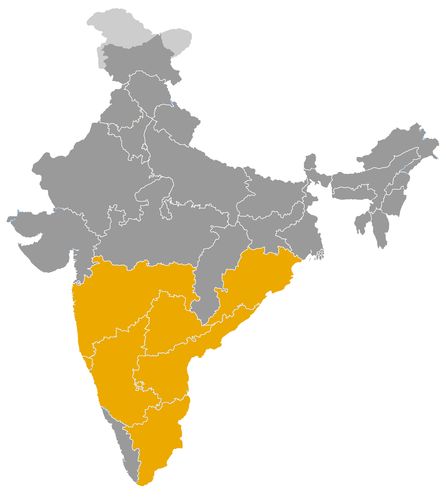
This map illustrates the maximum territory that the Satavahana Dynasty had reached at its height, covering the current regions of Goa, Karnataka, Maharashtra, Odisha, Tamil Nadu and Telangana in India. Its main purpose is to provide a visual aid to understand the geographical extent of this dynasty. However, it's important to note that the contemporary borders of these regions may not necessarily coincide with the historical territories.
The Satavahana Dynasty in Indian History: Political Power, Trade Networks and Cultural Integration
A Deccan power between northern and southern India
The Satavahana dynasty occupies a central position in the history of ancient India because it helped shape the political and cultural identity of the Deccan after the decline of Mauryan authority. Active mainly between the last centuries BCE and the early centuries CE, the Satavahanas ruled over territories that varied in extent but often included large parts of present day Maharashtra, Telangana, Andhra Pradesh, northern Karnataka and adjoining regions of central India. Their importance lies not only in the size of their kingdom, but also in their role as intermediaries between northern India, peninsular India and the maritime trade networks of the Indian Ocean.
The Deccan was not a marginal zone under their rule. It became a major political and economic region, connected to inland routes, coastal ports, monastic centres and urban settlements. The Satavahanas gave this broad area a more coherent historical profile and contributed to the rise of regional states that would later become a defining feature of Indian history.
Political consolidation after the Mauryan period
The emergence of the Satavahanas followed a period of political transition after the weakening of the Mauryan Empire. In this context, they developed a kingdom that combined royal authority, local elites, administrative officers and commercial networks. Their rule was not always continuous or uniform, and the chronology of the dynasty remains debated, but several rulers stand out for their political importance.
Simuka is traditionally regarded as the founder of the dynasty, while early rulers such as Kanha and Satakarni I helped establish the authority of the house. The dynasty reached one of its strongest phases under Gautamiputra Satakarni, who is often considered its most powerful ruler. In inscriptions, he is presented as a victorious monarch who restored Satavahana authority and defeated rival powers, especially the Western Kshatrapas. These claims reflect both political ambition and the need to legitimize royal authority in a competitive environment.
The Satavahana state was significant because it maintained control over a diverse region marked by different languages, local traditions and economic zones. Its political structure probably relied on a flexible balance between direct rule and regional authority. This flexibility allowed the dynasty to survive for a long time, although it also contributed to later fragmentation.
Rivalry with the Western Kshatrapas and regional diplomacy
One of the most important aspects of Satavahana political history was the rivalry with the Western Kshatrapas. These rulers controlled strategic areas in western and northwestern India, including regions connected to Gujarat, Malwa and the western coast. The competition between the two powers centred on access to trade routes, ports and inland corridors linking the Deccan with northern and western India.
The victories of Gautamiputra Satakarni over the Kshatrapas marked a major moment in this struggle. They strengthened Satavahana prestige and temporarily restored control over valuable territories. Yet the conflict did not eliminate the Kshatrapas. Relations between the two powers seem to have included warfare, competition and possibly diplomatic arrangements, including marriage alliances in some phases. This shows that the Satavahanas were part of a wider political system in which military rivalry and negotiation coexisted.
Economic strength based on routes and commerce
The Satavahana economy benefited greatly from the geographical position of the Deccan. Their territories linked the western coast, the interior plateau and the eastern regions connected to the Bay of Bengal. Control over these routes encouraged the movement of textiles, metals, agricultural goods, gemstones, ivory, beads and other products.
Trade with the Roman world and the wider Indian Ocean also contributed to prosperity in parts of the Satavahana realm. Ports on the western coast and inland centres were linked through commercial networks that connected India with the Mediterranean, Arabia and Southeast Asia. The presence of coins, imported goods and inscriptions associated with merchants shows the importance of commerce during this period.
The Satavahanas issued their own coinage, including coins in lead, copper and other metals. These coins are crucial historical evidence because they help identify rulers, titles, regional circulation and political influence. Their monetary system suggests a level of economic organization that supported both royal authority and commercial activity.
Cultural patronage and religious diversity
The cultural role of the Satavahanas was especially important in the development of religious and artistic life in the Deccan. They are closely associated with the growth of Buddhist monastic centres and rock cut architecture. Sites such as Nashik, Karla, Kanheri and Amaravati flourished in regions influenced by Satavahana power or by the economic networks linked to their rule.
Royal patronage was only one part of this process. Merchants, guilds, officials, monks, nuns and women from elite families also made donations. This pattern shows that culture under the Satavahanas was not limited to the court. It was deeply connected to trade routes, religious communities and urban society.
The dynasty also played an important role in the use of Prakrit in inscriptions. Before Sanskrit became dominant in many royal inscriptions, Prakrit served as a major language of public record, donation and political expression. This linguistic choice reflects a cultural environment rooted in regional traditions and commercial communication.
A lasting legacy in the history of the Deccan
The Satavahanas helped transform the Deccan into one of the major historical regions of India. Their rule linked political consolidation with trade, religious patronage and cultural exchange. Even after their decline, their former territories became the setting for later regional powers, including the Ikshvakus and other dynasties of the Deccan and Andhra regions.
Their legacy lies in the integration of the Deccan into the wider history of India. They connected inland and coastal economies, encouraged religious institutions, challenged rival powers and created models of regional kingship that influenced later centuries. The Satavahana dynasty therefore stands as one of the key forces in the formation of ancient Indian political and cultural geography.
The Geographic Expansion of the Satavahana Dynasty in India and Its Influence on Regional Relations
A Deccan centred realm with shifting frontiers
The Satavahana dynasty was one of the most important political powers of ancient India, particularly because it transformed the Deccan from a zone of regional chiefdoms and trade corridors into a major arena of royal authority. Their dominion was not fixed throughout their history. It expanded, contracted and fragmented according to military success, dynastic strength and rivalry with neighbouring powers. At different moments, Satavahana influence extended across large parts of present day Maharashtra, Telangana, Andhra Pradesh, northern Karnataka, southern Madhya Pradesh and portions of western India.
Their geographical position was central to their historical role. The Satavahanas controlled territories between northern India and the southern peninsula, as well as routes linking the Arabian Sea with the Bay of Bengal. This made their kingdom a bridge between several cultural, economic and political worlds. Their expansion was therefore not only a matter of territorial conquest, but also of controlling roads, river valleys, ports, markets and religious centres.
Early bases in the western and central Deccan
The early Satavahana kingdom appears to have been rooted in the western and central Deccan. Regions around the upper Godavari valley, western Maharashtra and the inland plateau were especially important. Pratishthana, generally identified with Paithan, is often regarded as one of their principal centres. Its location near the Godavari gave access to inland routes and helped connect the western Deccan with eastern regions.
Nashik, Junnar and nearby areas also played an important role in the early development of Satavahana power. These zones were strategically placed near passes leading from the Deccan plateau to the western coast. Control of such routes allowed the dynasty to benefit from trade between inland settlements and maritime ports. This explains why the western Deccan was not merely a political base, but also an economic foundation of royal authority.
Expansion toward the eastern Deccan and Andhra
Over time, Satavahana influence extended eastward toward the Andhra region, especially the lower Krishna and Godavari valleys. This eastern expansion was significant because it brought fertile agricultural lands, riverine routes and access to the Bay of Bengal into the Satavahana sphere. The association between the Satavahanas and Andhra history is partly due to this strong eastern presence, although the dynasty should not be reduced to Andhra alone.
The eastern Deccan became increasingly important in the later phases of Satavahana rule. As central authority weakened in the west, some rulers and regional branches appear to have retained influence in the Andhra region. This shift shows that the dynasty’s geography was flexible. Power could move between western and eastern centres depending on political circumstances. The Satavahana realm was thus a networked formation rather than a uniformly administered empire.
Control of trade corridors across the peninsula
The expansion of the Satavahanas was closely linked to commercial geography. Their territories connected the western ports of the Arabian Sea with the interior of the Deccan and the eastern coastal regions. This gave them access to routes used for the movement of textiles, metals, beads, gemstones, agricultural products and luxury goods.
The western coast was especially important because of trade with the Roman world, Arabia and other regions of the Indian Ocean. Inland towns and monastic centres benefited from this commercial activity. Buddhist caves and monasteries at sites such as Nashik, Karla, Kanheri and Amaravati developed in areas connected to these routes. The geographical reach of the Satavahanas therefore helped create a landscape in which political power, commerce and religious patronage were closely linked.
Rivalry with the Western Kshatrapas
The most important territorial conflict involving the Satavahanas was their rivalry with the Western Kshatrapas. These rulers controlled strategic regions in western India, including parts of Gujarat, Malwa and areas linked to the western coast. The dispute between the two powers centred on control of trade routes, ports and frontier zones between the Deccan and northwestern India.
Gautamiputra Satakarni is especially associated with a major revival of Satavahana power against the Western Kshatrapas. His victories restored Satavahana prestige and reasserted control over parts of western India. Yet the conflict did not permanently eliminate Kshatrapa authority. The frontier between the two powers remained politically sensitive, and relations may have included both warfare and diplomatic accommodation. Some dynastic marriages or alliances are suggested for certain phases, showing that territorial rivalry did not exclude negotiation.
Relations with southern and central Indian powers
To the south, Satavahana influence reached parts of northern Karnataka and the wider Deccan, but it did not permanently absorb the Tamil regions ruled by the Chera, Chola and Pandya dynasties. Relations with the far south were therefore shaped less by direct conquest than by trade, cultural exchange and indirect political contact. Goods and ideas moved between Satavahana territories and the southern kingdoms, particularly through inland routes and coastal networks.
To the north and northeast, Satavahana expansion brought the dynasty into contact with regions influenced by post Mauryan powers and local lineages. Their control of parts of central India helped them participate in wider political currents, but their strongest and most durable base remained the Deccan.
Fragmentation of the Satavahana territorial system
In the later period, Satavahana authority gradually weakened. Their large territorial network fragmented into regional powers, including the Ikshvakus in Andhra and other dynasties in the Deccan. This fragmentation was partly the result of the very geography that had supported Satavahana strength. A realm spread across distant regions, trade corridors and local power centres was difficult to hold together once central authority declined.
Even after their political disappearance, the Satavahanas left a lasting territorial legacy. They had connected western, central and eastern Deccan regions into a shared historical zone. Their expansion shaped the political geography of ancient India by making the Deccan a central field of dynastic competition, commercial exchange and cultural development.
The chronology of the Satavahanas remains uncertain: Puranic lists, coins and inscriptions do not always agree. The list below follows a short chronology based mainly on archaeological and numismatic evidence; the dates are indicative and may vary according to scholars. Some late rulers belong to regional branches in the Deccan after the weakening of central authority.
- Simuka (before 100 BCE) • Traditional founder of the Satavahana dynasty, he laid the foundations of royal power in the Deccan.
- Kanha (c. 100–70 BCE) • Also known as Krishna, he consolidated the early kingdom and is associated with expansion toward the Nashik region.
- Satakarni I (c. 70–60 BCE) • He strengthened dynastic prestige and appears in traditions connected with the Naneghat inscriptions.
- Satakarni II (c. 50–25 BCE) • His reign belongs to a phase of Satavahana assertion before stronger conflicts with the Western Kshatrapas.
- Hala (c. 20–24 CE, vassal ruler) • A king chiefly known through literary tradition, he is thought to have ruled during a period of dependence or retreat before the Kshatrapas.
- Gautamiputra Satakarni (c. 86–110 CE) • He restored Satavahana power and won major victories against the Western Kshatrapas.
- Vashishtiputra Pulumavi (c. 110–138 CE) • He maintained dynastic authority after Gautamiputra and developed links with the Deccan and Andhra regions.
- Vashishtiputra Satakarni (c. 138–145 CE) • His reign is associated with a transitional phase and complex relations with the Western Kshatrapas.
- Shiva Shri Pulumavi (c. 145–152 CE) • He belongs to the later period of the dynasty, when central authority began to fragment.
- Shiva Skanda Satakarni (c. 145–152 CE) • His reign appears partly contemporary with, or close to, that of Shiva Shri Pulumavi, reflecting chronological uncertainty.
- Yajna Shri Satakarni (c. 152–181 CE) • The last great Satavahana ruler, he tried to reassert dynastic control over trade routes and western territories.
- Vijaya Satakarni (until c. 200 CE) • He ruled during the phase of decline, marked by the rise of regional powers in the Deccan.
- Chandra Shri (3rd century CE) • A late or regional ruler, he is known from a period when the dynasty had lost much of its imperial authority.
- Pulumavi II (3rd century CE) • He is among the last Satavahana rulers attested in the eastern Deccan.
- Madhariputra Sakasena (3rd century CE) • A regional chief associated with the Satavahana legacy, he reflects the political fragmentation of the dynasty’s final period.
- Haritiputra Satakarni (3rd century CE) • A late regional ruler, he belongs to the final phase of Satavahana authority in the southern Deccan.
 Links to the main sections of the site