

 Français (France)
  Nederlands (nl-NL)
 Cave No. 10 at Ajanta, located in the Indian state of Maharashtra, is one of the oldest in the complex and belongs to a series of Buddhist caves spanning several centuries. It is renowned for its frescoes depicting scenes from the life of the Buddha and for its monumental sculptures. The cave features a central stupa, indicating its role as a worship hall. As a UNESCO World Heritage site, it draws visitors from around the globe, showcasing the significance of Buddhism’s spread in the region.
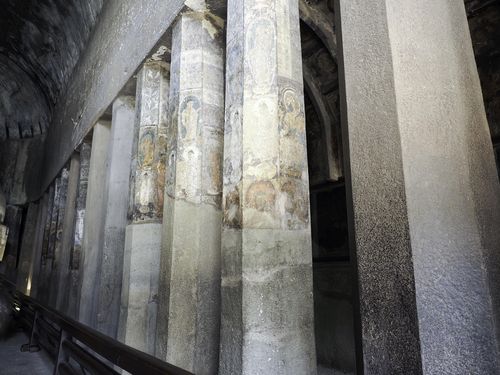
Ajanta • Cave No.10
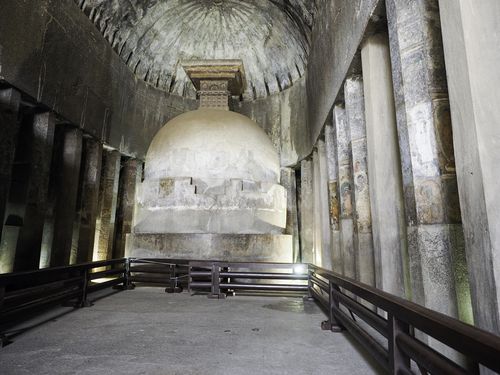
Ajanta • Cave No.10
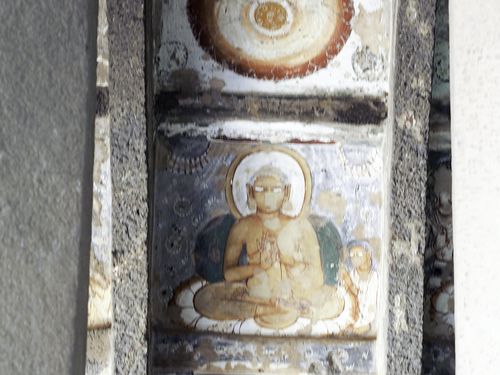
Ajanta • Cave No.10
Monument profile
Cave No.10
Monument categories: Monastery, Rock Sanctuary
Monument families: Monastery • Rock Sanctuary and Monumental Bas-reliefs
Monument genres: Religious
Cultural heritage: Buddhist
Geographic location: Ajanta • Maharashtra • India
Construction period: 1st century BC
This monument in Ajanta is inscribed on the UNESCO World Heritage List since 1983 and is part of the serial property "Ajanta Caves".See the UNESCO monuments featured on this site
• Links to •
• Dynasties that contributed to the construction of the monument •

• List of videos about Ajanta on this site •
Ajanta Caves • Maharashtra, India
• References •
UNESCO: Grottes d'Ajanta
Political and Social Motivations Behind the Construction of Cave No. 10 at Ajanta: Historical Significance and Global Context
Political and Social Motivations and Construction Period
Cave No. 10 at Ajanta, one of the oldest caves in the complex, was constructed around the 2nd century BCE, during the reign of the Satavahana dynasty. This dynasty, which ruled over large parts of central and southern India, played a crucial role in promoting Buddhism, both as a political and social tool. The construction of such monumental caves served multiple purposes. Politically, it helped the Satavahana rulers legitimize their power by aligning themselves with Buddhist institutions, which were becoming increasingly influential across India. Patronizing these religious centers also helped forge alliances with the monastic community and reinforced their rule over the Deccan region.
Socially, the caves were centers of Buddhist worship and meditation, serving both the local community and traveling monks. The presence of a chaitya-griha (prayer hall) in Cave No. 10 highlights its role as a space for communal worship and pilgrimage, bringing together different groups in a religious and cultural exchange. This social integration helped foster stability and unity in a diverse region where multiple cultures and ethnicities coexisted.
Historical Events and Impact on the Region
The construction of Cave No. 10 coincided with a period of prosperity and political stability under the Satavahanas. The region surrounding Ajanta was a key point along important trade routes that connected India with Central Asia and beyond, enabling the flow of goods, people, and ideas. These trade networks facilitated the spread of Buddhism beyond the Indian subcontinent, reaching regions like Southeast Asia and China.
However, after the fall of the Satavahanas in the 3rd century CE, the prominence of Ajanta began to wane. With the rise of new dynasties, such as the Vakatakas in the 5th century, the cave complex was revived, and additional artwork and decorations were added to older caves like Cave No. 10. This period saw the flourishing of Mahayana Buddhism, which left a profound influence on the art and architecture of Ajanta.
Global Context and Comparisons
During the construction of Cave No. 10, the world was undergoing significant changes. In the Roman Empire, this period marked the late Republic, soon to transform into the Roman Empire under Augustus. In China, the Han dynasty was expanding its influence, establishing a centralized state and promoting Confucianism, although Buddhism was already making inroads into Chinese society.
Ajanta, particularly Cave No. 10, was part of a broader global context where trade routes facilitated the exchange of religious and cultural ideas. Just as Buddhism was spreading along the Silk Road to Central Asia and China, the artistic styles of Ajanta, including influences from Greco-Buddhist art, reflect this cross-cultural interaction. The architectural innovations and artistic elements in Cave No. 10 mirror similar developments happening in other parts of the ancient world, such as the Roman Empire and China.
Major Transformations and External Influences
Over the centuries, Cave No. 10 has undergone significant transformations, largely reflecting shifts in political power and external influences. Initially built under the Satavahanas, the cave was later modified during the Vakataka period in the 5th century, when new frescoes were added. These paintings depicted scenes from the life of the Buddha, and their style was heavily influenced by Mahayana Buddhist thought, which emphasized the Buddha's divine qualities.
This infusion of new artistic techniques and themes reflects the changing religious landscape of India. While early Buddhist art in Ajanta was more symbolic, later Mahayana influences introduced more narrative and figurative elements. The cross-cultural exchanges brought by trade and the movement of Buddhist monks contributed to this artistic evolution, as seen in the stylistic fusion of indigenous Indian art with elements borrowed from Greco-Roman and Persian traditions.
Cultural Importance and Current State of Preservation
Today, Cave No. 10 is recognized as one of the most significant Buddhist monuments in India. Its combination of early and later Buddhist art provides valuable insights into the evolution of religious and artistic practices in ancient India. The central stupa in the cave, along with its elaborately carved columns and ceiling, is an excellent example of the technical prowess of ancient Indian craftsmen.
In 1983, Ajanta, including Cave No. 10, was designated a UNESCO World Heritage Site, marking its cultural significance on a global scale. This designation has helped preserve the cave complex and attract attention from scholars and tourists worldwide. The inclusion of Ajanta in the UNESCO list has also spurred international efforts to protect and conserve the site, ensuring its continued legacy.
Challenges to Preservation
Despite its importance, Cave No. 10 faces several preservation challenges. Natural erosion, exacerbated by the monsoon climate in Maharashtra, poses a constant threat to the structural integrity of the cave. The delicate frescoes and sculptures inside are particularly vulnerable to humidity and temperature fluctuations. Human-induced factors, such as the growing number of visitors, have also added pressure on the site, necessitating careful management to prevent damage.
Conservation efforts have included climate control measures inside the caves, as well as the careful restoration of the murals. However, the challenges of balancing the preservation of the site with its accessibility to the public remain a complex issue. Modern technology, including digital documentation and 3D scanning, is being used to help document and protect the cave's artistic treasures for future generations.
Conclusion
Cave No. 10 at Ajanta stands as a testament to the political and social motivations of the Satavahana dynasty and the enduring influence of Buddhism in ancient India. Its architecture and art reflect the technological innovations and cultural exchanges of the time, while its transformations over the centuries highlight the dynamic nature of Indian religious and artistic traditions. As a UNESCO World Heritage Site, Cave No. 10 continues to captivate visitors and scholars alike, even as efforts to preserve its integrity face modern challenges.
Architectural features
Technological Advancements and Architectural Innovation of Cave No. 10 at Ajanta: A Reflection of the Satavahana Era
Technological Advancements and Innovations During the Satavahana Period
Cave No. 10 at Ajanta, built during the 2nd century BCE, is one of the earliest chaitya-grihas (prayer halls) and reflects the technological ingenuity of the Satavahana dynasty. The Satavahanas, ruling much of central and southern India, promoted Buddhism through architectural patronage, commissioning rock-cut caves like those at Ajanta. The construction of Cave No. 10 demonstrates significant advances in engineering and architectural design, particularly in the techniques used to carve large, monolithic structures directly into basalt rock, the region's primary material.
The process of carving into solid rock involved cutting from the top down, ensuring structural integrity and preventing collapses. This method was crucial in creating large, open spaces, such as the expansive prayer hall in Cave No. 10, while maintaining stability. The vault-shaped roof and supporting arches in the cave showcase an advanced understanding of load distribution and acoustic engineering, enhancing the space’s resonance for religious chants and ceremonies.
Materials and Construction Techniques
The primary material used for Cave No. 10 is basalt, a volcanic rock native to the Deccan Plateau. This hard and durable material was difficult to carve but provided long-lasting stability. Artisans used basic iron tools to chip away at the rock, sculpting intricate columns, vaults, and religious iconography. The interior of the cave is divided by rows of intricately carved pillars, which not only support the ceiling but also add an artistic touch to the otherwise functional structure.
One of the key architectural achievements in Cave No. 10 is the use of natural lighting. Strategically placed openings allow sunlight to filter into the cave, illuminating the central stupa and enhancing the spiritual atmosphere for worshippers. This integration of light and space underscores the architects' ability to create functional yet aesthetically pleasing environments.
Architectural Features and the Fusion of Regional and Foreign Influences
The architecture of Cave No. 10 illustrates a unique blend of local artistic traditions and external influences, showcasing the cultural exchanges that occurred during the Satavahana period. The decorative motifs within the cave, including floral patterns and geometric designs, are rooted in Indian artistic traditions, yet elements of Greco-Buddhist art can also be observed. This fusion is a result of the interactions between India and the Hellenistic world through trade routes like the Silk Road.
The cave’s pillars and façade incorporate both indigenous Indian designs and more naturalistic, figurative styles, likely influenced by the Greco-Bactrian and Kushan empires. These foreign influences are visible in the portrayal of human figures, which bear a degree of realism not typically found in earlier Indian art. The cave paintings, added later, further demonstrate the evolution of artistic techniques influenced by both Indian and foreign traditions.
Notable Structure and Layout
The layout of Cave No. 10 is characteristic of chaitya halls, with a large central nave flanked by rows of pillars that guide devotees toward the central stupa, which serves as the focal point of worship. The stupa itself is a domed structure, symbolizing the Buddha’s presence and representing the path to enlightenment. The ceiling of the cave is vaulted, resembling an overturned boat, a design that amplifies sound and creates a serene, echoing atmosphere during religious ceremonies.
The cave’s dimensions are significant, measuring approximately 30 meters in length and 12 meters in width, making it one of the largest prayer halls at Ajanta. The grandeur of the space reflects the importance of communal worship in Buddhist practices and the Satavahanas' desire to promote their political and spiritual legitimacy through such monumental constructions.
Noteworthy Statistics and Anecdotes
Cave No. 10 is often cited as one of the earliest examples of a chaitya-griha in India. An interesting anecdote is that the cave was later redecorated in the 5th century CE, during the reign of the Vakataka dynasty. The addition of frescoes and murals depicting the Jataka tales (stories of the Buddha’s previous lives) added new layers of artistic and religious significance to the cave, blending early Buddhist architecture with later Mahayana influences.
In terms of statistics, the construction of Cave No. 10 likely spanned several decades, involving the labor of numerous skilled craftsmen. The cave’s interior is supported by 39 intricately carved pillars, each decorated with unique motifs, showcasing the high level of artistic craftsmanship achieved during this period.
International Recognition and Impact of UNESCO World Heritage Status
Cave No. 10, along with the entire Ajanta complex, was inscribed as a UNESCO World Heritage Site in 1983. This recognition brought global attention to the artistic and historical significance of Ajanta’s caves, particularly their role in the development of Buddhist art and architecture. The UNESCO designation has not only ensured the preservation of the site but has also led to increased scholarly research and tourism.
The international recognition of Cave No. 10 as part of the Ajanta complex has helped highlight the cultural exchanges that took place in ancient India, as seen in the blending of artistic traditions. The site’s preservation efforts, supported by UNESCO and the Indian government, have focused on protecting the fragile frescoes and sculptures from environmental and human-induced damage.
Challenges in Preservation
Despite its status as a UNESCO World Heritage Site, Cave No. 10 faces several challenges related to its preservation. The natural erosion caused by monsoons, humidity, and temperature fluctuations has taken a toll on the cave’s structure and its delicate murals. Human activities, such as the increasing number of tourists visiting the site, have also put pressure on the cave’s fragile interior.
Conservation efforts include implementing climate control measures inside the cave to protect the murals from humidity and light exposure. Additionally, restoration projects have been undertaken to preserve the intricate carvings and sculptures that define the cave’s architecture. While these efforts have helped maintain the site’s integrity, ongoing attention is required to address the challenges posed by both natural and human factors.
Conclusion
Cave No. 10 at Ajanta is a remarkable example of the technological and architectural advancements achieved during the Satavahana period. Its use of basalt, innovative construction techniques, and the integration of local and foreign artistic traditions make it a significant monument in the history of Buddhist architecture. The cave’s status as a UNESCO World Heritage Site has cemented its importance on the global stage, ensuring that its cultural and historical legacy is preserved for future generations. However, the challenges of preserving this ancient treasure in the face of modern threats underscore the need for continued conservation efforts.