

 Français (France)
  Nederlands (nl-NL)
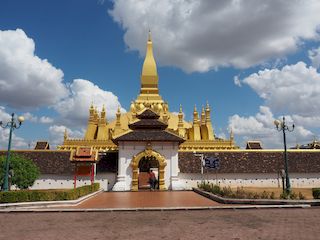
 Pha That Luang Stupa in Vientiane stands among the most distinctive landmarks of Laos. Its expansive Buddhist complex and golden profile mark it as a central symbol of national identity and religious life. Frequently associated with Lao sovereignty and collective heritage, it serves both as a spiritual reference point and as a public ceremonial space. Official events, cultural occasions, and popular gatherings regularly take place around its grounds, illustrating its dual significance within society. Today, Pha That Luang remains a recognised emblem of the country and an essential destination for travellers exploring Laos.
Monument profile
Pha That Luang stupa
Monument categories: Pilgrimage site, Stupa
Monument families: Pilgrimage site or memorial • Pagoda or stupa
Monument genres: Religious
Cultural heritage: Buddhist
Geographic location: Vientiane • Laos
Construction period: 16th century AD
• Links to •
• This monument illustrates the following theme •
Buddhist architecture • Stupas : Diversity of Stupas in Asia
• List of videos about Vientiane on this site •
Vientiane, Sacred Architectures • Laos
Laos • Fabric Arts
Vientiane, the Triumphal Arch Patuxay • Laos
• Sources •
Digital Sources
Books and Publications
- Michel Lorrillard, "Vientiane: Transformations of a Lao Landscape", Routledge, 2006.
- Martin Stuart-Fox, "History of Laos", Cambridge University Press, 1997.
- Grant Evans, "A Short History of Laos: The Land in Between", Allen & Unwin, 2002.
History of Pha That Luang Stupa – Vientiane, Laos
Foundations and political motivations
Pha That Luang, the monumental stupa of Vientiane, is deeply tied to the evolution of the Lao state. Its origins are linked to the reign of King Setthathirat in the mid-sixteenth century, when the Lan Xang kingdom relocated its political centre from Luang Prabang to Vientiane. The move aimed to consolidate power, reduce vulnerability to rival courts, and create a new ceremonial capital. The construction of a vast reliquary stupa served both spiritual and political ambitions: it symbolised the monarch’s role as defender of Buddhism and projected a vision of royal legitimacy rooted in religious authority. By claiming possession of a revered relic attributed to the Buddha, Setthathirat sought to strengthen dynastic prestige and attract monastic networks and pilgrims, reinforcing Vientiane as a focal point of regional influence.
Strategic setting and regional rivalries
The establishment of Pha That Luang occurred amid shifting alliances and escalating pressures from neighbouring powers, principally the Siamese to the west, Burmese to the northwest, and Vietnamese polities to the east. Lan Xang’s rulers used religious architecture as an instrument of statecraft, mirroring strategies visible in Ayutthaya, Pagan, and classical Khmer royal centres. The stupa embodied an assertion of autonomy at a time when control over monastic institutions and sacred objects could legitimise or destabilise competing regimes. The monument thus acted as both spiritual sanctuary and geopolitical statement, visibly anchoring the sovereignty of Lan Xang within a contested political landscape.
Global trends in sacred monumentalism
The construction of Pha That Luang reflects a broader global phenomenon in which monumental religious buildings were used to articulate and stabilise political authority. Similar currents can be observed elsewhere in the sixteenth century: stupas and pagodas were expanded in Burma, restored dagobas embellished in Sri Lanka, and cathedrals continued to symbolise civic order in Europe. In each context, sacred space and architecture served as expressions of legitimacy, social cohesion, and cultural distinctiveness. Pha That Luang is therefore not an isolated creation but part of a wider pattern linking monumental architecture to the consolidation of belief systems and political identity.
Decline, destruction, and abandonment
The fortunes of the stupa broadly mirror those of Lan Xang. Internal divisions and royal succession conflicts weakened the kingdom in the seventeenth and eighteenth centuries, opening the way for intensified Siamese intervention. The decisive rupture occurred in 1828, when King Anouvong attempted to reassert autonomy from Siam. The rebellion was crushed, Vientiane was devastated, its cultural institutions dismantled, and Pha That Luang was pillaged and abandoned. Materials were stripped away, and for decades the monument lay in ruins within a depopulated urban landscape. This period marks the eclipse of Vientiane as a royal and religious centre and demonstrates how monumental architecture can become a casualty of shifting regional power.
Rediscovery and reconstruction under French colonialism
Pha That Luang only recovered significance under French colonial administration in the late nineteenth and early twentieth centuries. The French sought to legitimise their presence by identifying, documenting, and restoring Lao heritage. The monument became central to colonial narratives of Lao civilisation, and archaeological surveys were undertaken by scholarly institutions. A reconstruction programme was launched to restore the stupa’s form, culminating in major rebuilding campaigns during the 1930s. Architectural decisions made at this time fixed the modern appearance of the monument, combining scholarship, colonial aesthetics, and selective interpretations of historical evidence. The reconstruction thus reflects both recovery and reinvention.
Twentieth-century transformations and political shifts
Following the Second World War, Laos experienced rapid political change: Japanese occupation, anti-colonial movements, independence struggles, and ultimately the creation of the Lao People’s Democratic Republic in 1975. Each regime adopted Pha That Luang as a symbolic expression of continuity. While Marxist ideology initially imposed restrictions on religious practice, the monument remained an emblem transcending political systems. Its surrounding area gradually evolved from peripheral space to a key urban site as Vientiane expanded. Successive restoration campaigns applied decorative gilding across broader surfaces, cementing the stupa as a visual and ceremonial icon of the state.
The monument in contemporary Laos
Today, Pha That Luang stands as the most recognised architectural symbol of Laos. It appears on national emblems, banknotes, and official publications, aligning Buddhist ideology with modern state identity. Annual festivals illustrate its ongoing ritual significance: the That Luang Festival combines religious merit-making with civic spectacle, drawing monks, state officials, and citizens in a rare intersection of official ceremony and popular devotion. The stupa functions as both pilgrimage destination and diplomatic backdrop, hosting delegations and national celebrations. Within Laos, its image mediates historical memory and contemporary nationalism, linking past kingship with current political authority.
Conservation challenges and heritage politics
Conservation of Pha That Luang presents technical and cultural challenges. The tropical climate accelerates deterioration, while rising urbanisation introduces pressure from pollution, water infiltration, and increased visitor traffic. Reconstruction campaigns have prompted debates about material authenticity, given that past restorations included significant rebuilding rather than preservation of original masonry. The monument is listed on the country’s National Heritage register and has been put forward for international recognition, an action that requires monitoring, documentation, and ongoing intervention planning. Balancing authenticity and public visibility remains a central issue: gilded surfaces are visually impressive but necessitate frequent renewal, and ground subsidence requires structural vigilance. Conservation strategies must therefore manage the stupa’s dual role as sacred object and touristic icon.
Conclusion
The history of Pha That Luang encapsulates fundamental themes of Lao identity—religion, monarchy, resilience, and reinvention. Conceived as a reliquary affirming dynastic legitimacy, it witnessed the collapse of royal authority, destruction under foreign domination, and rebirth through colonial reconstruction and revolutionary appropriation. Today it represents continuity through change: a monument that has repeatedly lost and regained meaning but remains Laos’ most prominent cultural emblem. Its trajectory exemplifies how sacred architecture can become a stage upon which conflict, memory, and nationalism intertwine.
Architecture of Pha That Luang Stupa – Vientiane, Laos
Overall conception and architectural intent
Pha That Luang is conceived as a monumental, closed reliquary rather than a temple in the conventional sense. Its architecture is organised around a massive central stupa rising from three superposed terraces of decreasing size. This tiered composition expresses a clear symbolic hierarchy: the lowest platform corresponds to the human and worldly sphere, the middle terrace marks the domain of religious practice, and the upper level leads to the transcendental space represented by the reliquary spire. The overall design privileges simple, powerful volumes over intricate structural complexity, producing a strong silhouette that dominates the surrounding urban landscape and is visible from a considerable distance.
The monument stands within a large rectangular enclosure that defines a sacred precinct, separated from the city while remaining integrated into its spatial logic. The enclosure wall, pierced by gates aligned with the cardinal points, acts as a transition zone between the everyday environment and the ritual space. The entire plan is strictly axial and symmetrical, reinforcing the impression of order, stability and ritual discipline.
Spatial organisation and structural layout
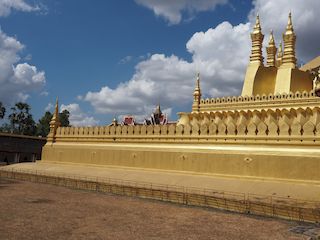
The core of Pha That Luang is a square base supporting three receding terraces. The lowest terrace forms a broad platform that stabilises the whole structure and accommodates the circulation of pilgrims around the monument. Above it, a second and then a third terrace create a stepped pyramid effect culminating in the central stupa. Around the upper platform, a series of smaller stupas is arranged in a regular rhythm, visually encircling and protecting the main reliquary. This ring of secondary stupas functions like an architectural chorus, echoing and amplifying the dominance of the central volume.
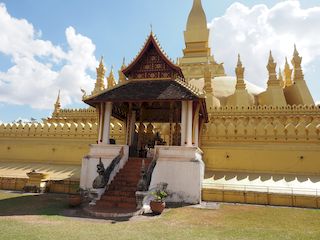
The surrounding cloister consists of covered galleries supported by simple columns, with open bays facing the stupa. These galleries provide sheltered space for processions, offerings and everyday monastic activities. The four main gateways, one on each side of the enclosure, concentrate circulation and structure the approach to the monument. The spatial sequence is thus carefully orchestrated: entry through a monumental gate, progression across the courtyard, circumambulation of the terraces, and visual ascent towards the spire.
Structurally, the stupa is essentially a massive, almost solid masonry core. There is no large internal chamber; instead, the relics are believed to be enclosed within the fabric of the structure itself. This massiveness contributes significantly to the stability and durability of the monument, especially in a region exposed to heavy rains and occasional seismic activity.
Materials and construction methods
The primary construction material is brick, bonded with lime-based mortars and covered with thick layers of plaster. Brick was widely available, relatively light compared with stone, and well suited to the curved and sloping surfaces characteristic of stupas. The plaster coating allowed for a smooth, continuous skin that could be periodically repaired, repainted or recoated without altering the underlying structure.
The golden appearance of Pha That Luang results from successive applications of decorative layers. The most sacred parts of the stupa, particularly the upper sections, are covered with gold leaf, while the lower areas are painted in a golden hue. This combination produces a unified visual effect, especially under strong sunlight, and reduces the cost and technical difficulty of gilding the entire structure with precious metal. The choice of a golden finish is both symbolic and practical: gold is associated with purity, enlightenment and royal power, and the reflective surfaces enhance visibility and prestige.
Foundations and lower courses incorporate more robust masonry and, par endroits, stone elements to resist humidity and erosion. The thick, inclined walls and the limited number of deep recesses reduce the exposure of vulnerable surfaces to driving rain. The simple geometry, with few delicate projections, contributes to the relative resistance of the monument despite repeated episodes of damage and restoration over the centuries.
Technological and architectural innovations
For its time and regional context, Pha That Luang represents a technically ambitious project. The stepped profile of the terraces distributes vertical loads over a wide base, limiting the risk of subsidence in an alluvial terrain. The constructors demonstrated a good understanding of weight transfer and of the behaviour of masonry under compression. The near-solid core minimises internal voids where water infiltration or structural weaknesses could develop.
In terms of environmental adaptation, the high base elevates the sacred zone above the level of potential flooding, a significant concern in the Mekong basin. The open courtyard and cloisters, combined with the height of the stupa, create air circulation around the monument, reducing moisture accumulation and providing shaded areas for worshippers. While the structure itself does not include sophisticated internal ventilation systems, its overall composition is clearly adapted to a hot, humid climate.
The regularity of the brickwork and the controlled curvature of the stupa body indicate advanced craftsmanship in brick production and laying techniques. The builders had to reconcile the geometric requirements of a square plan with the fluid outline of the rising spire, a challenge requiring careful setting-out and incremental adjustments. The result is an apparently simple but technically controlled shape, where any irregularity would be immediately visible.
Artistic and stylistic influences
Architecturally, Pha That Luang belongs to the wider family of Theravada Buddhist stupas found across mainland Southeast Asia, yet it presents distinct Lao characteristics. The basic typology of a dome or elongated bell on terraces recalls Sri Lankan dagobas, while the stepped base and enclosure echo Khmer and Siamese precedents. However, the Lao version tends to emphasise clarity of outline and a certain austerity, with fewer sculptural embellishments than many contemporaneous temples.
Decoration is concentrated on specific zones: the upper parts of the stupa, some cornices, and the gateways of the enclosure. Motifs include stylised lotus petals, flame-like patterns and geometric borders, all integrated into the architectural lines rather than applied as independent sculptures. This restrained ornamental programme heightens the visual impact of the main volumes and reinforces the role of colour and light as primary aesthetic components. While the monument incorporates forms recognisable in neighbouring regions, its overall composition and decorative economy are closely tied to its Lao context and to the desire to express a unified, monumental religious presence.
Dimensions, statistics and notable features
Although exact measurements can vary slightly between sources and restoration phases, Pha That Luang is generally described as a structure approaching fifty metres in height from the base of the lowest terrace to the tip of the spire. The terraces form progressively smaller squares, giving the monument a compact, pyramidal profile. The surrounding cloister encloses a large rectangular courtyard capable of accommodating significant crowds during major festivals.
A notable feature is the ring of numerous smaller stupas around the central core, each with its own miniature base and spire. These elements are not purely decorative; they act as a visual metaphor for the community of believers and monastics encircling the central teaching of the Buddha. Traditional narratives connect the monument with earlier religious sites on the same spot and with the enshrinement of a relic of the Buddha, though the archaeological evidence is difficult to verify. The layering of legends, reconstructions and symbolic readings adds depth to the architectural experience, even when the physical structure has been substantially rebuilt.
International recognition and conservation issues
The architectural qualities of Pha That Luang – its clear geometry, imposing mass and distinctive golden finish – contribute directly to its standing as the foremost monument of Laos. Its image serves as a visual shorthand for the country in tourism, diplomacy and national branding. This prominence has encouraged repeated restoration efforts, but it also subjects the monument to the pressures of mass tourism and to expectations of permanent visual perfection.
Conservation challenges are closely linked to the chosen materials and finishes. The gilded and painted surfaces require regular maintenance to counteract fading, peeling and corrosion. The brick and mortar core must be monitored for cracks, moisture penetration and subsidence, especially as urban development alters drainage patterns and increases environmental stress. Balancing the need for structural interventions with respect for historical fabric is a constant concern.
At the same time, Pha That Luang’s architecture plays a role in heritage policy and international perception. Its form and condition are scrutinised as indicators of how Laos manages and presents its cultural legacy. The monument therefore occupies a dual position: a sacred structure embedded in local religious life and a carefully curated architectural emblem displayed to the world.