

 Français (France)
  Nederlands (nl-NL)
 Wat Impeng Temple is a Buddhist monastery located in Vientiane, the capital of Laos. It forms part of the network of temples that shape the religious landscape of the city and serves as an active place of worship for the local Buddhist community. The complex includes several religious and monastic buildings arranged around an open courtyard used for ceremonies and gatherings. Like many monasteries in Vientiane, Wat Impeng supports the daily practice of Theravāda Buddhism, including offerings, religious instruction, and observances associated with the Buddhist calendar.

Vientiane • Wat Impeng temple

Vientiane • Wat Impeng temple
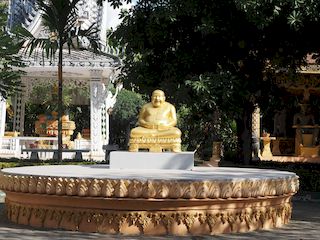
Vientiane • Wat Impeng temple
Monument profile
Wat Impeng temple
Monument category: Buddhist temple
Monument family: Temple
Monument genre: Religious
Cultural heritage: Buddhist
Geographic location: Vientiane • Laos
Construction period: 19th century AD
• Links to •
• List of videos about Vientiane on this site •
Vientiane, Sacred Architectures • Laos
Laos • Fabric Arts
Vientiane, the Triumphal Arch Patuxay • Laos
• Sources •
Online Sources
Books and Publications
- Evans, Grant. "A Short History of Laos: The Land in Between". Allen & Unwin, 2002.
- Stuart-Fox, Martin. "Historical Dictionary of Laos". Scarecrow Press, 2008.
History of Wat Impeng Temple in Vientiane
Foundation during the Lan Xang period
Wat Impeng is one of the Buddhist monasteries established in Vientiane during the period of the Lan Xang kingdom, when the city developed as an important political and religious center. The foundation of the temple is generally associated with the late sixteenth or seventeenth century, following the transfer of the royal capital from Luang Prabang to Vientiane under the reign of King Setthathirath.
The creation of monasteries in the capital formed part of a broader policy aimed at strengthening the religious institutions of the kingdom. Royal patronage encouraged the establishment of temples that could host monastic communities and serve as places for ritual practice and religious instruction. Wat Impeng was founded within this context as an urban monastery intended to support the expansion of Theravāda Buddhist practice in the capital.
The temple was located within the developing urban fabric of Vientiane, in an area where several religious institutions were gradually established. Its presence contributed to structuring the religious landscape of the city and provided a focal point for devotional activities carried out by the surrounding community.
Religious functions and role within the urban community
During the centuries that followed its foundation, Wat Impeng became integrated into the network of monasteries that shaped religious life in Vientiane. The temple hosted a resident community of monks responsible for conducting rituals, maintaining the monastic complex, and transmitting Buddhist teachings.
Local inhabitants visited the temple to perform acts of devotion, present offerings to the monastic community, and participate in ceremonies associated with the Buddhist calendar. The temple served as a place where religious observances were conducted and where the population could maintain regular contact with the monastic community.
Wat Impeng also played an educational role within the city. Monasteries traditionally functioned as centers of learning where novices studied Buddhist doctrine, monastic discipline, and religious texts. Young men sometimes entered the monastery for temporary ordination in order to receive religious instruction. Through these activities, the temple contributed to the transmission of Buddhist knowledge within the capital.
The temple also participated in larger religious events organized across the city. Ceremonial processions and collective festivals often involved multiple monasteries, reinforcing the connections between Wat Impeng and other religious institutions of Vientiane.
Destruction of Vientiane in the nineteenth century
The historical development of Wat Impeng was deeply affected by the destruction of Vientiane in 1828. That year the city was devastated following the failed rebellion of King Anouvong against the kingdom of Siam. Siamese forces captured the city and carried out extensive destruction, burning many buildings and dismantling numerous temples.
Wat Impeng was among the monasteries damaged during this period. Parts of the monastic complex were destroyed, and the disruption of the city’s population led to the dispersal of the monastic community. Religious activity at the site was interrupted as a result of these events.
Despite this destruction, the location of the temple continued to be recognized as a religious site. The remaining structures and the memory of the monastery preserved the identity of the place, making it possible to consider reconstruction in later decades.
Reconstruction and development in the modern period
The restoration of Wat Impeng began gradually during the late nineteenth century, when Vientiane was reoccupied and urban life slowly resumed. During the period of French colonial administration in Laos, several historical monasteries in the capital were reconstructed or restored in order to reestablish religious institutions and preserve cultural heritage.
Wat Impeng was rebuilt on its original site, and the principal structures of the monastic complex were reconstructed to allow the resumption of religious activities. The reestablishment of the viharn and other monastic buildings enabled the return of a resident monastic community.
During the twentieth century the temple continued to function as an active monastery within the religious life of Vientiane. Ceremonies, religious instruction, and daily devotional practices were again conducted within the temple complex. The site maintained its position within the network of monasteries serving the Buddhist population of the city.
Today Wat Impeng remains a functioning place of worship. The monastery hosts monks and continues to serve local devotees who visit the temple for religious ceremonies and offerings. Its continued use reflects the persistence of monastic institutions within the urban landscape of Vientiane.
Global historical context
The probable foundation period of Wat Impeng between the sixteenth and seventeenth centuries coincided with significant developments in other regions of the world. In Southeast Asia, regional kingdoms such as Ayutthaya and Burmese dynasties were expanding their influence. On the Indian subcontinent, the Mughal Empire reached a period of consolidation under rulers such as Akbar. In Europe, maritime exploration and expanding trade networks were reshaping global economic connections. These contemporaneous developments formed the broader historical setting in which the temple emerged in Vientiane.
Architecture of Wat Impeng Temple in Vientiane
Site placement and spatial organization of the monastic compound
Wat Impeng is located within the historic urban fabric of Vientiane, where numerous Buddhist monasteries form a dense religious landscape in the capital. The temple complex occupies a clearly delimited plot surrounded by a low boundary wall that defines the limits of the sacred precinct. The entrance to the compound is aligned with the main axis of the site and opens onto a central courtyard that organizes the circulation of visitors and monks within the monastery.
This courtyard forms the principal spatial element of the complex. It functions as a transitional space between the city and the religious buildings and serves as a gathering area for ritual events and communal ceremonies. The courtyard provides direct access to the viharn, which constitutes the architectural and symbolic center of the temple.
The viharn is positioned prominently along the main axis of the compound. Secondary buildings are distributed around the courtyard and include monastic residences, small service structures, and auxiliary religious buildings. This arrangement establishes a hierarchy within the complex in which the viharn dominates visually while the surrounding buildings support the daily activities of the monastic community.
The open courtyard maintains visual continuity between the structures and reinforces the central role of the sanctuary within the compound.
Architectural structure of the viharn
The viharn of Wat Impeng is an elongated rectangular structure that serves as the principal assembly hall of the monastery. The building stands on a slightly elevated platform separating the sacred interior from the courtyard level. A frontal staircase leads to a narrow terrace in front of the entrance, marking the transition between exterior space and the interior sanctuary.
The façade is structured by a sequence of regularly spaced columns supporting the projecting roof. These columns form a shaded portico along the front of the building and protect the entrance from sunlight and rainfall. Their regular spacing defines the architectural rhythm of the façade and articulates the elevation.
Openings between the columns provide natural ventilation and daylight to the interior. Doors and windows are arranged symmetrically along the longitudinal axis of the building, reinforcing the axial organization of the structure.
The roof constitutes one of the most prominent architectural elements of the viharn. It consists of several superimposed tiers descending outward from the central ridge. Each tier extends beyond the walls to create wide overhanging eaves that protect the building from heavy tropical rainfall.
Decorative finials are placed at the edges of the roof structure. These elements often take the form of stylized naga figures extending along ridge lines and roof corners. The triangular pediments above the façades are also decorated with carved or molded motifs that contribute to the visual identity of the building.
Interior layout and liturgical space
The interior of the viharn is organized as a large rectangular hall designed to accommodate gatherings of monks and lay worshippers. Structural columns arranged in parallel rows support the roof framework and divide the space into longitudinal bays while leaving a wide central area open for ritual activities.
The spatial orientation of the hall is directed toward the principal altar located at the far end of the building. This altar supports the main Buddha image of the temple, which serves as the central focus of devotional attention. Its elevated placement ensures visibility throughout the hall and establishes a clear visual hierarchy within the interior space.
Secondary Buddha images are placed on platforms along the sides of the sanctuary and around the main altar. These sculptures create a layered arrangement of sacred imagery within the hall and emphasize the central axis of the building while allowing additional devotional elements along the perimeter.
Interior walls are frequently decorated with painted murals and ornamental motifs related to Buddhist iconography. These decorative programs articulate the surfaces of the sanctuary and frame the altar area without modifying the structural organization of the hall.
Construction materials and structural techniques
The structural system of the viharn combines masonry walls with a timber roof framework. The exterior walls are built from brick masonry bonded with mortar and finished with plaster. This plaster surface provides a uniform exterior finish and forms a base for painted decoration or ornamental detailing.
The roof structure is composed of wooden beams, rafters, and supporting members assembled through traditional carpentry techniques. This timber framework distributes the load of the multi-tiered roof across the structural columns and masonry walls. The combination of masonry and timber allows the building to maintain stability while supporting the large roof surfaces characteristic of the viharn.
The roof covering consists of ceramic tiles arranged in overlapping rows. This arrangement ensures effective drainage during heavy rainfall and protects the interior from moisture. The wide overhanging eaves formed by the roof structure also shield exterior walls and openings from direct exposure to rain.
Columns positioned along the façade and within the interior provide essential structural support. Their regular distribution transfers roof loads evenly to the foundations and defines the architectural rhythm of both the exterior elevations and the interior hall.
Architectural restoration and preservation
The present architectural appearance of Wat Impeng reflects several phases of reconstruction and restoration following the destruction of Vientiane in the early nineteenth century. During the Siamese attack of 1828 many religious buildings in the city were severely damaged or destroyed, including parts of this temple complex.
Subsequent rebuilding campaigns restored the viharn and reestablished the layout of the monastery. Reconstruction preserved the spatial organization of the complex while replacing damaged structural elements such as roof frameworks, columns, and decorative components.
Restoration work undertaken during the twentieth century focused on repairing structural elements, renewing roof coverings, and restoring decorative surfaces. These interventions stabilized the buildings while maintaining architectural features associated with the monastery.
Wat Impeng remains an active Buddhist monastery in Vientiane. Ongoing maintenance preserves the viharn and surrounding structures while allowing the buildings to continue serving their religious functions within the urban environment of the capital.