

 Français (France)
  Nederlands (nl-NL)
 Wat That Luang Tai Temple is located in Vientiane, the capital of Laos, within the broader religious area surrounding the Pha That Luang monument, one of the most significant sacred landmarks in the country. The temple forms part of the religious environment connected with this major national symbol and contributes to the spiritual life of the city. It is visited by local residents for everyday religious practices as well as for certain Buddhist ceremonies. Wat That Luang Tai also plays a role in the historical and cultural identity of the surrounding district, where several temples together illustrate the presence of Lao Buddhist traditions.
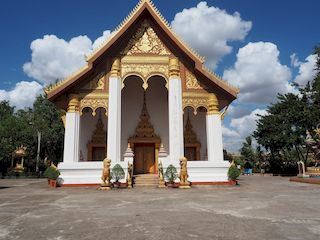
Vientiane • Wat That Luang Tai temple
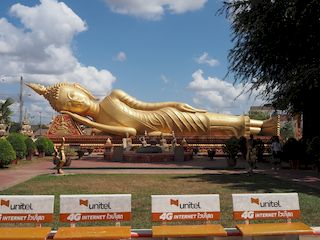
Vientiane • Wat That Luang Tai temple
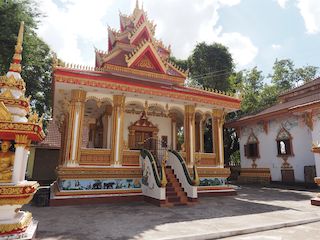
Vientiane • Wat That Luang Tai temple
Monument profile
Wat That Luang Tai temple
Monument category: Buddhist temple
Monument family: Temple
Monument genre: Religious
Cultural heritage: Buddhist
Geographic location: Vientiane • Laos
Construction period: 17th century AD
• Links to •
• List of videos about Vientiane on this site •
Vientiane, Sacred Architectures • Laos
Laos • Fabric Arts
Vientiane, the Triumphal Arch Patuxay • Laos
• Sources •
Books and Publications
- Stuart-Fox, Martin. "A History of Laos." Cambridge University Press, 1997.
- Evans, Grant. "The Politics of Ritual and Remembrance: Laos Since 1975." University of Hawaii Press, 1998.
- Freeman, Michael. "Lanna: Thailand's Northern Kingdom." River Books, 2001. - Although focused on Northern Thailand, this book provides insights into similar architectural and cultural influences found in Wat That Luang Tai.
- Zinoman, Peter. "The Colonial Bastille: A History of Imprisonment in Vietnam, 1862-1940." University of California Press, 2001. - Provides context on the broader Indochinese historical and cultural setting.
History of Wat That Luang Tai Temple in Vientiane
Foundation within the Sacred Landscape of That Luang
Wat That Luang Tai was established as part of the monastic ensemble surrounding the great stupa of Pha That Luang in Vientiane, the most important religious monument in Laos. The temple occupies the southern sector of the sacred precinct that developed around the stupa, forming one of the monastic institutions associated with the maintenance of religious activities in the area. Its foundation must be understood within the broader development of the That Luang complex during the period when Vientiane served as a royal capital of the Lao kingdom.
The core of the That Luang complex dates to the reign of King Setthathirath in the sixteenth century, when the capital of the kingdom of Lan Xang was transferred to Vientiane. The king initiated the construction of the monumental stupa of That Luang in 1566 as a symbol of both political authority and Buddhist devotion. Monasteries gradually developed around the stupa to serve the growing religious center. Wat That Luang Tai emerged within this context as one of the temples responsible for supporting the ritual life associated with the stupa.
Although precise documentation about the earliest structures of Wat That Luang Tai remains limited, the temple’s location indicates that it formed part of the organized religious landscape surrounding the stupa. Monasteries positioned around the monument provided spaces for monks, ritual ceremonies, and the reception of pilgrims visiting the sacred site.
Role within the Monastic Network of the That Luang Complex
Wat That Luang Tai functioned historically as one of several monasteries integrated into the religious network of the That Luang precinct. These temples played complementary roles in sustaining the ritual and educational functions of the Buddhist community established near the stupa.
The temple provided accommodation for monks who participated in religious ceremonies connected with the stupa. It also served as a site for daily monastic life, including meditation, teaching, and communal activities. The presence of multiple monasteries around That Luang reflects the importance of the site as a religious center within the kingdom of Lan Xang.
The temple’s location south of the stupa contributed to a spatial organization in which different monasteries framed the sacred monument. This arrangement reinforced the symbolic centrality of That Luang while allowing each monastery to maintain its own institutional identity. Wat That Luang Tai thus formed part of a larger ensemble in which religious, ceremonial, and educational functions were distributed among several temples.
Religious festivals associated with the stupa also influenced the activities of the temple. During major celebrations, particularly the annual That Luang festival, monks from surrounding monasteries gathered in the area to participate in rituals and processions. Temples such as Wat That Luang Tai therefore played a role in accommodating and organizing these collective religious practices.
Destruction and Reconstruction during Regional Conflicts
The history of Wat That Luang Tai was affected by the political upheavals that struck Vientiane during the nineteenth century. The city suffered major destruction in 1828 following the defeat of the Lao king Anouvong by the Siamese kingdom. During the military campaign that ended the rebellion, large parts of Vientiane were devastated, including temples and religious structures.
Many monasteries in the city were abandoned or destroyed during this period. The complex surrounding That Luang also experienced significant damage. Like other temples in the area, Wat That Luang Tai likely faced periods of decline or partial destruction as the urban population dispersed and monastic institutions lost support.
The revival of religious life in the area occurred gradually during the late nineteenth and early twentieth centuries. During the French colonial period, efforts were undertaken to restore several important monuments in Vientiane, including the stupa of That Luang. As the surrounding religious complex regained importance, monasteries such as Wat That Luang Tai were rebuilt or restored to reestablish the functioning of the monastic community.
These restoration processes often involved reconstructing damaged buildings while preserving the traditional layout of the temple grounds. The reestablishment of monastic institutions around That Luang contributed to the revival of Vientiane as a Buddhist center.
Evolution of Religious Functions and Contemporary Role
Over the course of the twentieth century, Wat That Luang Tai continued to function as an active Buddhist monastery within the sacred precinct of That Luang. The temple maintained its role as a residence for monks and as a place of worship for local communities.
The temple’s proximity to the national monument of Pha That Luang reinforced its importance during major religious events. Monks residing at Wat That Luang Tai participate in ceremonies connected with the stupa and contribute to the organization of festivals that attract pilgrims from across the country.
The temple also forms part of the broader cultural landscape of Vientiane. Its presence within the That Luang complex reflects the historical relationship between monastic institutions and royal authority in Lao history. Even after the political transformations of the twentieth century, monasteries in the area continued to serve as centers of religious education and spiritual practice.
In recent decades, the temple has also received visitors interested in the religious heritage of the That Luang complex. While the stupa itself remains the principal landmark, the surrounding monasteries contribute to the historical depth and ritual continuity of the site.
Global Historical Context
The main development of the That Luang complex in the sixteenth century occurred during a period of major political transformation across Asia. In mainland Southeast Asia, powerful kingdoms such as Ayutthaya in Siam and the Toungoo dynasty in Burma expanded their influence. In Europe, the sixteenth century corresponded to the Renaissance and the early stages of global maritime expansion. At the same time, the Mughal Empire was consolidating its authority in the Indian subcontinent under Emperor Akbar. These parallel developments illustrate the wider historical environment in which the religious landscape of Vientiane took shape.
Architecture of Wat That Luang Tai Temple in Vientiane
Spatial Layout and Relationship to the That Luang Sacred Precinct
Wat That Luang Tai occupies the southern sector of the religious complex surrounding the monumental stupa of Pha That Luang in Vientiane. The temple forms part of a spatial arrangement in which several monasteries frame the sacred monument while maintaining their own enclosed monastic compounds. The layout of Wat That Luang Tai reflects this relationship: its buildings are oriented toward the central religious axis defined by the stupa while remaining organized within a distinct temple enclosure.
The temple grounds are defined by perimeter walls that separate the monastic compound from the surrounding urban fabric. Entry into the complex occurs through a gate that opens onto a courtyard serving as the principal circulation space. This courtyard provides access to the main ordination hall and to a series of secondary structures used for monastic residence and ritual activities.
The ordination hall, or sim, constitutes the architectural focus of the complex. Its position slightly elevated above the surrounding courtyard reinforces its symbolic importance and ensures visual prominence within the enclosure. The surrounding open space creates unobstructed sightlines toward the building, emphasizing its role as the central architectural element of the temple.
The spatial organization of the complex relies on a combination of axial alignment and functional distribution. The principal sanctuary occupies the dominant axis, while subsidiary buildings are arranged along the edges of the courtyard. This configuration allows circulation paths to converge on the main hall while maintaining separation between ceremonial and residential zones.
Structural Composition of the Main Sanctuary
The principal sanctuary of Wat That Luang Tai is constructed on a raised masonry platform that defines the structural base of the building. This platform elevates the structure above ground level and protects the wooden components of the superstructure from ground moisture. Access to the hall is provided by a frontal staircase aligned with the main entrance, reinforcing the axial orientation of the building.
The superstructure is supported by a system of columns arranged along the perimeter of the hall. These columns sustain the roof structure and define the outer gallery that surrounds the interior sanctuary. The gallery forms a transitional zone between the exterior courtyard and the enclosed ritual space.
The structural system combines load-bearing masonry walls with wooden columns and beams. This hybrid construction technique distributes structural loads between the masonry base and the timber framework above. The wooden elements provide flexibility within the structure while the masonry components ensure stability.
Inside the sanctuary, the structural columns support a series of horizontal beams that carry the roof trusses. The arrangement of these beams defines the internal ceiling geometry and establishes the spatial proportions of the hall. The interior space remains largely unobstructed in order to accommodate ceremonial gatherings and the placement of religious imagery.
The façade composition reflects the internal structural rhythm. Openings between columns provide ventilation and natural illumination, while doorways mark the principal entrance axis.
Roofing System and External Architectural Elements
The roof of the sanctuary represents the most visually dominant architectural component of Wat That Luang Tai. It is composed of multiple tiers that rise above the central hall and extend outward to form wide eaves. The layered configuration of the roof creates a stepped silhouette that distinguishes the building within the temple complex.
Each tier of the roof is supported by the underlying wooden framework. The roof surfaces are covered with rows of ceramic tiles laid along the sloping planes. These tiles provide protection against heavy rainfall and facilitate efficient water drainage.
The extended eaves project significantly beyond the walls of the building. This architectural feature shields the façades and the surrounding gallery from direct exposure to rain and sunlight. The deep overhang also contributes to the passive regulation of temperature inside the sanctuary by limiting solar heat gain.
Decorative gable elements accentuate the triangular ends of the roof. These gables incorporate carved wooden panels that display ornamental motifs typical of Lao temple architecture. The panels serve both decorative and compositional functions, emphasizing the vertical axis of the building and framing the roofline.
Additional roof ornaments are positioned along the edges of the roof tiers. These sculptural elements visually extend the lines of the roof and contribute to the dynamic profile of the structure when viewed from the courtyard.
Materials, Decorative Components, and Interior Arrangement
The architectural fabric of Wat That Luang Tai combines masonry construction with extensive use of timber elements. The base platform and foundation structures are composed of brick and mortar, providing a stable and durable structural base. The masonry surfaces are typically finished with plaster coatings that create a smooth exterior appearance.
Above the masonry base, the structural framework relies primarily on wooden components. Columns, beams, and roof trusses are fabricated from hardwood elements capable of supporting the large roof structure. The joinery used in these wooden structures employs traditional carpentry techniques that allow the elements to interlock without relying entirely on metal fasteners.
Decorative features appear prominently on architectural surfaces that frame entrances and rooflines. Carved wooden panels decorate the gable ends and portions of the roof structure. These panels often incorporate layered patterns that create visual depth across the façade.
The entrance doors and window frames are also constructed from carved wood. Their surfaces may include ornamental motifs integrated into the structural framing of the openings. Such elements reinforce the visual hierarchy of the entrance axis.
Inside the sanctuary, the principal spatial focus is the altar platform located along the eastern end of the hall. This elevated area supports statues of the Buddha and other ritual objects. The interior walls surrounding the altar may include painted or sculpted decorative elements that contribute to the ceremonial character of the space.
The surrounding gallery allows circulation around the sanctuary while maintaining visual connection with the interior through the column openings. This spatial arrangement enables devotees to move around the hall during ritual practices while remaining under the protection of the roof.
Architectural Transformations and Conservation
Wat That Luang Tai has undergone several architectural interventions over the course of the twentieth and early twenty-first centuries. These interventions were undertaken to maintain the structural stability of the temple and to preserve its architectural features within the larger That Luang precinct.
Restoration campaigns have focused primarily on repairing wooden structural components exposed to environmental deterioration. Elements of the roof framework, including beams and rafters, have been reinforced or replaced where structural damage occurred. Care has generally been taken to reproduce the original dimensions and configurations of these components.
Roof coverings have also required periodic renewal due to the climatic conditions of the region. Damaged ceramic tiles are replaced in order to maintain the protective function of the roofing system and to preserve the visual continuity of the roof surfaces.
Conservation work has extended to decorative elements such as carved wooden panels and ornamental roof features. These components are cleaned, stabilized, and occasionally restored when deterioration threatens their structural integrity.
The ongoing maintenance of the temple reflects its continued use as a functioning monastic institution. Preservation efforts therefore aim not only to maintain the architectural fabric of the building but also to support the daily religious activities that take place within the complex.