

 Français (France)
  Nederlands (nl-NL)
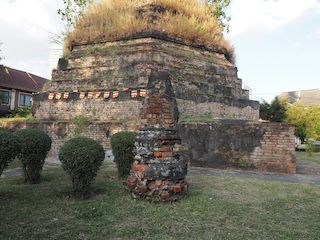
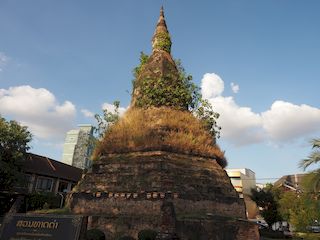
 The stupa of That Dam stands in Vientiane, the capital of Laos. This historic Buddhist monument occupies a prominent urban location and remains one of the most recognizable landmarks of the city. Its dark appearance and relatively unrestored surface distinguish it from many other stupas that have been extensively renovated. That Dam is closely connected with the cultural and religious memory of Vientiane and frequently appears in discussions of the city’s historical heritage. The monument continues to attract both local residents and visitors who are interested in the Buddhist tradition of Laos and in the historical landscape of the capital.
Monument profile
That Dam stupa
Monument category: Stupa
Monument family: Pagoda or stupa
Monument genre: Religious
Cultural heritage: Buddhist
Geographic location: Vientiane • Laos
Construction period: 16th century AD
• Links to •
• This monument illustrates the following theme •
Buddhist architecture • Stupas : Diversity of Stupas in Asia
• List of videos about Vientiane on this site •
Vientiane, Sacred Architectures • Laos
Laos • Fabric Arts
Vientiane, the Triumphal Arch Patuxay • Laos
• Sources •
Online Sources
Books and Publications
- Evans, Grant. "A Short History of Laos: The Land in Between". Allen & Unwin, 2002.
- Stuart-Fox, Martin. "Historical Dictionary of Laos". Scarecrow Press, 2008.
History of the That Dam Stupa in Vientiane
Foundation and Historical Context
The stupa known as That Dam stands in the central area of Vientiane, the capital of Laos. Historical documentation concerning its exact date of construction remains limited, but most interpretations associate the monument with the period of the Lan Xang kingdom, particularly between the fifteenth and sixteenth centuries. This was the period during which Vientiane emerged as a significant political and religious center.
The consolidation of the Lan Xang kingdom under King Setthathirath contributed directly to the development of the city’s religious landscape. In 1560 the king transferred the royal capital from Luang Prabang to Vientiane. This political decision led to the construction and restoration of several Buddhist monuments intended to reinforce the spiritual status of the new capital. Among the most prominent projects of this period was the creation of the great stupa of Pha That Luang in 1566.
That Dam likely formed part of the network of stupas that structured the religious geography of the city during this phase of expansion. Although the monument is smaller and less monumental than Pha That Luang, its presence within the city suggests a role connected with the preservation of Buddhist relics or the symbolic representation of Buddhist teachings, which correspond to the traditional functions of stupas in Theravāda Buddhism.
Symbolic Meaning and Local Traditions
That Dam became associated with an important body of local traditions that contributed to the monument’s cultural significance. One of the most widely known narratives relates the stupa to the presence of a naga, a mythical serpent-like creature frequently linked to sacred places in Southeast Asian religious traditions.
According to this tradition, the naga was believed to dwell beneath or within the stupa and to act as a guardian of the city. The creature was said to protect Vientiane from danger and to ensure the spiritual stability of the surrounding region. In this narrative, the naga withdrew or disappeared during the destruction of the city in the nineteenth century.
Although these accounts belong to the realm of legend rather than documented history, they illustrate the symbolic role that the monument acquired within the collective memory of Vientiane. The stupa became associated not only with Buddhist religious practice but also with the mythical protection of the city itself.
Destruction during the Siamese Invasion of 1828
The most significant historical transformation affecting That Dam occurred during the destruction of Vientiane in 1828. This event followed the failed rebellion of King Anouvong of Vientiane against the Siamese kingdom. After the rebellion was suppressed, Siamese forces devastated large parts of the city.
Numerous temples and religious structures were destroyed, looted, or abandoned. Precious materials, particularly gold coverings and decorative elements used on religious monuments, were often removed. According to several historical accounts and local traditions, the outer golden layer that once covered the stupa was stripped during this period.
The removal of this covering left the monument with the dark surface that characterizes its appearance today. The name “That Dam,” meaning “Black Stupa,” is directly linked to this transformation. While many surrounding religious buildings disappeared or fell into ruin after the destruction of the city, the stupa itself remained standing.
The loss of its original decorative covering significantly altered the monument’s visual presence. Instead of the bright, gilded appearance typical of many Buddhist stupas in the region, That Dam retained a darker and more austere surface.
Later History and Present Role in the City
During the late nineteenth and early twentieth centuries, Vientiane gradually regained its role as an administrative and cultural center. Urban reconstruction during the French colonial period transformed the city’s layout and introduced new administrative and residential districts.
Within this changing urban environment, That Dam remained in its historical location but no longer formed part of an active monastic complex. Unlike several other religious monuments that were restored or reconstructed, the stupa largely preserved the appearance it had acquired after the nineteenth-century destruction.
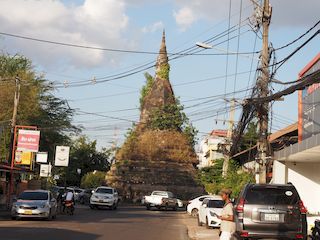
The monument eventually became a historical landmark integrated into the modern urban landscape of Vientiane. Its presence within a traffic circle and public square reflects the expansion of the city around the structure rather than the continuation of a traditional religious enclosure.
Today the stupa is recognized as one of the oldest surviving religious monuments in the capital. Although it no longer serves as a central ritual site comparable to major temples, it remains closely associated with the historical identity of Vientiane and with the collective memory of the city’s past.
Global Historical Context
The probable construction period of That Dam during the fifteenth or sixteenth century coincided with significant political developments in several parts of the world. In Southeast Asia, powerful states such as Ayutthaya in Siam and the Toungoo dynasty in Burma were expanding their influence. In South Asia, the Mughal Empire was consolidating its authority under rulers such as Akbar. In Europe, the Renaissance and the early phases of global maritime exploration were reshaping political and economic networks. These parallel developments provide a broader chronological framework for the period in which the religious monuments of Vientiane emerged.
Architecture of the That Dam Stupa in Vientiane
Urban Setting and Spatial Position
The That Dam stupa stands in the central district of Vientiane, occupying a small elevated plot surrounded today by urban streets and modern buildings. The monument is located within a circular traffic island that forms a distinct open space within the city grid. This configuration isolates the structure visually from the surrounding built environment and preserves a limited perimeter of open ground around the monument.
The stupa rises from a slightly raised earthen platform that separates the base of the monument from the surrounding terrain. The platform forms a shallow mound rather than a formally constructed terrace. This elevation enhances the visibility of the structure and establishes a clear transition between the ground plane and the mass of the monument.
Unlike stupas integrated into active temple compounds, That Dam currently appears as a solitary structure without surviving monastic buildings nearby. The absence of enclosing walls or auxiliary buildings allows unobstructed views of the monument from all sides. This exposure makes the geometric composition of the structure clearly legible within the urban landscape.
Vegetation surrounding the stupa consists mainly of trees and low plants that frame the monument without obscuring its silhouette. The visual prominence of the structure is therefore maintained despite the dense urban context of the surrounding neighborhood.
Overall Form and Structural Composition
The architectural form of That Dam is defined by a compact pyramidal mass that tapers gradually toward the summit. The monument is organized around a square base that supports the entire structure. This base establishes the fundamental geometric framework of the stupa and determines the orientation of the four principal faces.
Above the base rises the main body of the monument, which forms a truncated pyramidal volume. The walls incline inward as they ascend, creating a gradual reduction in width toward the upper portion of the structure. This inward slope produces a stable massing effect while emphasizing vertical progression.
The stupa does not display the highly articulated tiers commonly found in later or more elaborate Buddhist stupas. Instead, the external surfaces appear largely continuous, with only subtle changes in slope marking transitions between structural levels. These variations correspond to internal layers of masonry that step inward as the structure rises.
The summit of the monument is crowned by a smaller upper element that extends the vertical axis of the composition. Although the original decorative features that may have surmounted this section are no longer preserved, the overall silhouette still conveys the characteristic upward movement associated with Buddhist reliquary monuments.
Construction Techniques and Materials
The stupa is constructed primarily from brick masonry bonded with mortar. These bricks form a thick external shell surrounding a dense structural core. The construction technique relies on successive horizontal layers of brick that gradually step inward to create the pyramidal form.
The masonry walls are covered by a plaster coating that originally served both protective and aesthetic functions. The plaster surface protected the underlying brick structure from moisture infiltration and environmental exposure. Over time, weathering and the absence of major restoration campaigns have altered the appearance of this surface.
The dark coloration that characterizes the monument today results from the deterioration of the outer coating and the accumulation of environmental deposits on the plaster. This appearance differs from that of many Buddhist stupas in the region, which often display bright surfaces or metallic coverings.
The structural stability of the monument depends largely on the thickness of the masonry walls. The mass of the brickwork provides both load-bearing capacity and resistance against lateral forces. Because the structure is composed of compact masonry rather than internal frameworks, the monument behaves as a solid architectural mass.
Architectural Features and Proportions
The architecture of That Dam is notable for its simplicity and absence of elaborate ornamentation. The external surfaces of the stupa are largely uninterrupted by decorative niches or sculptural elements. The visual interest of the structure therefore derives primarily from its geometric form.
The square base establishes a stable platform that defines the monument’s proportions. Each of the four sides rises in a slightly concave plane, creating a subtle variation in the profile of the walls. This curvature becomes more visible when the monument is observed from a distance.
The transition between the base and the ascending body of the stupa is marked by a slight horizontal break in the masonry surface. This break indicates a structural change in the thickness of the walls rather than a decorative molding.
The proportions of the monument emphasize compact verticality. The height of the stupa remains relatively moderate in relation to the width of the base, producing a balanced silhouette. This proportion contributes to the perception of solidity and permanence that characterizes the structure.
The absence of projecting architectural elements also reinforces the compactness of the monument. Without balconies, niches, or terraces interrupting the surface, the entire mass reads as a continuous geometric volume rising from the ground.
Architectural Transformations and Conservation
Historical events have altered the architectural appearance of the monument, particularly the removal of its original outer decoration. Several historical accounts indicate that the stupa once possessed a gilded exterior covering. This decorative layer was reportedly stripped during the destruction of Vientiane in the nineteenth century.
Following this loss, the monument remained without the metallic covering that once distinguished it from surrounding structures. The exposed plaster gradually darkened through weathering, producing the characteristic appearance that gave the monument its name, meaning “Black Stupa.”
Despite the absence of extensive reconstruction, the structural core of the monument has remained intact. Maintenance interventions during the twentieth century focused primarily on stabilizing the masonry and preventing further deterioration of the outer surface.
Today the stupa remains structurally stable within its urban setting. Conservation efforts concentrate on preserving the existing masonry and preventing erosion of the plaster coating. The monument therefore retains its altered historical appearance while continuing to function as a visible architectural landmark in the center of Vientiane.