

 Français (France)
  Nederlands (nl-NL)
 The Wat Sisaket Museum, located in Vientiane in Laos, forms part of the historic religious complex associated with the Sisaket Temple, one of the oldest monuments in the capital. The site is notable for the significant collection of religious objects preserved within the temple compound and for its role in safeguarding Lao Buddhist heritage. The museum displays numerous statues and ritual artifacts originating from various periods of the country’s history. Through its exhibition and conservation activities, the institution contributes to the preservation and presentation of religious art and Buddhist cultural traditions in Vientiane.
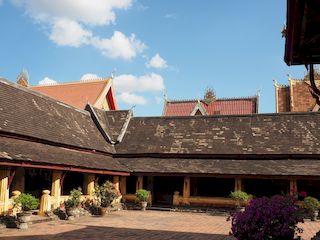
Vientiane • Wat Sisaket museum
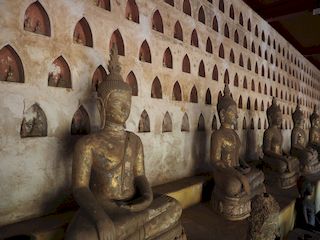
Vientiane • Wat Sisaket museum
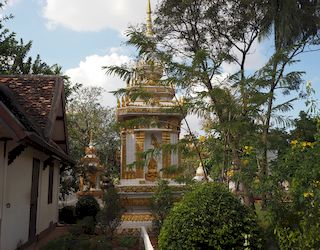
Vientiane • Wat Sisaket museum
Monument profile
Wat Sisaket museum
Monument categories: Museum, Buddhist temple
Monument families: Temple • Museum, remarkable architecture or group of buildings
Monument genres: Religious, Cultural or scientific
Cultural heritage: Buddhist
Geographic location: Vientiane • Laos
Construction period: 19th century AD
• Links to •
• List of videos about Vientiane on this site •
Vientiane, Sacred Architectures • Laos
Laos • Fabric Arts
Vientiane, the Triumphal Arch Patuxay • Laos
• Sources •
Online Sources
Books and Publications
- Evans, Grant. "A Short History of Laos: The Land in Between". Allen & Unwin, 2002.
- Stuart-Fox, Martin. "Historical Dictionary of Laos". Scarecrow Press, 2008.
History of the Wat Sisaket Museum in Vientiane
Foundation of Wat Sisaket and Royal Patronage
The Wat Sisaket Museum is closely connected to the history of Wat Sisaket, a temple constructed between 1818 and 1824 during the reign of King Anouvong, the last monarch of the Vientiane kingdom before the destruction of the city by Siamese forces. The temple was built during a period when Vientiane remained an important regional capital, although it had already come under the political influence of the Kingdom of Siam.
King Anouvong commissioned the construction of Wat Sisaket as part of a broader effort to reinforce the religious and symbolic authority of the monarchy. The temple was intended to serve as a royal religious foundation associated with the court and with the promotion of Buddhist practice within the capital. Its establishment also reflected the political and cultural exchanges between the Lao and Siamese courts during the early nineteenth century.
From the beginning, the temple played a role not only as a place of worship but also as a repository for sacred Buddhist images. Numerous Buddha statues were installed within the cloister galleries that surround the main sanctuary. These statues formed part of the ritual and devotional environment of the temple and contributed to the accumulation of a significant collection of religious sculpture within the complex.
Destruction of Vientiane and Survival of the Temple
In 1828 King Anouvong launched a rebellion against Siamese authority in an attempt to restore the independence of the Vientiane kingdom. The revolt provoked a military response from Siam that resulted in the defeat of Anouvong and the systematic destruction of the city of Vientiane.
Large sections of the capital were devastated following the suppression of the rebellion. Administrative buildings, residential areas, and many religious monuments were destroyed or abandoned. The destruction transformed the once prosperous capital into a largely deserted urban landscape.
Wat Sisaket survived these events in a manner that distinguishes it from most other temples of the city. Historical interpretations suggest that the temple was spared because its architectural style resembled contemporary Siamese temple forms. This similarity may have influenced the decision of the Siamese authorities not to demolish the structure during the destruction of the city.
The survival of the temple allowed the sculptures preserved in its galleries to remain largely intact. Thousands of Buddha statues placed in wall niches and along the cloister corridors were not removed or destroyed. As a result, Wat Sisaket became one of the few religious monuments in Vientiane to retain a substantial part of its original sacred collection after the nineteenth-century conflicts.
Colonial Preservation and the Emergence of a Museum Function
During the period of French colonial administration in Indochina, interest in the preservation of historical monuments in Vientiane increased. Wat Sisaket attracted particular attention because of its exceptional state of survival compared with other temples in the city.
Colonial authorities and scholars recognized the historical and artistic value of the large number of Buddha images preserved within the temple galleries. Restoration campaigns were therefore undertaken to stabilize the structures of the temple and protect the sculptures displayed within its architectural spaces.
These interventions marked the beginning of a transformation in the use of the site. While the temple retained its religious role, its collections of statues increasingly came to be regarded as an important cultural and artistic heritage. The galleries containing thousands of Buddha images were gradually interpreted not only as devotional spaces but also as areas suitable for heritage preservation.
Over time, this shift contributed to the development of a museum function within the temple complex. The preservation of the statues and religious objects led to the gradual organization of the site as a place where historical Buddhist sculpture could be protected and presented to visitors.
Development of the Wat Sisaket Museum and Current Cultural Role
In the decades following the end of French colonial rule and the independence of Laos, the heritage value of Wat Sisaket continued to be recognized by national cultural authorities. The temple complex increasingly served as a site for the conservation and presentation of Buddhist art.
The Wat Sisaket Museum today occupies parts of the temple complex and houses a large collection of religious sculptures, ritual objects, and historical artifacts. Many of the Buddha statues preserved in the galleries date from different historical periods and reflect the stylistic diversity of Lao Buddhist art.
The museum function does not entirely replace the religious significance of the site. Wat Sisaket continues to operate as an active temple, while at the same time preserving and exhibiting its historical collections. This dual role combines the ongoing religious life of the monument with its function as a repository of cultural heritage.
Conservation efforts focus on maintaining the structural integrity of the temple buildings and protecting the sculptures placed within the galleries. Maintenance programs address the preservation of architectural elements as well as the safeguarding of the thousands of statues that form the core of the museum’s collections.
Wat Sisaket and its museum are not individually inscribed on the UNESCO World Heritage List. Nevertheless, the monument holds an important place within the cultural heritage of Laos because it preserves one of the most extensive surviving collections of Buddhist sculpture in the capital.
Global Historical Context
The construction of Wat Sisaket in the early nineteenth century took place during a period of major political transformations in several parts of the world. In Europe the aftermath of the Napoleonic Wars reshaped political boundaries and state structures. In South Asia the British Empire expanded its control over large parts of the Indian subcontinent. In East Asia the Qing dynasty continued to govern China as a major imperial power. These chronological references place the foundation of the temple within the broader historical context of the early nineteenth century.
Architecture of the Wat Sisaket Museum in Vientiane
Site Layout and Spatial Organization of the Temple Complex
The Wat Sisaket Museum occupies the historic compound of Wat Sisaket, located in the central administrative district of Vientiane. The complex is enclosed within a rectangular perimeter wall that separates the temple grounds from the surrounding urban streets. This enclosure defines a controlled architectural environment in which the central sanctuary, cloister galleries, and subsidiary structures are organized around an open courtyard.
The main temple building stands at the center of this courtyard and forms the dominant architectural element of the complex. Its position establishes a clear spatial hierarchy, with the sanctuary occupying the focal point of the composition. Circulation within the compound follows a linear sequence beginning at the entrance gate and continuing toward the central structure.
The courtyard provides an unobstructed foreground that emphasizes the scale and form of the sanctuary. Around this open space runs a continuous cloister structure that encloses the courtyard on multiple sides. The cloister galleries connect the architectural elements of the complex and create a transitional zone between the open courtyard and the interior spaces of the temple buildings.
The organization of the site is therefore defined by three main spatial components: the central sanctuary building, the surrounding cloister galleries, and the open courtyard that links them. This arrangement allows movement around the sanctuary while preserving the visual prominence of the main structure.
Structural Composition of the Sanctuary Building
The central sanctuary of Wat Sisaket is constructed on a raised masonry platform that elevates the building above the level of the courtyard. Access to the platform is provided by a staircase aligned with the principal entrance façade. This elevated base creates a clear architectural separation between the ground level and the sacred interior space.
The structural framework of the building combines masonry walls with a system of wooden columns and beams. The columns support the roof structure and define the perimeter of the surrounding veranda. Their regular spacing establishes a rhythmic architectural pattern along the exterior of the building.
The sanctuary’s elevation is dominated by a multi-tiered roof structure. Several layers of sloping roofs rise above the central hall, creating a stepped profile that defines the silhouette of the building. The roof surfaces extend beyond the walls and veranda, producing wide overhanging eaves that protect the structure from rainfall and direct sunlight.
Decorative gables appear at the ends of the roof ridges. These gables contain carved wooden panels that emphasize the axial orientation of the building and accentuate the vertical composition of the sanctuary. The combination of the elevated base, columned veranda, and layered roof establishes the main architectural identity of the temple.
Construction Materials and Craft Techniques
The architectural structure of Wat Sisaket relies on a combination of masonry foundations and wooden superstructures. The platform and lower walls of the sanctuary are built from masonry that provides structural stability and resistance to ground moisture. This solid base supports the lighter structural elements above.
The columns, beams, and roof framework are constructed primarily from hardwood. These wooden elements form the load-bearing skeleton of the building. The structural components are connected using traditional joinery techniques that allow beams and columns to interlock precisely without extensive use of metal fasteners.
The roof is covered with rows of ceramic tiles arranged along the sloping roof surfaces. These tiles provide protection against rain while contributing to the distinctive layered appearance of the roof structure. The overlapping arrangement of tiles ensures efficient drainage during heavy rainfall.
Decorative components are integrated into the structural elements of the building. Carved wooden panels appear on pediments, door frames, and supporting beams. These carvings are frequently coated with lacquer and gilding, producing reflective surfaces that contrast with the darker tones of the structural wood.
The use of masonry for the foundation and wood for the upper structure allows the building to maintain both stability and structural flexibility. This combination is particularly suitable for the climatic conditions of the region.
Cloister Galleries and Architectural Integration of Sculpture
One of the most distinctive architectural features of the Wat Sisaket complex is the series of cloister galleries that surround the central courtyard. These galleries form elongated corridors supported by rows of columns and covered by a continuous roof.
Along the inner walls of these cloisters are numerous recessed niches designed to house Buddha statues. Thousands of statues are placed within these niches, creating a dense architectural surface that combines structural and display functions. The niches are arranged in horizontal rows that extend along the length of the galleries.
The repetition of niches and columns produces a regular architectural rhythm throughout the cloister corridors. The galleries function simultaneously as circulation routes and as spaces for the presentation of sculptures. Visitors move through these corridors while observing the statues integrated into the walls.
The relationship between architecture and sculpture is particularly evident in the design of the cloisters. The niches are not simply decorative elements but structural recesses incorporated into the masonry walls. Their dimensions and spacing correspond to the proportions of the statues they contain.
This integration transforms the cloister walls into continuous sculptural displays. The architecture therefore serves not only as a structural framework but also as an organizing system for the museum collections preserved within the temple complex.
Restoration, Adaptation, and Architectural Preservation
The present architectural condition of the Wat Sisaket Museum reflects several phases of restoration and conservation. Because the temple survived the nineteenth-century destruction of Vientiane, significant portions of the original structure remained intact. Nevertheless, repairs and stabilization work were required to maintain the integrity of the buildings.
Restoration programs focused on reinforcing the masonry platform, repairing wooden structural components, and replacing damaged roof tiles. These interventions were designed to preserve the original architectural configuration while ensuring the long-term stability of the structure.
The cloister galleries required particular attention due to the large number of statues placed within their niches. Conservation work has therefore included stabilization of the gallery walls and protection of the surfaces that support the sculptures.
Today the architectural spaces of the temple complex serve both religious and museum functions. The central sanctuary remains an active place of worship, while the cloister galleries and adjacent spaces display large collections of Buddhist statues and ritual objects.
The architectural preservation of Wat Sisaket ensures that the spatial organization of the temple complex remains largely unchanged. The elevated sanctuary, the surrounding cloisters, and the open courtyard continue to define the structure of the site, allowing the museum collections to be presented within the original architectural framework of the temple.