

 Français (France)
  Nederlands (nl-NL)
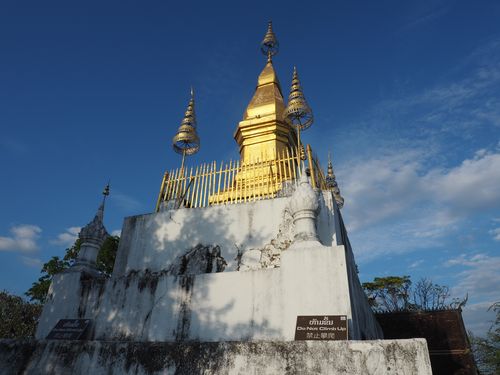
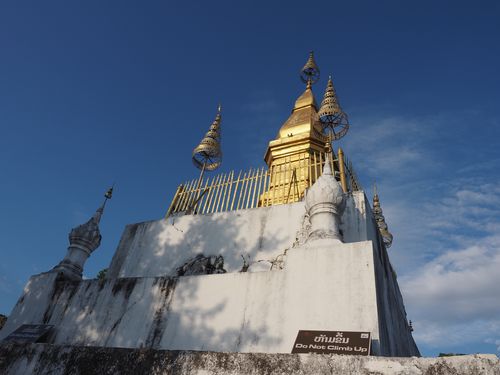
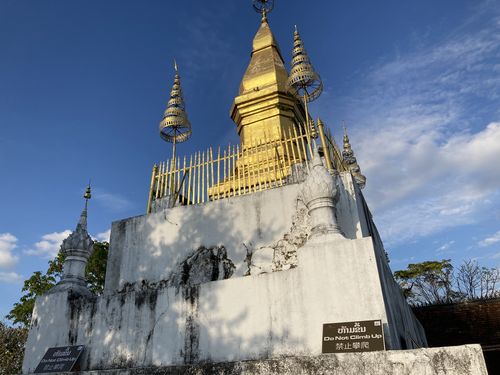
 The Wat Chom Si stupa stands on Mount Phou Si, a central hill rising above the city of Luang Prabang in Laos. Visible from many parts of the city, it serves as a prominent landmark within the urban landscape and the Mekong valley. This Buddhist monument is associated with the long-standing religious presence of Luang Prabang and the spiritual traditions that have shaped the city over centuries. Located near several temples and stairways leading to the summit of the hill, the stupa attracts both residents and visitors who come to observe the panoramic views over the surrounding town and rivers.
Monument profile
Wat Chom Si Stupa
Monument categories: Pilgrimage site, Stupa, Buddhist temple
Monument families: Temple • Pilgrimage site or memorial • Pagoda or stupa
Monument genres: Religious
Cultural heritage: Buddhist
Geographic location: Luang Prabang • Laos
Construction period: 19th century AD
This monument in Luang Prabang is inscribed on the UNESCO World Heritage List since 1995 and is part of the serial property "Town of Luang Prabang".See the UNESCO monuments featured on this site
• Links to •
• This monument illustrates the following theme •
Buddhist architecture • Stupas : Diversity of Stupas in Asia
• List of videos about Luang Prabang on this site •
Luang Prabang, Royal Palace • Laos
Luang Prabang, the markets • Laos
Luang Prabang, Wat Sensoukharam temple • Laos
Luang Prabang, Sunset on Mount Phou Si • Laos
Luang Prabang, Wat Xieng Thong temple • Laos
Luang Prabang, paper making workshop • Laos
Laos • Fabric Arts
Luang Prabang, a City in the Countryside • Laos
Luang Prabang, some temples • Laos
• References •
unesUNESCO: Town of Luang Prabang
History of the Wat Chom Si Stupa in Luang Prabang
The Wat Chom Si stupa is one of the most visible religious landmarks in the historic city of Luang Prabang in Laos. Rising from the summit of Mount Phou Si, a prominent hill located in the center of the old city peninsula between the Mekong River and the Nam Khan River, the monument occupies a position of both symbolic and geographic significance. Its history reflects the religious traditions of the Lao kingdoms, the political transformations of the region, and the evolution of Luang Prabang from a royal capital to a cultural and heritage city.
Political and social context of the construction
The stupa of Wat Chom Si was constructed in the early nineteenth century, during a period when the Lao territories were experiencing significant political change. Luang Prabang had long served as one of the principal centers of the former kingdom of Lan Xang, a powerful state established in the fourteenth century that once unified large parts of present-day Laos and surrounding regions. After the fragmentation of Lan Xang in the eighteenth century, several smaller Lao kingdoms emerged, including Luang Prabang, Vientiane and Champasak.
In this context, the rulers of Luang Prabang sought to reinforce the religious legitimacy of their authority through the patronage of Buddhist institutions. The construction of a stupa on Mount Phou Si served both spiritual and political purposes. In Theravāda Buddhist societies, stupas are closely associated with merit-making, the accumulation of religious virtue, and the symbolic protection of a city. By sponsoring the construction of such a monument, the royal court demonstrated its devotion to Buddhism and its role as protector of the faith.
The choice of Mount Phou Si as the location for the monument was particularly significant. The hill occupies a central position within the urban layout of Luang Prabang and rises prominently above the surrounding landscape. By placing a sacred monument at this point, the authorities created a visible symbol of religious authority that could be seen from many parts of the city and from the river routes that approached it.
At the time of its construction, the Lao kingdoms were also subject to increasing pressure from neighboring powers, particularly Siam. Political alliances and rivalries influenced the internal organization of the region. In this context, monuments associated with Buddhism often served as expressions of continuity and stability in a changing political environment.
Major historical events affecting the site
Although the Wat Chom Si stupa itself was not directly involved in major military events, the city of Luang Prabang experienced several periods of instability during the nineteenth century. Conflicts between regional powers and the shifting balance of authority in mainland Southeast Asia had indirect effects on the city’s religious institutions.
In the late nineteenth century the Lao territories gradually came under French colonial influence. Luang Prabang became the seat of a royal monarchy maintained under the French protectorate established in the 1890s. During this period the city was increasingly recognized for its cultural and religious significance. Many temples and monuments were preserved as part of colonial policies that sought to maintain local traditions while integrating the region into the administrative structure of French Indochina.
The Wat Chom Si stupa remained an important spiritual landmark throughout these transformations. As political authority shifted from local monarchs to colonial administration and later to the modern Lao state, the monument continued to function as a visible symbol of the city’s Buddhist identity.
Global context at the time of construction
The early nineteenth century was a period of profound change in many parts of the world. In Europe and North America, the era was marked by industrial expansion, political revolutions and the consolidation of modern nation-states. In Asia, many traditional kingdoms were confronted with new forms of regional competition and increasing contact with European colonial powers.
Within mainland Southeast Asia, rulers often reinforced their legitimacy by supporting religious construction and temple restoration. Buddhist monuments such as stupas, temples and monasteries played a crucial role in expressing political authority and cultural continuity. Similar processes could be observed in neighboring regions, where rulers invested in religious architecture as a way of reinforcing both spiritual and political order.
The construction of the Wat Chom Si stupa therefore formed part of a broader regional tradition in which religious monuments functioned as markers of stability and identity in a changing geopolitical environment.
Transformations and later developments
Over time, the site of Mount Phou Si underwent several modifications that affected the setting of the stupa. Paths and stairways were gradually developed to facilitate access to the summit. These routes linked the hill to surrounding temples and created a sequence of religious spaces leading toward the monument.
Throughout the twentieth century the stupa experienced periodic maintenance and restoration, reflecting the traditional practice of renewing Buddhist monuments in order to preserve their spiritual and visual significance. The surrounding hill also became an important place of pilgrimage and contemplation for residents of Luang Prabang.
After the political changes that led to the establishment of the Lao People’s Democratic Republic in 1975, religious institutions continued to play a role in local cultural life, although within a different political framework. The Wat Chom Si stupa remained a familiar symbol within the urban landscape and retained its religious associations.
Role of the monument in contemporary society
Today the Wat Chom Si stupa occupies an important place in the identity of Luang Prabang. Its golden structure rising above Mount Phou Si has become one of the most recognizable images of the city. Both residents and visitors regularly ascend the hill to reach the summit, where the monument stands alongside panoramic views of the surrounding rivers and urban areas.
The site combines religious, cultural and social functions. For practicing Buddhists it remains a place associated with merit-making, reflection and quiet devotion. For others it represents a symbolic point within the city where the historical relationship between landscape, religion and urban development becomes visible.
The paths and staircases leading to the summit are lined with smaller shrines and temples, creating a continuous religious environment that connects the stupa with the broader network of Buddhist architecture in Luang Prabang.
Preservation and contemporary challenges
The conservation of the Wat Chom Si stupa is closely linked to the preservation of the historic city of Luang Prabang. The city is internationally recognized for its architectural and cultural heritage, which includes numerous temples and historic structures.
However, the growing popularity of the site has introduced new challenges. Large numbers of visitors climb Mount Phou Si each day, particularly at sunset when the summit offers extensive views of the surrounding landscape. This level of activity requires careful management in order to prevent damage to pathways, vegetation and nearby religious structures.
Environmental factors also affect the monument. The tropical climate of northern Laos includes seasonal rainfall, humidity and temperature variations that can gradually affect surface coatings and structural elements. Regular maintenance is therefore necessary to preserve the appearance and stability of the stupa.
Despite these challenges, the Wat Chom Si stupa continues to represent an enduring element of Luang Prabang’s cultural landscape. Its history illustrates how religious monuments can persist through political change while maintaining their symbolic importance for local communities and the broader cultural heritage of the region.
Architectural Analysis of the Wat Chom Si Stupa in Luang Prabang
The Wat Chom Si stupa occupies the summit of Mount Phou Si, a hill rising at the center of the historic peninsula of Luang Prabang in northern Laos. Its elevated position gives the monument a distinctive architectural presence within the urban landscape, where it functions as both a religious marker and a visual landmark visible from the Mekong River, the Nam Khan River, and many parts of the surrounding city. The structure reflects architectural traditions associated with Lao Theravāda Buddhism while also incorporating stylistic elements characteristic of nineteenth-century religious monuments in mainland Southeast Asia.
Technological and architectural practices of the period
The construction of the Wat Chom Si stupa illustrates building practices typical of Buddhist religious architecture in the Lao kingdoms during the early nineteenth century. At that time, religious monuments were usually built using masonry techniques based on locally available materials combined with decorative finishes intended to enhance the spiritual symbolism of the structure.
The engineering approach used for stupas in the region relied primarily on thick masonry cores capable of supporting significant weight while maintaining structural stability over long periods. In the case of Wat Chom Si, the stupa stands on a terraced base constructed on the summit of Mount Phou Si. This location required careful adaptation to the topography of the hill. Builders had to create a stable platform capable of supporting the monument while resisting erosion and seasonal rainfall typical of the tropical climate of northern Laos.
The structural design of the monument emphasizes vertical stability. The core of the stupa is formed by a compact masonry mass that distributes weight evenly toward the base. This configuration helps the monument resist ground movement and environmental stress. The use of successive narrowing tiers also contributes to stability by reducing structural pressure toward the upper sections of the structure.
Another architectural consideration was visibility. The stupa was designed to be seen from many points within the city. Its height and its placement on the hill amplify its presence in the urban landscape. This combination of topographic prominence and vertical design transforms the monument into a focal point within the spatial organization of Luang Prabang.
Materials and construction methods
The materials used in the construction of the Wat Chom Si stupa reflect both practical and symbolic considerations. Traditional Lao religious architecture frequently employs brick masonry covered with plaster or stucco finishes. These materials provide both durability and a surface suitable for decorative treatment.
The internal core of the monument is most likely composed of brick bonded with lime-based mortar. Brick was widely used in religious construction throughout the region because it was relatively easy to produce and allowed builders to create curved or tapered forms characteristic of stupas. Lime mortar provided flexibility and resistance to humidity, important qualities in the tropical environment of Laos.
Once the masonry core was completed, the outer surface was coated with plaster layers that allowed artisans to refine the contours of the monument and create smooth surfaces suitable for gilding or decorative finishing. The most striking visual feature of the Wat Chom Si stupa today is its golden appearance, produced by painted or gilded surfaces that reflect sunlight and reinforce the monument’s sacred symbolism.
These materials also contribute to the monument’s longevity. Brick and plaster constructions, when maintained periodically, can remain structurally stable for centuries. Periodic restoration or renewal of the exterior finish is common practice in Buddhist monuments and forms part of the traditional maintenance of sacred architecture.
Architectural influences and artistic characteristics
The architectural form of the Wat Chom Si stupa reflects broader traditions of Buddhist architecture in mainland Southeast Asia while maintaining characteristics associated with Lao religious design. The basic form of the monument follows the symbolic geometry of the Buddhist stupa, which represents the cosmic axis linking the earthly world with the spiritual realm.
The monument’s tiered structure and elongated vertical profile are typical of Lao stupas constructed during the later periods of the Lan Xang cultural sphere and its successor kingdoms. The stupa’s proportions emphasize height and vertical ascent, a symbolic reference to spiritual elevation and enlightenment.
The decorative treatment of the monument also reflects regional artistic traditions. Smooth surfaces and symmetrical proportions create a visually balanced structure. The gilded exterior reinforces the spiritual significance of the monument, as gold surfaces in Buddhist architecture symbolize purity, merit and spiritual radiance.
Although the Wat Chom Si stupa follows local architectural traditions, it also reflects broader stylistic exchanges that occurred across Southeast Asia. Similar stupa forms can be found in neighboring regions such as Thailand and Myanmar, where Theravāda Buddhist architecture developed comparable symbolic structures. These cultural interactions influenced the evolution of architectural motifs, decorative techniques and proportions used in religious monuments.
Spatial organization and structural composition
The Wat Chom Si stupa stands on the summit of Mount Phou Si, which itself forms part of a broader religious complex composed of stairways, terraces and smaller shrines distributed along the slopes of the hill. The ascent toward the summit is an integral part of the architectural experience of the site.
Two principal staircases provide access to the summit, one beginning near the Mekong River and another near the Nam Khan River. These stairways pass through a sequence of temples and shrines before reaching the upper terrace where the stupa is located. This progression creates a spatial transition from the urban environment below toward a more contemplative religious space at the summit.
At the top of the hill, the stupa stands on a platform that allows visitors to circulate around the monument. This circular movement around the structure reflects a traditional ritual practice in Buddhist architecture known as circumambulation. The spatial design of the summit therefore integrates both architectural and religious functions.
The structure itself follows the typical composition of a stupa, consisting of a square or circular base supporting a series of ascending tiers that culminate in a pointed spire. The proportions are carefully balanced so that the monument appears slender yet stable. The absence of interior chambers emphasizes the symbolic rather than functional nature of the structure.
Dimensions and notable architectural features
Although the Wat Chom Si stupa is not among the largest Buddhist monuments in Southeast Asia, its architectural impact derives largely from its strategic location. Mount Phou Si rises approximately one hundred meters above the surrounding city, and the stupa occupies the highest point of the hill. This elevation significantly increases its visual prominence.
The monument itself is estimated to reach a height of roughly twenty to twenty-five meters. Its golden surface catches sunlight throughout the day, making it visible from the riverbanks and many points within Luang Prabang. The contrast between the monument’s gilded surface and the green vegetation of the hill further enhances its visual presence.
One notable architectural feature of the site is the integration between the monument and the natural landscape. Rather than being placed within a large temple courtyard, the stupa rises directly from the hilltop terrace. This relationship between architecture and topography reinforces the symbolic idea of spiritual elevation associated with the ascent toward the monument.
Anecdotes and symbolic associations
Mount Phou Si and the Wat Chom Si stupa are surrounded by local traditions and symbolic interpretations that contribute to the monument’s cultural importance. The hill itself has long been associated with sacred geography within the city of Luang Prabang.
Local narratives describe the hill as a place connected with spiritual guardianship of the city. The presence of a stupa at the summit reinforces this interpretation by symbolically protecting the surrounding urban area. The monument therefore functions not only as a religious structure but also as a symbolic guardian overlooking the city.
Another notable aspect of the site is its role as a vantage point. From the summit terrace surrounding the stupa, visitors can observe panoramic views of the Mekong River, the Nam Khan River and the historic districts of Luang Prabang. The architectural placement of the monument therefore creates a relationship between sacred architecture and landscape observation.
International recognition and conservation challenges
The architectural significance of the Wat Chom Si stupa is closely linked to the preservation of Luang Prabang as a historic city. The city is internationally recognized for its combination of traditional Lao religious architecture and urban structures reflecting several historical periods.
As one of the most visible monuments in the city, the stupa contributes to the distinctive skyline that characterizes Luang Prabang. Its presence on Mount Phou Si reinforces the visual identity of the historic peninsula and forms an integral element of the city’s architectural composition.
However, the monument also faces conservation challenges. The constant flow of visitors ascending the hill places pressure on pathways and surrounding vegetation. Weather conditions, particularly humidity and seasonal rainfall, also affect the maintenance of the monument’s plaster surfaces and gilded finishes.
Regular restoration efforts are therefore necessary to preserve both the structural integrity and the visual appearance of the stupa. These interventions typically involve renewing protective coatings, repairing plaster surfaces and maintaining the terraces that support the monument.
Despite these challenges, the Wat Chom Si stupa continues to serve as one of the most recognizable architectural landmarks of Luang Prabang. Its design, location and symbolic meaning illustrate how religious architecture can shape the identity of an entire urban landscape while maintaining its cultural and spiritual importance across generations.