

 Français (France)
  Nederlands (nl-NL)
 The Ashoka Rock Edict at Dhaulligiri, in the Indian state of Odisha, is a significant remnant of early Buddhist history. Dating to the 3rd century BCE, this monument is among the earliest known examples of state-issued inscriptions promoting a governance model based on ethics, tolerance, and respect for all forms of life. It reflects a shift from imperial conquest to a rule guided by moral principles. The location, close to the presumed site of the Kalinga war, underscores the symbolic relevance of this epigraphic site.
Monument profile
Ashoka Rock Edict
Monument category: Memorial monument
Monument family: Monument for cultural purposes
Monument genre: Cultural or scientific
Cultural heritage: Buddhist
Geographic location: Dhauli • Odisha • India
Construction period: 3rd century BC
• Links to •
• Dynasties that contributed to the construction of the monument •

• List of videos about Dhauli on this site •
Dhauli, Odisha • From Ashoka’s Edicts to the Shanti Stupa
The Ashokan Edict at Dhauli: Historical Foundations of an Imperial Moral Declaration
Political and Social Context of Its Creation
The Ashokan Rock Edict at Dhauli, carved into the side of a hill near Bhubaneswar in the present-day Indian state of Odisha, represents one of the most powerful early expressions of imperial authority transformed through ethical introspection. It was inscribed during the reign of Emperor Ashoka (c. 268–232 BCE), one of the greatest rulers of the Maurya dynasty, whose empire spanned much of the Indian subcontinent.
The edict at Dhauli is closely tied to the Kalinga War, a brutal conflict between the Mauryan Empire and the independent kingdom of Kalinga. This war, which likely occurred around 261 BCE, was marked by massive loss of life—Ashoka himself later claimed that over 100,000 were killed and even more deported or wounded. Though militarily victorious, Ashoka was profoundly shaken by the scale of human suffering.
This pivotal moment led to his personal conversion to Buddhism, and the subsequent adoption of Dhamma—a policy of moral governance that emphasized nonviolence, compassion, religious tolerance, and the welfare of all beings. The edict at Dhauli is one of several carved proclamations across the empire used to communicate these ethical reforms to subjects, especially in regions like Kalinga where resistance had been fierce.
The edict served both a political and social function. It was designed to pacify a newly conquered region by projecting a message of clemency and benevolence, thereby helping Ashoka solidify imperial control through moral legitimacy rather than force. It reflects the strategic use of written communication in public spaces to instill a unifying ideology across a diverse empire.
Major Historical Events Affecting the Site
After its creation, the rock edict at Dhauli remained relatively untouched for centuries. The Maurya Empire eventually declined, and the site fell into obscurity. Unlike many other ancient Indian monuments, the Dhauli edict was not integrated into religious complexes or later dynastic architectural projects, likely due to its form—a simple rock inscription without monumental construction.
The site escaped significant historical destruction or reconstruction, in part because it was not associated with wealth or religious ritual. It was rediscovered during the British colonial period, particularly in the 19th century, when scholars like James Prinsep began deciphering Brahmi script and unlocking the messages carved on Ashokan edicts.
In the 20th century, the site was revived as a cultural and spiritual landmark. Most notably, in the 1970s, a large Shanti Stupa (Peace Pagoda) was constructed on the hill above the edict, funded by the Japanese Nipponzan Myohoji Buddhist order. Though not directly connected to the original edict, this modern stupa helped draw public attention and pilgrimage to the site, transforming Dhauli into a symbol of global peace and Buddhist values.
Global Context During the Period of Construction
The 3rd century BCE was a transformative era not only in India but across several ancient civilizations. Ashoka's decision to propagate a moral code through stone edicts paralleled similar practices elsewhere, such as the inscriptions of Darius the Great at Behistun in Persia or Hellenistic royal decrees issued by successors of Alexander the Great in the Mediterranean.
What set Ashoka apart, however, was the content of his message. While most rulers of the era used inscriptions to assert divine authority, military triumphs, or territorial claims, Ashoka's edicts emphasized ethical governance, universal compassion, and religious tolerance. His approach marks one of the earliest known examples of state-sponsored ethical reform expressed through permanent, publicly accessible inscriptions.
In China, the Qin dynasty was laying the groundwork for a centralized imperial system under Qin Shi Huang, also employing standardized scripts and monumentality for imperial cohesion. In this broader context, Ashoka's edicts can be viewed as part of a global pattern of early statecraft, but with a uniquely pacifist and philosophical orientation.
Transformations Over Time
The original inscription at Dhauli has remained physically intact, though its meaning and perception have evolved. While initially a political communiqué, over time it has been reinterpreted through religious and nationalist lenses. The addition of the Shanti Stupa has shifted the site's orientation towards pilgrimage and tourism, integrating it into a wider spiritual geography that includes Buddhist landmarks throughout India.
Urban expansion around Bhubaneswar and increased road access have made the site more visible and visited. The once-isolated rock face now forms part of a complex heritage zone. The edict itself has not been moved or rebuilt, but its surroundings have changed, and protective measures—including barriers and interpretive signage—have been introduced.
While these developments enhance public access, they also alter the site's original spatial context, potentially diminishing the solitary and introspective experience intended by its creators.
Contemporary Role and Cultural Importance
Today, the Ashokan edict at Dhauli serves as a national symbol of reconciliation and peace. It features in educational curricula and is promoted as a cornerstone of India’s ancient moral heritage. For Buddhist communities, it represents the moment when imperial power aligned with spiritual values. For the broader public, it is a reminder of the potential for ethical transformation through leadership.
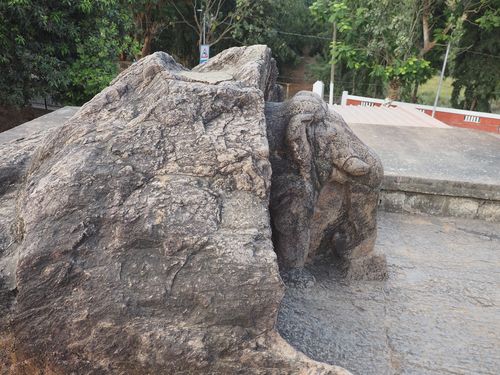
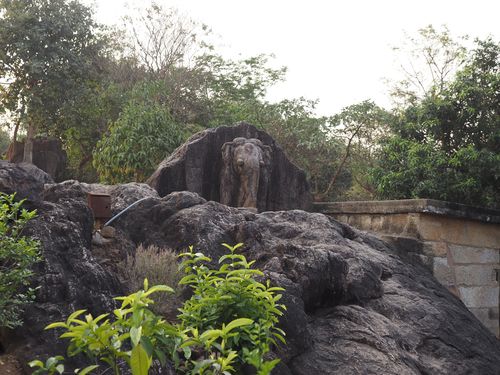
Annual peace events, meditation gatherings, and interfaith dialogues take place at the site, especially near the Shanti Stupa. The elephant carved in relief above the inscription, interpreted as a symbol of the Buddha, has become iconic, often replicated in artwork and educational materials.
The monument plays a role in constructing local identity as well. In Odisha, it is a point of pride and historical continuity, reflecting a long-standing cultural engagement with spiritual and philosophical traditions.
Conservation Status and Preservation Challenges
The Ashokan edict at Dhauli faces numerous environmental and anthropogenic threats. The stone surface is vulnerable to weathering, especially due to monsoonal rains, biological growth such as lichens, and air pollution from nearby urban centers. Despite the resilience of the rock and its protected location, natural erosion slowly affects the clarity of the inscription.
Human factors include unregulated tourism, littering, and the risk of vandalism, though these are somewhat mitigated by the site's protection under the Archaeological Survey of India (ASI). Regular monitoring, controlled access, and public awareness campaigns have improved the situation, but resource constraints continue to hamper comprehensive conservation.
The site has been proposed for UNESCO World Heritage status but is not yet inscribed. Such recognition would offer greater international visibility and funding, but could also increase tourist pressure and risk further altering the site’s delicate context.
Efforts are ongoing to digitize the inscription, improve signage in multiple languages, and develop buffer zones to protect the area from urban encroachment. These strategies reflect a growing understanding of the need to balance heritage preservation with modern development.
The Architecture of the Ashokan Rock Edict at Dhauli: Monumental Simplicity and Symbolic Permanence
Technological and Architectural Innovations of the Period
The Ashokan Rock Edict at Dhauli is a prime example of non-monumental architecture that nevertheless exerts monumental influence. Though it lacks the form of a conventional built structure, the architectural logic behind its conception—its spatial placement, material treatment, and visual messaging—reflects notable technological and design innovations of the Mauryan period (3rd century BCE).
The principal innovation lies in the use of inscription as architecture: Ashoka’s strategy of engraving moral and political declarations directly onto rock surfaces constitutes an architectural act. It represents a form of permanent public communication, utilizing natural elements not only as a canvas but as an integral architectural element.
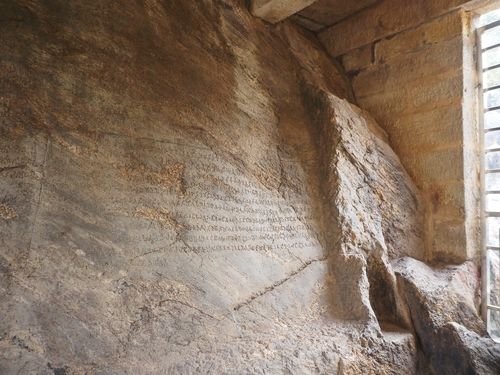
The precision of the Brahmi script, carved with remarkable regularity and depth, implies the use of hardened iron tools and a sophisticated method for transferring script onto the rock surface. This required collaboration between scribes, masons, and imperial overseers, as the act of engraving was irreversible and errors had to be minimized.
The site at Dhauli is particularly significant in that it combines textual communication with symbolic relief sculpture—specifically, a life-sized elephant carved in high relief above the edict. This combination of inscription and imagery reveals an early example of integrating artistic and communicative functions within a designed natural landscape, aligning political messages with sacred iconography.
Materials and Construction Methods
Unlike most traditional architecture that employs masonry, mortar, or timber, the Ashokan edict at Dhauli is entirely rock-cut. The substrate is a form of quartzite-rich sandstone, a durable yet workable material found abundantly in the region. Its fine-grained texture allows for deep, legible inscriptions and relatively precise relief carving.
The rock face was likely prepared manually, leveled or smoothed to some extent before the script was laid out. Scribes would have used chalk or pigment to outline the text, followed by craftsmen who engraved it using iron chisels and hammers. The depth and consistency of the engraving indicate advanced manual techniques and a deep understanding of the stone's properties.
The elephant sculpture, measuring approximately 1 meter in length, required three-dimensional modeling skills and knowledge of animal anatomy. Its naturalistic rendering is unusual for the time and suggests either exposure to foreign sculptural traditions or an advanced local workshop capable of producing high-relief stonework.
No binding materials, structural frameworks, or additions were involved—yet the rock itself, through intentional selection and intervention, becomes both surface and structure. This minimalistic use of material is reflective of Mauryan architectural austerity, which emphasized function, clarity, and endurance over ornamental excess.
Artistic and Architectural Influences
Although the Dhauli inscription may appear straightforward, it is embedded in a complex web of artistic and cultural exchanges. The very idea of using inscriptions as tools of imperial governance has Achaemenid precedents, as seen in the Persian rock carvings of Behistun. However, Ashoka's adaptation is distinct in its ethical content and integration with Buddhist symbolism.
The elephant above the inscription functions as both an imperial emblem and a religious metaphor. In Buddhist tradition, the elephant is a symbol of mental strength and often represents the Buddha’s conception. Its inclusion above the edict at Dhauli transforms a political statement into a spiritual declaration, reinforcing the idea that the emperor's rule is guided by Dhamma rather than conquest.
Stylistically, the sculpture shows early signs of narrative reliefs that would later flourish in the Buddhist sites of Sanchi and Bharhut. While the carving is less intricate than later Mauryan stone pillars, it reveals a transitional phase in Indian art—one where symbolic motifs begin to complement text, foreshadowing the elaborate visual programs of post-Mauryan architecture.
Regionally, the edict reflects an architectural response to the landscape of Odisha, where later Buddhist caves and Jain monuments would also be cut into hillsides. The rock-cut tradition, though embryonic at Dhauli, would evolve into a defining feature of Indian sacred architecture in the centuries that followed.
Spatial Organization and Structural Features
The site’s spatial layout is minimal but deliberate. The inscription is located on a gently sloped rock surface, positioned at a height of approximately 1.5 meters above ground level—perfect for viewing by a standing adult. The placement ensures visibility without requiring elevation or stairs, making it accessible to the general public, including travelers and traders along the nearby Daya River.
Above the inscription is the elephant relief, carved in such a way that it appears to emerge naturally from the rock, as if part of a living narrative. The lack of framing devices, arches, columns, or enclosures allows the inscription to integrate harmoniously with its natural setting, turning the rock into a functional medium rather than a passive support.
There are no domes, gateways, or formal approach paths, yet the hillside location grants the edict a processional quality. Visitors must ascend a slight incline to encounter the message, reinforcing the edict's solemn tone. The elephant acts as a visual cue that marks the site from a distance, guiding the viewer to the inscription below.
This direct engagement with natural terrain—not as a backdrop but as an active part of architectural design—prefigures the Indian subcontinent's longstanding tradition of rock-cut sanctuaries and temples.
Notable Dimensions and Anecdotes
The inscribed panel measures approximately 2 meters wide and 1 meter high, containing a series of lines in Prakrit, written in Brahmi script. The uniformity of the text, achieved without modern measuring tools, is a testament to the Mauryan administrative system’s standardization and attention to detail.
The elephant relief is unique among Ashokan edicts. While many inscriptions are accompanied by lion capitals or standalone pillars, Dhauli is the only known example to incorporate a sculpted animal directly into the rock face. This feature lends the site a singular character within the Ashokan corpus and elevates it from a utilitarian message board to an integrated cultural monument.
An oft-repeated anecdote—more poetic than factual—claims that Ashoka, upon seeing the Daya River run red with blood after the Kalinga War, chose this exact spot to inscribe his message of remorse and moral reform. While unverifiable, the narrative adds a mythical dimension to the site’s emotional resonance.
Recognition and Conservation Issues
The architectural simplicity of the Dhauli edict is, paradoxically, what makes it so vulnerable. Exposed to the elements, the engraving faces erosion from rainfall, temperature changes, and biological growth such as moss and lichen. Unlike built structures, it cannot be enclosed or easily sheltered without compromising its visual context.
As urban development encroaches upon the surrounding hills, the visual sanctity of the site is increasingly threatened. The addition of the Shanti Stupa in the 20th century, while spiritually resonant, introduces an architectural layer foreign to the edict's original purpose and style.
Currently under the care of the Archaeological Survey of India, the edict benefits from basic conservation and interpretive efforts. Still, long-term preservation will require innovative conservation techniques that respect both the material and immaterial dimensions of the monument.
Though not yet a UNESCO World Heritage Site, Dhauli has been proposed for inclusion. Its architecture, minimalist yet symbolically rich, offers unique insight into how early imperial regimes used the landscape itself as an enduring architectural canvas for moral and political ideas.