Français (France)
  Nederlands (nl-NL)
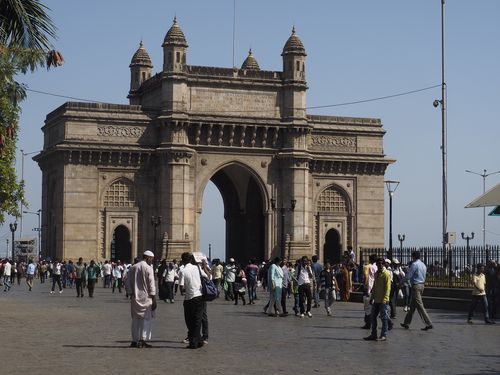
 The Gateway of India, located in Mumbai in the state of Maharashtra, India, is a prominent monument linked to the city’s colonial past and maritime exchanges. Built as a ceremonial landing point, it reflects Mumbai’s role as a major port. It now serves as a widely recognized urban landmark and a popular gathering site. Through its symbolic function and visibility, it forms an integral part of the city’s historical and cultural landscape.

Mumbai • Gateway of India
Mumbai • Gateway of India

Mumbai • Gateway of India
Monument profile
Gateway of India
Monument category: Memoral
Monument family: Monument for cultural purposes
Monument genre: Cultural or scientific
Geographic location: Mumbai • Maharashtra • India
Construction period: 20th century AD
• Links to •
• Dynasties that contributed to the construction of the monument •

• List of videos about Mumbai on this site •
Mumbai (Bombay) - megalopolis of western India • Maharashtra, India
• Sources •
Online sources
Books and Publications
- Jalal, Ayesha. The Sole Spokesman: Jinnah, the Muslim League and the Demand for Pakistan. Cambridge University Press, 1994.
- Metcalf, Barbara D. A Concise History of Modern India. Cambridge University Press, 2002.
Gateway of India in Mumbai: colonial origin and evolving symbolic role
Conception and foundation within the imperial context
The Gateway of India was conceived in the early twentieth century as a ceremonial structure linked to the representation of British imperial authority in India. The project was initiated following the visit of King George V and Queen Mary in 1911, an event intended to affirm the political presence of the British Crown. The monument was designed as a formal landing point for dignitaries arriving by sea in Mumbai.
Construction began in 1913 on a waterfront site selected for its direct connection to maritime routes. The choice of location reflects the importance of Bombay as a principal port within the colonial network. The structure was completed and formally opened in 1924, after a prolonged construction phase that included technical adjustments related to coastal conditions.
Ceremonial function and political significance
The monument was intended as an architectural setting for official receptions and ceremonial events. Its position facing the sea allowed it to function as a threshold between maritime arrival and urban entry. The central arch framed the point of disembarkation, reinforcing the ceremonial nature of arrivals.
Beyond its functional role, the Gateway of India operated as a visual symbol of imperial authority. Its presence in the urban landscape established a fixed point of reference associated with governance and colonial administration. The monument’s scale and placement contributed to its role in projecting political power within the city.
Transformation after independence and changing uses
The role of the monument changed significantly after India’s independence in 1947. A key historical event associated with the site occurred in 1948, when the last British troops departed from India, passing through this location. This moment marked a reversal in the monument’s symbolic meaning, transforming it from a representation of imperial arrival to one of departure.
Following independence, the Gateway of India ceased to serve its original ceremonial function and became accessible as a public space. Its role shifted toward that of a civic landmark integrated into the daily life of the city. The structure remained unchanged physically, but its interpretation evolved in response to the political transformation of the country.
Contemporary role and preservation
Today, the Gateway of India functions as a major urban landmark and a focal point within the public space of Mumbai. It retains its visibility and continues to attract large numbers of visitors. Its significance lies in the coexistence of historical layers, combining its colonial origins with its later association with independence.
Maintenance and conservation efforts focus on preserving the structure against environmental exposure, particularly due to its coastal location. These interventions aim to ensure the stability of the monument while maintaining its original architectural characteristics. The monument remains an enduring element of the city’s historical identity.
Global historical context
During the early twentieth century, when the monument was constructed, European colonial empires maintained extensive control over territories in Asia and Africa. The British Empire governed large parts of the Indian subcontinent. The First World War reshaped global political dynamics from 1914 onward. In Europe, the Austro-Hungarian and Ottoman Empires underwent significant transformations. These developments formed part of a broader reconfiguration of global power structures.
Architectural composition and spatial configuration of the Gateway of India in Mumbai
Site placement and relationship to the waterfront
The Gateway of India is positioned along the waterfront of Mumbai, directly facing the Arabian Sea. Its placement establishes a clear spatial alignment between the monument and maritime access routes. The structure is set on a raised platform that separates it from the surrounding ground level, forming a defined threshold between the urban fabric and the shoreline.
The orientation of the central arch is perpendicular to the coastline, creating a direct visual axis between the inland urban space and the open sea. The absence of built obstructions in front of the monument reinforces its visibility from offshore. The platform extends laterally, providing a base that stabilizes the structure and organizes pedestrian circulation around it.
Plan organization and volumetric composition
The monument follows a symmetrical plan organized around a dominant central archway. This passage forms the core of the structure, both functionally and visually. On either side of the arch, solid masses provide structural support and frame the opening, creating a balanced composition.
The plan integrates secondary openings within the lateral volumes, allowing movement along the sides while maintaining the prominence of the central axis. The overall composition is compact, with clearly defined boundaries and no extended annexes. The vertical hierarchy is structured around the height of the central arch, which rises above the adjacent elements.
Materials and construction techniques
The structure is built primarily from locally sourced basalt, a dense and durable stone capable of resisting coastal environmental conditions. Reinforced concrete is used in structural components to enhance stability and distribute loads effectively. The combination of these materials allows for both structural strength and controlled shaping of architectural elements.
Stone blocks are carefully assembled to create continuous surfaces, with precise jointing that contributes to the monument’s structural integrity. The central arch is constructed using techniques that channel loads toward the supporting piers, ensuring stability despite the large span. The surface treatment maintains a consistent texture across the entire structure.
Architectural features and stylistic elements
The central feature of the monument is a large arched opening, defined by a smooth curvature and framed by vertical supports. Above the arch, a superstructure incorporates decorative stonework integrated into the mass of the building. These elements include carved motifs and perforated screens that introduce variation without disrupting the overall geometry.
The lateral sections are topped with smaller domed elements that contribute to the skyline profile. These features are symmetrically arranged and proportionally scaled to complement the central arch. Surface ornamentation remains integrated within the structure, avoiding protruding decorative layers. The combination of structural clarity and controlled detailing defines the monument’s architectural character.
Modifications and conservation conditions
Since its completion, the monument has undergone limited structural alteration. Interventions have focused on maintenance and conservation, particularly in response to exposure to marine conditions such as humidity, salt, and wind. Cleaning and consolidation work have been carried out to preserve the surface quality of the stone.
The platform and surrounding paving have been periodically adjusted to manage visitor circulation and environmental impact. Despite these interventions, the original architectural configuration remains intact. The structural system, material composition, and spatial organization continue to reflect the initial design without significant modification.