

 Français (France)
  Nederlands (nl-NL)
 Gaden Phelgayling Namgyal Datsang is a Tibetan Buddhist temple located in Bodhgaya, in the Indian state of Bihar. Established in the 20th century, it contributes to the preservation and dissemination of Tibetan Buddhist spiritual traditions. The monastery welcomes monks and visitors from around the world, drawn by its atmosphere of reflection and its religious significance. It forms an important part of Bodhgaya’s cultural landscape, a key pilgrimage site for Buddhists. Its affiliation with Namgyal Monastery in 1998 strengthened its role in the study and practice of sacred texts.
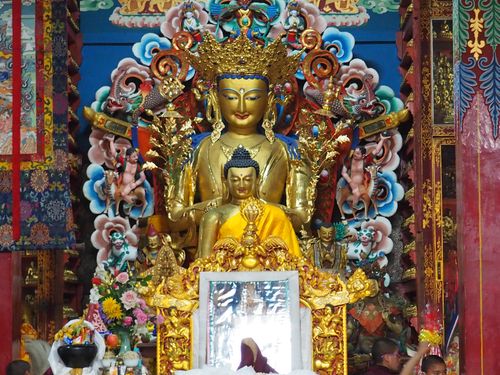


Monument profile
Gaden Phelgayling Namgyal Datsang temple
Monument categories: Monastery, Buddhist temple
Monument families: Temple • Monastery
Monument genres: Religious
Cultural heritage: Buddhist
Geographic location: Bodhgaya • Bihar • India
Construction period: 20th century AD
• Links to •
• List of videos about Bodhgaya on this site •
Bodhgaya, the Mahabodhi temple • Bihar, India
Bodhgaya, temples in town and life in a village • Bihar, India
The Historical Journey of Gaden Phelgayling Namgyal Datsang in Bodhgaya, India
Gaden Phelgayling Namgyal Datsang, a Tibetan Buddhist temple located in Bodhgaya, Bihar, India, stands as a significant symbol of cultural preservation and religious devotion. Founded in the early 20th century, it encapsulates the political, social, and spiritual currents of its time while maintaining a vital role in the religious landscape of Bodhgaya.
Political and Social Context of Construction
The construction of Gaden Phelgayling Namgyal Datsang began in 1938, a period marked by rising political uncertainty in Tibet and broader Asia. The Tibetan government, under theocratic rule with the Dalai Lama as the spiritual and temporal leader, faced increasing threats from internal political instability and external pressures, particularly from the growing tensions between China and Japan, and the global shifts caused by colonial powers.
Venerable Ngawang Samten, the founding abbot, sought to establish a permanent Tibetan monastic presence at Bodhgaya—the sacred site of the Buddha’s Enlightenment. His ambition reflected a dual purpose: to propagate Tibetan Buddhism on an international platform and to safeguard Tibetan religious traditions in a rapidly changing world. The Tibetan government supported the initiative, recognizing it as a way to assert spiritual influence beyond its national borders and to reinforce diplomatic presence through cultural means.
No significant political rivalry is directly associated with the temple’s construction, but the broader Tibetan-Chinese tensions and the desire to strengthen Buddhist unity against political upheavals deeply influenced the timing and urgency of the project.
Major Historical Events Impacting the Site
The historical trajectory of Gaden Phelgayling Namgyal Datsang has been relatively stable compared to older religious sites subjected to centuries of conflict. However, significant geopolitical shifts in Tibet had indirect repercussions. After the Chinese annexation of Tibet in 1950, the temple became a sanctuary for Tibetan monks and scholars in exile, reinforcing its role as a bastion of Tibetan religious education and cultural identity.
In January 1998, the monastery underwent a major institutional transformation when it was formally integrated into Namgyal Monastery, the personal monastery of the Dalai Lama. This affiliation enhanced the educational and administrative standards of Gaden Phelgayling, ensuring that the monastery continued to serve both religious and educational purposes at an elevated level.
Unlike many historical sites, the monastery has not suffered from major destruction, siege, or forced restoration, which has allowed it to preserve much of its original design and spirit.
Global Context at the Time of Construction
Globally, the 1930s were characterized by the disintegration of colonial empires, the rise of nationalist movements, and significant social transformations. In Europe, totalitarian regimes were emerging, while in Asia, Japan’s militaristic expansion and China’s internal struggles reshaped regional dynamics.
In this context, the construction of Gaden Phelgayling Namgyal Datsang aligned with a broader trend of cultural reaffirmation through monumental architecture. Similar efforts elsewhere included the revival of Islamic, Hindu, and Buddhist monuments as markers of identity and resilience. The establishment of the monastery at Bodhgaya can thus be viewed as part of a global movement where religious and cultural communities sought to consolidate their heritage against the backdrop of political uncertainty.
Transformations Over Time
While the core structure of Gaden Phelgayling has remained consistent, there have been modest transformations to adapt to changing needs. The integration into Namgyal Monastery led to improvements in educational facilities and living quarters for monks. The surrounding urban environment of Bodhgaya has become increasingly commercialized and dense, prompting the monastery to reinforce its perimeter and implement measures to maintain a serene atmosphere within its premises.
No significant architectural changes have altered the traditional Tibetan design. Instead, the transformations have primarily focused on maintaining the monastery’s functionality amid the growing influx of international pilgrims and tourists.
The Role of the Monument Today and Its Cultural Importance
Today, Gaden Phelgayling Namgyal Datsang stands as a significant center for Tibetan Buddhist practice and study. It continues to attract monks and devotees from across the globe, contributing to the transmission of Buddhist teachings in their pure Tibetan form. The monastery is active in hosting major religious events, including collective prayer gatherings such as the Monlam Chenmo, and it plays an important role during the Kalachakra initiations often held in Bodhgaya.
Beyond its spiritual function, the monastery symbolizes the resilience and adaptability of Tibetan culture in exile. It provides a space where traditional religious practices are preserved and revitalized, reinforcing a sense of identity among the Tibetan diaspora and Buddhist communities worldwide.
Current State of Conservation and Modern Challenges
Gaden Phelgayling Namgyal Datsang remains in good overall condition but faces several contemporary challenges. Environmental threats such as increased humidity during the monsoon season, urban pollution, and the physical wear caused by heavy tourist traffic necessitate ongoing conservation efforts.
The monastery has adopted regular maintenance protocols, often collaborating with heritage specialists to ensure that restorations use traditional materials and techniques. The greatest risk lies in balancing the need for visitor access with the preservation of the sacred atmosphere and delicate artwork, including ancient murals and statues.
Although not individually listed as a UNESCO World Heritage Site, the monastery benefits from the broader protection afforded to the sacred zone of Bodhgaya. This status imposes certain conservation standards but also draws larger numbers of visitors, which paradoxically amplifies preservation challenges.
Efforts are continuously being made to integrate sustainable tourism practices and to educate visitors about the site’s spiritual and cultural significance, ensuring that Gaden Phelgayling Namgyal Datsang continues to serve as a vibrant and enduring monument to Tibetan Buddhism.
The Architecture of Gaden Phelgayling Namgyal Datsang: A Testament to Tibetan Tradition at Bodhgaya
The Gaden Phelgayling Namgyal Datsang, a Tibetan Buddhist monastery established in Bodhgaya, Bihar, in the 20th century, embodies a meticulous adaptation of traditional Tibetan architecture within the climatic and cultural conditions of India. Combining ancestral construction techniques with subtle innovations, it stands as a vivid reflection of spiritual endurance and architectural sophistication.
Technological and Architectural Innovations of the Period
Although built during a time of increasing modernization, Gaden Phelgayling Namgyal Datsang remained fundamentally rooted in traditional Tibetan architectural practices. The technological sophistication of the monastery is reflected in its mastery of structural balance, resilience, and environmental adaptation.
Key techniques included the construction of thick masonry walls combined with wooden frames to provide seismic resistance, a crucial consideration even in the moderately seismic regions of Bihar. Traditional knowledge of passive ventilation was also implemented: high windows, open corridors, and internal courtyards were designed to facilitate natural airflow, ensuring a cool environment during the intense summer heat.
Urban planning considerations were addressed through the monastery’s strategic positioning. Situated within Bodhgaya’s sacred precincts, it was laid out to preserve both spiritual sanctity and accessibility, while anticipating future urban expansion by enclosing key spaces within protective walls.
Materials and Methods of Construction
Materials used in Gaden Phelgayling’s construction were selected for both symbolic and practical reasons. Locally sourced fired bricks and stone formed the core of the monastery’s walls, chosen for their thermal mass properties, which regulate internal temperatures naturally.
Timber, essential to Tibetan monastic architecture, was employed for roofing structures, door and window frames, columns, and interior decorative elements. While some wood was imported to maintain stylistic authenticity, much of it came from Indian forests, reflecting a pragmatic approach to material availability.
Traditional lime plaster was used to coat the walls, offering breathability and natural resistance to moisture. The monastery’s vibrant murals were created using mineral-based pigments on prepared lime surfaces, ensuring durability against Bodhgaya’s humid monsoon climate.
One notable innovation was the careful combination of Indian and Tibetan masonry techniques. Indian masons contributed local expertise in brick bonding patterns and plastering methods, enhancing the monastery’s longevity without compromising its traditional aesthetic.
Architectural and Artistic Influences
The Gaden Phelgayling Namgyal Datsang illustrates a deliberate and harmonious blending of Tibetan architectural orthodoxy with subtle local influences. The layout and decorative motifs strictly adhere to Tibetan spiritual symbolism, yet certain aesthetic choices reveal regional adaptations.
The tiered roofing style, characterized by multiple flat roofs stacked in diminishing tiers, mirrors traditional Tibetan monasteries but also incorporates elements suited to the Indian monsoon, such as slightly steeper gradients and water runoff systems.
The use of ornate doorways and window frames, decorated with brightly painted lotus motifs and mythical creatures such as snow lions and dragons, reflects the Tibetan Buddhist cosmology. However, the intricacy and vibrancy of the carvings bear the unmistakable imprint of Indian artisan traditions, particularly those prevalent in Bihar and Bengal.
Stupa-like structures placed within the courtyard align with Indian Buddhist architectural elements, symbolizing the interconnectedness of the Tibetan and Indian Buddhist heritages.
Organization and Structure
Spatially, the monastery is organized according to traditional Tibetan monastic design. A central courtyard forms the heart of the complex, surrounded by cloistered walkways and living quarters for monks. The main prayer hall (dukhang) is situated directly opposite the entrance gate, emphasizing its prominence.
The prayer hall is notable for its large timber beams supporting a flat roof, richly painted with sacred motifs. Rows of wooden columns divide the interior space, while wall murals narrate episodes from the life of the Buddha and Tibetan spiritual history.
An assembly of prayer wheels lines the periphery of the courtyard, allowing pilgrims to perform circumambulations while engaging in prayer. The presence of multi-tiered, gilded finials atop the temple roof echoes both Tibetan spiritual traditions and architectural practices intended to symbolize spiritual ascent.
The design avoids excessive ornamentation, focusing instead on creating a harmonious, meditative space that facilitates contemplation and ritual practice.
Notable Statistics and Anecdotes
Covering approximately 2,000 square meters, Gaden Phelgayling Namgyal Datsang features a main prayer hall reaching a height of around 15 meters. This vertical dimension not only enhances ventilation but also serves to inspire spiritual elevation among worshippers.
An interesting historical anecdote relates to the consecration ceremony of the monastery, during which religious representatives from various parts of Tibet and the Himalayan regions participated. This symbolic gathering highlighted a rare moment of unity among diverse Tibetan communities facing a turbulent future.
It is also noted that certain ornamental elements, such as gold-leafed decorations, were donated by Tibetan lay communities living in exile, demonstrating a collective effort in preserving their cultural identity.
International Recognition and Conservation Challenges
While Gaden Phelgayling Namgyal Datsang is not individually inscribed as a UNESCO World Heritage Site, its location within Bodhgaya, a recognized global pilgrimage site, grants it indirect protective status.
Architecturally, its value lies not in grandiose innovation but in the faithful transmission of a monastic tradition in a foreign land. It serves as a vital example of how Tibetan architectural norms adapted subtly yet effectively to new environmental and cultural conditions.
Modern conservation challenges primarily involve mitigating the effects of environmental stressors, such as moisture infiltration and pollution from increasing urbanization. Conservation efforts focus on maintaining the integrity of wall paintings, timber structures, and plaster surfaces through regular monitoring and traditional restoration techniques.
The growing popularity of Bodhgaya as a tourist destination places additional pressure on the site, necessitating careful visitor management strategies to ensure that the monastery’s spiritual and architectural integrity remains undiminished.