

 Français (France)
  Nederlands (nl-NL)
 The Karma Temple, located in Bodhgaya in the state of Bihar, is a Buddhist place of worship linked to the Tibetan Karma Kagyu tradition. It is one of several monasteries established in Bodhgaya, a major global center of Buddhism. The temple functions as a venue for religious ceremonies, meditation retreats, and teachings led by senior lamas. It attracts practitioners and visitors from various countries and reflects the international character of contemporary Buddhist practice in Bodhgaya, contributing to the city’s ongoing spiritual and cultural significance.
Monument profile
Karma Temple
Monument categories: Monastery, Buddhist temple
Monument families: Temple • Monastery
Monument genres: Religious
Cultural heritage: Buddhist
Geographic location: Bodhgaya • Bihar • India
Construction period: 20th century AD
• Links to •
• List of videos about Bodhgaya on this site •
Bodhgaya, the Mahabodhi temple • Bihar, India
Bodhgaya, temples in town and life in a village • Bihar, India
Historical Development of a Karma Kagyu Monastic Center in Bodhgaya
Located in Bodhgaya in the state of Bihar, the Karma Temple represents one of the principal institutional presences of the Tibetan Karma Kagyu lineage at Buddhism’s most revered pilgrimage site. Its history is inseparable from the twentieth-century exile of Tibetan monastic communities, the reconfiguration of religious authority outside Tibet, and the transformation of Bodhgaya into a global Buddhist center.
Political and Social Context of Foundation
The establishment of the Karma Temple must be understood within the political upheaval that followed events in Tibet in 1959. The flight of the Fourteenth Dalai Lama and thousands of monks and lay followers into India led to the relocation of major Tibetan Buddhist institutions. The Government of India adopted a policy of asylum and facilitated the creation of refugee settlements and monastic centers.
For the Karma Kagyu lineage, one of the four principal schools of Tibetan Buddhism, institutional continuity required the re-establishment of monastic training and ritual practice outside Tibet. Bodhgaya held exceptional symbolic value as the site associated with the Enlightenment of the Buddha. Establishing a permanent center there provided both spiritual legitimacy and international visibility.
The construction of the temple was not the result of royal patronage in the classical sense, but rather of collective initiative supported by senior lineage holders and the diaspora community. It responded to several objectives: safeguarding doctrinal transmission, consolidating authority within the lineage, and ensuring representation within a shared religious landscape that included other Tibetan schools and Asian Buddhist traditions.
Rivalries within the Karma Kagyu lineage—particularly concerning the recognition of its leading hierarchs—formed part of the broader institutional background. However, the Bodhgaya establishment functioned primarily as a stabilizing center rather than as a site of sectarian confrontation.
Global Religious Context of the Late Twentieth Century
The latter half of the twentieth century witnessed a significant internationalization of Tibetan Buddhism. Monastic leaders traveled to Europe and North America, founding centers and engaging with global audiences. This expansion coincided with a renewed scholarly and spiritual interest in Buddhism worldwide.
Within this global framework, Bodhgaya emerged as a focal point of international pilgrimage. Large gatherings, public teachings, and seasonal retreats brought together practitioners from multiple continents. The Karma Temple became part of a transnational religious network in which Bodhgaya served as a symbolic axis linking Tibetan exile communities, Indian Buddhist heritage, and global converts.
Its establishment parallels a broader movement of religious reconstruction following political displacement, comparable to other diaspora communities rebuilding institutional centers in new geographic settings.
Institutional Development and Key Phases
Following its foundation, the Karma Temple developed as a monastic residence, teaching venue, and ritual center. It hosted annual ceremonies, lineage transmissions, and meditation programs. The presence of high-ranking lamas reinforced its institutional significance.
Unlike many medieval monuments, the temple has not undergone cycles of destruction or dynastic transformation. Its evolution has been primarily administrative and functional rather than architectural. Changes in leadership within the Karma Kagyu tradition influenced programming and governance, but the temple remained continuously active.
The late twentieth and early twenty-first centuries saw expansion of facilities to accommodate growing numbers of visitors and practitioners. Additional buildings were constructed to provide accommodation, classrooms, and assembly halls, reflecting the increasing scale of international participation.
Urban Transformation and Environmental Setting
Bodhgaya experienced rapid urban growth, particularly after the Mahabodhi Temple complex was inscribed on the UNESCO World Heritage List in 2002. Infrastructure development, hotels, and monastic institutions reshaped the town’s spatial organization.
The Karma Temple adapted to this evolving urban environment. While maintaining its core religious functions, it incorporated logistical infrastructure to manage seasonal influxes of pilgrims. Its location within a dense cluster of international monasteries situates it in a unique religious landscape characterized by architectural diversity and shared pilgrimage activity.
Transformations and Functional Continuity
The primary transformations of the Karma Temple have concerned scale and usage rather than symbolic purpose. Its role expanded from a modest monastic establishment to a center capable of hosting large-scale teachings and community events.
Technological modernization—such as improved lighting, sound systems, and climate management—has supported contemporary ritual practice without altering the institution’s foundational objectives. There has been no documented period of abandonment or repurposing; rather, the site has experienced sustained continuity since its establishment.
Contemporary Role and Cultural Significance
Today, the Karma Temple functions as an active religious institution affiliated with the Karma Kagyu lineage. It hosts prayer ceremonies, empowerment rituals, and educational programs for monastic and lay participants. During major Buddhist festivals and the Tibetan New Year, it becomes a focal point of communal activity.
Culturally, the temple symbolizes the resilience of Tibetan Buddhism in exile. It reflects the capacity of a displaced religious tradition to reconstitute institutional structures in a foreign environment. Within India, it contributes to the pluralistic religious landscape of Bihar and reinforces Bodhgaya’s international identity.
The temple also serves as a site of intercultural exchange. Visitors from diverse backgrounds engage with Tibetan ritual traditions, reinforcing Bodhgaya’s role as a meeting ground of global Buddhism.
Conservation and Contemporary Challenges
The Karma Temple is not individually listed as a World Heritage property. However, its proximity to the Mahabodhi Temple complex places it within a regulated urban zone subject to heritage management guidelines.
Conservation challenges relate primarily to environmental and urban pressures. The humid subtropical climate of Bihar affects building materials, requiring regular maintenance. Seasonal tourism increases strain on infrastructure and necessitates careful management of visitor flow.
Urban expansion poses additional challenges, including land use pressures and infrastructural congestion. Monastic authorities coordinate with local administrations to ensure that development remains compatible with religious functions.
Routine renovation and maintenance policies prioritize structural stability and preservation of ritual spaces. Because the temple is a modern institution, conservation focuses less on archaeological preservation and more on sustainable functionality.
Conclusion
The Karma Temple of Bodhgaya represents a significant chapter in the history of Tibetan Buddhism’s twentieth-century diaspora. Founded in response to political displacement and institutional necessity, it became part of a global network centered on one of Buddhism’s most revered pilgrimage sites. Its historical trajectory illustrates continuity amid exile, adaptation within a plural religious environment, and the integration of a Himalayan monastic tradition into the contemporary urban landscape of Bihar.
Architectural Analysis of a Karma Kagyu Monastic Complex in Bodhgaya
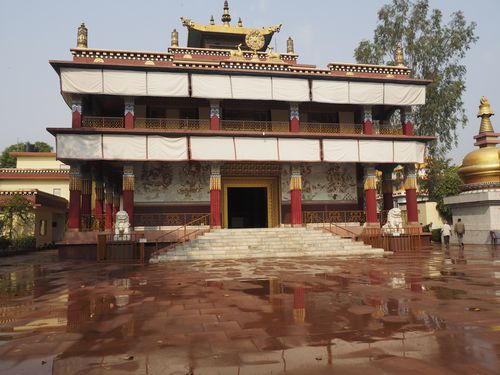
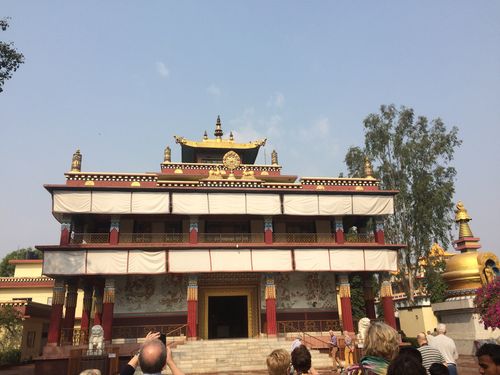
Located in Bodhgaya, within the state of Bihar, the Karma Temple represents a contemporary monastic complex of the Tibetan Karma Kagyu lineage constructed in the late twentieth century. Its architecture does not replicate ancient Indian temple typologies but rather transposes Himalayan monastic forms into the climatic, urban, and regulatory framework of modern Bihar. The building is therefore best understood as an architectural adaptation that combines traditional symbolic vocabulary with contemporary construction technology.
Technological and Architectural Innovations
The principal innovation of the Karma Temple lies in its structural system. Unlike historical Tibetan monasteries built primarily of rammed earth, timber, and stone, the Bodhgaya complex employs reinforced concrete as its primary load-bearing framework. This material choice ensures structural stability in a region characterized by monsoon rainfall, seasonal humidity, and moderate seismic risk.
The reinforced concrete skeleton allows large interior spans in the main assembly hall without excessive internal supports. This creates an unobstructed visual axis toward the central altar, which is essential for collective ritual practice. Modern structural engineering enables upper floors to accommodate residential quarters, administrative rooms, and teaching spaces without compromising spatial clarity.
Environmental adaptation constitutes another technical consideration. The building incorporates wide overhanging eaves that shield façades from direct sun and heavy rain. Cross-ventilation is achieved through aligned window openings, reducing heat accumulation during the summer months. Ceiling heights are proportioned to facilitate air circulation, and in some sections mechanical ventilation complements passive cooling strategies.
Urban planning constraints in Bodhgaya also shaped the design. Height regulations and proximity to the Mahabodhi complex required moderation in vertical development. As a result, the temple emphasizes horizontal massing rather than vertical monumentality.
Materials and Construction Methods
The core structural system consists of reinforced concrete columns and slabs, complemented by brick infill walls. Exterior surfaces are finished with plaster and mineral pigments, allowing for the application of traditional polychrome decorative schemes.
Roof structures combine concrete slabs with layered waterproofing systems designed to withstand intense monsoon precipitation. In contrast to traditional Tibetan flat roofs compacted with earth, the Bodhgaya temple incorporates modern drainage channels and concealed water outlets.
Interior finishes include stone or ceramic flooring, chosen for durability and ease of maintenance under high visitor traffic. Decorative timber elements—such as window frames, cornices, and painted beams—are either carved locally or prefabricated and assembled on site. These components recreate traditional Himalayan visual motifs without replicating historical construction methods.
The synthesis of modern structural materials and traditional ornament demonstrates a pragmatic approach: symbolic authenticity is maintained while technical resilience is enhanced.
Architectural and Artistic Influences
The architectural language of the Karma Temple derives directly from Tibetan monastic design associated with the Karma Kagyu lineage. The composition typically features a central assembly hall, upper residential levels, and a clearly articulated façade framed by painted cornices and symbolic motifs.
Color plays a central role. Red, yellow, blue, green, and white correspond to canonical Tibetan symbolic palettes. Decorative friezes and geometric borders echo Himalayan artistic conventions, including stylized lotus motifs and protective symbols.
The temple does not incorporate Indian shikhara towers or Islamic domes, distinguishing it clearly from surrounding architectural traditions. Instead, it maintains the cubic massing and layered rooflines typical of Tibetan religious buildings. However, its setting within a diverse international monastic district introduces a contextual dialogue with Thai, Japanese, Bhutanese, and Sri Lankan architectural forms present in Bodhgaya.
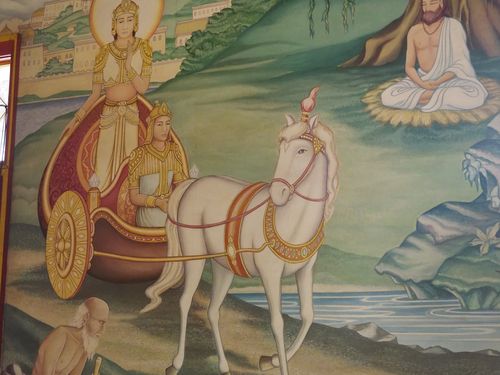
Murals and iconographic programs inside the main hall follow Vajrayana Buddhist conventions. Painted representations of lineage masters emphasize institutional continuity. These artworks are executed using contemporary pigments on prepared plaster surfaces rather than on traditional mineral grounds.
Spatial Organization and Structural Composition
The spatial organization reflects monastic functional hierarchy. The ground level generally contains the main prayer hall, capable of accommodating several hundred practitioners. This hall is oriented toward a central shrine platform featuring statues and thangka paintings.
Above or adjacent to the assembly hall are residential quarters for monks, administrative offices, and classrooms for doctrinal instruction. Circulation corridors connect these functions efficiently while preserving the sanctity of the main ritual space.
Structurally, the temple relies on a grid of reinforced concrete columns. This modular framework allows flexibility in interior partitioning. Staircases are placed strategically to separate public access from monastic areas.
Rooflines may incorporate symbolic elements such as Dharma wheels and deer motifs, referencing canonical Buddhist imagery. However, these are attached to modern structural substrates rather than forming load-bearing components.
Distinctive Structural Features
A key distinction of the Karma Temple lies in its deliberate moderation of scale. Unlike historical Himalayan monasteries dominating mountainous landscapes, this temple is integrated into a dense urban religious environment. Its architectural prominence derives from color and symbolic detail rather than from height.
The building avoids excessive ornamentation that might conflict with local planning regulations. Structural safety standards reflect contemporary Indian building codes, including reinforced concrete shear walls and load calculations adapted to seismic zones.
Electrical systems, artificial lighting, and sound installations are fully integrated into the architecture. These technical features support large ceremonial gatherings without altering the fundamental spatial concept.
Dimensions and Notable Characteristics
While exact measurements vary with later additions, the main assembly hall typically spans a broad rectangular footprint sufficient for collective ceremonies. Ceiling heights are proportioned to enhance acoustics and visual focus toward the altar.
The façade’s polychrome detailing is periodically renewed to preserve chromatic intensity. The structural frame allows repainting without compromising load-bearing elements.
No medieval legends are attached to the building, as it is a modern foundation. Its significance derives instead from its association with the Karma Kagyu lineage and from the presence of prominent lamas who have taught there.
International Recognition and Conservation Considerations
Although the Karma Temple is not individually inscribed as a World Heritage monument, its location within the broader Bodhgaya heritage zone subjects it to planning oversight. Proximity to the Mahabodhi Temple complex necessitates compliance with heritage protection guidelines.
Conservation challenges relate primarily to climate exposure and urban pressure. Monsoon humidity affects exterior paint layers, requiring periodic maintenance. Visitor influx during peak pilgrimage seasons increases wear on flooring and structural components.
Maintenance policies emphasize durability rather than archaeological preservation. Regular repainting, waterproofing, and structural inspection ensure functional continuity.
Conclusion
The architecture of the Karma Temple in Bodhgaya exemplifies the transplantation of Tibetan monastic design into a contemporary Indian urban context. By combining reinforced concrete construction with traditional symbolic ornamentation, the complex achieves structural resilience and visual continuity with Himalayan precedents. Its architectural identity is defined less by monumental ambition than by functional clarity, ritual suitability, and institutional representation within a global Buddhist pilgrimage center.