

 Français (France)
  Nederlands (nl-NL)
 The chörtens of Ladakh are characteristic religious monuments found across the high plateau of the Indian state of Ladakh in the Himalayan region. Associated with Tibetan Buddhist traditions, these structures play an important role in the spiritual organization of the landscape. They are commonly positioned along paths, near settlements, or close to monasteries, marking places of passage, memory, and devotion. Their distribution reflects the historical presence of Buddhism in the region and the significance of ritual practices in local communities. Chörtens contribute to the cultural identity of Ladakh and remain visible elements of the region’s religious and geographic environment.
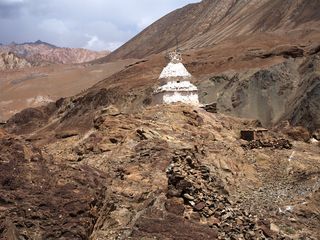
High Plateau • Chörtens of Ladakh
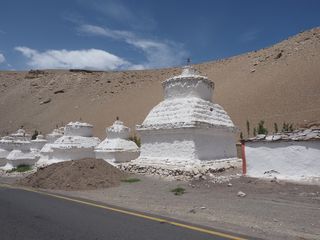
High Plateau • Chörtens of Ladakh
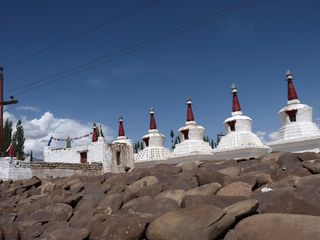
High Plateau • Chörtens of Ladakh
Monument profile
Chörtens of Ladakh
Monument category: Stupa
Monument family: Pagoda or stupa
Monument genre: Religious
Cultural heritage: Buddhist
Geographic location: High Plateau • Ladakh • India
Construction period: Unknown era
• Links to •
• This monument illustrates the following theme •
Buddhist architecture • Stupas : Diversity of Stupas in Asia
• List of videos about High Plateau on this site •
Ladakh, Landscapes and Faces • India
History of the Chörtens of Ladakh
Foundation and religious context of construction
The chörtens of Ladakh are religious monuments associated with the development of Tibetan Buddhism in the high plateau region of the western Himalayas. Their construction is linked to the establishment of Buddhist monastic networks that progressively expanded across Ladakh between the early medieval period and the later consolidation of regional Buddhist institutions. These structures were erected by monastic communities, local rulers, or lay patrons who sought to materialize the presence of Buddhist doctrine in the landscape.
Many chörtens were constructed near monasteries or along traditional routes connecting settlements across the plateau. Their location reflects the importance of religious markers in the spatial organization of Ladakhi society. By placing these monuments along frequently used paths, builders ensured that acts of devotion could be integrated into everyday movement across the territory.
Some chörtens were also associated with the commemoration of specific religious figures or events. In certain cases they contained relics, ritual deposits, or sacred texts placed within the internal core of the structure. These deposits reinforced the symbolic significance of the monument and linked it to the authority of Buddhist teachings and institutions present in Ladakh.
Patronage and social functions
The construction of chörtens in Ladakh often involved the participation of several social actors. Monasteries could initiate the building of such monuments as part of their religious activities, while local elites or wealthy families sometimes sponsored their construction as an act of religious merit. These initiatives were frequently supported by the surrounding community, which contributed labor or materials during the construction process.
Chörtens served multiple functions within the social and religious life of Ladakhi settlements. They acted as focal points for devotional practices such as circumambulation, a ritual movement performed clockwise around the monument. This practice formed part of the daily religious routines of monks and lay inhabitants.
Their placement near village entrances, crossroads, or pilgrimage routes also gave them a protective and symbolic function. By marking important points in the landscape, chörtens contributed to defining the sacred geography of the region. Their presence visually signaled the influence of Buddhist institutions and reinforced the connection between local communities and the monastic tradition.
Historical transformations and continuity
Over time, the chörtens of Ladakh underwent numerous repairs and reconstructions. The environmental conditions of the Himalayan plateau, including strong winds, temperature variations, and erosion, gradually affected the structural stability of these monuments. As a result, maintenance and rebuilding formed a regular part of their history.
Restoration work was usually carried out by nearby communities or by monks associated with neighboring monasteries. When deterioration occurred, damaged sections of masonry were repaired and external plaster layers were renewed. In some cases, entire upper sections of the monument had to be rebuilt while preserving the original form and proportions.
Despite political changes in the region during the nineteenth and twentieth centuries, including the incorporation of Ladakh into modern political structures, the religious role of chörtens remained largely unchanged. Ritual practices associated with these monuments continued to be performed, demonstrating the continuity of local devotional traditions.
Cultural significance and present condition
Today the chörtens of Ladakh remain visible features of the high plateau landscape and continue to play an active role in the religious life of local communities. Many are still located along traditional paths used by villagers, pilgrims, and visitors moving through the region.
The monuments are regularly maintained by nearby settlements or by monastic institutions that supervise their upkeep. Repairs typically involve renewing plaster coatings, stabilizing masonry elements, or reconstructing damaged sections of the structure. These interventions aim to preserve the monument’s form while maintaining its ritual function.
Chörtens also contribute to the cultural identity of Ladakh. Their repeated presence across the plateau forms a recognizable architectural pattern that reflects the historical development of Buddhist practices in the region. Through continued maintenance and ritual use, these monuments remain integrated into both the religious and cultural life of Ladakhi society.
Global historical context
The period during which chörtens began to spread across Ladakh corresponds to centuries of significant political and cultural developments in several parts of the world. In East Asia, China experienced successive imperial dynasties that influenced regional trade and cultural exchange. In South Asia, large parts of the subcontinent were governed by different regional kingdoms and later by the Mughal Empire. In Europe, the medieval period saw the consolidation of feudal states and expanding trade networks. These broader developments form the chronological background to the historical period in which the chörtens of Ladakh became established in the Himalayan plateau.
Architecture of the Chörtens of Ladakh
Spatial placement within the high plateau landscape
The chörtens of Ladakh are positioned across the high plateau in locations that reflect both ritual practice and patterns of movement through the landscape. These monuments frequently appear along traditional paths connecting villages, at the entrances of settlements, or in proximity to monastic complexes. Their placement establishes visible markers that structure movement across open terrain characterized by sparse vegetation and extensive mineral surfaces.
In several areas of Ladakh, chörtens form continuous alignments along pathways or roads. These sequences create a repeated architectural rhythm in which each monument maintains similar proportions while differing slightly in height or detailing. Such arrangements visually guide movement along the route and establish a ceremonial progression toward villages or monastic sites.
Topography often influences the positioning of these monuments. Chörtens are frequently placed on slightly elevated ground, ridges, or slopes where their silhouettes remain visible over long distances. Their pale plastered surfaces contrast with the darker geological formations of the plateau, reinforcing their visual prominence in the surrounding environment.
The spatial distribution of chörtens therefore contributes to the structuring of the landscape by introducing repeated vertical elements within otherwise open terrain.
Architectural composition and volumetric structure
The architectural form of a chörten consists of a vertically organized composition composed of several superimposed elements. The structure generally begins with a square or slightly rectangular base platform that provides stability and defines the footprint of the monument. In many cases this base is composed of one or more stepped levels that gradually elevate the main body of the structure above the surrounding ground.
Above the base rises the central mass of the monument. This section typically appears as a cylindrical or gently domed volume forming the principal body of the chörten. Its curved surface contrasts with the geometric form of the base and establishes the dominant visual mass of the structure.
At the top of the central body stands a cubic element often identified as the harmika. This small upper structure functions as a transition between the dome-like body and the vertical spire above it. The harmika introduces a clear geometric break in the vertical composition while supporting the upper architectural elements.
The spire forms the terminal section of the monument. It usually consists of a sequence of circular rings or discs stacked vertically and gradually decreasing in diameter toward the top. This arrangement emphasizes the vertical axis of the monument and visually completes the architectural composition.
The combination of base platform, central body, harmika, and spire creates a clearly stratified structure in which each component contributes to the balance of the overall form.
Construction materials and structural techniques
The construction of chörtens in Ladakh relies primarily on locally available materials adapted to the environmental conditions of the high Himalayan plateau. Foundations and base structures are generally built using rough stone blocks arranged in masonry courses. These stones are bonded using earth-based mortar or occasionally lime-based mixtures.
The central body of the monument is typically constructed from stone masonry or compacted earth reinforced with smaller stones. Once the structural mass is completed, the surface is covered with a thick layer of plaster. This plaster coating creates a smooth exterior finish and protects the underlying structure from erosion caused by wind and temperature fluctuations.
The plaster surface is most often white, a color that reflects sunlight and produces a strong visual contrast with the surrounding terrain. In some examples additional painted bands or pigment layers are applied to highlight structural divisions between the base, the central body, and the upper section.
The spire and its stacked rings may be constructed using masonry elements coated with plaster or molded directly from thick plaster layers applied over a structural core. These techniques allow the formation of circular shapes that gradually taper toward the top.
Because the monuments rely on relatively simple masonry methods, local communities have historically been able to construct and repair them using regional materials and traditional building knowledge.
Decorative elements and symbolic architectural features
The external decoration of Ladakhi chörtens remains generally restrained and concentrated on a limited number of architectural surfaces. The most visually dominant element is the white plaster coating that covers the main body of the monument. This continuous surface creates a unified visual appearance and emphasizes the monument’s geometric form.
Color is occasionally introduced through painted horizontal bands applied around the base or the lower section of the dome-like body. These bands may appear in red, ochre, or yellow tones and serve to articulate the transition between architectural elements.
Some chörtens include small niches integrated into the masonry of the base or body. These recesses may contain small devotional objects, miniature statues, or inscribed stones placed within the structure during construction or later ritual activities.
Stone slabs engraved with sacred inscriptions or mantras may also be incorporated into the surrounding base platforms or placed adjacent to the monument. These elements reinforce the symbolic significance of the structure while remaining subordinate to the dominant architectural mass.
Despite the presence of such details, the overall appearance of the monument remains defined primarily by its volumetric composition rather than by extensive decorative programs.
Structural maintenance and architectural preservation
The chörtens of Ladakh have undergone repeated cycles of repair and restoration throughout their existence. The environmental conditions of the plateau, including strong winds, freeze–thaw cycles, and seasonal erosion, gradually affect plaster surfaces and masonry joints.
Maintenance typically involves renewing plaster coatings, repairing cracks in the masonry core, and stabilizing sections of the base platform that may have shifted due to ground movement. In cases where the upper portion of the monument deteriorates, the harmika or the spire may be reconstructed while maintaining the original proportions of the structure.
These interventions are generally carried out by nearby communities or by monks associated with local monasteries. The use of locally available materials allows repairs to be undertaken without altering the architectural appearance of the monument.
Today many chörtens continue to be maintained through periodic restoration work that preserves their structural integrity and visual presence within the landscape. Their continued upkeep ensures that these monuments remain stable architectural markers across the high plateau of Ladakh while retaining their original form and spatial role.