

 Français (France)
  Nederlands (nl-NL)
 Wat Thai Buddhagaya is a Thai Buddhist monastery located in Bodhgaya, in the Indian state of Bihar. It forms part of the international group of temples established near the Mahabodhi Temple, one of the most important pilgrimage destinations in Buddhism. Founded by the Thai community, it serves as a religious and cultural center for monks and devotees from Thailand and other countries. The monastery hosts ceremonies, meditation activities, and international visitors. It contributes to the multicultural character of Bodhgaya and reflects the continued engagement of Thai Buddhism with sites of global spiritual significance.

Bodhgaya • Wat Thai Buddhagaya
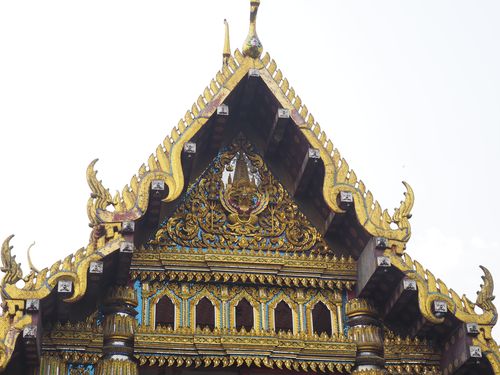
Bodhgaya • Wat Thai Buddhagaya
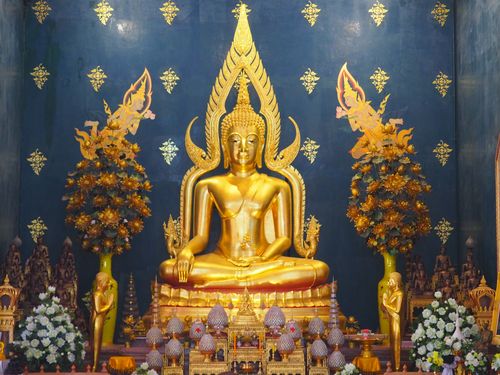
Bodhgaya • Wat Thai Buddhagaya
Monument profile
Wat Thai Buddhagaya
Monument categories: Pagoda, Buddhist temple
Monument families: Temple • Pagoda or stupa
Monument genres: Religious
Cultural heritage: Buddhist
Geographic location: Bodhgaya • Bihar • India
Construction period: 20th century AD
• Links to •
• List of videos about Bodhgaya on this site •
Bodhgaya, the Mahabodhi temple • Bihar, India
Bodhgaya, temples in town and life in a village • Bihar, India
Historical Development of Wat Thai Buddhagaya (Bodhgaya, Bihar, India)
Political and Social Context of Construction
Wat Thai Buddhagaya was established within the broader twentieth-century revival of Bodhgaya as an international Buddhist pilgrimage center. After centuries during which institutional Buddhism had largely disappeared from most of India, the site of the Mahabodhi Temple regained prominence in the nineteenth and early twentieth centuries through archaeological restoration and renewed transnational religious engagement. This reactivation of Bodhgaya encouraged Buddhist-majority countries to assert a visible presence near the place traditionally associated with the Buddha’s enlightenment.
For Thailand, where Theravāda Buddhism constitutes a central pillar of national identity, the creation of a monastery in Bodhgaya carried profound religious and symbolic significance. The Thai Sangha and state authorities viewed the project as a way to reinforce spiritual ties with India, regarded as the birthplace of Buddhism. The construction of Wat Thai Buddhagaya thus served both devotional and diplomatic objectives. It provided Thai pilgrims with a familiar religious environment while also representing Thai Buddhist tradition in an international setting.
The initiative was supported by Thai religious institutions and received encouragement from the monarchy and government. In the decades following the Second World War, Thailand pursued policies aimed at strengthening cultural diplomacy across Asia. Establishing a temple at Buddhism’s most revered site aligned with broader efforts to affirm Thailand’s role as a protector and promoter of Theravāda heritage.
Within Bodhgaya, the presence of national temples reflected a pattern of symbolic coexistence. Burmese, Tibetan, Japanese, and Chinese institutions were also constructed in proximity to the Mahabodhi Temple. Although a degree of representational competition existed—particularly regarding architectural expression and proximity to the sacred core—the atmosphere remained cooperative. Indian authorities facilitated these developments, recognizing the international character of Bodhgaya and encouraging plural religious representation under regulated urban planning frameworks.
Major Historical Developments Affecting the Site
As a modern monument, Wat Thai Buddhagaya did not experience medieval invasions, dynastic destruction, or long-term abandonment. Its history unfolded primarily within the geopolitical realities of the twentieth and early twenty-first centuries. Regional instability in parts of Southeast Asia and the broader Cold War environment influenced patterns of international travel, occasionally affecting the number of Thai pilgrims able to visit India.
Nevertheless, the monastery itself was not directly targeted by military conflict. Diplomatic relations between India and Thailand remained stable, allowing continuous institutional operation. Over time, increasing accessibility to air travel contributed to a steady growth in pilgrimage activity.
Administrative changes in India, particularly after independence in 1947, influenced regulatory oversight in Bodhgaya. The establishment of formal management structures for the Mahabodhi Temple Complex shaped land-use policies and construction regulations affecting surrounding monasteries, including Wat Thai. These changes required compliance with evolving safety and planning standards but did not disrupt religious continuity.
Throughout its existence, the temple underwent periodic renovations rather than reconstructions. Maintenance initiatives addressed structural durability, aesthetic preservation, and infrastructural modernization. There is no evidence of prolonged decline, though visitor numbers fluctuated during global crises, including economic downturns and health emergencies.
Global Context at the Time of Construction
The establishment of Wat Thai Buddhagaya coincided with a global resurgence of religious identity and monumental construction in the post-war period. Across Asia, Buddhist-majority nations invested in temple-building projects that reinforced cultural continuity and spiritual legitimacy. In Thailand, religious patronage formed an integral part of statecraft, linking monarchy, Sangha, and national identity.
Simultaneously, improvements in international transportation facilitated transnational pilgrimage. Bodhgaya evolved into a cosmopolitan religious landscape, hosting temples representing diverse Buddhist traditions. The Thai monastery participated in this broader movement of architectural internationalization, whereby sacred geography was expressed through national forms.
Comparable developments occurred elsewhere in Asia. Countries such as Japan, Sri Lanka, and Myanmar sponsored religious constructions at sites of historical or doctrinal importance. These initiatives reflected a shared understanding that architectural presence at foundational locations could strengthen cultural diplomacy and collective memory.
Wat Thai Buddhagaya thus belongs to a global phenomenon of twentieth-century religious monumentalization, characterized by the projection of national identity into shared sacred spaces.
Transformations and Urban Evolution
At the time of its construction, Bodhgaya remained a relatively modest settlement. Over subsequent decades, the expansion of pilgrimage tourism transformed the town’s infrastructure. Roads, accommodations, and commercial facilities multiplied, reshaping the urban environment surrounding the Mahabodhi Temple.
Wat Thai Buddhagaya adapted to these changes through functional expansion. Additional residential quarters for monks and facilities for visiting pilgrims were developed. Modern utilities, including electricity and improved sanitation systems, were incorporated to meet contemporary standards.
While the architectural core remained stable, the monastery’s role evolved in response to increasing international engagement. It became not only a site of worship but also a hub for cultural exchange, hosting visiting delegations and participating in inter-monastic dialogue.
No extended period of abandonment occurred. Instead, the temple’s history reflects steady institutional continuity supported by transnational networks of patronage.
Contemporary Role and Cultural Significance
Today, Wat Thai Buddhagaya functions as an active Theravāda monastery and pilgrimage center. Thai monks reside on-site, conducting rituals, meditation sessions, and educational activities aligned with the liturgical calendar. Major Buddhist commemorations—such as Vesak—draw significant numbers of visitors.
The monastery holds symbolic importance for Thailand. It represents a tangible extension of Thai religious culture within the geographic origin of Buddhism. For Thai pilgrims, the temple provides a familiar ritual context in a foreign environment. Its presence reinforces narratives of spiritual lineage connecting Southeast Asia to ancient India.
For India, the monastery contributes to Bodhgaya’s image as a global Buddhist crossroads. The coexistence of multiple national temples illustrates the pluralistic dimension of contemporary pilgrimage. In this context, Wat Thai serves both religious and diplomatic functions, embodying shared heritage while affirming distinctive identity.
Conservation Status and Modern Challenges
Wat Thai Buddhagaya does not possess individual UNESCO World Heritage designation. However, it lies within the broader regulatory framework governing the Mahabodhi Temple Complex, inscribed on the World Heritage List. Urban planning restrictions ensure that surrounding constructions do not compromise the historical integrity or visual prominence of the core monument.
Environmental factors pose ongoing challenges. Seasonal monsoon rains, high summer temperatures, and airborne pollutants affect structural materials and decorative finishes. Regular maintenance is required to preserve painted surfaces and ornamental elements.
The steady growth of pilgrimage tourism introduces issues of crowd management and infrastructural wear. Balancing accessibility with preservation remains a central concern. Collaboration between Thai monastic authorities and Indian administrative bodies supports conservation efforts.
Conclusion
Wat Thai Buddhagaya emerged from a twentieth-century context of religious revival, national identity formation, and international engagement. Its history reflects diplomatic cooperation between Thailand and India, as well as the broader transformation of Bodhgaya into a global pilgrimage center. Free from the cycles of destruction and reconstruction characteristic of many ancient monuments, the monastery’s development has been defined by continuity, adaptation, and expansion. Today, it stands as both a functioning religious institution and a symbol of enduring spiritual connections between Southeast Asia and the Indian subcontinent.
Architecture of Wat Thai Buddhagaya (Bodhgaya, Bihar, India)
Overall Design Concept and Spatial Orientation
Wat Thai Buddhagaya represents a deliberate architectural transplantation of Thai Theravāda temple design into the sacred landscape of Bodhgaya. Its composition adheres to principles characteristic of royal and monastic architecture in Thailand, while accommodating the climatic, regulatory, and spatial conditions of northern India. The complex is organized around a dominant ceremonial hall placed along a central longitudinal axis, creating a processional sequence from entrance to sanctuary.
The primary building stands slightly elevated on a plinth, a feature serving both symbolic and functional purposes. The elevation demarcates sacred territory and protects the structure from seasonal water accumulation during monsoon rains. Ancillary buildings, including monks’ residences and reception areas, are arranged around the central volume in a clear functional hierarchy. The overall layout emphasizes symmetry, axial clarity, and visual focus on the principal shrine.
Height and massing are calibrated in response to the protected status of the Mahabodhi Temple Complex nearby. Rather than competing in vertical scale, Wat Thai asserts identity through intricate roof articulation, ornamentation, and refined proportions.
Structural System and Technological Adaptation
Although its visual language derives from traditional Thai timber architecture, the temple’s structural core is constructed in reinforced concrete. This system ensures durability, seismic resistance, and stability under heavy rainfall conditions. Concrete columns and beams form a rigid frame capable of supporting multi-tiered roof structures and concentrated loads from interior statuary.
Foundation design accounts for the alluvial soils typical of the Ganges basin. Reinforced footings distribute weight evenly to prevent settlement. The structural grid is arranged to create broad interior spans within the main hall, minimizing visual obstruction and enabling unobstructed ritual assembly.
Passive climatic adaptation is integrated into the architectural design. High-pitched roofs facilitate rapid drainage during monsoon storms. Extended eaves shield walls from direct rain exposure and reduce solar heat gain. Openings positioned along opposing walls promote cross-ventilation, reducing reliance on mechanical cooling. These strategies reflect a synthesis of traditional Thai climatic solutions and modern engineering calculations.
Electrical systems, fire-resistant materials, and concealed service conduits are incorporated within the structural framework. Technical infrastructure is designed to remain visually discreet, preserving the integrity of ornamental elements.
Materials and Construction Methods
The primary structural material is reinforced concrete, chosen for longevity and structural capacity. Exterior walls combine brick masonry infill with plaster finishes, painted in tones associated with Thai religious architecture. Gold accents and polychromatic detailing are applied using weather-resistant coatings.
Roof assemblies typically consist of concrete slabs supporting decorative frameworks. Traditional glazed ceramic tiles are often replaced by lighter, durable materials that simulate the appearance of Thai temple roofing while resisting climatic stress. Ornamental gables and finials are fabricated in wood, fiberglass, or molded concrete, allowing precise detailing with reduced maintenance requirements.
Interior flooring is executed in polished stone or ceramic tile, materials capable of withstanding sustained foot traffic from pilgrims and visitors. Platforms supporting Buddha images are structurally reinforced to accommodate concentrated loads. Decorative stucco, gilded surfaces, and painted murals are applied over stable substrates designed to resist humidity.
The integration of industrial fabrication techniques with handcrafted ornamentation illustrates the modernization of Thai temple construction in the twentieth century. Prefabricated structural components coexist with artisan-crafted decorative features.
Architectural Influences and Artistic Expression
The architectural vocabulary of Wat Thai Buddhagaya derives primarily from Rattanakosin-period temple models in Thailand. Multi-tiered roofs with sharply inclined slopes define the silhouette. The upward-curving roof finials, often shaped as stylized chofah, reference mythological motifs and signify sacred elevation.
Color and ornament adhere to established Thai conventions. Red, gold, and green dominate the palette, reflecting symbolic associations with merit, purity, and spiritual authority. Intricate gable decorations incorporate floral and geometric motifs derived from Thai artistic traditions.
While the aesthetic remains distinctly Thai, adaptation to Indian building practices is evident. Wall thickness, structural detailing, and drainage solutions reflect local construction norms. The monument therefore represents a hybrid condition: visually Thai in form and ornament, structurally grounded in contemporary Indian engineering.
Interior mural programs depict episodes from the life of the Buddha and narratives from the Jataka tales. The iconographic arrangement follows Theravāda doctrinal hierarchy, centering the principal Buddha image along the axial line. The integration of narrative painting and architectural framing reinforces spatial coherence.
Spatial Organization and Notable Design Elements
Access to the main sanctuary is provided by a frontal staircase bordered by balustrades frequently ornamented with naga-inspired forms. The entrance portal emphasizes axial symmetry, guiding visitors toward the interior shrine.
The principal hall is rectangular, covered by a steeply pitched, multi-layered roof. The roof profile narrows progressively upward, creating a dynamic vertical rhythm. Internally, columns are arranged in symmetrical rows supporting concealed structural beams. The open-plan layout accommodates collective chanting and ceremonial gatherings.
Unlike Islamic or Hindu architectural forms present elsewhere in India, the temple does not incorporate domes, minarets, or arcuated systems. Horizontal lintels and layered rooflines dominate the structural expression. Ceiling surfaces may feature painted patterns or gilded motifs aligned with the central axis.
Secondary pavilions serve residential and administrative functions. Their architectural treatment is consistent with the main hall, though scaled appropriately. Circulation paths are direct and clearly defined, ensuring efficient movement during major ceremonies.
Distinctive Structural Characteristics
A defining characteristic of the temple is the separation between structural function and decorative articulation. In historical Thai architecture, elaborate timber joinery played a primary load-bearing role. In Wat Thai Buddhagaya, reinforced concrete assumes structural responsibility, while decorative brackets and roof elements function symbolically.
Integrated drainage systems manage heavy rainfall through concealed channels and downspouts embedded within the architectural composition. Fire-resistant materials meet contemporary safety standards, essential for a building accommodating large congregations.
The structural rationality allows for a degree of dimensional stability not achievable with traditional timber construction. This ensures longevity in a climate subject to extreme seasonal variation.
Dimensions and Noteworthy Details
The main ceremonial hall rises to a height accentuated by stacked roof tiers, enhancing interior air circulation and visual grandeur. The central Buddha statue, often several meters tall, commands the spatial focus. Its installation required careful engineering to distribute weight across reinforced flooring systems.
The floor area of the principal hall supports large congregations during major Buddhist observances. While not monumental in comparison to Thailand’s royal temples, the scale is significant within Bodhgaya’s urban context.
Accounts indicate that certain ornamental components were produced by Thai artisans or crafted according to Thai design specifications. Transporting and assembling these elements required logistical coordination, underscoring the transnational dimension of the construction process.
International Recognition and Conservation Challenges
Although Wat Thai Buddhagaya is not individually inscribed as a UNESCO World Heritage Site, it stands within the regulated environment surrounding the Mahabodhi Temple Complex. Height restrictions and visual impact guidelines influence architectural interventions.
Environmental pressures include airborne dust, humidity, intense sunlight, and seasonal rainfall. Painted surfaces and gilded decorations require periodic restoration to maintain aesthetic integrity. Increasing visitor numbers contribute to wear on flooring and structural finishes.
Urban densification around the temple presents additional conservation concerns. Managing crowd flow while preserving architectural coherence necessitates ongoing collaboration between Thai monastic authorities and Indian administrative bodies.
Conclusion
The architecture of Wat Thai Buddhagaya embodies a precise adaptation of Thai Theravāda temple design to the technical and environmental conditions of Bodhgaya. Reinforced concrete frameworks, climate-responsive features, and elaborate roof ornamentation coexist within a coherent spatial hierarchy. The building achieves durability without compromising stylistic authenticity. Through its structural rationality and decorative refinement, the monument contributes a distinct architectural presence to Bodhgaya’s international monastic landscape while maintaining fidelity to Thai religious tradition.