

 Français (France)
  Nederlands (nl-NL)
 The Shwedagon Pagoda, located in Yangon in Myanmar, is one of the most important Buddhist sanctuaries in the country and a major symbol of Burmese spirituality. For centuries the site has functioned as a significant place of pilgrimage and religious gathering. It occupies a central role in the religious and cultural life of Myanmar while also attracting visitors from around the world who come to observe its spiritual and historical importance. The pagoda is closely associated with longstanding religious traditions that remain deeply embedded in Burmese society, and it continues to serve as an active center for worship, public ceremonies, and communal devotion.

Monument profile
Shwedagon pagoda
Monument categories: Pagoda, Stupa
Monument family: Pagoda or stupa
Monument genre: Religious
Cultural heritage: Buddhist
Geographic location: Yangon • Myanmar
Construction period: 6th century AD
• Links to •
• This monument illustrates the following theme •
Buddhist architecture • Stupas : Diversity of Stupas in Asia
• List of videos about Yangon on this site •
Yangon, a walk in the city • Myanmar
Yangon, Shwedagon pagoda • Myanmar
• References •
Wikipedia FR: Pagode Shwedagon
Wikipedia EN: Shwedagon Pagoda
UNESCO: Shwedagon Pagoda on Singuttara Hill
History of the Shwedagon Pagoda
Political and Religious Context of the Foundation
The Shwedagon Pagoda in Yangon is one of the most revered Buddhist monuments in Southeast Asia and has long been regarded as a central symbol of religious devotion in Myanmar. According to traditional accounts preserved in Burmese chronicles and religious literature, the origins of the shrine date back to the lifetime of the historical Buddha. Two merchant brothers from the region, Tapussa and Bhallika, are said to have encountered the Buddha in northern India and received several strands of his hair as sacred relics. These relics were reportedly enshrined on Singuttara Hill, a site already associated with earlier Buddhist relics and regarded as spiritually significant.
Although these narratives belong largely to the religious tradition rather than to verifiable historical documentation, they illustrate the ideological importance of relic worship in early Buddhist communities. The establishment of a shrine housing relics served both a devotional purpose and a political one. Possession of sacred relics was widely interpreted as a sign of divine favor and legitimacy, enabling rulers to reinforce their authority by associating themselves with the protection of Buddhism.
In the centuries that followed, the shrine developed into an important pilgrimage center. As Buddhist kingdoms emerged across the region, rulers supported the expansion of the sanctuary in order to strengthen their political standing and demonstrate their commitment to the religion. Patronage of religious monuments became a fundamental element of statecraft throughout mainland Southeast Asia, and the Shwedagon Pagoda gradually evolved into one of the most prominent expressions of this relationship between kingship and religious authority.
Development under Burmese Kingdoms
The growth of the Shwedagon Pagoda is closely connected to the history of successive Burmese kingdoms. From the fourteenth and fifteenth centuries onward, the site received sustained royal patronage from the rulers of the Mon kingdom of Hanthawaddy, whose capital was located at Bago. During this period, the sanctuary underwent substantial enlargement and renovation.
One of the most influential patrons was Queen Shin Sawbu in the fifteenth century. Historical traditions credit her with donating large quantities of gold to cover the stupa, symbolically offering her own weight in precious metal for the embellishment of the shrine. Her successor, King Dhammazedi, continued these works and reinforced the religious prestige of the monument by sponsoring inscriptions and ceremonial dedications.
Later Burmese dynasties also contributed to the expansion and restoration of the pagoda. The rulers of the Toungoo and Konbaung kingdoms carried out repeated renovations, particularly after natural disasters damaged the structure. Earthquakes in the region periodically affected the monument, leading to reconstruction efforts that gradually transformed the shrine into the monumental complex visible today.
These continuous interventions added terraces, auxiliary shrines, and ceremonial structures around the central stupa. Over time, the pagoda became not only a religious sanctuary but also an architectural focal point within the evolving urban landscape of the region.
Wars, Occupations, and Colonial Transformations
The nineteenth century introduced a new phase in the history of the Shwedagon Pagoda, as Burma became increasingly affected by European colonial expansion. During the First Anglo-Burmese War between 1824 and 1826, British forces occupied Singuttara Hill because of its strategic position overlooking the surrounding plains and the port area that would later develop into Yangon.
The hill was again militarized during the Second Anglo-Burmese War in 1852. British troops established fortifications on the terraces of the pagoda and used the elevated site as a defensive position. These military occupations caused damage to several religious structures and temporarily disrupted the traditional activities associated with the sanctuary.
Despite these events, the pagoda remained a powerful symbol of Burmese cultural and religious identity. During the colonial period, it gradually became a focal point for expressions of national sentiment. Public gatherings, religious ceremonies, and political demonstrations occasionally took place on the site, reinforcing its symbolic significance beyond the strictly religious sphere.
Global Context of Monumental Religious Construction
The development of the Shwedagon Pagoda can be understood within a broader historical context of monumental religious construction across Asia. Throughout the first and second millennia, many Buddhist kingdoms constructed large reliquary monuments as expressions of faith and political legitimacy.
Across South Asia and Southeast Asia, stupas and temple complexes were erected to house sacred relics and to serve as centers of pilgrimage. These monuments reflected both religious devotion and the authority of ruling dynasties. In many cases, rulers sponsored the construction of monumental sanctuaries in order to strengthen the cohesion of their kingdoms and promote a shared cultural identity.
Within this broader pattern, the Shwedagon Pagoda stands out because of its continuous development over many centuries and its enduring role in Burmese religious life. While its architectural form evolved through successive reconstructions, the central concept of a relic shrine remained unchanged.
Transformations and Urban Evolution
The transformation of Yangon during the colonial era significantly altered the environment surrounding the pagoda. As the city expanded into a major administrative and commercial center under British rule, new roads, residential districts, and public buildings appeared around Singuttara Hill.
Despite these changes, the pagoda maintained its dominance over the urban skyline. The elevation of the hill ensured that the stupa remained visible from many parts of the city, reinforcing its symbolic presence within the evolving colonial landscape.
After Myanmar gained independence in 1948, the pagoda continued to play an important role in the cultural and religious life of the nation. Government authorities and religious organizations undertook various restoration programs to stabilize the structure and preserve its decorative elements. Improvements were also made to accommodate the growing number of pilgrims visiting the site.
Contemporary Role and Cultural Importance
Today the Shwedagon Pagoda is widely regarded as the most sacred Buddhist site in Myanmar. Pilgrims from across the country travel to Yangon to pay homage, perform rituals, and participate in religious festivals. The sanctuary remains an active center of devotion, where offerings, meditation practices, and ceremonial gatherings take place throughout the year.
Beyond its religious significance, the pagoda occupies an important place in the cultural identity of the nation. It serves as a powerful symbol of continuity between Myanmar’s historical traditions and its modern society. Major public events and national commemorations are sometimes associated with the site, reflecting its enduring role in collective memory.
The monument also attracts visitors from around the world who come to observe its cultural and spiritual significance. Its presence contributes significantly to the international recognition of Yangon as one of the historical capitals of mainland Southeast Asia.
Conservation and Modern Challenges
Preserving the Shwedagon Pagoda presents ongoing challenges due to environmental and structural factors. The tropical climate exposes the monument to heavy rainfall, humidity, and temperature variations that can affect building materials. Periodic seismic activity in the region also requires careful monitoring of the structure.
Maintenance and restoration are therefore continuous processes. Traditional techniques are often employed alongside modern conservation methods in order to maintain the historical integrity of the monument while ensuring its long-term stability.
Although the pagoda has not yet been formally inscribed on the UNESCO World Heritage List, it is widely recognized as one of the most significant religious monuments in Southeast Asia. Its historical development reflects the interplay of religion, politics, and culture over many centuries, making it an essential reference point for understanding the history of Myanmar and the broader Buddhist world.
Architecture of the Shwedagon Pagoda
Architectural Design and Structural Innovations
The Shwedagon Pagoda represents one of the most accomplished expressions of Buddhist monumental architecture in Myanmar. Rising from Singuttara Hill in Yangon, the complex was designed to integrate religious symbolism with practical architectural solutions adapted to the climate, terrain, and ritual functions of the site. Its commanding position above the surrounding city not only enhances its visibility but also reflects the traditional Buddhist concept of sacred elevation, where religious monuments are placed on prominent natural features.
The central structure is a stupa, a reliquary monument characteristic of Buddhist architecture across South and Southeast Asia. In the Burmese tradition, the stupa developed into a distinctive vertical form composed of a sequence of geometric volumes rising in a smooth, continuous profile. At Shwedagon, the stupa stands on a broad circular base that gradually narrows as it rises, creating a balanced structure capable of distributing the weight of the monument toward its foundation.
One of the principal architectural innovations of the monument lies in the combination of mass and elevation. The stupa reaches approximately 99 meters in height while maintaining structural stability through a thick masonry core. The tapered profile reduces lateral stress and helps the structure resist seismic vibrations, an important consideration in a region where earthquakes occur periodically.
The design also reflects careful consideration of environmental conditions. The platform terraces are slightly inclined, allowing rainwater to drain efficiently during the monsoon season. The open layout of the surrounding terraces encourages natural air circulation, reducing humidity and heat accumulation within the complex. These adaptations demonstrate the builders’ understanding of both structural engineering and environmental constraints.
Materials and Construction Techniques
The structural core of the Shwedagon Pagoda is built primarily of brick masonry. Brick construction has long been a defining feature of monumental architecture in mainland Southeast Asia, offering durability, ease of production, and flexibility in shaping large curved forms such as stupas.
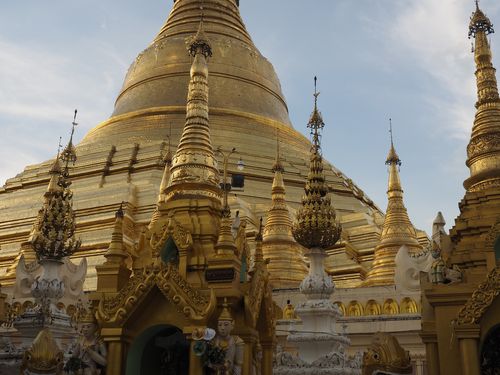
The masonry core is coated with layers of lime-based plaster that create a smooth exterior surface. This outer layer provides both protection and an ideal base for the decorative elements that give the monument its distinctive appearance. The entire exterior of the stupa is covered with gold plates, applied through repeated acts of religious donation by devotees. The continuous addition of gold over centuries has produced the brilliant golden surface that has become the pagoda’s defining visual characteristic.
At the summit of the monument stands the hti, an elaborate umbrella-shaped finial that is unique to Burmese stupa architecture. The hti consists of a complex metal framework supporting multiple rings, bells, and decorative elements. Precious stones and diamonds are set into the structure, while small bells suspended along the rings produce soft sounds when moved by the wind. This crowning element not only enhances the monument’s visual impact but also symbolizes the spiritual authority associated with the sacred relics housed within the stupa.
The surrounding pavilions and gateways incorporate a wider range of materials. Wood, lacquered surfaces, gilded metalwork, and decorative stone elements are used extensively in these auxiliary structures. Wooden beams and carved panels demonstrate the sophistication of traditional Burmese craftsmanship, particularly in the roof structures that shelter pilgrims ascending the hill.
Artistic Influences and Regional Traditions
The architectural language of the Shwedagon Pagoda reflects a synthesis of influences drawn from several historical traditions. The fundamental concept of the stupa originated in ancient India as a reliquary mound associated with the early spread of Buddhism. As the religion expanded into Southeast Asia, the stupa form was gradually adapted to local artistic traditions.
In Myanmar, this evolution produced a distinctive architectural style characterized by tall, slender stupas with richly ornamented surfaces. The Shwedagon Pagoda exemplifies this tradition through its harmonious proportions and its extensive decorative program.
The terraces surrounding the central stupa are populated with smaller shrines, statues of the Buddha, and symbolic structures representing planetary deities associated with the Burmese astrological system. These elements illustrate the integration of Buddhist religious practices with local cosmological beliefs.
The entrance pavilions leading to the upper platform also demonstrate the influence of Burmese royal architecture. Their tiered roofs, known as pyatthat structures, are composed of multiple superimposed levels that taper upward. This design was traditionally associated with royal and sacred buildings and signals the elevated status of the pagoda within the cultural hierarchy of Burmese architecture.
Decorative motifs found throughout the complex include floral patterns, mythical creatures, and symbolic guardians derived from Buddhist cosmology. These elements contribute to a visual environment that combines religious symbolism with artistic expression.
Spatial Organization of the Sacred Complex
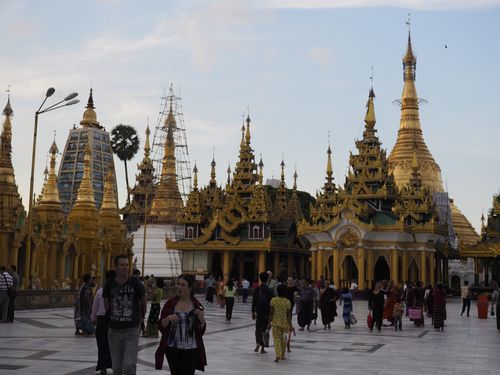
The Shwedagon Pagoda is not a single structure but a vast architectural ensemble organized around the central stupa. The entire complex occupies a large platform at the summit of Singuttara Hill. Access to this platform is provided by several monumental stairways that ascend the hill from different directions.
These stairways are enclosed by long covered corridors that gradually guide visitors upward. The corridors serve both practical and ceremonial purposes. They provide shelter from the tropical climate while also creating a transitional space that prepares pilgrims for entry into the sacred precinct.
At the summit, the platform forms a wide open terrace surrounding the central stupa. This terrace functions as the main ritual space where devotees perform circumambulation, a traditional Buddhist practice involving walking clockwise around the sacred monument.
The perimeter of the platform is lined with numerous subsidiary shrines, prayer halls, and pavilions. Each of these structures serves a specific ritual or devotional function. Some contain large statues of the Buddha, while others are dedicated to planetary posts corresponding to the days of the week in the Burmese astrological system.
Large ceremonial bells are also located within the complex. These bells are traditionally struck by worshippers after making offerings or prayers, symbolizing the sharing of merit with all beings.
Dimensions and Notable Architectural Features
The central stupa of the Shwedagon Pagoda reaches a height of approximately 99 meters, making it one of the tallest religious monuments in Myanmar. Because the pagoda stands on an elevated hill, its total visual prominence above the surrounding landscape is even greater.
The monument’s surface is covered with thousands of gold plates donated by worshippers. The cumulative weight of these plates is substantial, reflecting centuries of religious patronage. The upper sections of the stupa and the hti are adorned with numerous precious stones, including diamonds and other gemstones that catch and reflect sunlight.
Several monumental guardian statues stand at the entrances of the stairways leading to the platform. These figures represent mythological beings traditionally believed to protect sacred sites. Their scale and placement emphasize the ceremonial character of the approach to the shrine.
The platform also includes numerous smaller stupas and memorial structures constructed at different times in the monument’s history. These additions contribute to the layered architectural character of the site, illustrating the cumulative development of the complex over many centuries.
Architectural Significance and Conservation
The architectural importance of the Shwedagon Pagoda extends far beyond its national context. As one of the most prominent examples of Buddhist stupa architecture in Southeast Asia, it represents a culmination of centuries of architectural experimentation and religious patronage.
The monument’s distinctive golden appearance, monumental scale, and complex spatial organization have made it an enduring symbol of Myanmar’s cultural heritage. Its architecture demonstrates how religious devotion, royal patronage, and local craftsmanship combined to create one of the most recognizable sacred landscapes in the Buddhist world.
Conservation of the monument remains a continuous process. The tropical climate, heavy rainfall, and seismic risks require ongoing maintenance of both structural and decorative elements. Restoration work is regularly undertaken to reinforce the masonry core, replace damaged materials, and renew the gold plating applied to the exterior surfaces.
Urban expansion around Yangon has transformed the environment surrounding Singuttara Hill, yet the pagoda continues to dominate the skyline. Its architecture remains a defining feature of the city’s identity and a central reference point in the religious and cultural life of Myanmar.