

 Français (France)
  Nederlands (nl-NL)
 Map of videos including a monument related to the theme featured on this page
• Use the markers to explore the content •
Gurdwaras are the places of worship in Sikhism, a religion founded in the 15th century in Punjab by Guru Nanak. This theme brings together key monuments that reflect the spiritual and geographic breadth of Sikh heritage in India-from the historic heartland of Punjab to Delhi, Ladakh, and Bihar.
Each of these buildings embodies religious devotion, community service (langar), and the memory of the Sikh Gurus. The Golden Temple in Amritsar stands as the spiritual center of Sikhism, welcoming millions of visitors each year. Nearby, the Gurdwara Baba Atal Rai and the Langar Hall highlight the social and charitable dimensions of Sikh practice. Other major pilgrimage sites are found in Delhi and Patna, while the gurdwara in Leh, Ladakh, represents the historical reach of Sikh presence into the Himalayas.
Grouped under the family “Temples” and the category “Gurdwaras,” these monuments reflect a living religious tradition founded on openness, equality, and service. Their architectural variety speaks to both their regional roots and national significance.
The Gurdwara as an Expression of Sikh Faith and Community
Sacred spaces centred on the Guru Granth Sahib
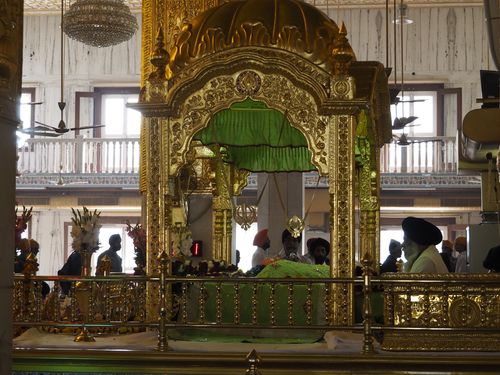
The gurdwara, literally the “gateway to the Guru,” is the principal place of worship in Sikhism. Its function differs from that of a temple devoted to a deity represented in material form. The religious space is organised around the Guru Granth Sahib, the sacred scripture regarded by Sikhs as the living and permanent Guru. Installed beneath a canopy in the prayer hall, it forms the symbolic and ritual centre of the building.
The gurdwaras of Amritsar, Delhi, Patiala, Patna, and Leh belong to different historical and geographical settings, yet they share this fundamental organisation. The prayer hall enables worshippers to sit together, listen to readings from the scripture, and participate in devotional singing. Seating participants at the same level expresses the principle of equality that occupies a central place in Sikh belief and communal practice.
The Gurus and the geography of Sikh memory
The development of the gurdwara network is closely connected with the lives of the ten Sikh Gurus. In Amritsar, the Golden Temple, or Sri Harmandir Sahib, stands at the centre of a city established as the foremost spiritual centre of Sikhism. The nearby Gurdwara Baba Atal Rai commemorates Baba Atal, the son of Guru Hargobind, and demonstrates the importance of personal and religious memory within the sacred landscape of Amritsar.
Other sanctuaries commemorate events far beyond Punjab. Gurdwara Bangla Sahib in Delhi is associated with Guru Har Krishan, who stayed at the site and assisted local inhabitants during an epidemic. Gurdwara Patna Sahib marks the birthplace of Guru Gobind Singh and ranks among the principal seats of Sikh religious authority. In Leh, Gurdwara Sri Datun Sahib preserves the tradition of a visit by Guru Nanak to the Himalayan region. Together, these sites form a religious geography extending across northern India.
An architecture shaped by regional traditions
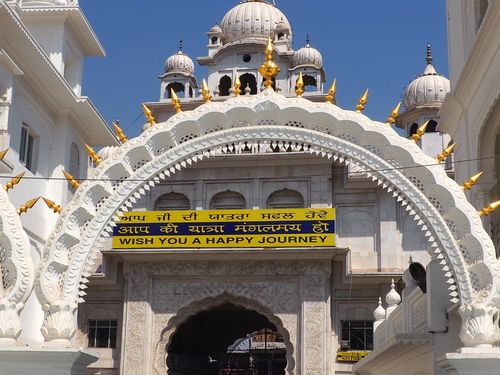
Gurdwaras do not follow a single fixed architectural model. Their appearance reflects adaptations to the materials, building techniques, and artistic traditions of the regions in which they were constructed. Domes, corner pavilions, cusped arches, galleries, and floral decoration often reveal exchanges with Mughal and Rajput architecture. These elements are nevertheless incorporated into buildings designed for specifically Sikh forms of worship and community service.
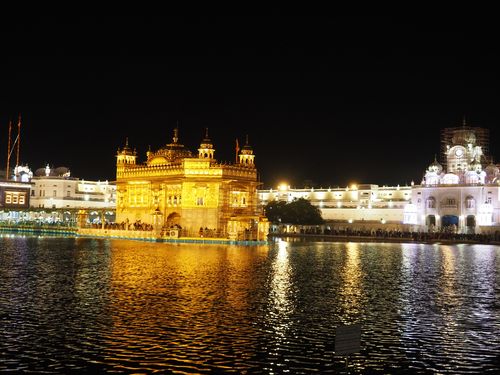
The Golden Temple provides a prominent example of this synthesis. Its sanctuary, positioned within a sacred pool, combines a marble-clad lower section with upper surfaces covered in gilded metal. Its domes, inlaid decoration, and ornamental details draw on several artistic traditions of northern India. Gurdwara Baba Atal Rai is distinguished by its tall, multi-storeyed, octagonal structure, while the complexes at Delhi, Patiala, and Patna use broad pale façades, dominant domes, and extensive facilities designed to accommodate large numbers of worshippers.
Water, access, and visible identity
Several major gurdwaras are associated with a sacred pool, or sarovar, used for devotional bathing and ritual purification. At Amritsar, the pool surrounds the central sanctuary and determines the organisation of the entire complex. The causeway leading to Sri Harmandir Sahib establishes a processional transition between the surrounding walkway and the religious centre. Water also occupies an important place in the traditions and physical arrangements of Bangla Sahib and Dukh Niwaran Sahib.
Entry to a gurdwara follows widely shared practices. Visitors remove their shoes, cover their heads, and generally wash their feet before entering the principal spaces. Outside, the Nishan Sahib, a tall flagpole carrying the Sikh flag, identifies the building in its urban or rural setting. It announces both a place of worship and a centre offering assistance and hospitality. These features provide functional coherence to complexes that otherwise vary considerably in size and appearance.
The langar as an architectural and social institution
A gurdwara is not limited to its prayer hall. It normally includes a langar, consisting of a community kitchen and dining area where vegetarian meals are served without charge or distinction of religion, origin, or social status. This practice translates the principle of equality into a physical and organisational system. Kitchens, storerooms, food-preparation areas, washing facilities, and communal dining halls are therefore essential parts of the architectural programme.
The Langar Hall of the Golden Temple demonstrates the scale this function can reach at a major pilgrimage centre. Its operation depends on volunteer service, collective food preparation, and the capacity to receive large numbers of visitors each day. The architecture must facilitate circulation, continuous cleaning, the storage and preparation of ingredients, and the rapid succession of meals. Seva, or selfless service, consequently shapes both the use of the building and the relationship between religious practice and community life.
Historical monuments in continuing use
The selected gurdwaras are simultaneously historical monuments and active religious institutions. Their maintenance does not consist solely of preserving a particular architectural state. Extensions, restorations, and decorative renewals respond to the continuity of worship and changing levels of attendance. Marble surfaces, gilded decoration, accommodation facilities, and expanded langar infrastructure demonstrate how these complexes continue to adapt while retaining their principal religious functions.
From the extensive urban complex of Amritsar to the smaller Himalayan sanctuary at Leh, these buildings share an emphasis on sacred memory, scripture, assembly, and service. Their unity does not depend on a uniform architectural style but on a common set of functions and principles. The presence of the Guru Granth Sahib, open access, collective worship, shared meals, and volunteer participation define an architecture in which religious space remains inseparable from community life.
Major Gurdwaras and Community Institutions of Sikhism in India
India
Bihar, Patna • Gurdwara Patna Sahib Gurdwara Patna Sahib, also known as Takht Sri Harmandir Sahib, stands in the historic Patna City district. It marks the birthplace of Guru Gobind Singh, the tenth Sikh Guru, who was born in Patna in 1666. This association gives the sanctuary the status of a takht, one of the principal seats of Sikh religious authority. The present complex reflects several phases of reconstruction, including work following a nineteenth-century fire. Its architecture combines pale façades, domes, corner pavilions, and facilities for pilgrims. The Guru Granth Sahib occupies the central place in the prayer hall, while various objects are traditionally associated with Guru Gobind Singh.
Delhi (NCT), Delhi • Gurdwara Bangla Sahib Located near Connaught Place in central Delhi, Gurdwara Bangla Sahib occupies the site of a former aristocratic residence where Guru Har Krishan stayed during the seventeenth century. According to Sikh tradition, the eighth Guru assisted inhabitants during an epidemic before dying from illness. A large pool, or sarovar, recalls the importance attributed to water in this episode. The complex is recognisable by its white marble surfaces, gilded domes, and tall Nishan Sahib flagpole. In addition to the prayer hall containing the Guru Granth Sahib, it includes a community kitchen, dining areas, accommodation, and charitable services. The sanctuary demonstrates how a major gurdwara functions within a dense modern city.
Ladakh, Leh • Gurdwara Sri Datun Sahib Gurdwara Sri Datun Sahib is situated in Leh, within a region shaped mainly by Tibetan Buddhism and Islam. It commemorates a traditional account of Guru Nanak’s travels through the Himalayan territories. The word datun refers to a wooden twig used for cleaning the teeth, and the sanctuary is associated with a tree believed to have grown from a twig left there by the Guru. Modest in scale compared with the complexes of Amritsar, Delhi, and Patna, it serves as a local place of remembrance and worship. Its presence illustrates how narratives of Guru Nanak’s journeys contributed to a network of Sikh sites extending far beyond Punjab.
Punjab, Amritsar • Golden Temple The Golden Temple, or Sri Harmandir Sahib, is the foremost spiritual centre of Sikhism. Its sanctuary stands within the Amrit Sarovar, the sacred pool around which the city of Amritsar developed. Reached by a causeway, the building combines a marble-clad lower section with upper surfaces covered in gilded metal. Domes, arches, inlaid work, and floral decoration reflect interaction with several artistic traditions of Mughal and Rajput India. The Guru Granth Sahib is read and sung there daily before being carried ceremonially to the Akal Takht. Four entrances are commonly interpreted as symbols of openness. The pool, surrounding walkway, central sanctuary, and community buildings form an integrated religious complex.
Punjab, Amritsar • Gurdwara Baba Atal Rai Gurdwara Baba Atal Rai stands near the Golden Temple in the religious centre of Amritsar. It commemorates Baba Atal, a son of Guru Hargobind, the sixth Sikh Guru. The building is distinguished by its tall octagonal tower of several storeys, a form that contrasts with the predominantly horizontal arrangement of many gurdwaras. Its height makes it a prominent feature of the surrounding urban landscape. The interior contains murals representing episodes from the lives of the Gurus and Sikh tradition. Its superimposed levels and domed crown give the structure the character of both a commemorative tower and a place of worship, broadening the architectural range represented within Amritsar.
Punjab, Amritsar • Langar Hall of the Golden Temple The Langar Hall forms part of the Golden Temple complex but performs a different function from the central sanctuary and prayer spaces. It provides free vegetarian meals to visitors without distinction of religion, origin, or social position. Rooted in the teachings of the Sikh Gurus, this practice gives material expression to equality, sharing, and selfless service. The building includes kitchens, preparation areas, storerooms, washing facilities, and large dining halls where participants sit together at the same level. Its organisation supports a high daily attendance and depends substantially on volunteer work. The hall demonstrates that a gurdwara’s architecture encompasses the practical infrastructure required for hospitality and communal life.
Punjab, Patiala • Gurdwara Shri Dukh Niwaran Sahib Gurdwara Shri Dukh Niwaran Sahib is located in Patiala and is traditionally associated with a visit by Guru Tegh Bahadur, the ninth Sikh Guru. Local accounts relate that inhabitants sought his help during an epidemic affecting the area. The sanctuary developed around the place connected with this event, beside a pool to which worshippers attach religious significance. The present complex has pale façades, a central dome, prayer spaces, and facilities for the langar and the reception of visitors. Its name refers to release from suffering. Like Gurdwara Bangla Sahib, it combines the memory of a Guru, the symbolic role of water, active worship, and continuing community service.