Français (France)
  Nederlands (nl-NL)
 The Pinjrapole Gaushala in Amritsar, Punjab, is an institution devoted to the care and protection of cattle, mainly abandoned or elderly cows. Operated as a charitable organization, it reflects the Indian principle of ahimsa, or non-violence toward living beings. The facility combines traditional practices with modern management to ensure animal welfare and promote sustainability. It also serves a social and educational function by encouraging compassion for animals and awareness of rural resources among the urban population.
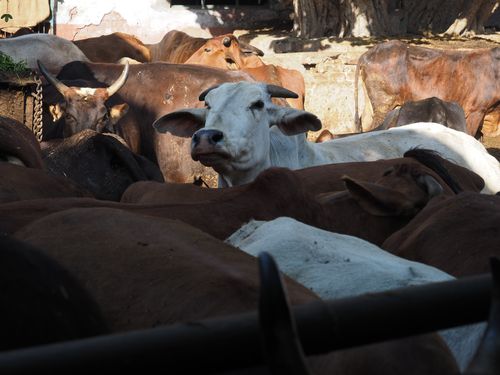
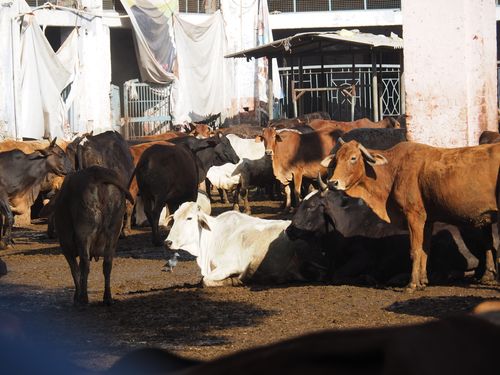

Pinjrapole Gaushala
Pinjrapole Gaushala of Amritsar: Origins, Evolution, and Continuity of a Sacred Refuge
Foundation and Early Context
The Pinjrapole Gaushala of Amritsar, founded around 1888, emerged from the religious and social philosophy of ahimsa, or non-violence toward all living beings. During the late nineteenth century, Amritsar—already a thriving commercial and spiritual hub of the Punjab—faced the dual challenge of rapid urbanization and the growing number of stray animals in its streets. Prominent Bania merchants, along with Jain patrons and Hindu philanthropists, established a shelter to house and care for abandoned cattle, both as a moral act and as a public health necessity.
Municipal records from 1892 mention approximately 70 cows living on a two-acre plot donated by a local trader. The initiative relied on daily in-kind offerings—grain, salt, straw, and molasses—collected from markets and temples. From the outset, the Gaushala functioned not only as a refuge for animals but also as a civic institution blending religious devotion and urban hygiene.
Institutional Growth and Colonial Recognition
Between 1895 and 1915, the Gaushala expanded through donations of land and the involvement of local guilds. A well, watering trough, and a small animal dispensary were added to improve facilities. In 1915, a formal management committee was created to oversee finances and ensure the sustainability of operations. By the late 1920s, the complex covered more than two hectares, housing over 200 cattle. Its ornate gateway, completed in 1928, remains a landmark of religious philanthropy.
The British municipal authorities soon acknowledged the Gaushala’s public value. A 1934 city report recorded that it accounted for roughly 3% of Amritsar’s sanitation budget, integrating the shelter into the civic health framework. By 1932, the population of cows exceeded 250, and the site had become an emblem of the collaboration between moral duty and colonial urban policy.
Partition and Post-Independence Transformation
The Partition of India in 1947 brought immense disruption. As populations migrated, countless animals were left behind. The Gaushala suddenly hosted more than 600 cattle, far exceeding its capacity. In response, the Punjab government granted additional land, expanding the premises to about three hectares. A permanent veterinary post was established in the early 1950s, and quarantine areas were introduced to prevent epidemics. By 1960, the number of animals stabilized around 400, and the institution regained balance after a decade of crisis.
Throughout the 1970s, improvements focused on sanitation, drainage, and fodder storage. The Gaushala obtained charitable trust status in 1985, making it eligible for tax exemptions and public grants. A modern veterinary center was inaugurated in 1991, providing vaccinations and medical care free of charge. Partnerships with the Ludhiana Agricultural University further reinforced technical standards.
Innovation and Modern Role
Since 2010, the Gaushala has integrated environmental objectives into its spiritual mission. A biogas plant installed in 2015 now processes animal waste, supplying up to 30% of the site’s energy needs. Compost produced from manure is sold to local farmers, linking religious compassion to ecological sustainability. In 2024, the Gaushala shelters roughly 550 cattle and receives nearly 900 admissions annually, financed by a yearly budget of about 15 million rupees, 70% of which comes from private donations.
Today, the Pinjrapole Gaushala of Amritsar stands as a living synthesis of faith, philanthropy, and environmental management—a heritage institution that continues to serve both the sacred and civic life of Punjab.
Pinjrapole Gaushala of Amritsar: Social Ecology and the Moral Economy of Compassion
Governance and Funding Framework
The Gaushala operates under a community-based management system combining religious devotion and civic responsibility. A board of twelve volunteer trustees supervises a staff of 35–40 employees, including herders, caretakers, administrative clerks, and veterinary assistants. The budget structure reflects a diversified economy: 70% private donations, 20% public subsidies, and 10% income from compost and biogas sales. The daily fodder requirement averages three tons, representing more than half of the institution’s total expenditures.
The Culture of Giving
At the heart of the Gaushala’s endurance lies the Hindu and Jain ethic of dāna, or altruistic giving. Donors bring food, fodder, or cash offerings, particularly during religious festivals such as Navratri and Diwali. Contributing to a cow’s well-being is viewed as an act of virtue ensuring spiritual merit. Since 2020, the Gaushala has introduced online donations and animal sponsorships, allowing members of the Punjabi diaspora to participate remotely. These innovations doubled the volume of contributions over three years, illustrating how traditional ethics adapt to modern connectivity.
Daily Routines and Educational Role
The Gaushala functions like a small ecosystem. Every morning begins with the Gomata Puja, a collective prayer performed by workers and visitors. After cleaning and feeding, the staff attends to veterinary duties and public visits. About 1,800 to 2,000 students visit annually through school programs promoting compassion and environmental awareness. Exhibitions explain the processes of composting and biogas generation, linking religion, ecology, and science within a coherent civic framework.
Labor, Gender, and Transmission of Knowledge
Division of labor remains pragmatic: men manage transportation and animal care, while women oversee administration and public relations. The staff’s average tenure of nine years ensures continuity in practical knowledge—disease prevention, fodder selection, and animal behavior. The Gaushala also serves as a training site for veterinary students, who complete around 20 internships per year under supervision. This circulation of expertise fosters a bridge between traditional compassion and modern veterinary science.
Civic Function and Environmental Value
Beyond its religious foundations, the Gaushala plays a crucial civic role. It cooperates with the municipal council to rescue 20–25 stray cattle per month, providing treatment and temporary shelter before relocation to rural areas. Each year, the biogas plant converts waste from over 500 animals into clean energy, and the 40 tons of compost produced are sold at subsidized prices to local farmers. These efforts have transformed the institution into a model of urban environmental management in Punjab.
A Symbol of Urban Solidarity
The Pinjrapole Gaushala of Amritsar stands as a moral center where religious, civic, and ecological concerns converge. In a rapidly modernizing city, it offers a space where compassion is practiced collectively rather than merely preached. By integrating spiritual ideals with tangible social utility, the Gaushala embodies the resilience of Indian traditions in the contemporary world—an enduring reminder that reverence for life remains a viable foundation for social harmony and ecological balance.
 Links to the main sections of the site