

 Français (France)
  Nederlands (nl-NL)
 The Golden Temple, officially known as Harmandir Sahib, is the most important shrine of Sikhism. It is located in Amritsar, in the state of Punjab. The complex represents a central spiritual and symbolic reference for Sikhs worldwide. Open to all visitors regardless of background or belief, it reflects the core Sikh principles of equality, service, and community. The site also includes communal facilities and receives large numbers of pilgrims and visitors every day. It remains an active place of worship and a significant landmark in India’s religious landscape.
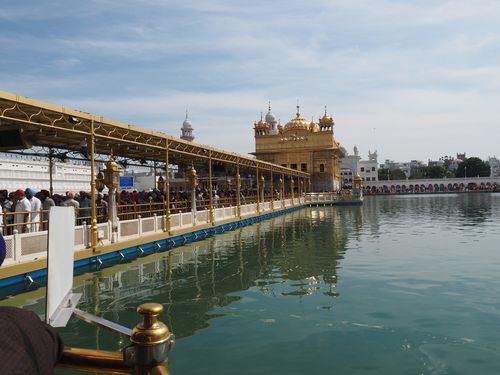
Amritsar • Golden Temple
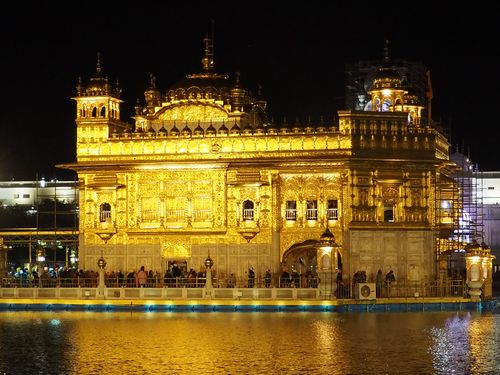
Amritsar • Golden Temple
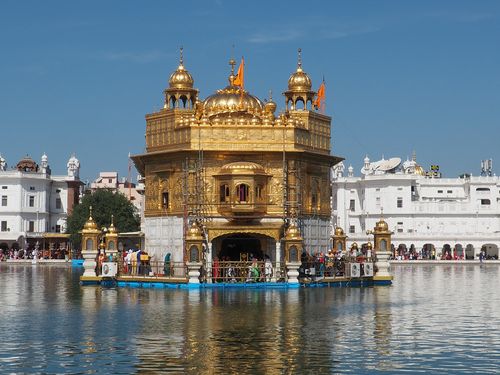
Amritsar • Golden Temple
Monument profile
Golden Temple
Monument categories: Gurdwara, Sikh temple
Monument families: Temple • Gurdwara
Monument genres: Religious
Cultural heritage: Sikh
Geographic location: Amritsar • Punjab • India
Construction period: 16th century AD
• Links to •
• This monument illustrates the following theme •
Temples • Gurdwaras : Sikh temples in India
• List of videos about Amritsar on this site •
Amritsar, Holy City of Sikhism • Punjab, India
• References •
Wikipedia EN: Golden Temple
UNESCO: Sri Harimandir Sahib, Amritsar, Punjab
• Sources •
Digital Sources
- Encyclopaedia Britannica - Golden Temple
- SikhiWiki - Golden Temple
- SikhNet - Golden Temple: Then and Now
Books and Publications
- Singh, Patwant. "The Golden Temple: A Gift to Humanity." HarperCollins Publishers, 2005.
- Murphy, Anne. "Materiality of the Sacred: The Golden Temple of Amritsar." Oxford University Press, 2012.
- Fenech, Louis E. "The Golden Temple: Religion, History, and the Idea of Spatial Sanctity." Oxford University Press, 2016.
The Golden Temple of Amritsar: Historical Development, Conflict, and Enduring Significance
The Golden Temple, formally known as Harmandir Sahib, stands in Amritsar, in the state of Punjab. As the pre-eminent shrine of Sikhism, it has functioned for over four centuries as a spiritual, institutional, and symbolic centre of the Sikh community. Its history reflects the broader political transformations of northern India, from Mughal imperial rule to Sikh sovereignty, British colonial administration, and the modern Indian republic.
Political and Social Context of Foundation
The origins of the shrine are closely connected to the consolidation of Sikhism as a distinct religious community in the late sixteenth century. By the time of the fourth Sikh Guru, Guru Ram Das, the growing community required a central pilgrimage site. He founded the town of Amritsar around a sacred tank (sarovar), creating an urban and devotional nucleus.
The construction of the Harmandir Sahib was initiated under the fifth Guru, Guru Arjan (r. 1581–1606), during a period when the Mughal Empire under Emperor Akbar exercised relative religious tolerance. The shrine was conceived not merely as a place of worship but as a visible institutional centre for an expanding community with its own scripture, liturgy, and leadership. In 1604, the Adi Granth, the foundational Sikh scripture, was installed in the temple, formally establishing it as the doctrinal heart of Sikhism.
However, the political equilibrium was fragile. Under Emperor Jahangir, tensions between Mughal authority and the increasingly organized Sikh community intensified. Guru Arjan’s execution in 1606 marked a decisive rupture. His death was interpreted by Sikhs as martyrdom and initiated a transformation in Sikh political culture, including the gradual militarization of the community under subsequent Gurus. The Golden Temple thus became associated not only with devotion but also with resistance and identity formation.
Major Historical Events and Transformations
Throughout the seventeenth and eighteenth centuries, the shrine endured repeated attacks amid regional instability. Mughal forces targeted Sikh centres during periods of rebellion. Later, in the mid-eighteenth century, invasions by Afghan ruler Ahmad Shah Durrani led to severe destruction of the temple complex. On several occasions, the sanctuary was damaged or demolished.
Each time, the Sikh community undertook reconstruction. These rebuilding efforts were acts of collective reaffirmation, demonstrating the resilience of a dispersed but cohesive religious body. By the late eighteenth century, as Mughal authority waned and Sikh misls (confederacies) consolidated regional control, conditions allowed for greater stability.
A decisive phase occurred under Ranjit Singh (r. 1801–1839), who unified the Sikh territories into a sovereign state. His patronage of the shrine included extensive renovation and embellishment. The upper structure was covered with gold-plated copper plates, giving rise to the popular name “Golden Temple.” These interventions symbolized the fusion of temporal sovereignty and spiritual authority. The temple became not only a sacred site but also a monument of Sikh political power.
Global Context at the Time of Construction
The late sixteenth and early seventeenth centuries witnessed significant religious and architectural developments worldwide. In Europe, the Reformation and Counter-Reformation stimulated large-scale church construction as confessional identities hardened. In the Ottoman and Safavid empires, monumental mosques and urban religious complexes articulated imperial legitimacy and doctrinal authority.
Within this broader context, the Golden Temple represents a parallel phenomenon: the architectural consolidation of a distinct religious community amid imperial frameworks. Like other monumental religious centres of the era, it functioned as a focal point for scripture, ritual, and collective identity. Its establishment aligns with a global pattern in which emerging or reforming religious traditions anchored themselves spatially through permanent monumental structures.
Colonial Period and Institutional Reform
After the annexation of Punjab by the British in 1849, the Golden Temple remained the central shrine of Sikhism. British colonial policy generally avoided direct interference in Sikh religious affairs, but questions of management and control emerged in the early twentieth century. Reform movements within Sikh society sought to wrest control of gurdwaras from hereditary custodians and ensure community oversight.
The Gurdwara Reform Movement culminated in the establishment of the Shiromani Gurdwara Parbandhak Committee (SGPC) in the 1920s, which assumed responsibility for the administration of major Sikh shrines, including the Golden Temple. This institutional shift marked a modernization of governance structures and reinforced the temple’s central role in Sikh public life.
Twentieth-Century Crisis: Operation Blue Star
One of the most traumatic episodes in the shrine’s history occurred in June 1984. During a period of political unrest in Punjab, armed militants had taken refuge within the temple complex. The Indian government ordered a military operation, known as Operation Blue Star, to remove them. The assault resulted in significant damage to parts of the complex and numerous casualties.
The event profoundly affected Sikh–state relations. It was followed by the assassination of Prime Minister Indira Gandhi by her Sikh bodyguards and subsequent anti-Sikh violence. Restoration works were undertaken to repair physical damage, but the episode left enduring psychological and political scars. The Golden Temple acquired an additional layer of meaning as a site of martyrdom and contested sovereignty.
Urban Evolution and Functional Continuity
Over the centuries, Amritsar expanded from a modest religious settlement into a major urban centre. The Golden Temple remained its focal point. The surrounding city adapted to accommodate increasing numbers of pilgrims, particularly during major festivals such as Vaisakhi.
Despite political upheavals, the shrine’s core functions remained consistent: continuous recitation of scripture, communal worship, and the operation of the langar, a large-scale community kitchen serving free meals daily. These practices reinforce egalitarian principles and sustain the temple’s social significance.
The physical environment has evolved to manage visitor flows and modern infrastructure demands. Renovations have addressed crowd management, sanitation, and structural reinforcement while attempting to preserve historical integrity.
Contemporary Role and Cultural Importance
Today, the Golden Temple is one of the most visited religious sites in India. It attracts millions of pilgrims and tourists annually. For Sikhs worldwide, it represents the spiritual epicentre of their faith. Its image is widely reproduced in diasporic communities, where it functions as a powerful symbol of continuity and belonging.
Nationally, the temple occupies a complex position. It is both a revered religious monument and a reminder of sensitive political histories. Its ceremonies, particularly on Vaisakhi and other commemorative dates, gather large congregations and reaffirm communal cohesion.
The site also serves as a venue for public discourse and religious deliberation. The Akal Takht, situated within the complex, remains the highest temporal authority in Sikhism, issuing edicts and addressing matters of doctrine and conduct.
Conservation and Preservation Challenges
The Golden Temple is not inscribed on the UNESCO World Heritage List, but it enjoys recognition as a monument of exceptional cultural significance. Its conservation is managed primarily by Sikh authorities, with periodic technical interventions.
Environmental challenges include air pollution, which affects the gilded surfaces, and water quality management within the sacred tank. The heavy volume of visitors generates structural stress and necessitates constant maintenance. Periodic re-gilding and marble restoration are undertaken to preserve aesthetic and structural integrity.
Urban density around the complex poses additional pressures. Efforts have been made to regulate construction in the immediate vicinity and improve access routes while safeguarding the sanctity of the site.
In sum, the history of the Golden Temple illustrates the interplay between religion, politics, and architecture over four centuries. It has endured imperial repression, foreign invasion, colonial administration, and modern state intervention. Through cycles of destruction and restoration, it has remained the institutional and symbolic centre of Sikhism, embodying both spiritual continuity and historical resilience.
Architectural Analysis of the Golden Temple in Amritsar
The Golden Temple, formally known as Harmandir Sahib, represents the most significant architectural expression of Sikh religious identity. Situated at the centre of a large sacred pool in Amritsar, within the state of Punjab, the monument embodies a synthesis of structural pragmatism, regional craftsmanship, and refined ornamental design. Its architectural form evolved through successive reconstructions between the late sixteenth and nineteenth centuries, producing a composition that is both technically coherent and symbolically deliberate.
Urban Composition and Spatial Framework
The architectural ensemble is organized around the Amrit Sarovar, a nearly square tank measuring approximately 150 metres per side. A continuous marble circumambulatory path (parikrama) frames the water, defining a rectilinear precinct enclosed by gateways and surrounding buildings. The decision to place the sanctum at the geometric centre of the pool is the defining spatial innovation of the complex.
Unlike most North Indian Hindu temples, which are elevated on dominant plinths, the sanctum stands slightly below the level of the surrounding walkways. Visitors descend a few steps before reaching the causeway that links the perimeter to the shrine. This inversion of vertical hierarchy is architecturally intentional, structuring ritual approach through controlled descent and axial progression.
A straight causeway approximately 60 metres long and about 6 metres wide connects the western entrance to the sanctum. The clarity of this linear axis establishes a ceremonial sequence: gateway, circumambulatory court, water, bridge, sanctum. The geometry is rigorous, and the symmetry is reinforced by balanced massing across the four cardinal directions.
Structural System and Engineering Solutions
The shrine rests on a square platform of roughly 20 metres per side. The structural core consists of brick masonry bonded with lime mortar, a construction technique characteristic of Mughal-period Punjab. Given its placement within a water basin, particular attention was required to stabilize foundations. Timber piles and stone reinforcements were inserted into the saturated ground to ensure load distribution and long-term settlement control.
Drainage mechanisms were integrated to regulate water levels in the sarovar and to protect the plinth from hydrostatic pressure. The design reflects an understanding of soil mechanics and moisture mitigation, especially important in a climate subject to monsoon cycles.
The building rises in two principal storeys. Load-bearing walls support timber beams and intermediate floors, distributing weight evenly. The superstructure, including the dome and upper pavilions, was engineered to balance mass and lateral thrust. The dome’s profile, slightly flattened rather than fully hemispherical, reduces structural stress while maintaining visual prominence.
Ventilation was addressed through a system of arched openings, perforated stone screens, and balcony recesses. These features allow cross-ventilation, dissipating heat generated by large congregations. Light enters through multiple apertures, softened by latticework that filters glare while preserving interior luminosity.
Materials and Surface Treatment
The material contrast between white marble and gilded copper defines the monument’s aesthetic identity. The lower façade is clad in white marble panels, many of which incorporate relief carving and pietra dura inlay. Marble was selected for durability, resistance to moisture, and its capacity to receive intricate carving.
The upper storey is sheathed in copper plates overlaid with gold leaf. This gilding, introduced in the early nineteenth century under the patronage of Maharaja Ranjit Singh, required advanced metallurgical skill. Sheets of copper were shaped, fitted onto the masonry shell, and then gilded through a leaf application process. The metallic surface reflects sunlight and water simultaneously, producing dynamic visual effects throughout the day.
Interior surfaces display elaborate decorative programs, including mirror inlay, fresco painting, and repoussé metalwork. Floral arabesques, geometric bands, and stylized vegetal motifs dominate the ornamentation. Figurative representation is absent, aligning with Sikh aesthetic principles that emphasize abstraction and scriptural centrality.
The gilded dome culminates in a finial composed of a lotus base and a kalash element. This combination references North Indian architectural vocabulary while integrating it into a distinct Sikh context.
Stylistic Influences and Artistic Synthesis
The Golden Temple demonstrates a deliberate synthesis of regional and imperial architectural languages. Mughal influence is evident in the use of cusped arches, decorative cornices, chhatris (domed kiosks), and symmetrical planning. These elements parallel features found in seventeenth-century Mughal palaces and mausoleums.
At the same time, the monument departs from large-scale imperial prototypes in scale and emphasis. Its compact dimensions and centralized placement in water distinguish it from expansive mosque courtyards or garden tombs. The integration of lotus symbolism and certain roofline treatments draws from broader Indic traditions.
The absence of minarets and the relative modesty of the elevation reinforce the shrine’s inward orientation. Architectural expression remains focused on sanctity rather than dominance. This balanced hybridization results in a style neither fully Mughal nor conventionally Hindu, but distinctly Sikh.
Spatial Organization of the Interior
The ground floor houses the principal prayer hall, where the Guru Granth Sahib is placed beneath an ornate canopy. The hall is square, with circulation organized around the scripture platform. Structural piers articulate the interior volume without obstructing sightlines.
The upper level provides additional devotional space and supports access to roof terraces. Balconies overlook the sarovar, reinforcing visual continuity between interior and exterior. The interior ceiling panels feature painted and gilded ornamentation arranged in geometric registers.
Acoustic considerations were implicit in the design. The enclosed volume and reflective surfaces enhance the projection of recitation and music, central components of Sikh worship.
Quantitative Features and Notable Details
The Amrit Sarovar occupies roughly 28,000 square metres of surface area. The sanctum’s total height to the base of the finial is approximately 12–13 metres. The gilding is estimated to include several hundred kilograms of gold, periodically renewed.
Four principal entrances into the outer precinct symbolize openness in all directions. This architectural statement of inclusivity is embedded in the plan itself rather than merely articulated in doctrine.
An often-cited anecdote concerns the laying of the foundation stone, traditionally attributed to the Sufi saint Mian Mir. While debated historically, the narrative reflects the architectural openness of the complex to cross-cultural interaction.
Transformations and Structural Interventions
Repeated historical damage necessitated reconstruction phases that refined structural resilience. Nineteenth-century reinforcements strengthened masonry and replaced earlier materials. Twentieth-century conservation campaigns introduced discreet modern supports to address settlement and stress.
After the damage sustained in 1984, restoration focused on repairing marble surfaces, reinstating gilded panels, and stabilizing structural elements. Conservation efforts sought fidelity to traditional craftsmanship, employing skilled artisans trained in historic techniques.
Urban densification around the complex required adaptation of access routes and crowd management systems. Subsurface utilities, electrical installations, and security measures have been integrated with minimal visual intrusion.
Architectural Significance and Conservation Challenges
The monument’s architectural importance derives from its synthesis of water-centered planning, compact sacred volume, and gilded superstructure. Its silhouette, mirrored in the surrounding tank, creates a compositional unity rarely achieved in comparable religious architecture.
Although not inscribed on the UNESCO World Heritage List, it enjoys national recognition and continuous custodial oversight. Conservation challenges include atmospheric pollution affecting gold leaf and marble, structural stress from high visitor numbers, and maintenance of water quality in the sarovar.
Regular cleaning, re-gilding, and marble restoration are institutionalized practices. Skilled artisans periodically dismantle and refurbish metallic cladding. Water filtration systems maintain clarity and structural safety.
In architectural terms, the Golden Temple stands as a highly resolved composition: geometrically ordered, technically adapted to its aquatic setting, and ornamentally refined. Its structural clarity, material contrast, and hybrid stylistic vocabulary have secured its position as the most architecturally emblematic monument of Sikhism.