

 Français (France)
  Nederlands (nl-NL)
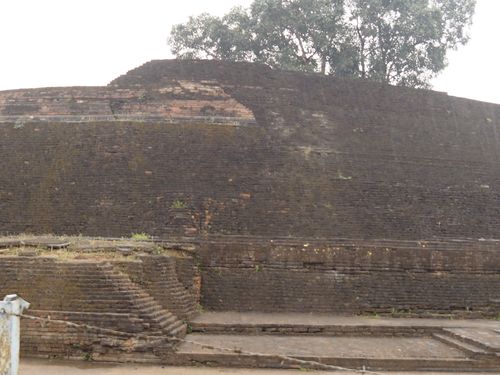
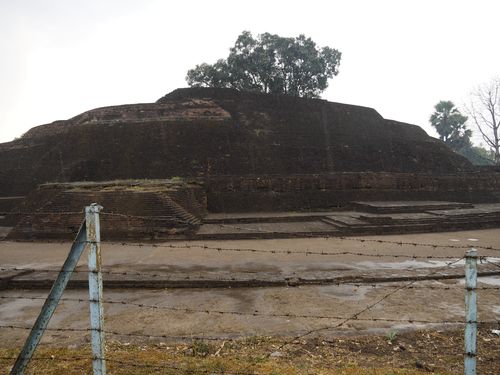
 The Sujata Stupa is a Buddhist monument located in Bodhgaya, in the Indian state of Bihar. It is dedicated to Sujata, the young woman said to have offered a bowl of rice to the future Buddha shortly before his enlightenment. This gesture represents a turning point in Siddhartha Gautama’s spiritual journey, signaling a departure from extreme asceticism. Today, the site is a place of reflection for pilgrims and visitors, often included in spiritual circuits around Bodhgaya. The current structure shows signs of multiple restorations, reflecting its continued relevance in Buddhist tradition. It is located a few kilometers from the Mahabodhi Temple, the main pilgrimage center in the area.
Monument profile
Sujata Stupa
Monument category: Stupa
Monument family: Pagoda or stupa
Monument genre: Religious
Cultural heritage: Buddhist
Geographic location: Bodhgaya • Bihar • India
Construction period: 3rd century BC
• Links to •
• Dynasties that contributed to the construction of the monument •


• This monument illustrates the following theme •
Buddhist architecture • Stupas : Diversity of Stupas in Asia
• List of videos about Bodhgaya on this site •
Bodhgaya, the Mahabodhi temple • Bihar, India
Bodhgaya, temples in town and life in a village • Bihar, India
The Sujata Stupa in Bodhgaya: Historical Significance and Transformations Through Time
The Sujata Stupa, located on the western bank of the Phalgu River in Bodhgaya, Bihar, stands as a commemorative Buddhist monument with profound symbolic value. Though modest in scale compared to the nearby Mahabodhi Temple, it marks a pivotal moment in the narrative of Siddhartha Gautama’s path to enlightenment: the offering of milk-rice by a village woman named Sujata. This stupa not only embodies a key turning point in the Buddha’s life but also illustrates the evolving religious, political, and cultural landscape of the Ganges valley across more than two millennia.
Political and Social Context of the Construction
While the precise founding date of the Sujata Stupa remains uncertain due to the absence of inscriptions, most scholars agree that the earliest structure likely dates back to the Maurya period, in the third century BCE. This was the era of Emperor Ashoka, whose support for Buddhism shaped the religious landscape of the Indian subcontinent. Ashoka’s missionary zeal was expressed through the construction of stupas and pillars at locations associated with key events in the Buddha’s life.
In this context, the Sujata Stupa commemorated a defining shift in the Buddha’s journey: his rejection of extreme asceticism in favor of a middle path. The act of Sujata offering food to the emaciated ascetic was more than an anecdote—it was a foundational moment that needed monumentalization. From a political perspective, such constructions helped to legitimize the moral authority of rulers like Ashoka, who positioned themselves as dharma-protecting sovereigns. The erection of this stupa in a rural environment also extended the Buddhist sacred geography beyond urban centers and monasteries, bringing it into direct contact with lay communities.
Later dynasties, such as the Shungas and the Guptas, may have supported the site indirectly, although they favored Brahmanical traditions. The Palas, ruling from the 8th to 12th centuries CE, revived Buddhist architecture and monastic patronage. As patrons of the Mahavihara tradition and of major sites like Nalanda and Vikramashila, they likely contributed to the upkeep or renovation of the Sujata Stupa, which formed part of the Bodhgaya pilgrimage circuit.
Major Historical Events Affecting the Site
Over time, the Sujata Stupa has weathered cycles of neglect and renewal. The fall of the Pala Empire and the subsequent Islamic incursions in the 12th and 13th centuries brought widespread destruction to Buddhist institutions across eastern India. Many monasteries were sacked, scholars dispersed, and stupas fell into disrepair. While there is no direct record of the Sujata Stupa being targeted or destroyed, the general decline of Buddhist structures in Bihar would have affected it as well.
The site disappeared from active pilgrimage routes and lay dormant until colonial interest in ancient India revived attention to Bodhgaya. In the late 19th century, British archaeologist Alexander Cunningham documented the monument and initiated initial clearance and surveys. During the 20th century, the Archaeological Survey of India (ASI) undertook limited restoration work, stabilizing the structure and incorporating it into the broader historical interpretation of Bodhgaya.
Global Context During the Period of Construction
The third century BCE, when the stupa was likely first erected, was marked by a surge in monumental religious architecture across Eurasia. In the Hellenistic world, monumental tombs and temples expressed the power of emerging kingdoms following the fragmentation of Alexander’s empire. In China, the early Qin and Han dynasties began constructing massive imperial complexes and mausoleums. Similarly, in the Indian subcontinent, Ashokan stupas and pillars asserted both religious devotion and imperial ideology.
The Sujata Stupa thus fits into a broader historical pattern of using sacred architecture to express ethical and political order. The Mauryan emphasis on non-violence and spiritual conquest found tangible form in such structures, linking political power to sacred geography. By commemorating an intimate and moral moment—an act of generosity—the stupa amplified the idea that ethical action transcends social status or gender.
Architectural Transformations and Changes in Use
The stupa visible today is the product of multiple layers of construction, renovation, and consolidation. Archaeological evidence suggests that earlier phases consisted of simpler brick platforms, possibly with votive offerings and small shrines nearby. Later additions may have introduced a more defined drum and dome, although no harmika or umbrella remains have survived intact.
The site may have transitioned over time from a pilgrimage point for local devotees to a symbol of collective memory, gradually losing its functional role as Buddhist institutions declined in India. During the colonial period, it became part of the emerging academic interest in India’s archaeological heritage. In the post-independence era, the stupa has reemerged as a destination for Buddhist pilgrims from around the world, particularly those tracing the footsteps of the historical Buddha.
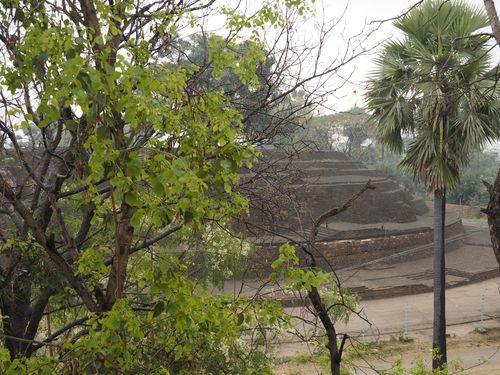
Its surroundings have also evolved. What was once a forested riverside setting has gradually become part of a peri-urban landscape shaped by tourism, infrastructure development, and the growing prominence of Bodhgaya as a global spiritual hub. A footbridge now links the stupa to a sacred tree identified with Sujata’s offering, further embedding the site into the narrative of the Buddha’s awakening.
Role in Contemporary Society and Cultural Relevance
In modern times, the Sujata Stupa plays a dual role. It functions as a sacred memorial and a historical artifact. For Buddhist pilgrims, particularly from Southeast Asia, East Asia, and Sri Lanka, the site offers a meditative space honoring feminine compassion and the principle of generosity. It is especially significant in promoting narratives that highlight the agency of women in Buddhist history.
Local communities in Bodhgaya and the surrounding areas increasingly recognize the stupa’s value as a cultural asset. Occasional ceremonies are held during major Buddhist festivals, and the site is integrated into religious circuits promoted by the Bihar State Tourism Department. The monument also figures in educational and heritage awareness initiatives, albeit less prominently than the Mahabodhi Temple.
In the broader Indian context, the stupa represents a connection to the region’s rich Buddhist past and complements ongoing efforts to preserve and revitalize India’s diverse religious heritage. While not formally inscribed as a separate UNESCO World Heritage site, it benefits from its proximity to the Mahabodhi Temple, which is on the World Heritage List.
State of Preservation and Conservation Challenges
Despite its importance, the Sujata Stupa faces several conservation challenges. Environmental exposure—particularly during the monsoon season—poses risks to the brick structure. The pressure of foot traffic from visitors, combined with limited infrastructure for site management, exacerbates wear. Urban encroachment and the expansion of tourist facilities in Bodhgaya further threaten the integrity of the landscape surrounding the monument.
Conservation work conducted by the ASI has included structural stabilization and cleaning, but there is a need for more comprehensive long-term planning. Integrating the stupa into interpretive trails, improving signage, and ensuring visitor management would enhance both its preservation and its accessibility.
There have been calls within heritage circles to nominate a broader buffer zone around Bodhgaya that would formally include secondary sites like the Sujata Stupa. Such a move would facilitate international cooperation, funding, and technical expertise, ensuring that this unique monument continues to serve both its religious and educational roles for future generations.
L’architecture du Sujata Stupa à Bodhgaya : techniques anciennes et héritage structurel
Le Sujata Stupa, situé à Bodhgaya dans l’État indien du Bihar, est un monument bouddhique d’une grande sobriété architecturale, mais d’une portée symbolique remarquable. Son apparence actuelle, marquée par des reconstructions successives, dissimule une structure plus ancienne qui conserve les traces de savoir-faire constructifs caractéristiques des débuts de l’architecture religieuse bouddhique dans le sous-continent. Bien qu’il soit moins monumental que les grands stupas d’Amaravati, Sanchi ou Sarnath, le Sujata Stupa illustre une transition architecturale majeure entre les formes primitives de commémoration et les structures plus évoluées des périodes ultérieures.
Innovations technologiques et architecturales de l’époque
L’origine probable du Sujata Stupa remonte à la période Maurya, au IIIe siècle avant notre ère. Cette époque se distingue par une forte impulsion donnée à la monumentalisation des lieux associés à la vie du Bouddha. Les techniques de construction alors en usage étaient à la fois pragmatiques et symboliques, combinant des exigences de stabilité avec des fonctions cultuelles codifiées.
Une innovation notable est l’usage de la brique cuite en tant que matériau principal, à une époque où la pierre taillée commençait à peine à être employée dans le nord de l’Inde. Cette technologie permettait une modularité accrue, facilitant la construction de formes circulaires, tout en assurant une résistance suffisante aux intempéries. Le recours à des mortiers à base d’argile, enrichis parfois de matériaux organiques, témoignait d’un savoir-faire empirique en matière de cohésion et de régulation thermique.
Le plan circulaire du stupa, associé à une base surélevée et à un noyau interne compact, assurait une stabilité structurelle remarquable, adaptée à un climat soumis à de fortes variations hygrométriques. Si l’on ajoute à cela une orientation soigneusement étudiée en fonction des points cardinaux, on constate que le Sujata Stupa s’inscrit dans une logique architecturale intégrant l’environnement naturel comme paramètre fondamental.
Matériaux et méthodes de construction
Le Sujata Stupa a été édifié majoritairement en briques cuites, de dimensions standardisées, posées en assises horizontales concentriques. Ce choix répondait à plusieurs critères : disponibilité locale des matériaux argileux, facilité de production, et adaptabilité aux courbes de la structure. Les briques utilisées étaient généralement moulées à la main, puis cuites dans des fours ouverts, ce qui leur conférait une teinte rougeâtre typique des constructions anciennes du Bihar.
La structure interne repose sur un noyau massif, sans cavité centrale, formé de remblais compactés entourés d’un parement de briques. Aucun appareillage de pierre sculptée n’a été observé sur le monument lui-même, ce qui distingue le Sujata Stupa des stupas plus élaborés comme ceux de Bharhut ou de Sanchi, où les balustrades et les toranas étaient ornés de scènes narratives.
Le système de construction s’appuyait sur un agencement simple mais robuste : les couches de briques étaient disposées selon une légère pente interne, assurant le bon écoulement des eaux de pluie. Ce dispositif, combiné à l’absence de joint vertical aligné, garantissait une excellente tenue dans le temps. On suppose également l’existence initiale d’un enduit protecteur à base de chaux ou d’argile, aujourd’hui disparu, destiné à protéger les briques de l’érosion.
Influences architecturales et artistiques
L’architecture du Sujata Stupa ne présente pas de décor figuré visible aujourd’hui, mais sa forme globale témoigne d’une filtration locale des modèles architecturaux panindiens. L’influence maurya est perceptible dans la simplicité des lignes et dans l’économie ornementale, contrastant avec les motifs abondants visibles dans les régions plus méridionales ou occidentales.
Des comparaisons stylistiques avec les stupas primitifs du Gandhara et du Deccan suggèrent une circulation de concepts formels, mais une adaptation contextuelle aux traditions constructives du Magadha. Ainsi, alors que les reliefs narratifs se développent ailleurs, le Sujata Stupa incarne une tradition plus épurée, centrée sur la forme pure du dôme comme support de méditation.
Il est probable que certaines influences d’Asie centrale aient atteint la région au cours des siècles suivants, notamment sous la dynastie des Gupta, mais elles ne se manifestent pas clairement dans la structure conservée. En revanche, la transmission symbolique de la forme stupa, en tant que représentation du cosmos bouddhique (base carrée = terre, dôme = ciel, hamika = axis mundi), reste pleinement présente, même dans une structure aussi dépouillée.
Organisation et structure
Le Sujata Stupa se compose d’une base circulaire légèrement surélevée, d’un tambour (ou médaillon de soubassement), et d’un dôme hémisphérique en élévation. Aucun élément de balustrade, de perron, ni de chemin rituel surélevé (pradakshina patha) n’est visible aujourd’hui, bien que ces éléments aient pu exister à une époque antérieure. La simplicité de la composition actuelle laisse penser qu’il s’agissait avant tout d’un mémorial secondaire, non destiné à accueillir un reliquaire majeur, mais plutôt à marquer un lieu symbolique précis : l’endroit de l’offrande de Sujata au Bouddha.
L’absence d’arcs, de colonnades ou de portiques indique que le stupa ne faisait pas partie d’un vaste complexe architectural. Toutefois, des traces de plateformes secondaires et de sanctuaires annexes ont été relevées à proximité, suggérant un usage rituel régulier, peut-être associé à des retraites ou à des commémorations locales.
L’élément le plus singulier réside dans le lien spatial direct entre le stupa et le site identifié comme celui de l’arbre de Sujata, accessible par une passerelle contemporaine. Cette disposition renforce l’unité narrative du lieu et rappelle la logique des “circuitos de pèlerinage”, dans laquelle chaque site est porteur d’un fragment du récit bouddhique.
Statistiques et anecdotes notables
Les dimensions exactes du Sujata Stupa varient selon les relevés, mais la base mesure environ 7 à 8 mètres de diamètre, et la hauteur totale actuelle dépasse légèrement 5 mètres. Ces proportions le placent dans la catégorie des stupas commémoratifs de taille moyenne, comparables à certains édifices votifs de Sarnath ou Nalanda.
Une anecdote souvent rapportée par les pèlerins évoque la pureté du geste de Sujata, qui aurait offert son bol de riz en silence, sans attente de réciprocité. Ce geste serait à l’origine du nom du village voisin, Bakraur, parfois identifié comme le lieu d’habitation de Sujata.
Une autre légende locale rapporte que le stupa aurait été construit par les femmes du village en hommage à Sujata, à une époque où les moines ne pouvaient ériger de monument à une laïque. Bien que cette version ne soit pas attestée historiquement, elle renforce le caractère féminin et populaire associé au site.
Reconnaissance architecturale et enjeux de conservation
L’architecture du Sujata Stupa, bien que modeste, contribue à l’intérêt mondial porté à Bodhgaya comme lieu de mémoire bouddhique. Sa valeur patrimoniale réside dans son ancienneté, dans la continuité de sa fonction, et dans sa capacité à incarner une facette méconnue de l’héritage bouddhique : celle des gestes quotidiens, anonymes, mais décisifs.
Le monument ne fait pas l’objet d’un classement distinct au patrimoine mondial, mais bénéficie de la protection de l’Archaeological Survey of India en tant que structure historique. L’absence de couverture, l’exposition aux pluies de mousson, les racines souterraines et l’érosion progressive des briques posent des défis structurels constants.
Le développement urbain autour de Bodhgaya, notamment l’augmentation du trafic touristique et la densification des abords du site, pose également la question de l’intégration harmonieuse du monument dans un paysage en mutation. Des efforts sont en cours pour renforcer la signalétique, limiter l’accès direct aux structures fragiles, et intégrer le stupa dans des parcours pédagogiques dédiés aux visiteurs.