Français (France)
  Nederlands (nl-NL)
 00:00 • intro | 00:30 • Hadrian's triumphal arch | 01:26 • the forum | 01:51 • cardo maxima | 02:31 • the cathedral | 03:50 • the amphitheater | 04:33 • temple of Artemis, anti-seismic construction | 05:10 • churches bishop Isaiah and Saint John the Baptist | 05:45 • back to forum
Personal creation from visual material collected during my trip Jordan (2017)
Map of places or practices in Jerash on this site
• Use the markers to explore the content •
Jerash, Major Roman City of Jordan
An Ancient City Preserved with Remarkable Clarity
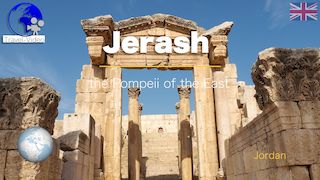
Jerash, the ancient city of Gerasa, is one of the most important archaeological sites in the Middle East. Located in northern Jordan, it preserves an urban ensemble of unusual coherence where colonnaded streets, public squares, temples, theatres and churches still make it possible to understand the functioning of a major ancient city. The nickname “Pompeii of the East” refers less to a direct historical comparison than to the exceptional state of preservation and the readability of the site.
This video offers a gradual journey through a city of stone. Its monuments appear not as isolated ruins, but as parts of a carefully organized urban whole. Civic spaces, religious buildings and entertainment venues can still be read in relation to one another, allowing visitors to understand how the city once operated.
Jerash is also valuable because several historical layers remain visible. Its Greco-Roman heritage dominates the site, while Byzantine additions reveal how the city continued to evolve over time.
The Major Monuments Seen in the Video
Hadrian’s Arch opens the visit in monumental fashion. Built in the second century during the emperor’s visit, it symbolized the prosperity and prestige of Gerasa under Roman rule. Its scale and decorative ambition immediately announce the importance of the city.
The Forum is one of Jerash’s most distinctive spaces. This large oval plaza surrounded by columns connects the monumental entrance with the Cardo Maximus. Its elegant geometry creates one of the most memorable views of the site and demonstrates sophisticated urban planning.
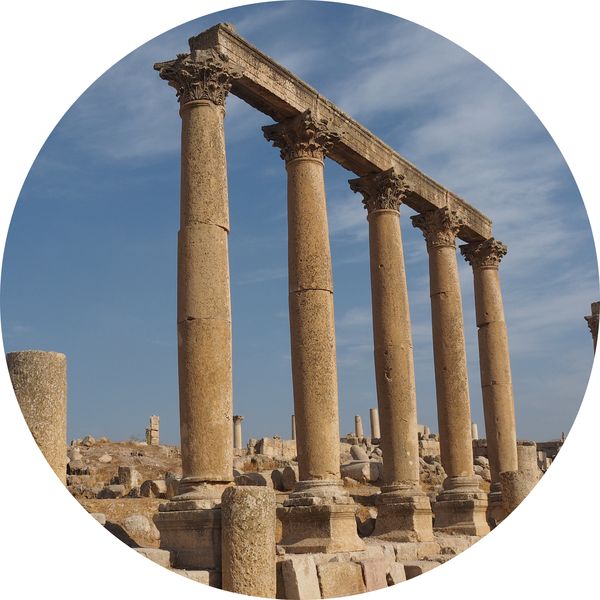
The Cardo Maximus, the city’s principal colonnaded avenue, structured movement through the urban center. It linked key districts and monuments while likely serving commercial and ceremonial functions. Even today, walking along its paving stones gives a clear sense of the city’s scale.
The Cathedral and several churches reflect Jerash’s Byzantine phase. The Church of Bishop Isaiah and the Church of Saint John the Baptist show how Christianity reshaped the urban landscape while preserving the city’s regional importance.
The theatres illustrate the civic and cultural life of Gerasa. The South Theatre, often the most impressive for visitors, still preserves its seating tiers and stage arrangement. The North Theatre complements this architectural group dedicated to gatherings and performances.
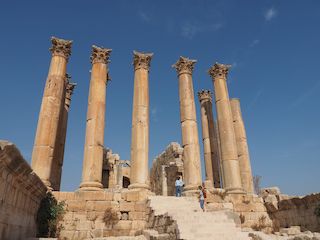
The Temple of Artemis rises above part of the city and remains one of its dominant landmarks. Dedicated to the city’s protective deity identified with Artemis, it expressed religious prestige and civic identity. Its powerful columns are still striking, while some structural techniques are often noted for their adaptation to a seismic environment.
A Prosperous City Between Rome and Byzantium
Jerash had earlier occupations, but its major development began under Roman control. Incorporated into the Decapolis, a network of urbanized cities in the Levant, it benefited from imperial stability, trade routes and significant investment in monumental construction.
During the first three centuries of the Roman era, the city acquired the features expected of a prosperous eastern provincial center: paved streets, colonnades, sanctuaries, baths, fountains, theatres and civic plazas. The quality of these works suggests wealthy local elites able to finance ambitious building programs.
From the fourth century onward, Christianization gradually transformed the city. New churches were constructed, sometimes close to earlier civic or religious spaces. Jerash remained active and important, though under changing political and spiritual conditions.
Later earthquakes affected the region, while broader economic and political changes altered the balance of power in the Near East. The city slowly declined before being rediscovered and studied in the modern archaeological era.
Urban Planning, Architecture and Adaptation to the Landscape
Jerash is especially valuable for showing how Roman urban principles were adapted to uneven terrain. The city was not imposed as a rigid geometric grid. Instead, streets, plazas and monuments were adjusted to slopes and natural contours. The oval Forum is a notable example of this flexibility.
Colonnaded streets created shade, monumentality and visual continuity. They guided movement while framing the façades of nearby buildings. Religious monuments often occupied elevated positions, while theatres made intelligent use of natural gradients.
The Temple of Artemis demonstrates the quality of local construction techniques. Carefully fitted stone blocks and certain structural arrangements may have helped absorb seismic movement, contributing to the survival of important architectural elements.
What the Videos on This Site Make Especially Clear
The videos on travel-video.info, often created from carefully selected photographs animated with smooth movement and transitions, are particularly suited to an archaeological city like Jerash. Understanding the site depends on perspectives, alignments and relationships between monuments that may stand far apart.
Gradual transitions allow viewers to move from a carved detail to a wide view of the Forum, then from a colonnaded avenue to a theatre or temple. This method restores the logic of the urban plan with notable clarity.
It also helps reveal architectural volumes: the height of columns, the width of streets, the curve of theatre seating and the commanding position of sanctuaries. Where a rapid visit can feel fragmented, animated imagery reconnects the city into a coherent whole.
The final return to the Forum acts as a visual synthesis, reminding viewers that Jerash was not a collection of ruins but a functioning urban organism.
An Ancient City Still Readable Today
Discovering Jerash through this video means exploring a place where history remains directly visible in stone. Roman urban planning, imperial monuments, Byzantine heritage and archaeological memory meet here with unusual clarity. The detailed pages devoted to its principal monuments offer an excellent way to continue exploring one of Jordan’s great heritage sites.
Music:
- - YouTube video library - Butterflies in Love
- - YouTube video library - Everything is fine
- - YouTube video library - People Watching
Disclaimer: Despite its appropriateness, copyright issues prevent the use of jordanian traditional music in "Jerash, Pompeii of the East • Jordan ", hence the use of royalty-free music. Despite our careful selection, some might regret this decision, which is necessary to avoid potential lawsuits. Although difficult, this decision is the only viable solution.
Links to related pages
Audio Commentary Transcript
Jerash was founded towards the end of the 4th century BC and was an important city in antiquity. Successive conquests made it fall under the Judeans, the Nabataeans and finally the Romans.
It will be plundered in the 7th century by the Persians and then by the Arabs.
After having suffered various earthquakes it was abandoned after destruction during clashes between Muslims and Crusaders during the Crusades.
Jerash has remained hidden under a thick layer of sand for centuries, which explains its extraordinary state of preservation.