Français (France)
  Nederlands (nl-NL)
 00:00 • intro | 00:34 • Fort Mehrangarh | 03:23 • santur recital | 05:43 • Jaswant Thada | 05:55 • singer with harmonium
Personal creation from visual material collected during my trip India • Rajasthan and Varanasi (2015)
• Use the markers to explore the content •
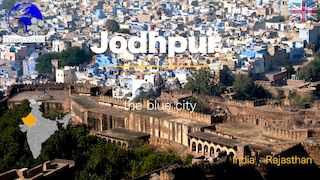
Jodhpur, the Blue City: Architecture, Sound and Memory in Rajasthan
A historic city shaped by stone and color
Jodhpur stands as one of the most visually distinctive cities in Rajasthan, defined by its elevated fortress and the dense fabric of blue-painted houses spreading below it. Founded in the 15th century by the Rathore dynasty, the city developed in a semi-arid environment at the edge of the Thar Desert, where strategic positioning and adaptation to climate were essential. The fortified hill at its center provided both protection and authority, while the surrounding urban quarters evolved into a vibrant and tightly structured settlement.
The characteristic blue hue of the old city, initially associated with Brahmin households, gradually became a broader urban identity. Beyond its symbolic dimension, this coloration also reflects practical responses to heat and light, contributing to a distinctive visual coherence. The video explores this layered environment through a combination of architectural landmarks and cultural expressions, revealing how monuments, urban forms and musical traditions coexist within a shared historical framework.
Monumental power and intimate cultural expressions
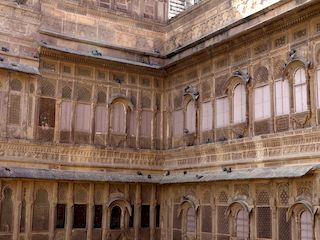
The Mehrangarh Fort dominates the city both physically and symbolically. Rising from a rocky outcrop, its massive walls and successive gates illustrate a defensive architecture designed to control access and project strength. Inside, however, the atmosphere shifts toward refinement. Palaces, courtyards and intricately carved elements reflect a sophisticated aesthetic, where stone is shaped into screens, balconies and decorative surfaces that filter light and structure space. This dual nature, combining military function with royal residence, defines much of Rajasthan’s fortified architecture.
In contrast, the Jaswant Thada introduces a more delicate architectural language. Built in white marble in the late 19th century, this cenotaph commemorates a ruler of Jodhpur and embodies a tradition of memorial construction associated with Rajput elites. Its finely carved surfaces, translucent stone panels and carefully proportioned volumes create an atmosphere of calm and introspection. Set within a landscaped environment, it offers a visual and symbolic counterpoint to the imposing presence of the fort.
The video also integrates musical sequences that enrich the understanding of place. A recital of santur, a string instrument played with light mallets, evokes a refined musical tradition historically linked to courtly settings. Its precise and resonant tones echo the architectural clarity of the spaces in which it is performed. In contrast, the presence of a singer accompanied by a harmonium reflects a more immediate and popular form of expression, rooted in everyday life and oral traditions. Together, these performances highlight the coexistence of formal and informal cultural practices within the city.
Historical layers and environmental adaptation
Jodhpur’s development is inseparable from its historical and environmental context. Established in 1459, the city emerged as a political and military center within a region marked by competition among Rajput kingdoms. The construction and expansion of Mehrangarh Fort over several centuries reflect both defensive needs and the evolving ambitions of its rulers. Architectural additions reveal stylistic influences shaped by regional exchanges and interactions with larger imperial powers, including the Mughal Empire.
At the urban level, the structure of the old city reflects a gradual and organic growth. Narrow streets, compact housing and inward-facing courtyards respond to climatic constraints, offering shade and ventilation in a hot and dry environment. The use of lime-based coatings, including the blue pigment, contributes to temperature regulation while also reinforcing visual identity.
The Jaswant Thada belongs to a later phase in the city’s history, when commemorative architecture became more elaborate and visually expressive. Its construction illustrates the importance of dynastic memory within Rajput culture, where rulers are honored through carefully designed monuments distinct from funerary sites. This separation between ritual practices and memorial representation adds complexity to the interpretation of such structures.
A visual approach that clarifies space and detail
The videos presented on this site rely largely on carefully selected photographs, animated through gradual transitions and controlled framing. This method allows for a detailed and progressive reading of places that might otherwise be perceived only in fragments.
In the case of Jodhpur, this approach enhances the perception of scale and contrast. The relationship between the elevated fort and the compact urban fabric becomes clearer, as does the interplay between mass and ornament within architectural spaces. Close views reveal the precision of carved stone, the subtle variations of marble surfaces and the textures of painted walls. The integration of musical sequences within this visual progression reinforces the sense of continuity between built forms and lived experience.
By structuring the sequence around key locations and moments, the video offers a coherent narrative that connects architecture, environment and cultural practices. It becomes possible to understand not only individual monuments, but also the spatial and symbolic relationships that define the city as a whole.
A balanced heritage between permanence and living traditions
Jodhpur illustrates a dynamic balance between enduring architectural forms and ongoing cultural expression. The fort and the cenotaph represent different aspects of political authority and memory, while musical performances reflect the persistence of intangible traditions within an evolving urban context.
This combination gives the city a depth that goes beyond its visual identity. For those seeking a more detailed understanding, the dedicated pages on individual monuments provide further insight into their history and architectural characteristics, extending the exploration initiated through the video.




Audio Commentary Transcript
Jodhpur, the blue city. It is the second city of Rajasthan by the number of inhabitants and it has a very impressive fort as well as some richly decorated monuments, most of which are cenotaphs, funerary monuments not intended to receive the body of the person in honor. from which the monument was erected.

Music :
- - YouTube video library - Butterflies in Love
- - YouTube video library - Dance of the Mammoths
- - YouTube video library - Epic TV Theme, (© Epic TV Theme by Audionautix is licensed under a Creative Commons Attribution 4.0 license. https://creativecommons.org/licenses/by/4.0/
- Artist: http://audionautix.com/)
- - YouTube video library - Evil March, (© Evil March by Kevin MacLeod is licensed under a Creative Commons Attribution 4.0 license. https://creativecommons.org/licenses/by/4.0/
- Source: http://incompetech.com/music/royalty-free/index.html?isrc=USUAN1100727
- Artist: http://incompetech.com/)
Disclaimer: Despite its appropriateness, copyright issues prevent the use of indian traditional music in "Jodhpur • Mehrangarh Fort, Jaswant Thada and music", hence the use of royalty-free music. Despite our careful selection, some might regret this decision, which is necessary to avoid potential lawsuits. Although difficult, this decision is the only viable solution.