Français (France)
  Nederlands (nl-NL)
 00:00 • intro | 01:47 • Amman | 02:31 • the Temple of Hercules | 03:36 • Byzantine church | 03:59 • the Umayyad mosque and market square | 05:37 • the roman amphitheater | 06:54 • Jerash | 07:52 • Cardo Maximus | 10:13 • the temple of Artemis | 11:07 • The Church of Saints Cosmas and Damian | 11:52 • Umm Qais | 13:58 • the amphitheater
Personal creation from visual material collected during my trip Jordan (2017)
Map of places or practices featured in the video
• Use the markers to explore the content •
Roman Jordan: Ancient Cities from Amman to Umm Qais
A major classical heritage in the Middle East
Jordan is often associated with Petra, desert landscapes, and medieval fortresses. Yet the country also preserves one of the richest collections of Greco-Roman urban remains in the Near East. This video explores that lesser-known Jordan: a land of temples, theatres, colonnaded streets, Byzantine churches, and cities whose original layout can still be understood with unusual clarity.
The journey moves through several major northern sites. Amman, now a modern capital, still reveals Roman, Byzantine, and early Islamic layers on its citadel and in the city below. Jerash ranks among the best-preserved Roman provincial cities anywhere in the eastern Mediterranean. Umm Qais, the ancient Gadara, combines monumental ruins with wide views across hills, valleys, and neighboring lands. Together, these places show how Roman civic culture adapted to local geography, earlier traditions, and later religious change.
Temples, theatres, and monumental streets
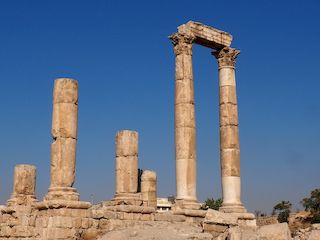
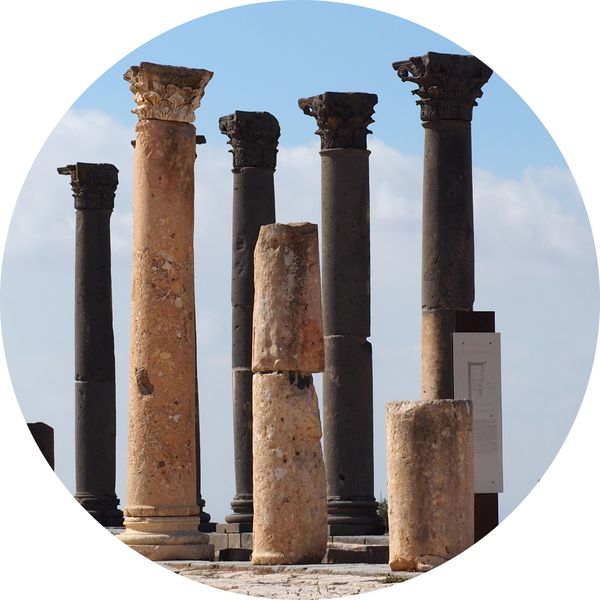
The route begins in Amman, ancient Philadelphia. On the citadel, the Temple of Hercules remains one of the most visible Roman monuments in the country. Its surviving columns and massive stone blocks still suggest the scale of a sanctuary placed above the city as both a religious and symbolic landmark. Nearby, a Byzantine church recalls the transformation of the urban landscape when Christianity became dominant in the late Roman and early Byzantine periods.
The presence of a mosque and the Umayyad market square adds another important chapter. Amman is not a site frozen in one age, but a place where successive civilizations reused and reshaped the same commanding hilltop. Below, the Roman theatre remains one of the city’s most impressive survivals. Cut into the slope, it reflects the importance of spectacle, ceremony, and public gathering in ancient urban life.
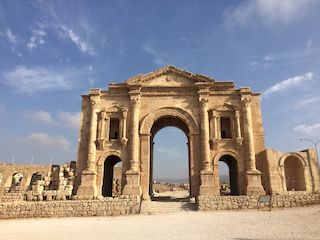
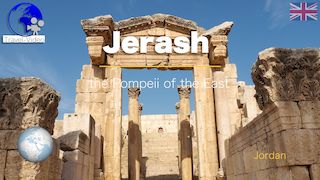
Jerash forms the central highlight of the journey. Ancient Gerasa offers an exceptionally readable Roman city plan. The Cardo Maximus, lined with columns, still organizes movement through the archaeological zone. Its long perspective, paved surface, and intersections help visitors understand the rhythm of civic space.
The Temple of Artemis dominates one of the higher sectors of the city. Dedicated to the local protective deity identified with Artemis, it expressed both religious prestige and municipal prosperity. Its towering columns remain among the strongest visual symbols of Jerash. Nearby, the Church of Saints Cosmas and Damian represents the later Byzantine phase, when Christian buildings became major components of the urban landscape.
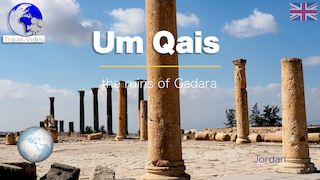
At Umm Qais, ancient Gadara, the theatre and surrounding remains overlook northern Jordan, the Sea of Galilee, and distant highlands. Here, architecture and landscape remain closely linked.
Jordan at the crossroads of the ancient world
These cities flourished because of their position between the Mediterranean world, Arabia, Syria, and Egypt. Several belonged to the Decapolis, a network of urban centers shaped by Hellenistic traditions and later integrated into the Roman imperial system. Trade routes, regional markets, and agricultural wealth helped support ambitious public construction.
Under Roman rule, local elites financed temples, streets, baths, fountains, and theatres that reflected both civic pride and imperial order. The monuments seen today were not isolated works of architecture. They were part of functioning cities where religion, administration, commerce, and public entertainment were closely connected.
From the fourth century onward, Christianity reshaped many urban centers. Churches were built beside or above earlier civic and sacred spaces. Later, the Islamic period introduced new institutions and architectural forms, especially visible in Amman. Jordan’s Roman heritage therefore did not simply vanish. It was absorbed into changing historical landscapes.
The region’s terrain also influenced urban form. Hillsides encouraged theatres, elevated sanctuaries, and commanding citadels, while valleys shaped roads and settlement patterns. Roman planning in Jordan often adapted to topography rather than imposing a rigid geometric grid.
What the videos of this site make especially clear
The videos of travel-video.info, often created from carefully selected photographs animated with smooth transitions, are particularly effective for archaeological sites of this scale. Cities such as Jerash or Umm Qais are best understood through alignments, changing viewpoints, and relationships between monuments sometimes separated by considerable distance.
Gradual movement from a carved detail to a broad view of a forum, then from a colonnaded avenue to a theatre or temple, helps restore the logic of the city. Instead of seeing ruins as disconnected fragments, the viewer can follow how streets linked sacred, civic, and cultural spaces.
This method also clarifies proportion. The height of columns, width of avenues, depth of seating tiers, and dominant placement of sanctuaries become easier to grasp than during a rapid physical visit. Architectural volumes regain coherence.
Layered history becomes clearer as well. In Amman, the sequence from Roman temple to Byzantine church to Umayyad complex reveals how one strategic site was repeatedly reinterpreted. The animated image format helps connect those periods without confusion.
Panoramic scenes from hilltop sites such as Umm Qais finally explain why these places mattered. They were not chosen randomly, but for visibility, control, prestige, and access to routes and fertile land.
A different way to discover Jordan
Watching Roman Jordan through this video means discovering a country where ancient urban life remains unusually legible in stone. Temples, theatres, colonnaded streets, churches, and later Islamic monuments together tell a long and complex story. The detailed pages linked to the main sites offer an excellent way to continue exploring one of the most rewarding archaeological landscapes of the Middle East.
Links to related pages
Audio Commentary Transcript
Amman is a very old city, one of the oldest cities in the world to be still inhabited.
Formerly the capital of the Ammonites, a biblical people who have occupied the area since the Iron Age. The city was called Rhabbat Ammon and was fortified several millennia BC. Centuries later, the Greeks renamed it Philadelphia. In the meantime, the city was occupied among others by the Assyrians and the Persians
The citadel is now an open-air museum and you can see the ruins of the temple of Hercules built by the Romans.
The Umayyad Palace dating from the 7th or 8th century and a Byzantine church from the 6th century also occupied the site.
Amman being in a fairly active seismic zone and was destroyed several times by an earthquake and was gradually abandoned to the point of being nothing more than a small village when the Circassians at the end of the 19th century rebuilt the city that was going become the capital of Transjordan in 1921. Later, Transjordan became the Hashemite Kingdom of Jordan.
The Roman theater probably built by Emperor Antoninus Pius in the middle of the 2nd century AD has 6000 seats.
Next to the amphitheater is the much smaller odeon. The odeon was used for musical performances.
These buildings are still used today for shows.
Jerash was founded towards the end of the 4th century BC and was an important city in antiquity. Successive conquests made it fall under the Judeans, the Nabataeans and finally the Romans.
It will be plundered in the 7th century by the Persians and then by the Arabs.
After having suffered various earthquakes it was abandoned after destruction during clashes between Muslims and Crusaders during the Crusades.
Jerash has remained hidden under a thick layer of sand for centuries, which explains its extraordinary state of preservation.
This temple is extraordinarily well preserved.
Most of its columns remained standing despite the fact that Jerash experienced many earthquakes.
This temple being very important, the Roman architects implemented all the anti-seismic techniques which were known at the time.
Like what, the architects did not wait for the XXth century to counter the forces of nature.
If the name of Umm Qais evokes little for those who have not visited it, it is a safe bet that its ancient name is much more evocative: Antioch. Umm But also bears the name of Gadara.
Here is another city dating from the Roman era which presents an admirable state of conservation, in addition to the admirable landscapes and panoramas that can be admired while walking there.
Music:
- - YouTube video library - Anamalie, (© Anamalie by Kevin MacLeod is licensed under a Creative Commons Attribution 4.0 license. https://creativecommons.org/licenses/by/4.0/
- Source: http://incompetech.com/music/royalty-free/index.html?isrc=USUAN1500007
- Artist: http://incompetech.com/)
- - YouTube video library - Argonne - Zachariah Hickman
- - YouTube video library - Carol of the Bells
- - YouTube video library - Clouds
- - YouTube video library - Crusade - Video Classica, (© Crusade - Video Classica by Kevin MacLeod is licensed under a Creative Commons Attribution 4.0 license. https://creativecommons.org/licenses/by/4.0/
- Source: http://incompetech.com/music/royalty-free/index.html?isrc=USUAN1100884
- Artist: http://incompetech.com/)
Disclaimer: Despite its appropriateness, copyright issues prevent the use of jordanian traditional music in "Jordan • the Roman Jordan", hence the use of royalty-free music. Despite our careful selection, some might regret this decision, which is necessary to avoid potential lawsuits. Although difficult, this decision is the only viable solution.