

 Français (France)
  Nederlands (nl-NL)
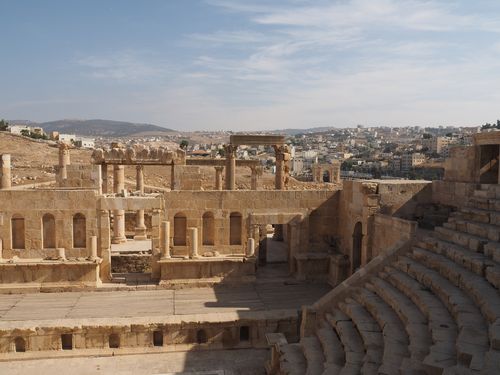
 The North Theatre in Jerash, Jordan, is one of the principal public monuments of ancient Gerasa, a prominent city of the Decapolis. Built during the Roman period, it was used for theatrical performances and civic gatherings. The structure reflects the importance of public entertainment and communal events in the social and political life of the ancient city. As part of the extensive archaeological complex of Jerash, the North Theatre illustrates the urban organization and cultural vitality that characterized Gerasa under Roman rule.

Jerash • North Theatre

Jerash • North Theatre
Jerash • North Theatre
Monument profile
North Theatre
Monument categories: Archaeological, Amphitheatre
Monument families: Archaeological • Monument for cultural purposes
Monument genres: Archaeological site, Cultural or scientific
Cultural heritage: Roman antiquity
Geographic location: Jerash • Jordan
Construction period: 2nd century AD
• Links to •
• List of videos about Amman, Jerash, Umm Qais on this site •
Jordan • the Roman Jordan
Jerash, Pompeii of the East • Jordan
History of the North Theatre in Jerash
The North Theatre of ancient Gerasa, today Jerash in Jordan, represents one of the principal civic monuments of the Roman city. Constructed in the late first century CE and enlarged during the second century, the theatre reflects the urban development of Gerasa within the Decapolis and its progressive integration into the Roman imperial system. Its history illustrates the political aspirations, social organization, and cultural transformations that shaped the city from antiquity to the modern era.
Political and Social Context of Construction
In the late first century CE, Gerasa was experiencing sustained economic growth under Roman rule. Situated along regional trade routes connecting Syria and Arabia, the city benefited from commercial exchange and administrative stability. The construction of a theatre formed part of a broader urban program aimed at equipping Gerasa with the architectural features characteristic of Roman civic life.
The theatre served both social and political functions. As a venue for dramatic performances, public ceremonies, and assemblies, it provided a structured environment for communal gathering. In Roman cities, theatres were not merely entertainment facilities but arenas of civic identity. By constructing such a monument, Gerasa signaled its adherence to Roman cultural norms and its participation in the imperial order.
Local elites likely financed and promoted the project. Their involvement enhanced personal prestige while reinforcing loyalty to the empire. Within the Decapolis, cities competed symbolically through monumental architecture. The North Theatre thus embodied Gerasa’s ambition to assert its prominence among neighboring urban centers.
Imperial Framework and Urban Ambition
The Flavian and Antonine periods were marked by relative peace and infrastructural investment throughout the Roman world. In the eastern provinces, theatres, baths, and colonnaded streets proliferated as visible expressions of Roman urbanism. The construction of the North Theatre fits within this pattern of provincial monumentalization.
During the second century, the theatre was expanded, suggesting demographic growth or increasing demand for civic space. This enlargement likely corresponded to a period of heightened prosperity under the Antonine emperors. The development of the theatre reflects the integration of Gerasa into a wider imperial network of cities shaped by standardized architectural forms.
Major Historical Events and Transformations
Throughout the second and third centuries, the North Theatre functioned as a center for performances and civic gatherings. Public announcements, cultural events, and possibly political assemblies took place within its semi-circular cavea.
The Christianization of the Roman Empire in the fourth century gradually altered the cultural landscape. Traditional theatrical performances declined in importance as Christian liturgical spaces assumed greater prominence. Although there is no evidence of abrupt destruction, the theatre’s original function diminished. Portions of the structure may have been adapted for administrative or communal uses.
Under Byzantine rule, Gerasa remained active but increasingly oriented toward ecclesiastical architecture. The theatre likely entered a phase of reduced maintenance. Following the Islamic conquest in the seventh century, the city was incorporated into new political structures. The theatre no longer served its original purpose and became part of the evolving urban environment.
The earthquake of 749 CE had devastating effects on many cities in the region. Structural damage to the North Theatre was substantial, contributing to partial collapse and long-term abandonment. Stone blocks were reused in later constructions, a common practice in declining urban centers.
Global Context at the Time of Construction
The construction of the North Theatre occurred during a period when Roman urban culture was at its height. Across the Mediterranean, theatres symbolized civic organization and imperial cohesion. From North Africa to Asia Minor, similar structures were erected as instruments of social integration and political display.
Beyond the Roman world, public gathering spaces also flourished in other civilizations. Architectural complexes in South Asia and East Asia similarly facilitated communal events and ceremonial performances. The North Theatre thus participates in a broader global pattern of monumental public architecture serving collective identity.
Within the Roman sphere, the theatre expressed not only entertainment culture but also the ideological unity of the empire. Gerasa’s adoption of this model confirmed its participation in a shared architectural language.
Decline, Rediscovery, and Archaeological Work
Following centuries of neglect, the ruins of Gerasa drew attention from European travelers in the nineteenth century. Descriptions and illustrations documented the theatre’s remains, stimulating scholarly interest. Systematic excavations in the twentieth century cleared accumulated debris and revealed the structural organization of the cavea, orchestra, and stage building.
Restoration efforts focused on stabilization rather than reconstruction. Archaeologists consolidated seating rows and reinforced vulnerable sections. The approach emphasized preservation of authenticity while ensuring public access.
The modern city of Jerash developed adjacent to the ancient site, allowing the archaeological complex to remain largely unobstructed. This separation contributed to the preservation of the theatre’s structural integrity.
Contemporary Role and Cultural Significance
Today, the North Theatre forms a central element of the Jerash archaeological park. It occasionally hosts cultural demonstrations and musical performances, highlighting the enduring functionality of its acoustic design. Although more modest in scale than the South Theatre, it retains strong symbolic value.
The monument contributes to Jordan’s national heritage by illustrating the Roman layer of the country’s historical identity. Cultural festivals organized within the broader archaeological site reinforce its visibility and contemporary relevance.
Jerash has been included on UNESCO’s Tentative List for World Heritage inscription. Recognition at this level would emphasize the importance of its Roman monuments, including the North Theatre, within the history of urban planning and public architecture.
Current Conservation and Challenges
The North Theatre faces environmental pressures, including limestone erosion, temperature variation, and seismic vulnerability. Conservation programs implemented by Jordanian authorities aim to stabilize seating tiers and monitor structural movement.
Tourism management remains a significant concern. Controlled access and periodic maintenance are necessary to limit wear on ancient stone surfaces. Despite centuries of transformation, the theatre preserves sufficient architectural clarity to convey its original design and civic function.
Conclusion
The North Theatre of Gerasa embodies the aspirations of a Roman provincial city integrated into the imperial cultural framework. Constructed in a period of stability and expansion, expanded during urban growth, and transformed by religious and political change, it reflects the layered history of Jerash. Today, as an archaeological monument and cultural symbol, it continues to illustrate the enduring impact of Roman civic architecture in the eastern Mediterranean.
Architectural Analysis of the North Theatre in Jerash
The North Theatre of ancient Gerasa, present-day Jerash in Jordan, represents one of the earliest monumental performance spaces of the city. Constructed in the late first century CE and expanded in the second century, the theatre illustrates the adaptation of canonical Roman design principles to the topography, materials, and urban framework of a provincial city in the eastern Mediterranean. Its architecture combines technical precision, structural efficiency, and decorative restraint, reflecting both imperial standards and regional building traditions.
Technological and Architectural Innovations
The theatre was conceived according to established Roman typologies, yet its execution demonstrates technical sophistication tailored to local conditions. Unlike Greek theatres carved entirely into natural hillsides, the North Theatre integrates both natural slope and constructed substructures. The lower seating rests partially on prepared terrain, while the upper cavea is supported by vaulted chambers and radial retaining walls. This hybrid approach ensured stability while accommodating the site’s gradient.
Radial and concentric load-bearing walls distribute structural stress evenly across the semi-circular seating area. The use of barrel vaults beneath the cavea provided both reinforcement and circulation space. Access corridors allowed controlled movement of spectators, reflecting Roman concerns for crowd management and safety. Vomitoria—arched passageways leading directly to seating tiers—facilitated efficient entry and exit, reducing congestion.
Acoustic performance was integral to the design. The curvature of the cavea, combined with carefully calculated tier angles, enhanced sound projection toward the audience. The stone surfaces reflected sound waves effectively, allowing unamplified speech to reach upper rows. The orchestra floor, slightly concave, further contributed to acoustic distribution.
Urbanistically, the theatre was aligned with surrounding colonnaded streets and public spaces. Its orientation corresponded to the city’s orthogonal grid, integrating it within the broader architectural program of Gerasa. The structure functioned not as an isolated monument but as a component of coordinated urban planning.
Materials and Construction Techniques
Local limestone served as the principal building material. Abundant in the region, it provided durability and ease of carving. Large ashlar blocks were cut with precision and laid in regular courses without mortar, relying on weight and friction for stability. Iron clamps and dowels secured key structural elements.
The seating tiers were fashioned from finely dressed limestone blocks, each carved to standardized dimensions. This modular system simplified replacement and maintenance. The exterior retaining walls were composed of heavier masonry, designed to withstand lateral pressure from the seating mass.
The stage building (scaenae frons) incorporated columned façades and architectural ornamentation executed in limestone. Decorative capitals, cornices, and entablatures were carved using established Roman orders. Although less elaborate than theatres in major metropolitan centers, the craftsmanship reveals skilled local artisans familiar with imperial decorative vocabulary.
Water drainage constituted another technical consideration. Channels integrated beneath seating rows directed rainwater away from the cavea, preventing erosion and structural weakening. Slight gradients within the stone pavement ensured runoff efficiency.
Architectural Influences and Stylistic Integration
The North Theatre reflects Roman architectural conventions while incorporating eastern Mediterranean influences. Its semi-circular cavea and articulated stage façade adhere to Roman theatrical standards developed during the late Republic and early Empire. However, certain proportional adjustments correspond to regional preferences and spatial constraints.
The decorative program appears comparatively restrained. Unlike theatres in cities such as Ephesus or Aspendos, the North Theatre did not emphasize monumental verticality. Instead, it presents a balanced composition harmonizing with surrounding civic buildings. The use of Corinthian capitals reflects widespread adoption of this order in the eastern provinces.
The stage façade likely featured niches for statuary, integrating sculptural display into the architectural composition. Such niches reinforced the relationship between architecture and imperial iconography, although surviving elements suggest modest ornamentation relative to larger provincial centers.
Spatial Organization and Structural Composition
The theatre comprises three principal components: the cavea (seating area), the orchestra (semi-circular performance space), and the scaenae frons (stage building). The cavea is divided into horizontal sections separated by walkways. Stone staircases radiate upward, segmenting seating into wedge-shaped sections for orderly access.
The orchestra occupies the lowest semi-circular zone and was originally paved with stone slabs. In Roman theatres, this space accommodated dignitaries rather than performers, reflecting social hierarchy embedded within architectural planning.
The stage platform extends across the diameter of the orchestra. Behind it, the scaenae frons formed an architectural backdrop articulated by columns and decorative entablatures. Although partially ruined, evidence indicates a two-tiered façade, providing visual depth and structural stability.
The theatre’s capacity is estimated at approximately 3,000 to 3,500 spectators in its expanded phase. This moderate scale distinguishes it from the larger South Theatre in Jerash. The North Theatre’s proportions suggest its use for civic assemblies in addition to performances.
Distinctive Structural Characteristics
One notable feature is the integration of the theatre into a densely built urban quarter rather than into an isolated hillside. This required reinforced substructures and retaining systems to compensate for limited natural support. The careful adaptation to terrain demonstrates advanced engineering awareness.
The expansion undertaken in the second century involved extending the cavea and adding additional seating rows. Such modification required recalibration of load distribution and reinforcement of existing foundations. The structural continuity between original and expanded sections reveals sophisticated planning.
The monument’s masonry joints exhibit high precision, minimizing displacement over centuries. Despite seismic activity in the region, substantial portions of the seating remain intact, attesting to effective construction methods.
Dimensions and Notable Data
The diameter of the cavea measures approximately 90 meters following expansion. The preserved height of the seating structure reaches several tiers above the orchestra level, with radial staircases evenly spaced to maintain proportional symmetry.
The theatre’s acoustic performance remains demonstrable today. Modern tests confirm that spoken words projected from the orchestra are audible in upper seating rows without amplification, illustrating the enduring success of Roman acoustic engineering.
An interesting architectural detail lies in the inscribed seat rows discovered during excavation. Some seats bear inscriptions identifying reserved sections, indicating regulated seating arrangements tied to civic offices or social status.
Conservation and Architectural Significance
Architecturally, the North Theatre contributes to the understanding of Roman provincial adaptation. It exemplifies how standardized imperial models were recalibrated according to local materials, urban density, and demographic scale. Its design aligns with broader Roman engineering principles while maintaining regional specificity.
The theatre stands within the protected archaeological zone of Jerash, recognized for its concentration of Roman monuments. Conservation initiatives focus on stabilizing masonry, monitoring structural stress, and mitigating environmental degradation.
Challenges include limestone weathering, seismic vulnerability, and tourism impact. Conservation strategies emphasize minimal intervention, preserving original fabric while ensuring public accessibility.
Conclusion
The North Theatre of Jerash embodies the technical competence and architectural coherence of Roman provincial urbanism. Its hybrid structural system, calculated acoustics, and integration within the city grid demonstrate advanced engineering adapted to local context. Though modest in scale compared to grand imperial theatres, it offers valuable insight into the architectural language of civic space in the eastern Mediterranean. Its preserved form continues to illustrate the durability and precision of Roman construction methods, affirming its significance within the architectural heritage of Jordan.