

 Français (France)
  Nederlands (nl-NL)
 The South Theatre of Jerash, Jordan, is one of the most prominent monuments of the ancient city of Gerasa. Built during the Roman period, it reflects the central role of performance venues and civic gathering spaces within the cities of the Decapolis. Owing to its scale and preservation, it stands as a major feature of the archaeological site. The theatre is occasionally used for contemporary cultural events, maintaining its function as a performance venue. It plays a significant role in the heritage landscape of Jerash and contributes to Jordan’s cultural and tourism profile.
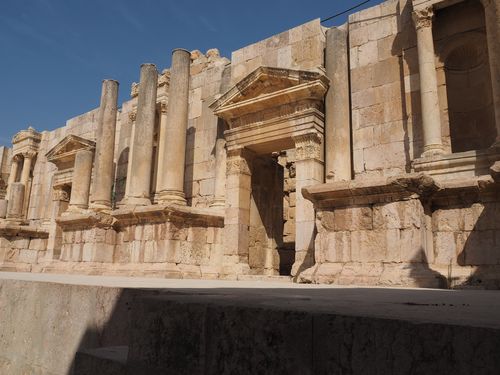
Jerash • South Theater
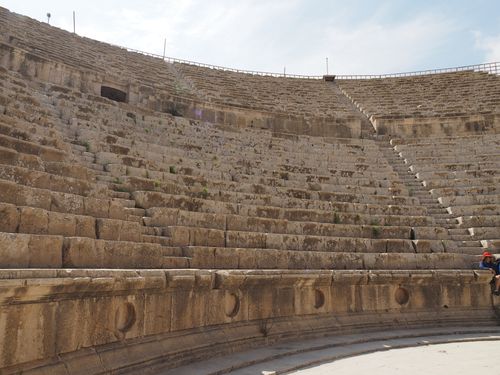
Jerash • South Theater
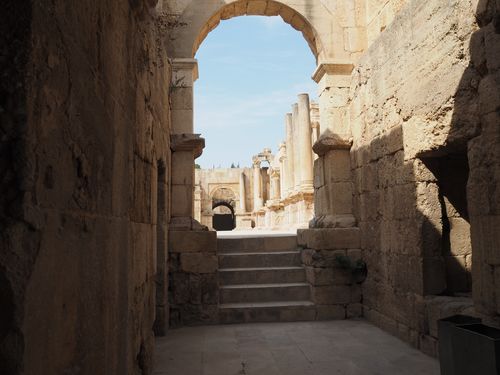
Jerash • South Theater
Monument profile
South Theater
Monument categories: Archaeological, Amphitheatre
Monument families: Archaeological • Monument for cultural purposes
Monument genres: Archaeological site, Cultural or scientific
Cultural heritage: Roman antiquity
Geographic location: Jerash • Jordan
Construction period: 1er siècle
• Links to •
• List of videos about Amman, Jerash, Umm Qais on this site •
Jordan • the Roman Jordan
Jerash, Pompeii of the East • Jordan
History of the South Theatre of Jerash
The South Theatre of ancient Gerasa, modern Jerash in Jordan, stands as one of the most imposing monuments of the Roman city. Constructed in the late first century CE, traditionally dated to the reign of Emperor Domitian (81–96 CE), and expanded during the second century, it reflects the political ambition, social organization, and cultural integration of Gerasa within the Roman Empire. Its history illustrates the trajectory of a provincial city that adopted and adapted imperial models of urban monumentalism.
Political and Social Context of Construction
In the late first century CE, Gerasa was a flourishing member of the Decapolis, a league of cities in the eastern Roman provinces characterized by a strong Hellenistic heritage and growing Roman influence. Although culturally diverse, these cities shared a commitment to monumental architecture as a marker of civic status.
The construction of the South Theatre must be understood within this competitive and aspirational framework. Roman authorities encouraged urban development in the provinces as a means of consolidating imperial control. Monumental buildings such as theatres, baths, and temples expressed both loyalty to Rome and the prosperity of the local elite.
The South Theatre was likely financed, at least in part, by wealthy citizens seeking public recognition. In Roman civic culture, benefaction reinforced social hierarchy while fostering communal cohesion. By endowing a theatre of substantial capacity, Gerasa’s elite demonstrated their city’s economic strength and cultural sophistication.
The political implications were equally significant. The theatre served not only as a venue for dramatic performances but also as a space for civic assemblies, official announcements, and imperial ceremonies. Its construction symbolized the city’s integration into Roman administrative structures and its adherence to imperial cultural norms.
Expansion and Urban Consolidation
During the second century CE, under the Antonine emperors, the South Theatre underwent enlargement. This period marked a high point in the prosperity of many eastern cities. The expansion increased the seating capacity to approximately 5,000 spectators, transforming the theatre into one of the largest in the region.
The enlargement reflects demographic growth and intensified civic activity. Gerasa was investing in a coherent urban program that included colonnaded streets, temples, and public baths. The theatre occupied a prominent position within this ensemble, reinforcing its role as a central node of urban life.
Major Historical Events and Long-Term Transformations
The third century brought political instability across the Roman Empire. Although Gerasa did not experience catastrophic destruction during this period, economic fluctuations likely affected the frequency and scale of public spectacles. Over time, the theatre’s role evolved.
The Christianization of the empire in the fourth century introduced new religious dynamics. Theatrical performances, often associated with pagan traditions, declined in prominence. While there is no evidence of immediate abandonment, the cultural significance of the theatre diminished relative to newly constructed churches.
Following the Islamic conquest of the Levant in the seventh century, Gerasa was incorporated into Umayyad administrative networks. The theatre no longer functioned as a performance venue. Urban contraction gradually altered the surrounding landscape, and maintenance of large Roman monuments ceased.
The devastating earthquake of 749 CE caused extensive structural damage throughout the region. The South Theatre suffered partial collapse, particularly in its upper sections. Over subsequent centuries, stone blocks were reused in other constructions, a common practice in abandoned or declining urban centers.
Global Context of Monumental Construction
The South Theatre’s construction occurred during a period when Roman cities across the Mediterranean invested heavily in monumental public architecture. From North Africa to Asia Minor, theatres represented civic identity and imperial unity.
This wave of building activity corresponded to a broader phenomenon of urban monumentalization. In other parts of the world, including the Parthian realm and regions of South Asia, large-scale architectural complexes were similarly used to articulate political authority and communal identity. However, the Roman theatre was distinctive in its standardized typology and integration into a cohesive imperial urban system.
Gerasa’s adoption of this model demonstrates its participation in a shared architectural and cultural language extending across the Roman world.
Decline, Rediscovery, and Archaeological Intervention
By the medieval period, the theatre had fallen into ruin. European travelers in the nineteenth century documented its impressive remains, noting the preservation of the seating tiers. Systematic archaeological excavations in the twentieth century cleared debris and stabilized the structure.
Restoration policies emphasized conservation over reconstruction. Damaged seating rows were consolidated, and vulnerable masonry was reinforced. The theatre’s setting within a protected archaeological zone has helped preserve its integrity.
Modern Jerash developed adjacent to, rather than directly over, the ancient city, allowing the monument to remain relatively unobstructed by contemporary construction.
Contemporary Role and Cultural Significance
Today, the South Theatre functions as a focal point within the Jerash archaeological site. It is occasionally used for cultural festivals and musical performances, reactivating its original acoustic properties. These events reinforce the monument’s symbolic continuity as a gathering place.
The theatre contributes substantially to Jordan’s national heritage narrative. It represents the Roman layer of the country’s complex historical identity, complementing Nabataean, Byzantine, and Islamic elements.
Jerash has been included on UNESCO’s Tentative List for World Heritage inscription. Recognition would highlight the ensemble of Roman monuments, with the South Theatre as one of its most significant components.
Conservation Status and Modern Challenges
The South Theatre remains one of the best-preserved Roman theatres in the Levant. Nonetheless, environmental and structural challenges persist. Limestone is susceptible to erosion caused by temperature variation, wind, and moisture. Seismic vulnerability remains a long-term concern in this tectonically active region.
Tourism presents both opportunity and risk. While visitor engagement supports heritage awareness and economic development, foot traffic can accelerate wear on ancient surfaces. Conservation strategies implemented by Jordanian authorities focus on structural monitoring, controlled access, and minimal intervention.
Pollution and urban expansion in the vicinity require ongoing management to protect the visual and physical integrity of the site.
Conclusion
The South Theatre of Jerash embodies the political ambition, civic organization, and cultural aspirations of a Roman provincial city. Constructed during a period of stability and prosperity, expanded in an era of urban consolidation, and transformed by religious, political, and natural upheavals, it reflects the layered history of Gerasa. Today, as both archaeological monument and cultural venue, it continues to illustrate the enduring impact of Roman urbanism in the eastern Mediterranean.
Architectural features
Architectural Analysis of the South Theatre of Jerash
The South Theatre of ancient Gerasa, modern Jerash in Jordan, represents one of the most accomplished examples of Roman theatre architecture in the eastern provinces. Constructed in the late first century CE and enlarged in the second century, it embodies the technical precision, structural logic, and urban coherence characteristic of imperial Roman design. Its scale, preservation, and integration within the cityscape make it a key monument for understanding provincial adaptations of metropolitan architectural models.
Technological and Architectural Innovations
The South Theatre follows the canonical Roman typology: a semi-circular cavea facing an orchestra and framed by a monumental scaenae frons. Unlike earlier Greek theatres carved entirely into natural slopes, the Roman model combines landscape integration with engineered substructures. At Jerash, the lower seating tiers rest partly on the natural incline, while the upper sections are supported by a complex system of radial walls and vaulted corridors.
The structural framework relies on concentric and radial masonry walls designed to distribute vertical and lateral loads efficiently. Barrel vaults constructed beneath the cavea provide both reinforcement and circulation space. These substructures allowed the theatre to achieve greater height and capacity than a purely hillside-supported structure would permit.
Vomitoria, or vaulted passageways, channel spectators directly into specific seating sectors. This innovation optimized crowd movement and minimized congestion, reflecting Roman concerns for orderly public assembly. The geometry of the cavea—its curvature, inclination, and tiered segmentation—was calculated to ensure optimal sightlines and acoustic performance.
Acoustic engineering constitutes one of the theatre’s most remarkable features. The consistent gradient of the seating tiers enhances sound projection from the stage to the upper rows. The reflective properties of local limestone amplify spoken voices without artificial assistance. Even today, the clarity of sound transmission demonstrates the effectiveness of this architectural design.
Urbanistically, the theatre is carefully aligned with the city’s orthogonal street grid. Its placement complements nearby colonnaded avenues and civic structures, reinforcing the coherence of Gerasa’s monumental core.
Materials and Construction Techniques
The primary construction material is locally quarried limestone, chosen for its durability and workability. Large ashlar blocks were cut with precision and laid in regular courses. The masonry relies primarily on gravity and exact jointing rather than extensive mortar bonding.
Metal clamps and dowels were inserted at key structural points to enhance stability. The seating blocks were produced in standardized dimensions, allowing systematic installation and facilitating future maintenance. This modular approach reflects advanced planning and logistical coordination.
The stage building incorporated architectural ornamentation carved from the same limestone. Columns, entablatures, and decorative capitals were shaped according to classical orders, predominantly Corinthian. Although portions of the scaenae frons have deteriorated, surviving fragments attest to refined craftsmanship.
Drainage systems were integrated into the design. Channels beneath the seating tiers directed rainwater away from the structure, preventing erosion and structural weakening. Slight inclines in the orchestra pavement further aided water runoff.
Architectural Influences and Stylistic Synthesis
The South Theatre exemplifies the Roman closed theatre type, where the cavea and stage building form a unified architectural entity. This configuration contrasts with the open Greek theatre model while retaining certain Hellenistic elements, particularly in the adaptation to terrain.
The decorative program balances imperial formalism with regional restraint. Compared to theatres in Asia Minor or North Africa, the vertical articulation of the scaenae frons is moderate, consistent with the scale of Gerasa. The use of Corinthian capitals and proportional harmony reflects widespread eastern Mediterranean preferences during the early Empire.
Sculptural niches integrated into the stage façade likely accommodated statues of emperors or benefactors. These features linked architecture with political symbolism, reinforcing the monument’s civic function.
Inscriptions carved into selected seating rows designate reserved sections, revealing the social hierarchy embedded within the architectural layout. Such details demonstrate how spatial organization reinforced civic structure.
Spatial Organization and Structural Composition
The theatre consists of three principal components: the cavea, the orchestra, and the scaenae frons. The cavea is divided into horizontal zones separated by walkways (praecinctiones). Radial staircases segment the seating into wedge-shaped sectors, ensuring accessibility and visibility.
The orchestra forms a semi-circular space at the base of the seating tiers. In Roman usage, this area often accommodated dignitaries rather than performers, reflecting social stratification within the spatial hierarchy.
The stage platform (pulpitum) spans the diameter of the orchestra. Behind it, the scaenae frons provided both structural support and a permanent architectural backdrop. Multi-tiered column arrangements created depth and visual emphasis, framing theatrical performances.
After its second-century expansion, the theatre reached a diameter of approximately 100 meters and could accommodate around 5,000 spectators. This capacity places it among the larger provincial theatres of the Levant.
Distinctive Structural Characteristics
One notable characteristic is the seamless integration of the second-century enlargement into the original first-century structure. Additional seating tiers were incorporated without compromising structural coherence, indicating careful engineering recalibration.
The upper cavea retains a substantial portion of its original seating rows, demonstrating the durability of the masonry system. The precision of block alignment and the stability of the radial supports have enabled the monument to withstand centuries of seismic activity and environmental exposure.
The theatre’s acoustic performance remains a defining feature. Spoken words projected from the orchestra can be heard clearly in upper tiers, a testament to the enduring functionality of Roman acoustic design.
Dimensions and Noteworthy Data
The cavea’s diameter approaches 100 meters, with seating rising in a continuous arc. The vertical height of the preserved tiers provides insight into the monument’s original grandeur. The radial staircases are evenly spaced, maintaining geometric symmetry throughout the structure.
The theatre’s orientation maximizes exposure while minimizing direct wind interference. This alignment reflects practical considerations integrated into the overall design.
International Significance and Conservation
Architecturally, the South Theatre represents a mature example of Roman provincial adaptation. It demonstrates how standardized imperial typologies were implemented with technical consistency while accommodating local topography and materials.
The monument forms part of the protected archaeological complex of Jerash, currently on UNESCO’s Tentative List. Conservation programs focus on stabilizing masonry, monitoring structural stress, and mitigating erosion of limestone surfaces.
Seismic vulnerability remains a critical concern in the region. Controlled visitor access and periodic maintenance help preserve the structural integrity of seating tiers and circulation corridors.
Conclusion
The South Theatre of Jerash exemplifies the engineering sophistication and architectural coherence of Roman urbanism in the eastern provinces. Through its vaulted substructures, precise masonry, and calculated acoustics, it embodies the technical mastery of Roman builders. Its spatial organization reflects social hierarchy and civic function, while its enduring preservation underscores the resilience of its construction. As a monumental expression of provincial Roman identity, it remains a central architectural reference within the archaeological landscape of Jerash.