

 Français (France)
  Nederlands (nl-NL)
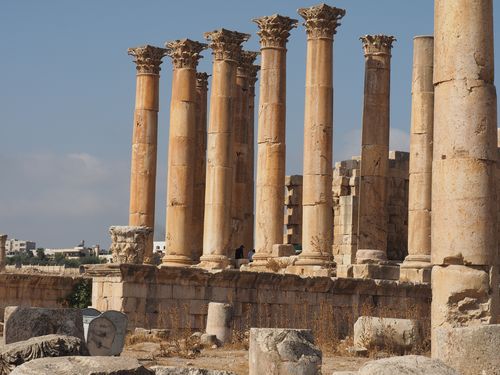
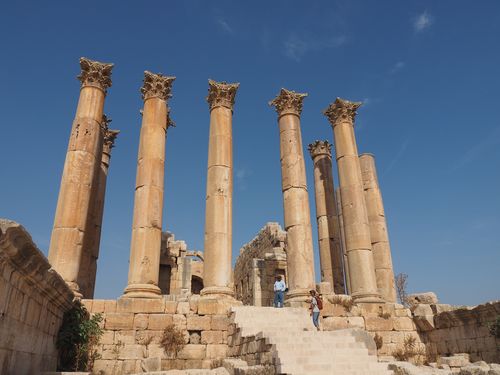
 The Temple of Artemis in Jerash, Jordan, is one of the principal monuments of ancient Gerasa, a leading city of the Decapolis. Dedicated to Artemis, the city’s patron deity, it held a prominent place within the urban organization of the classical settlement. The sanctuary reflects the significance of civic cults and the role of religious institutions in the public life of Gerasa during the Greco-Roman period. Today, its remains form a key component of the archaeological site of Jerash and illustrate the cultural and religious influences that shaped the region’s historical development.
Monument profile
Temple of Artemis
Monument categories: Archaeological, Roman temple
Monument families: Temple • Archaeological
Monument genres: Religious, Archaeological site
Cultural heritage: Roman antiquity
Geographic location: Jerash • Jordan
Construction period: 2nd century AD
• Links to •
• List of videos about Amman, Jerash, Umm Qais on this site •
Jordan • the Roman Jordan
Jerash, Pompeii of the East • Jordan
History of the Temple of Artemis in Jerash
The Temple of Artemis in Jerash, ancient Gerasa, stands as one of the most significant monuments of Roman Arabia. Constructed in the second century CE, it was dedicated to Artemis, the patron deity of the city. Its history reflects the political integration of Gerasa into the Roman Empire, the assertion of civic identity within the Decapolis, and the profound religious and social transformations that reshaped the Levant from antiquity to the modern era.
Political and Social Context of Construction
Gerasa was a member of the Decapolis, a league of Hellenistic cities in the eastern Roman provinces. Although the city had earlier experienced Hellenistic influence following Alexander the Great’s campaigns, its most substantial urban development occurred under Roman rule. In 106 CE, the annexation of the Nabataean Kingdom by Emperor Trajan led to the creation of the province of Arabia Petraea. Gerasa benefited directly from this reorganization, gaining access to imperial trade networks and administrative stability.
The construction of the Temple of Artemis occurred during a period of prosperity in the second century CE, often described as the Pax Romana. Monumental building programs served both religious and political purposes. The erection of a grand sanctuary dedicated to the city’s patron deity affirmed civic pride, strengthened communal identity, and demonstrated loyalty to Rome.
Local elites, who held magistracies and financed public works, played a decisive role in promoting the temple’s construction. Their patronage expressed both piety and political ambition. By investing in monumental architecture, they enhanced their social prestige and positioned Gerasa competitively among neighboring cities of the Decapolis. The sanctuary thus functioned as an instrument of urban representation within a broader regional framework.
Imperial Ambitions and Regional Rivalries
The second century was marked by imperial consolidation under emperors such as Trajan, Hadrian, and Antoninus Pius. Public architecture in the provinces mirrored the ideological priorities of Rome: order, prosperity, and cultural cohesion. Although the temple was primarily a civic initiative, it formed part of a wider imperial pattern of monumentalization.
Hadrian’s documented visit to the region around 129–130 CE symbolized imperial engagement with the eastern provinces. Such visits often stimulated urban embellishment projects. Even if direct imperial sponsorship of the temple remains uncertain, its scale and refinement suggest that Gerasa sought to align itself visually and symbolically with Roman metropolitan standards.
Rivalries among Decapolis cities likely encouraged competitive building campaigns. Monumental sanctuaries were tangible expressions of civic rank. The Temple of Artemis reinforced Gerasa’s prominence within the regional urban hierarchy.
Major Historical Events Affecting the Site
During the third century, the temple remained an active center of civic worship. However, the political instability that affected the Roman Empire in this period may have limited further enhancements. The sanctuary nevertheless retained its symbolic importance.
A decisive transformation occurred in the fourth century with the Christianization of the Empire. Following the Edict of Milan in 313 CE and subsequent imperial legislation favoring Christianity, pagan cults gradually declined. The Temple of Artemis lost its religious function. In many cases across the eastern provinces, temples were abandoned, repurposed, or dismantled for building materials.
Under Byzantine rule, Gerasa continued as a Christian city. Churches were constructed within the urban fabric, sometimes reusing architectural elements from earlier pagan monuments. The temple complex likely experienced partial dismantling, reflecting shifting religious priorities.
The Islamic conquest of the Levant in the seventh century introduced new political structures. Gerasa became part of the Umayyad Caliphate. By this stage, the temple had long ceased to function as a sanctuary. Its ruins formed part of the evolving urban landscape.
The earthquake of 749 CE was catastrophic for many cities in the region, including Gerasa. Numerous structures collapsed or were severely damaged. Although several columns of the Temple of Artemis remained standing, the seismic event contributed significantly to its ruinous state. Subsequent centuries saw gradual abandonment and material reuse.
Global Context at the Time of Construction
The temple’s construction coincided with a global era of monumental religious architecture. Across the Roman Empire, grand temples symbolized imperial stability and urban vitality. In Rome, Asia Minor, North Africa, and the Levant, sanctuaries were erected or renovated as expressions of civic prosperity.
Beyond the Roman world, large-scale religious monuments were also prominent. In South Asia, Buddhist and Hindu complexes expanded under Kushan and early Gupta patronage. In China, monumental projects flourished during the Han dynasty. These parallel developments illustrate a broader pattern in which architecture functioned as a medium of political and spiritual representation.
Within this global framework, the Temple of Artemis represents the provincial adaptation of imperial architectural ideals. It embodied Rome’s cultural authority while reflecting local identity.
Transformations, Decline, and Archaeological Rediscovery
Following its abandonment as a pagan sanctuary, the temple entered a prolonged phase of decline. Stones were removed for secondary construction. Natural erosion and seismic activity accelerated deterioration. By the medieval period, the site had largely fallen into ruin.
European travelers of the nineteenth century documented the remains, bringing renewed attention to Gerasa. Systematic archaeological excavations began in the early twentieth century, notably under the auspices of American and European institutions. These efforts aimed to document, stabilize, and partially clear the monumental complex.
Restoration campaigns focused on structural consolidation rather than reconstruction. The surviving columns were reinforced, and fallen architectural elements were catalogued. The archaeological approach emphasized preservation of authenticity.
Role in the Modern Era and Cultural Significance
Today, the Temple of Artemis is one of the most recognizable monuments within the archaeological park of Jerash. It serves as a visual emblem of the city’s Roman heritage and attracts visitors from around the world.
The monument contributes to Jordan’s cultural identity as a custodian of diverse historical layers, including Hellenistic, Roman, Byzantine, and Islamic periods. Public festivals, such as the Jerash Festival of Culture and Arts, occasionally use the broader archaeological setting as a backdrop, reinforcing the site’s symbolic resonance.
Jerash has been proposed for inclusion on UNESCO’s World Heritage Tentative List. Such recognition would underscore the temple’s importance within the corpus of Roman provincial architecture and enhance international cooperation in preservation.
Conservation Challenges and Preservation Policies
The temple faces environmental and structural challenges. Limestone deterioration, temperature fluctuations, and seismic vulnerability require ongoing monitoring. Conservation authorities implement stabilization measures, including structural assessments and careful maintenance of standing columns.
Tourism management constitutes another critical factor. Visitor access is regulated to minimize physical impact on fragile remains. Conservation policies aim to balance public engagement with long-term preservation.
Urban expansion of modern Jerash has remained relatively contained, allowing the ancient city to retain spatial integrity. Continued investment in heritage protection remains essential to safeguard the monument.
Conclusion
The Temple of Artemis in Jerash encapsulates the aspirations of a provincial Roman city at the height of imperial prosperity. Conceived as a monumental expression of civic identity and religious devotion, it endured successive political and religious transformations before becoming a prominent archaeological landmark. Its history mirrors the broader evolution of the eastern Mediterranean, from pagan antiquity through Christian and Islamic periods to contemporary heritage preservation. The temple stands not only as a relic of Roman architecture but also as a testament to the layered historical narrative of the region.
Architectural features
Architecture of the Temple of Artemis in Jerash
The Temple of Artemis in Jerash represents one of the most accomplished examples of Roman religious architecture in the eastern provinces of the Empire. Built in the second century CE, the sanctuary reflects the mature phase of provincial monumental design, combining canonical Greco-Roman forms with regional adaptations. Its scale, technical refinement, and integration within the urban fabric of Gerasa demonstrate both architectural ambition and advanced construction expertise.
Urban Setting and Spatial Organization
The temple occupies a commanding position on elevated ground in the northwestern sector of the ancient city. This topographical choice was deliberate. By situating the sanctuary above the surrounding streets, the builders reinforced its visual dominance and symbolic authority. The elevated temenos establishes a clear spatial hierarchy between sacred and civic zones.
Access to the sanctuary follows a carefully structured ceremonial progression. A monumental stairway leads from the lower city to a vast forecourt enclosed by colonnaded porticoes. This courtyard functioned as an assembly space for rituals and public gatherings. The temple itself stands on a high podium within this enclosure, emphasizing axial alignment and controlled movement toward the cella.
The plan follows the classical peripteral arrangement. The building features six columns on the façade and eleven along each lateral side, creating a rhythmic colonnaded perimeter. The longitudinal axis directs attention toward the pronaos and the cella entrance, reinforcing the ritual focus of the structure. The geometric clarity of the layout reflects Roman planning principles adapted to the Levantine context.
Structural System and Engineering Innovations
The architectural design demonstrates a sophisticated understanding of structural mechanics. The temple stands on a massive podium constructed with large ashlar blocks. Beneath the visible platform, vaulted substructures stabilize the slope and distribute loads evenly. This solution compensates for irregular terrain while preserving proportional harmony.
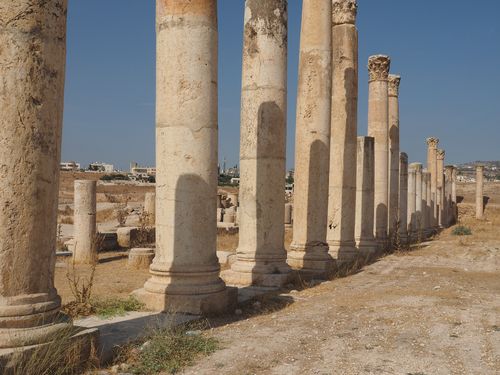
Columns are composed of stacked drums precisely carved and aligned. Metal clamps secured with molten lead were inserted into prepared cavities, ensuring cohesion between stone elements. This technique reduced displacement during seismic activity, a crucial consideration in a region prone to earthquakes.
The Corinthian columns reach approximately thirteen meters in height. Their slender proportions required accurate calculation of weight distribution and entablature support. The entablature—comprising architrave, frieze, and cornice—was engineered to balance decorative elaboration with structural stability. Deep cornices provide shadow articulation while contributing to the rigidity of the upper structure.
The absence of large interior vaults or domes corresponds to the traditional Greco-Roman temple typology, yet the substructures employ barrel vaulting. This integration of vaulted engineering beneath a classical superstructure reflects Roman adaptability and technical maturity.
Materials and Construction Techniques
The primary building material is locally quarried limestone. Its fine grain allowed detailed carving, especially in capitals and moldings. Limestone’s relative lightness compared to marble facilitated transport and erection while maintaining durability.
Blocks were extracted in standardized dimensions to facilitate modular construction. Quarry marks and lifting holes indicate the use of cranes equipped with pulley systems. These devices, common in Roman construction, allowed the placement of massive stone components with precision.
Surface treatment included careful smoothing and finishing. Although the stone appears monochromatic today, traces suggest that architectural elements were originally painted. Polychromy enhanced decorative features and increased visual contrast under intense Mediterranean light.
The podium’s core consists of tightly fitted ashlar masonry, demonstrating high-quality stone dressing. Mortar use is minimal in the visible superstructure, underscoring the reliance on precise stone-to-stone contact.
Decorative Program and Artistic Influences
The temple’s architectural language is rooted in the Corinthian order, characterized by acanthus-leaf capitals and ornate entablatures. This stylistic choice aligns the monument with metropolitan Roman taste and imperial aesthetics.
Nevertheless, regional craftsmanship is evident. Variations in leaf carving, volute curvature, and molding depth suggest local workshops interpreting established models. The blending of Roman canonical proportions with provincial carving techniques produces a distinctive visual identity.
The sanctuary complex integrates Hellenistic precedents through its elevated temenos and axial progression. The interplay between open courtyard and elevated shrine reflects Eastern Mediterranean sacred planning traditions adapted to Roman formalism.
Ornamental detailing remains concentrated on capitals, cornices, and door frames. The restrained decorative distribution enhances structural clarity while emphasizing symbolic zones, particularly the façade.
Architectural Components and Distinctive Features
The high podium constitutes one of the temple’s defining characteristics. Rising approximately ten meters above the courtyard level, it magnifies vertical perception and reinforces monumentality. The grand staircase accentuates this vertical transition.
The pronaos features six frontal columns supporting a richly articulated entablature. Behind this portico lies the cella, originally housing the cult statue. The cella walls are robust and comparatively austere, contrasting with the refined external colonnade.
Eleven columns remain standing today, forming a striking silhouette against the skyline. Their preservation illustrates the structural resilience achieved through precise stone assembly. The entablature fragments reveal deeply carved moldings and projecting cornices.
Unlike later Roman temples incorporating domes or complex vault systems, the Temple of Artemis adheres to the classical trabeated system. This structural choice emphasizes horizontal layering and columnar rhythm.
Dimensions and Architectural Data
The temple measures approximately forty meters in length and twenty-two meters in width. The podium elevation exceeds ten meters, contributing to the monument’s commanding presence. Columns reach more than thirteen meters in height, with substantial diameters ensuring proportional stability.
The courtyard enclosure further amplifies spatial scale. The overall sanctuary complex extends beyond the immediate footprint of the temple, integrating porticoes and processional pathways.
These dimensions position the Temple of Artemis among the largest Roman sanctuaries in modern Jordan. Its proportions are comparable to significant provincial temples across the eastern Empire.
Technological Adaptation to Environmental Conditions
Regional seismic activity influenced structural choices. The use of massive ashlar blocks and metal clamps improved resistance to lateral forces. Drum-based column construction allowed partial movement without catastrophic collapse.
The elevated location also enhanced natural ventilation. Open colonnades facilitated airflow across the courtyard and around the temple structure. Deep cornices created shade, moderating thermal expansion and protecting decorative surfaces.
Drainage channels integrated into the platform directed rainwater away from foundations, reducing erosion risks. Such measures reflect practical adaptation to local climatic conditions.
Conservation Status and Architectural Significance
Today, the Temple of Artemis forms a central element of the archaeological park of Jerash. Its standing columns constitute one of the most recognizable architectural ensembles in the region. Conservation efforts focus on structural monitoring, stabilization of entablature fragments, and mitigation of limestone weathering.
Environmental exposure, temperature fluctuation, and micro-fracturing remain ongoing concerns. Preservation policies prioritize minimal intervention and reversible techniques.
The architectural value of the temple lies in its synthesis of classical form and provincial adaptation. It demonstrates the transmission of imperial design principles across geographic and cultural boundaries. Its survival provides critical insight into Roman engineering practices in seismic zones.
Conclusion
The Temple of Artemis in Jerash exemplifies the technical mastery and aesthetic ambition of Roman provincial architecture in the second century CE. Through its elevated podium, peripteral colonnade, Corinthian detailing, and integrated substructures, the monument embodies both adherence to canonical forms and sensitivity to regional conditions. Its enduring verticality, marked by the preserved colonnade, continues to illustrate the structural sophistication achieved by Roman builders in the eastern Mediterranean.