Français (France)
  Nederlands (nl-NL)
 00:00 • intro | 00:33 • Sasivekalu Ganesha temple | 02:18 • the temple of Virupaksha, first pearl of Hampi | 07:59 • some temples in an amazing nature | 09:21 • the royal enclosure | 09:58 • the Zenana enclosure (women's enclosure) | 10:41 • Lotus Mahal | 11:25 • the elephants stable | 13:35 • the temple of Vittala, the other pearl of Hampi
Personal creation from visual material collected during my trip Unknown India • Ladakh, Karnataka, Telangana (2022)
Map of places or practices in Hampi on this site
• Use the markers to explore the content •
Hampi, Imperial Grandeur and Sacred Landscapes of Karnataka
A Monumental Capital Among the Granite Hills
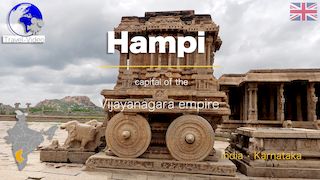
Hampi is one of the most remarkable archaeological landscapes in India. Located in the present-day state of Karnataka, it was the capital of the Vijayanagara Empire, one of the major powers of southern India between the fourteenth and sixteenth centuries. This video offers an introduction to a vast historical city where temples, royal compounds, ceremonial platforms and elegant pavilions stand within a dramatic setting of granite boulders, river plains and cultivated valleys.
Hampi is far more than a collection of ruins. It was once a large and carefully organized metropolis with religious districts, markets, processional roads, administrative zones and palace areas. Even in fragmentary form, the site still preserves the logic of an imperial capital. Its enduring fascination lies in the rare combination of urban planning, sacred architecture and an extraordinary natural environment.
Inscribed in 1986 as the UNESCO World Heritage property known as the Group of Monuments at Hampi, the site remains one of the most important testimonies to medieval South Indian civilization.
Major Monuments and Spaces Seen in the Video
The journey begins with the Sasivekalu Ganesha temple, known for its monumental image of Ganesha carved from stone. This shrine introduces one of Hampi’s recurring themes: sculpture conceived at architectural scale and integrated into open space.
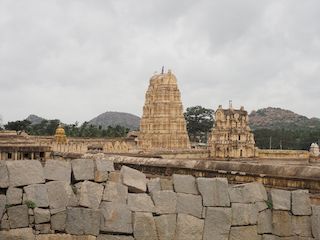
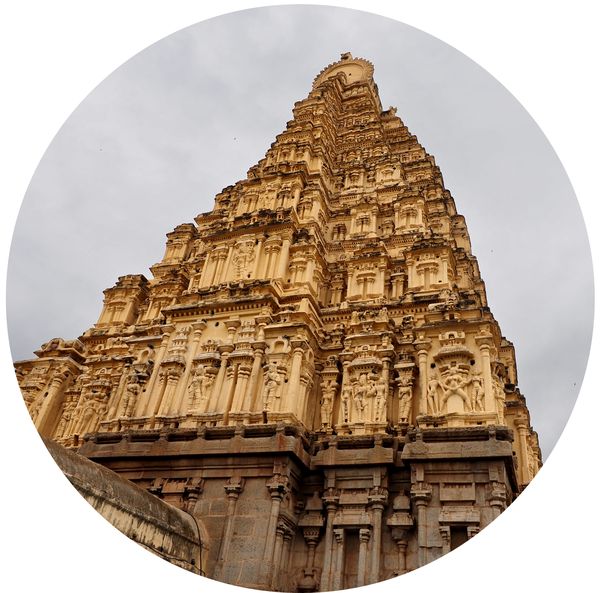
The Virupaksha Temple follows as one of the spiritual centers of Hampi and one of its oldest surviving sacred institutions. The temple predates the empire but was incorporated into the capital during Vijayanagara rule. Its towering gateway, successive courtyards and continuous ritual life make it one of the principal landmarks of the site. It represents the link between an earlier sacred tradition and later imperial expansion.
The sequence showing several temples scattered through striking natural surroundings reminds viewers that Hampi was also a sacred landscape. Shrines, mandapas and ritual structures were placed among rocky hills, pathways and water sources. Religion here was not confined to enclosed compounds; it shaped the wider territory.
The Royal Enclosure then reveals the political heart of the capital. This zone once contained palaces, audience halls, ceremonial platforms and administrative buildings. Structures such as the Mahanavami Dibba, a massive elevated platform associated with state ceremonies and public spectacle, demonstrate how architecture was used to stage royal authority.
The so-called Women’s Enclosure, often identified with the Zenana area, presents another dimension of the city: refined residential and courtly spaces. Within it stands the Lotus Mahal, one of Hampi’s most elegant monuments. Its arches, layered elevations and balanced proportions combine local traditions with Indo-Islamic influences, making it architecturally distinctive.
Nearby, the Elephant Stables form one of the best-known secular buildings at Hampi. Their row of domed chambers recalls the ceremonial and military importance of elephants in South Asian royal courts.
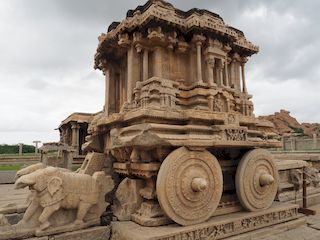
The final major sequence is devoted to the Vittala Temple, often considered Hampi’s second great masterpiece after Virupaksha. Its sculpted halls, celebrated stone chariot and refined stonework represent the architectural ambition of the empire at its height.
Historical and Architectural Context of Vijayanagara
The Vijayanagara Empire emerged in the fourteenth century during a period of political reorganization in southern India. Hampi became its capital and benefited from major royal patronage. Successive rulers invested in temples, roads, water systems, markets, fortifications and ceremonial spaces designed to express stability and power.
The city functioned simultaneously as a political capital and a sacred center. Royal legitimacy was closely linked to temple patronage, festivals and public ritual. Monumental architecture therefore had practical, symbolic and ideological purposes. Religious buildings served devotion, but they also projected wealth and dynastic prestige.
Local granite strongly shaped the appearance of Hampi. Builders transformed this hard material into massive platforms, finely carved columns and durable structures that still dominate the landscape. Rather than erasing the natural terrain, planners often incorporated boulders, ridges and existing topography into the city’s design. This explains why Hampi appears both constructed and geological at the same time.
The capital declined rapidly after the Battle of Talikota in 1565, when Vijayanagara forces were defeated by a coalition of Deccan sultanates. The city was subsequently plundered and gradually abandoned. Yet the scale of surviving remains still conveys the magnitude of what once stood here.
What the Videos of This Site Make Especially Clear
The videos on travel-video.info, often created from carefully selected photographs animated with smooth transitions, are particularly effective for a site as extensive as Hampi. They allow viewers to move gradually from one monument to another while preserving a sense of urban continuity.
Slow shifts in framing make scale easier to understand: the height of gateways, the breadth of courtyards, the length of processional avenues and the position of temples within the rocky terrain. Instead of seeing isolated ruins, the viewer perceives relationships between sacred zones, royal spaces and natural features.
This approach also highlights details that may be overlooked during a rapid visit. The sculpted columns of the Vittala Temple, the graceful geometry of the Lotus Mahal, the rhythmic domes of the Elephant Stables and the commanding mass of ceremonial platforms become easier to read when the image lingers.
The alternation between broad views and close studies is especially useful at Hampi because the site operates on multiple levels. It is at once a city, a ritual landscape and a collection of individual monuments. The visual method used here helps explain those layers progressively.
Finally, animated photographic sequences are well suited to the textures of Hampi: weathered granite, carved surfaces, open sky and long sightlines across the ruins. They restore coherence to a place spread across a large territory.
A Lost Capital of Exceptional Scale
To discover Hampi through this video is to approach one of Asia’s great vanished capitals, where religion, royal power and landscape design were combined on an extraordinary scale. The detailed pages linked to the site offer the opportunity to explore each monument more deeply and to understand how this imperial city once functioned as a living center of South Indian civilization.








Audio Commentary Transcript
At the entrance to the archaeological site of Hampi, capital of the ancient Vijayanagara empire, stands a temple typical of the architecture of this period, housing a monolithic statue of Ganesh, the Sasivekalu Ganesha temple.
On this statue, Ganesh seems to have 4 arms. In reality, if we look at the monolithic statue from behind, we see that in fact Ganesh is seated on the lap of a woman. This woman is his mother, Parvati. It is to highlight the importance of the mother-child relationship in Hindu culture that Ganesh is sometimes represented on Parvati's lap.
Between the Sasivekalu Ganesha temple and one of the high places of Hampi, the Virupaksha temple, many small temples dot an atypical path, mostly made of improbable granite soil. But this geological particularity of the region also participated in the decision of the first rulers of the dynasty to choose Hampi to establish their new capital.
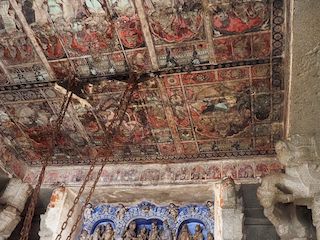
The Virupaksha temple is the most important monument in Hampi. The temple was built in the 7th century, long before Hampi was designated as the capital of the empire in the 14th century. This temple is remarkable for its imposing architecture, carved columns and painted ceilings. It has remained an important place of pilgrimage and festival in the region.
The interest of a visit to Hampi is not limited to the many temples of the place, but also lies in a truly amazing surrounding nature. The rock formations and numerous granite boulders that seem to be stacked randomly provide an interesting visual contrast to the temples and other monuments.
Following the defeat of the Vijayanagara Empire in 1565 against the Deccan League, Hampi was plundered and sacked. Many buildings have suffered greatly from this looting. Among these buildings, there is the royal palace of which only the foundations remain in our time.
This is pretty much all that remains of the royal palace. Only the Secret Council Chamber is still visible, since it was underground. Other buildings in this district are still visible today, including the Queen's Baths, the Lotus Mahal, the stables of the elephants or the wellstep.
The royal elephant enclosure has 11 rooms, each of which is intended to accommodate a single elephant. The architecture of the building is remarkable. Each bedroom has a large archway for the elephant to easily walk in and out of. In addition to this entrance door, an ingenious system of openings is used to ventilate and light the rooms.
After the temple of Virupaksha, here is the second pearl of Hampi, the Vittala temple dedicated to Vishnu. This temple is remarkable in more ways than one. First the stone chariot, symbolizing Vishnu's chariot drawn by elephants in the courtyard. Next, this temple has a music hall in which there are 56 musical pillars that emit sounds when struck lightly. Obviously visitors are not allowed to touch or hit these pillars, thus depriving us of the sound produced.
There is also the Kalyana Mantapa within the grounds of the Vittala temple. A Mantapa in South India designates a pavilion or a hall with pillars intended for various activities. The Kalyana Mantapa was used for wedding rituals.
Music:
- - YouTube video library - A Revelation
- - YouTube video library - Approaching Space Time Event
- - YouTube video library - At Odds
- - YouTube video library - BTS Prologue, (© BTS Prolog by Kevin MacLeod is licensed under a Creative Commons Attribution 4.0 license. https://creativecommons.org/licenses/by/4.0/
- Source: http://freepd.com/Unclassified/BTS%20Prolog
- Artist: http://incompetech.com/)
- - YouTube video library - Clouds
- - YouTube video library - Constancy Part 1 - The Descent, (© Constancy Part 1 - The Descent by Kevin MacLeod is licensed under a Creative Commons Attribution 4.0 license. https://creativecommons.org/licenses/by/4.0/
- Source: http://incompetech.com/music/royalty-free/index.html?isrc=USUAN1100775
- Artist: http://incompetech.com/)
- - YouTube video library - Constancy Part 2 - The Descent, (© Constancy Part 2 - The Descent by Kevin MacLeod is licensed under a Creative Commons Attribution 4.0 license. https://creativecommons.org/licenses/by/4.0/
- Source: http://incompetech.com/music/royalty-free/index.html?isrc=USUAN1100774
- Artist: http://incompetech.com/)
- - YouTube video library - Constancy Part 3 - The Descent, (© Constancy Part 3 - The Descent by Kevin MacLeod is licensed under a Creative Commons Attribution 4.0 license. https://creativecommons.org/licenses/by/4.0/
- Source: http://incompetech.com/music/royalty-free/index.html?isrc=USUAN1100774
- Artist: http://incompetech.com/)
Disclaimer: Despite its appropriateness, copyright issues prevent the use of indian traditional music in "Hampi, capital of the Vijayanagar empire • Karnataka, India", hence the use of royalty-free music. Despite our careful selection, some might regret this decision, which is necessary to avoid potential lawsuits. Although difficult, this decision is the only viable solution.