

 Français (France)
  Nederlands (nl-NL)
 The Stone Chariot of the Vittala Temple, located in Hampi in the Indian state of Karnataka, is one of the most iconic monuments of the UNESCO World Heritage site. Carved in the early 16th century, it represents a ceremonial vehicle dedicated to Garuda, the mythical mount of Vishnu. Although it belongs to the larger Vittala Temple complex, the chariot stands out as a distinct work due to its monolithic form and symbolic role. It reflects the artistic achievements of the Vijayanagara dynasty and has become one of the most recognisable images associated with Hampi.
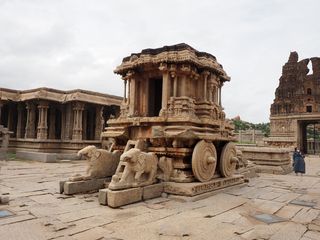
Hampi • Stone Chariot of the Vittala Temple
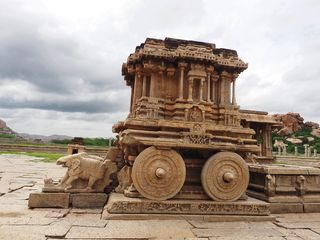
Hampi • Stone Chariot of the Vittala Temple
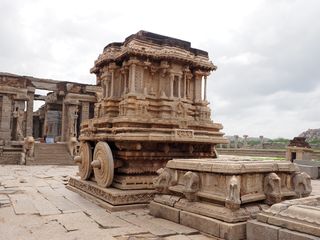
Hampi • Stone Chariot of the Vittala Temple


History of the Stone Chariot of the Vittala Temple in Hampi
The Stone Chariot of the Vittala Temple, located in Hampi in the southern Indian state of Karnataka, is one of the most iconic monuments of medieval India. Built in the early 16th century under the Vijayanagara Empire, this monolithic structure not only reflects religious devotion but also conveys political ambition and artistic achievement. Its survival, despite centuries of turmoil, makes it a valuable witness to the history of South India and an emblem of cultural heritage recognized worldwide.
Political and Social Context of Construction
The chariot was erected during the reign of Krishnadevaraya (1509–1529), widely regarded as the greatest ruler of the Vijayanagara Empire. At that time, South India was marked by political fragmentation and rivalry. The Bahmani Sultanate had disintegrated into smaller Deccan sultanates, which regularly clashed with Vijayanagara over territory and influence. The construction of monumental temples and their sculptural elements served as visible markers of imperial strength and legitimacy.
The Stone Chariot, dedicated to Garuda, the mythical mount of Vishnu, carried a strong symbolic message. It reflected the empire’s deep commitment to Vaishnavism and projected the image of Krishnadevaraya as a protector of dharma and guardian of Hindu traditions in a period of religious and political contestation. By commissioning such an innovative and enduring monument, the king was not only making a devotional offering but also reinforcing the ideological foundation of his rule, linking divine authority to earthly power.
The chariot also reflected social dynamics. Hampi, as the capital, was a vibrant urban center attracting traders, pilgrims, and artisans. Public monuments reinforced civic identity, and the chariot, prominently placed in the courtyard of the Vittala Temple, was both a spiritual symbol and a political statement to residents and visitors alike.
Major Historical Events
The fate of the chariot is closely tied to the fortunes of Vijayanagara. The city flourished under Krishnadevaraya and his immediate successors, but in 1565 it suffered a devastating blow at the Battle of Talikota. A confederation of Deccan sultanates inflicted a crushing defeat on Vijayanagara’s forces, leading to the sack of Hampi. The city was looted and burned, leaving many of its monuments damaged or abandoned.
Although the Vittala Temple complex was partly desecrated, the Stone Chariot survived, albeit with some loss of wooden superstructures and decorative elements. Unlike certain temples converted to other uses, the chariot did not find a new function but remained as a silent relic of a fallen empire. Over the following centuries, Hampi was largely deserted, and the chariot endured as a ruin exposed to natural forces rather than human activity.
Restoration efforts began much later, particularly during the colonial and post-independence periods. In the 20th century, the Archaeological Survey of India carried out conservation work, stabilizing the structure, securing its wheels, and protecting its bas-reliefs from further deterioration. These interventions preserved the chariot as one of Hampi’s most remarkable monuments.
Global Context at the Time of Construction
The early 16th century was a period of intense monumental building across the globe. In Europe, Gothic cathedrals reached their final flowering while Renaissance architecture was spreading, expressing civic pride and religious devotion. The Ottoman Empire was consolidating power through grand mosques in Constantinople. In the Americas, the Aztec and Inca civilizations were erecting ceremonial centers and temples with symbolic power.
The Stone Chariot of Hampi fits within this global trend of monumental construction. Like other great works of the period, it embodied a ruler’s ambition to assert legitimacy and leave a lasting mark on cultural memory. Though modest in scale compared to vast cathedrals or mosques, its innovation lay in the choice of form: transforming a temporary wooden ritual object into an eternal stone monument.
Transformations Over Time
The monument did not remain unchanged. Originally, the chariot included wooden elements, possibly forming part of the roof or superstructure, which have since disappeared. Its wheels were originally designed to be movable, enhancing the illusion of functionality, but they were later fixed in place to prevent damage. Sculpted horses that once appeared to pull the chariot were replaced by elephants during restoration, altering its symbolic imagery.
During centuries of neglect, erosion and weathering affected the carvings, while vegetation and natural wear weakened parts of the structure. The restoration campaigns of the 20th century sought to halt this decline, consolidating joints and re-carving minimal areas for stability, though with care to preserve authenticity.
Role and Cultural Importance Today
In modern India, the Stone Chariot has transcended its original religious function to become a cultural icon. It appears on currency notes, postage stamps, and in tourism campaigns, representing not only Hampi but also Indian heritage as a whole. Visitors from around the world come to admire it, and for local communities it remains a source of pride tied to the history of Vijayanagara.
Though no longer used in ritual processions, the chariot retains its symbolic link to Vishnu and Garuda. It is often seen as a representation of the continuity of Hindu traditions despite historical disruptions. Its prominence in cultural discourse illustrates how monuments can acquire new roles as symbols of identity and heritage long after their original functions have ceased.
State of Conservation and Modern Challenges
The Stone Chariot is structurally stable today but vulnerable to environmental and human pressures. Granite, though durable, is not immune to erosion from wind, rain, and temperature changes. Tourism brings both economic benefits and physical risks: vibrations, accidental contact, and pressure on the surrounding site contribute to gradual wear. Pollution and urban encroachment add further challenges.
Since Hampi was inscribed as a UNESCO World Heritage Site in 1986, protective measures have been strengthened. The Archaeological Survey of India oversees conservation, limits direct contact by visitors, and monitors environmental impact. However, balancing mass tourism with preservation remains a delicate task. Continuous vigilance and sustainable tourism practices are essential to safeguard the monument for future generations.
Conclusion
The Stone Chariot of the Vittala Temple is far more than a sculptural curiosity. Conceived during the zenith of the Vijayanagara Empire, it embodied the political ambitions of Krishnadevaraya, the devotional spirit of Vaishnavism, and the artistic mastery of South Indian craftsmen. Its survival through war, decline, and neglect has made it a rare witness to a vanished empire. Today, it is celebrated as a national icon and a symbol of resilience, embodying the enduring link between history, architecture, and cultural memory.
Architecture of the Stone Chariot of the Vittala Temple in Hampi
The Stone Chariot of the Vittala Temple, located in Hampi in the southern Indian state of Karnataka, is one of the most remarkable examples of monolithic architecture in South Asia. Built during the early 16th century under the Vijayanagara Empire, it combines technological innovation, artistic refinement, and symbolic meaning. Although modest in scale compared to full temple structures, its design and execution demonstrate the high level of craftsmanship achieved by the builders of Vijayanagara.
Technological and Architectural Innovations
The decision to sculpt a ceremonial chariot in stone represented a bold architectural innovation. Wooden chariots were traditionally used in temple processions dedicated to Hindu deities, but these were perishable and temporary. By recreating such a structure in granite, the builders transformed an object of ritual mobility into a permanent monument.
The artisans of Vijayanagara adapted techniques of stone cutting and assembly with exceptional precision. The wheels of the chariot, measuring about 1.5 meters in diameter, were originally carved to rotate. This detail reinforced the illusion of a functioning vehicle, an extraordinary technical achievement for the period. Later, the wheels were fixed in place to prevent structural stress, but the design remains a testimony to inventive engineering.
Stability was a key consideration. The chariot rests on a square granite platform carefully proportioned to distribute weight and resist weathering. The proportions of the base and the superstructure ensure that the monument maintains balance despite the heavy stone materials. This attention to structural soundness mirrors broader Vijayanagara architectural practices, which emphasized monumental scale while adapting to the natural geology of Hampi’s rocky terrain.
Materials and Construction Methods
Granite, abundant in the region, was the primary material. Its hardness and density made it ideal for long-term durability, though it posed significant challenges for sculptors. Artisans employed iron tools and progressive chiseling to achieve the refined details visible in the friezes and bas-reliefs.
The monument is not carved from a single block but from multiple granite segments joined with remarkable accuracy. Mortise-and-tenon techniques, commonly used in Indian stone architecture, ensured cohesion without the use of mortar. The overall effect is that of a monolith, although the structure is composed of carefully fitted components.
Some elements of the chariot were originally completed in wood, particularly the roof and decorative embellishments. These have since disappeared due to exposure and the passage of time, but their traces indicate an intentional interplay between durable stone and ephemeral wooden features. This mixture reflects the transitional character of the monument: a stone replica of a wooden form, bridging tradition and permanence.
Architectural and Artistic Influences
The Stone Chariot reflects the cultural synthesis typical of the Vijayanagara Empire. It follows the Dravidian temple tradition, drawing inspiration from the processional rathas of Tamil Nadu. The choice of form symbolized continuity with earlier South Indian dynasties, particularly the Cholas and Pandyas, who had long patronized elaborate temple rituals involving chariots.
The iconography reinforces Vaishnavite devotion. The chariot is dedicated to Garuda, the divine eagle and vehicle of Vishnu. Sculptural motifs include mythological figures, lions, elephants, and floral designs, all carved with intricate detail. The mixture of decorative elements illustrates both local artistic traditions and cross-cultural borrowings, as Vijayanagara was a hub for traders and artisans from across South India and beyond.
In stylistic terms, the monument reveals an awareness of both indigenous and foreign techniques. Some scholars have noted the influence of Kerala wood-carving traditions in the depiction of supporting animals, while others point to parallels with temple art in Orissa and even with Southeast Asian Hindu architecture. This cosmopolitan blend reflects the empire’s role as a center of commerce and cultural exchange.
Organization and Structural Features
The chariot stands on a raised plinth approximately 4.5 meters square. The base is adorned with carved reliefs depicting scenes from Hindu mythology, symbolic animals, and ornamental bands. Four wheels, placed at the corners, are proportioned to appear functional, reinforcing the illusion of mobility.
Above the base rises the rectangular body of the chariot, divided into sculpted registers. Decorative pilasters, miniature shrines, and ornamental motifs create a rich surface texture. At the center, a niche once housed a statue of Garuda, underscoring the monument’s devotional purpose.
The placement of the chariot within the Vittala Temple complex is equally significant. Positioned in the courtyard facing the sanctum, it forms a focal point for ritual and visual experience. Its orientation and alignment mirror the practice of placing wooden chariots in temple forecourts for festivals, thereby embedding a mobile ritual object into the fixed architecture of the sacred space.
Statistics and Notable Features
The chariot measures about 5 meters in height and is one of the most precisely proportioned structures of its type. Its wheels, at 1.5 meters in diameter, were once capable of limited movement, a feature that distinguishes it from similar monuments elsewhere.
One notable anecdote concerns the replacement of sculpted horses with elephants at the base of the chariot. Originally, the vehicle was drawn by horses, consistent with textual descriptions of Vishnu’s chariots. During a later restoration, the damaged horses were replaced with elephants, altering the iconography and symbolically increasing the monument’s association with strength and stability.
Another detail of interest is the possible use of polychromy. Though no pigments survive today, traces suggest that paint may have been applied to accentuate certain carvings, a common practice in Indian temple art. This would have given the chariot a more vivid appearance than the monochrome granite visible today.
International Recognition and Conservation Challenges
The architecture of the Stone Chariot has made it an emblem of Indian heritage worldwide. It is frequently used in visual representations of Hampi and even of Karnataka as a whole. Its architectural distinctiveness—transforming a temporary wooden festival object into a permanent granite structure—contributes to its uniqueness and symbolic power.
The monument is part of the Group of Monuments at Hampi, inscribed as a UNESCO World Heritage Site in 1986. This recognition has provided resources for conservation but also highlighted the challenges posed by tourism. The granite surfaces are susceptible to erosion, and the growing number of visitors increases the risk of physical damage. Conservation efforts have included sealing the wheels, consolidating joints, and restricting direct contact by visitors.
Balancing preservation with accessibility remains a key concern. The monument’s delicate carvings face threats from weathering, pollution, and vibrations. Sustainable management policies are essential to ensure that the chariot, as both an architectural masterpiece and a cultural symbol, remains intact for future generations.
Conclusion
The Stone Chariot of the Vittala Temple is an extraordinary achievement of Vijayanagara architecture. Combining technical ingenuity, artistic refinement, and symbolic resonance, it demonstrates how artisans could adapt ritual forms into permanent stone monuments. Its use of granite, intricate carvings, and careful integration into the temple courtyard make it unique among Indian architectural works. Beyond its physical presence, the chariot embodies the cultural ambition of its builders, serving as a timeless reminder of the empire’s creativity and devotion. Today, it stands not only as a relic of the 16th century but as a global icon of Indian heritage, celebrated for both its architectural excellence and its enduring cultural meaning.