

 Français (France)
  Nederlands (nl-NL)
 The Royal Enclosure at Hampi, located in Karnataka, India, stands as a testament to the former grandeur of the Vijayanagara Empire, despite being mostly destroyed after the Empire's fall. Today, only foundations, platforms, and remnants remain, reflecting the historical and administrative significance of the site. The ruins evoke the scale and sophistication of a once-thriving civilization.
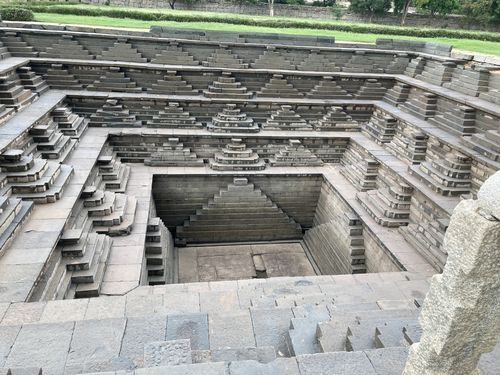
Hampi • Royal Enclosure: the stepwell

Hampi • Royal Enclosure: entrance to the underground secret room

Hampi • Royal Enclosure: Mahānavami Dibba
Royal Enclosure


The Royal Enclosure of Hampi: Political, Social, and Cultural Significance
The Royal Enclosure of Hampi, located in the state of Karnataka, India, is a monumental testament to the grandeur of the Vijayanagara Empire, which flourished between the 14th and 16th centuries. Though much of it lies in ruins today, the site remains an invaluable source of historical, political, and cultural insights, illustrating the complex interplay of power, society, and religion in its time.
Political and Social Motivations Behind Its Construction
The construction of the Royal Enclosure was deeply rooted in the political aspirations of the Vijayanagara rulers. Designed as the administrative and ceremonial heart of the empire, it served as a center of governance and a symbol of royal authority. The expansive courtyards, elevated platforms, and intricate infrastructure highlighted the ruler's power, wealth, and ability to govern effectively.
Socially, the enclosure functioned as a space for large public gatherings, festivals, and rituals that reinforced communal identity and loyalty to the empire. Its grandeur was intended to inspire awe and respect among the populace and visiting dignitaries, demonstrating the stability and cultural sophistication of the Vijayanagara Empire.
Major Historical Events and Their Influence
Constructed primarily in the 14th and 15th centuries, the Royal Enclosure witnessed several pivotal moments in the history of the Vijayanagara Empire. It reached its zenith under rulers like Krishna Deva Raya, who expanded and embellished the site. However, the decisive Battle of Talikota in 1565 marked the empire’s catastrophic decline. Following their defeat by a coalition of Deccan Sultanates, the city of Vijayanagara was sacked, and the Royal Enclosure was left in ruins.
This destruction symbolized a significant shift in the political landscape of South India, with the region transitioning from a dominant Hindu empire to fragmented rule by smaller states. The ruins today stand as a reminder of this tumultuous history, reflecting both the resilience and fragility of power.
Global Context and Comparisons
During the Vijayanagara Empire’s zenith, the Royal Enclosure was contemporaneous with significant global developments. In Europe, the Renaissance was reshaping art, science, and governance, while the Ottoman Empire was at its peak, controlling vast territories across Europe, Asia, and Africa. Similarly, the Ming Dynasty in China was consolidating power and fostering cultural and technological advancements.
Compared to these regions, the Vijayanagara Empire’s emphasis on monumental architecture and hydraulic engineering reflects a parallel drive to assert authority and foster cultural identity. The Royal Enclosure’s architectural innovations and urban planning underscore the empire’s alignment with global trends in statecraft and cultural expression.
Transformations Over the Centuries
The Royal Enclosure has undergone significant transformations since its initial construction. Originally comprising grand palaces, ceremonial platforms, and complex water systems, the site was heavily damaged after the empire’s fall. What remains are foundations, terraces, and scattered ruins that provide valuable clues to its original layout and purpose.
The enclosure’s sophisticated hydraulic systems, including aqueducts, reservoirs, and canals, remain a remarkable aspect of its design. These features not only highlight the technological expertise of the time but also serve as a testament to the importance of water management in sustaining a thriving urban center.
Cultural Importance and Current State of Conservation
Today, the Royal Enclosure is recognized as a UNESCO World Heritage Site, underscoring its global cultural significance. Its ruins continue to attract historians, archaeologists, and tourists, serving as a gateway to understanding the Vijayanagara Empire’s legacy. However, the site faces challenges such as natural erosion, unregulated tourism, and encroachment, which threaten its preservation.
Efforts to conserve the enclosure include detailed documentation, structural stabilization, and community engagement programs. Modern technologies, such as 3D mapping and digital reconstruction, are being used to study and restore the site while maintaining its authenticity.
Challenges to Preservation
The preservation of the Royal Enclosure faces numerous modern challenges. Urbanization around Hampi has put pressure on the site, and increasing visitor numbers pose risks to its fragile remains. Environmental factors, such as weathering and vegetation overgrowth, further exacerbate the site’s vulnerability. Balancing conservation with accessibility is a constant challenge for heritage managers.
Conclusion
The Royal Enclosure of Hampi stands as a powerful symbol of the Vijayanagara Empire’s political and cultural achievements. Its ruins offer a window into the empire’s sophisticated urban planning, architectural ingenuity, and societal organization. As efforts to conserve and study the site continue, it remains a vital link to understanding the historical and cultural evolution of South India. The Royal Enclosure is not just a relic of the past but a living testament to the enduring importance of preserving cultural heritage for future generations.
Architectural Innovation of the Royal Enclosure at Hampi: A Testament to Vijayanagara Ingenuity
The Royal Enclosure at Hampi, located in Karnataka, India, stands as an extraordinary example of architectural brilliance and technological innovation during the Vijayanagara Empire. Spanning over several centuries, the site, although largely in ruins, provides a profound understanding of the empire’s engineering mastery, material usage, urban planning, and artistic achievements. Its architectural ingenuity reflects not only technical skill but also the cultural and political aspirations of a thriving empire.
Materials and Construction Techniques
The structures within the Royal Enclosure were primarily constructed using locally sourced granite, a durable and readily available material. This choice underscores the builders’ deep understanding of the region’s resources and their commitment to constructing monuments that could withstand centuries of natural and human-induced challenges. The use of precisely cut and interlocked stone blocks without mortar reveals advanced stonemasonry techniques, enhancing both stability and resilience. The meticulous craftsmanship is evident in the flawless alignment of the stones, which creates a seamless appearance.
A hallmark of the enclosure is its sophisticated hydraulic engineering. The site features an extensive network of aqueducts, canals, and reservoirs that facilitated efficient water management for domestic, agricultural, and ceremonial purposes. These hydraulic systems were designed with remarkable precision, incorporating features such as sluice gates, stepped tanks, and overflow channels to ensure consistent water distribution. This advanced understanding of hydrology demonstrates the Vijayanagara Empire’s ability to combine practicality with aesthetics, as evidenced by the ornate designs of water tanks such as the Pushkarni.
Architectural Features and Decorative Motifs
The Royal Enclosure is celebrated for its monumental platforms, terraced structures, and open pavilions, which served diverse purposes, including royal ceremonies, public gatherings, and administrative functions. One of the most iconic structures is the "Mahanavami Dibba," a massive stone platform standing approximately 12 meters high. This grand edifice was used as a vantage point for the king to oversee festivals, military parades, and cultural performances. The Dibba’s commanding presence and intricate carvings symbolize the empire’s emphasis on grandeur and cultural expression.
The decorative elements within the enclosure reveal a harmonious blend of regional artistic traditions and external influences. Intricate carvings on walls, platforms, and pillars depict scenes of courtly life, mythical narratives, and elaborate processions featuring animals such as horses, elephants, and camels. These carvings offer invaluable insights into the social, cultural, and religious practices of the Vijayanagara period. The architectural style combines elements of Dravidian design with Persian and Islamic motifs, showcasing the empire’s cosmopolitan nature and its extensive interactions through trade and diplomacy.
Notable structures such as the stepped tanks exemplify both functional and aesthetic ingenuity. These tanks, designed to collect and store water, are adorned with symmetrical patterns and geometric precision, reflecting the Vijayanagara artisans’ ability to merge utility with beauty.
Notable Features and Anecdotes
The Mahanavami Dibba is adorned with detailed carvings that include depictions of dancers, musicians, warriors, and courtly rituals, offering a vivid representation of the cultural vibrancy of the Vijayanagara court.
The stepped tanks, such as the Pushkarni, served as both practical water reservoirs and ceremonial spaces, emphasizing the dual-purpose design philosophy of the era.
Historical accounts from travelers such as Persian envoy Abdur Razzaq and Portuguese merchant Domingo Paes describe the Royal Enclosure as a hub of unparalleled architectural sophistication and opulence.
International Recognition and UNESCO World Heritage Status
The Royal Enclosure is part of the Hampi group of monuments, which was inscribed as a UNESCO World Heritage Site in 1986. This recognition highlights its global significance as a cultural and historical treasure. The UNESCO designation has played a pivotal role in initiating conservation efforts, including archaeological studies, detailed documentation, and structural stabilization projects aimed at preserving the site’s authenticity and historical integrity.
Modern technologies, such as 3D mapping and digital reconstruction, have been employed to analyze the layout and design of the enclosure. These tools have provided valuable insights into its original construction while aiding in restoration efforts. Community engagement programs and sustainable tourism initiatives have also been implemented to balance accessibility with the need to protect the fragile ruins.
Challenges to Preservation
The preservation of the Royal Enclosure faces numerous challenges, including natural erosion, encroachment, and the pressures of increasing tourism. The site’s exposure to extreme weather conditions, combined with vegetation overgrowth, poses risks to its structural stability. Urbanization around Hampi has added to the complexity of conservation efforts, necessitating stringent protective measures.
Efforts to address these challenges involve collaboration between local authorities, heritage organizations, and international bodies. Public awareness campaigns and educational initiatives have been instrumental in fostering a sense of responsibility among visitors and local communities, ensuring that the site remains a cherished legacy for future generations.
Conclusion
The Royal Enclosure at Hampi exemplifies the technological, artistic, and cultural advancements of the Vijayanagara Empire. Through its ingenious use of materials, innovative construction techniques, and intricate decorative motifs, it stands as a testament to the empire’s enduring legacy. The site’s recognition as a UNESCO World Heritage Site underscores its significance as a global cultural treasure, highlighting the importance of preserving such monumental achievements. As conservation efforts continue, the Royal Enclosure remains not only a symbol of historical grandeur but also an inspiration for appreciating the architectural and cultural heritage of humanity.