

 Français (France)
  Nederlands (nl-NL)
 The Mahanavami Dibba is one of the prominent structures at the archaeological site of Hampi, located in the Indian state of Karnataka. This large stone platform was historically used for royal ceremonies and public celebrations during the Vijayanagara Empire. Its carved surfaces display intricate artwork that highlights the era’s artistic achievements. With its imposing presence, the structure symbolized royal authority and served as a gathering space during major events. The Mahanavami Dibba is part of a wider complex of remains that reflect the former grandeur of this UNESCO World Heritage-listed capital.
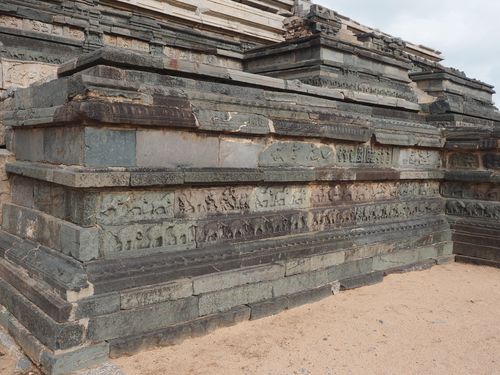
Hampi • Mahanavami Dibba: foot of the terrace
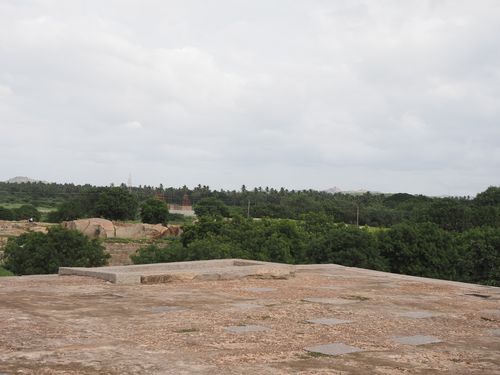
Hampi • Mahanavami Dibba: view of the surroundings
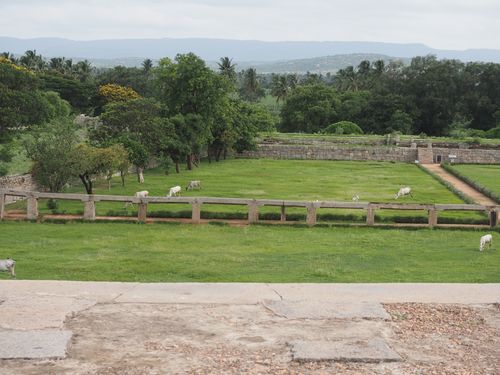
Hampi • Mahanavami Dibba: view of the surroundings
Mahanavami Dibba


The Mahanavami Dibba in Hampi: A Monumental Stage of Imperial Ceremonial Power
Political and Social Context of Construction
The Mahanavami Dibba, also known as the Dasara Dibba, is a grand stone platform located within the Royal Enclosure of Hampi, in the present-day Indian state of Karnataka. It was constructed in the early 16th century, most likely during the reign of Krishnadevaraya (1509–1529), the most renowned monarch of the Vijayanagara Empire.
Krishnadevaraya’s reign marked a period of political consolidation, territorial expansion, and flourishing cultural activity. The construction of the Mahanavami Dibba must be understood within this context of imperial ambition. Vijayanagara was at the height of its power, and the king, fresh from successful military campaigns—particularly against the Gajapati kingdom of Orissa—sought to project his authority through public architecture.
The platform was conceived as the central stage for the annual Mahanavami (Navaratri or Dasara) festival. During these nine days of celebration, the king ascended the platform to preside over grand ceremonies: military parades, dance and music performances, animal processions, and the reception of envoys. The Mahanavami Dibba allowed the sovereign to perform his role as divinely sanctioned ruler, visible to the entire court and populace.
This use of ceremonial space was not merely theatrical—it was politically strategic. It reinforced the social hierarchy, manifested the cosmic order of kingship, and affirmed the unity of the empire under central rule. In this way, the Mahanavami Dibba served as an architectural expression of Vijayanagara’s ideological foundations.
Major Historical Events Affecting the Site
The fall of the Vijayanagara Empire began with the catastrophic defeat at the Battle of Talikota in 1565. A confederation of Deccan sultanates dealt a decisive blow to the empire, and the capital, Hampi, was looted and devastated. While temples, palaces, and markets were destroyed or abandoned, the stone-built platform of the Mahanavami Dibba survived, albeit stripped of its ceremonial function.
Over the centuries, the site faded into obscurity. Without a continued political or ritual purpose, it was gradually overtaken by vegetation and erosion. Its upper structures—likely built from wood or other perishable materials—disappeared completely. Unlike temples which retained religious functions and attracted patronage, the Mahanavami Dibba, being a secular ceremonial platform, was not maintained or repurposed in later centuries.
The British colonial period brought renewed attention to Hampi. In the 19th century, surveyors and antiquarians began to document the ruins. The Mahanavami Dibba, due to its distinctive form and sculptural elements, was noted in their accounts and became one of the earliest structures to be cleared and studied during modern archaeological efforts in the 20th century.
Global Context at the Time of Construction
The early 16th century was a period of monumental construction across several parts of the world. In Europe, the Renaissance had transformed architecture with new principles of proportion, geometry, and symmetry. The Ottoman Empire was commissioning grand imperial mosques in Constantinople. In China, the Ming dynasty was enhancing the Forbidden City, while in the Americas, the Aztecs were erecting religious platforms and pyramids in Tenochtitlan.
The Mahanavami Dibba fits within this broader global trend of using monumental architecture to express centralized authority and cosmological symbolism. Unlike temples or palaces, its sole purpose was public ceremony. It was not a place of worship or habitation, but a platform from which the ruler engaged in performative governance. As such, it shares functional similarities with Mesoamerican ceremonial platforms or even with certain Roman imperial stages, though its form is distinctively Indian.
Through such monuments, rulers across civilizations sought to assert their legitimacy, impress their subjects and rivals, and participate in a form of political theatre that merged spectacle with power.
Transformations of the Monument
Today, the Mahanavami Dibba is a shadow of its original grandeur. What remains is a three-tiered granite platform approximately 12 meters in height, with a base measuring around 40 by 35 meters. The sculptural friezes on the sides, though weathered, still depict processions of elephants, horses, dancers, and soldiers, offering glimpses of the vibrant festivals once held there.
The wooden superstructures that once stood on the top tier have vanished completely. These may have included tents, thrones, or pavilions constructed for temporary ceremonial use. No roofing or protective elements survive, exposing the platform to the elements.
Unlike religious monuments that have been restored or adapted, the Mahanavami Dibba has not undergone significant architectural modification. Restoration efforts have focused on cleaning, stabilizing, and documenting the surviving stonework. It has remained a static monument—archaeologically protected but functionally dormant.
Its urban context has also changed. Whereas it was once the center of imperial ceremony, today it stands in a quiet archaeological zone visited mainly by scholars and tourists. The loss of its surrounding architecture and the absence of functional continuity give it an austere and fragmentary character.
Contemporary Role and Cultural Importance
Although not the most visited monument in Hampi, the Mahanavami Dibba holds a unique place in India’s architectural and historical heritage. It is one of the few surviving examples of a purely ceremonial, non-religious royal platform from medieval South India.
It does not host religious events today, nor does it play an active role in local festivals. However, its significance endures in the collective memory of the region and in academic discourse. It represents a past where architecture was employed to reinforce political ideology and ritual spectacle.
In the broader cultural narrative, the Mahanavami Dibba contributes to a sense of regional pride in Karnataka. It features in school curricula, heritage tours, and state-level cultural promotion, even if its modest physical appearance does not match the grandeur of its historical function.
The monument serves as a poignant reminder of how architectural form and political power can be intimately linked, and how the physical survival of a structure does not necessarily imply the survival of its meaning.
Current Conservation Status and Preservation Challenges
The Mahanavami Dibba is part of the Group of Monuments at Hampi, designated as a UNESCO World Heritage Site in 1986. It is protected by the Archaeological Survey of India, which monitors its condition and conducts periodic maintenance.
Despite these measures, the monument faces numerous conservation challenges. The granite, though durable, is subject to erosion, particularly in areas with sculptural detail. Seasonal monsoons accelerate surface wear, and unrestricted foot traffic threatens the integrity of the stairways and platform edges.
Unlike temples which benefit from continued devotional use and community care, the Dibba’s secular nature makes it dependent solely on institutional stewardship. Interpretive signage and physical barriers have been introduced to guide visitors and reduce damage, but the monument remains vulnerable to environmental and human pressures.
Its status as a World Heritage Site helps attract attention and funding, but also increases tourist numbers, which can paradoxically strain its fragile structure. Balancing access with preservation remains a delicate task.
Architectural Analysis of the Mahanavami Dibba: Monumentality and Symbolism in Stone
The Mahanavami Dibba, a monumental stone platform located in the Royal Enclosure of Hampi, India, is a unique example of secular ceremonial architecture from the Vijayanagara period. Though only its base survives today, the structure encapsulates the imperial vision of grandeur, ritual centrality, and architectural prowess. Unlike temples or palaces, the Mahanavami Dibba served as a stage for power, constructed to project the authority of the king through spatial hierarchy and formal spectacle. Its architecture reveals both regional innovation and eclectic stylistic integration.
Technological and Architectural Innovations
The very concept of a massive, freestanding stone platform for ceremonial use was innovative for the South Indian architectural context of the early 16th century. The Mahanavami Dibba was not intended for habitation or worship but for seasonal state ceremonies such as the Mahanavami (Dasara) festival. This deliberate elevation of the ruler on a prominent structure allowed visual and symbolic dominance over assembled subjects and dignitaries.
Architecturally, the structure demonstrates a profound understanding of massing, weight distribution, and functional elevation. Instead of vertical enclosures, it uses horizontal expansion and stepped design to create a monument that is both accessible and imposing. Its tiered configuration ensures structural integrity while facilitating ritual movement—processions, ascents, and public performances.
The platform’s integration into the broader Royal Enclosure also reflects advanced planning. Aligned with cardinal orientations and adjacent to other administrative buildings, it was part of a larger civic and ceremonial grid. The openness of the platform, coupled with its height, facilitated ventilation and visibility—both practical in a warm, dry climate and essential for its performative role.
Materials and Construction Techniques
The Mahanavami Dibba was constructed entirely from locally sourced granite, a hard volcanic stone that offers both strength and resistance to environmental erosion. Granite was chosen not only for its durability but also for its imposing visual character. The natural grey-brown tone of the stone gave the platform a weighty, grounded presence suitable for its ceremonial function.
Construction was likely executed using dry masonry techniques, where blocks were fitted with extreme precision without mortar. The horizontal placement of stones in courses and the stepped retreat of each tier suggest careful load management. The use of massive granite blocks implies the involvement of complex logistics: quarrying, shaping, transporting (probably using elephants and wooden sleds), and lifting into place.
Ornamental carving was done in situ, particularly on the vertical faces of the platform. These bas-reliefs display a consistent register, indicating that carving was integrated with structural placement rather than treated as surface decoration added post-construction. The durability of granite preserved these details, though time and exposure have softened them considerably.
Artistic and Architectural Influences
While rooted in the Dravidian tradition of monumental platforms and temple bases, the Mahanavami Dibba displays a fusion of influences. Its layout, decoration, and sculptural motifs reveal an absorption of diverse styles circulating in South India during the height of the Vijayanagara Empire.
Motifs carved into the stone friezes include courtly processions, hunting scenes, animal parades, musicians, and dancers. These represent not only royal spectacle but also the cultural milieu of a cosmopolitan capital. Stylistically, the sculptures reflect a blend of local artistic schools and possibly Islamic and Deccan Sultanate influences, visible in the geometric patterns, border motifs, and depictions of Persian-style robes or headgear in some figures.
Unlike Indo-Islamic architecture, which uses arches, domes, and vaulted spaces, the Mahanavami Dibba follows a flat, open-plan design. However, the ornamental vocabulary shows a willingness to incorporate non-native elements, illustrating the cultural plurality of the empire and its openness to cross-regional artistic exchange.
Spatial Layout and Structural Features
The Mahanavami Dibba is a three-tiered platform approximately 12 meters high, with a rectangular base of about 40 by 35 meters. Each tier is slightly recessed from the one below it, forming a stepped pyramid shape. Access to the platform is provided by staircases on the eastern, northern, and southern sides—each flanked by elaborate sculptural panels.
The top tier was likely the site of temporary pavilions or royal tents, possibly made from wood, fabric, or bamboo, none of which survive today. Evidence of post holes or column bases suggests the use of superstructures that could be dismantled after the festival. These would have provided shade and seating for the king and his court during ceremonies.
No arches, domes, or vaults are present, distinguishing it from contemporary Islamic structures. Instead, visual interest is created through repetitive carving, proportional balance, and surface richness. The lack of enclosed space underscores the platform’s role as a stage rather than a shelter.
The horizontal emphasis, rhythmic repetition, and sculptural storytelling link the structure to temple architecture, but its secular function marks it as architecturally unique. The Mahanavami Dibba thus stands out not for its complexity but for its clarity and its adaptation of traditional design elements to a political and ceremonial context.
Dimensions and Notable Details
Measuring nearly 1,400 square meters in base area and reaching 12 meters in height, the Mahanavami Dibba was among the tallest and most expansive structures in the capital. The breadth of its stairs and the extensive narrative friezes suggest it was designed for large public audiences.
Some carvings are especially notable: elephants in procession, women in classical dance poses, soldiers in parade formation, and horses with decorative harnesses. One frieze shows a line of foreign envoys, possibly suggesting the presence of international guests during festivals—emphasizing the diplomatic function of such events.
Legends claim the entire structure was built without the use of mortar, relying solely on perfect stone alignment and gravity—a feat that continues to impress modern observers. It is also said that the king’s throne once stood at the summit, beneath a temporary canopy, offering him a commanding view of the Royal Enclosure and the surrounding hills.
Architectural Significance and Conservation Challenges
Architecturally, the Mahanavami Dibba is a rare example of non-religious, monumental platform architecture from medieval South India. Its spatial clarity, sculptural program, and imperial associations contribute significantly to the understanding of Vijayanagara’s built environment.
As part of the Hampi World Heritage Site, the platform is protected by national and international preservation frameworks. Nevertheless, it faces challenges: erosion of reliefs, biological growth, and stress from unregulated tourism. The exposed nature of the monument—no roof, no internal shelter—means that weathering is constant.
Conservation efforts have focused on documentation, surface cleaning, and visitor management. Unlike temples, which often receive religious or community support, the Dibba relies solely on institutional care. Its relatively low profile among tourists, compared to the Virupaksha or Vitthala temples, ironically helps preserve its integrity by limiting foot traffic.
In architectural history, the Mahanavami Dibba stands as a symbol of the ceremonial imagination of a vanished empire. It bridges art and authority, function and form, memory and monumentality—etched in stone, yet suspended between past grandeur and modern fragility.