

 Français (France)
  Nederlands (nl-NL)
 The stepwell at Hampi is located within the former capital of the Vijayanagara Empire in the present-day state of Karnataka in southern India. It formed part of an elaborate hydraulic network designed to supply water to residential areas and the royal complex. Its orderly structure, composed of regular steps descending toward a central basin, reflects the attention given to water management in the urban planning of the capital. The monument illustrates the essential role of hydraulic infrastructure in the daily functioning of Hampi.


History of the stepwell at Hampi
The stepwell at Hampi is located within the royal enclosure of the former capital of the Vijayanagara Empire, in the present-day state of Karnataka in southern India. This hydraulic structure formed part of an extensive water management system designed to supply the royal complex and surrounding urban areas. Its position within the ceremonial core of the capital indicates that it was not only a utilitarian installation but also a component of the political and administrative infrastructure of the imperial city.
Political and social context of construction
The stepwell was likely constructed between the fourteenth and sixteenth centuries, during the period of expansion and consolidation of the Vijayanagara Empire. Founded around 1336 by the brothers Harihara and Bukka, the empire emerged in response to political instability in southern India. Earlier regional dynasties, including the Hoysala and Kakatiya, had weakened under military pressure from northern powers and internal fragmentation.
Within this context, the establishment of a strong, well-organized capital became a central political objective. Hampi was transformed into a vast imperial city, with fortifications, temples, markets, reservoirs, canals, and palace complexes. Hydraulic infrastructure played a fundamental role in this transformation. Reliable access to water was essential not only for domestic consumption but also for agriculture, ritual use, and the maintenance of gardens and ceremonial spaces.
The construction of a stepwell in the royal enclosure reflects the priorities of the Vijayanagara rulers. On a practical level, it ensured a stable supply of water for the court and administrative personnel. On a symbolic level, it demonstrated the capacity of the state to manage natural resources and sustain a large urban population. In premodern South Asian political culture, effective control over water systems was closely associated with royal authority and good governance.
The rulers of Vijayanagara were engaged in continuous rivalry with neighboring powers, particularly the Bahmani Sultanate and later the Deccan sultanates. These political tensions reinforced the need for a well-defended and self-sufficient capital. Hydraulic systems, including reservoirs, canals, and stepwells, were part of a broader strategy aimed at urban resilience and logistical security during periods of conflict.
Major historical events affecting the site
During the fifteenth and early sixteenth centuries, Hampi reached the peak of its prosperity. The city became one of the largest urban centers in the Indian subcontinent, attracting merchants, diplomats, and travelers from across Asia, the Middle East, and Europe. The royal enclosure, where the stepwell was located, functioned as the administrative and ceremonial core of the empire.
This period of stability ended abruptly in 1565, at the Battle of Talikota. A coalition of Deccan sultanates defeated the army of Vijayanagara. Soon after, the capital was captured and extensively looted. Many palace structures, built partly of brick and timber, were destroyed. Stone constructions, including the stepwell, survived more substantially but lost their original function as the city was abandoned.
After the fall of the capital, the rulers of Vijayanagara relocated their court to other centers, first at Penukonda and later at Chandragiri. Hampi gradually declined in political and economic importance. Without regular maintenance, the hydraulic network deteriorated, reducing the operational role of the stepwell within the abandoned royal precinct.
In the following centuries, the region passed under the authority of various local powers before becoming part of the British colonial administration. The ruins of Hampi, including the stepwell, attracted the attention of explorers and surveyors during the nineteenth century, leading to the first systematic documentation of the site.
Global context at the time of construction
The period during which the stepwell was constructed corresponds to a time of significant political and urban development in many parts of the world. In Europe, the fourteenth and fifteenth centuries marked the transition from the late Middle Ages to the Renaissance. Major cities invested in urban infrastructure, including aqueducts, canals, and public fountains, to support growing populations.
In the Islamic world, the capitals of the Ottoman and Timurid empires were equipped with sophisticated hydraulic systems, including aqueducts, gardens, and ceremonial pools. In China, under the Ming dynasty, major hydraulic works were carried out to supply cities and imperial complexes, reflecting the importance of water management in state planning.
Within this global context, the hydraulic infrastructure of Vijayanagara forms part of a broader pattern of monumental capital construction. The stepwell at Hampi reflects the technical capabilities and administrative organization required to sustain a large urban center in a semi-arid environment.
Transformations and periods of decline
Following the destruction of the capital in the sixteenth century, the stepwell lost its role as an active component of the hydraulic system. The abandonment of canals and reservoirs reduced the flow of water into the structure. Although the stone construction allowed it to survive, it gradually ceased to function as an operational water source.
Over the following centuries, the monument was exposed to weathering, vegetation growth, and sediment accumulation. Unlike certain temples that remained in ritual use, the stepwell did not continue to serve a major social or religious function.
In the nineteenth century, early archaeological surveys began documenting the hydraulic structures of Hampi. Engineers and scholars recognized the sophistication of the water management system, including the stepwell, which formed an integral part of the royal precinct.
During the twentieth century, conservation efforts were undertaken by the Archaeological Survey of India. Vegetation was cleared, structural elements were stabilized, and access to the monument was improved. These measures aimed to preserve the structure while maintaining its character as an archaeological relic rather than reconstructing it fully.
Present role and cultural significance
Today, the stepwell forms part of the monumental complex of Hampi, one of the most important historical sites in southern India. It lies within the area designated as a UNESCO World Heritage Site. This recognition has increased international awareness and strengthened conservation efforts.
The monument is now understood as a key element in the hydraulic system of the imperial capital. It provides insight into the technical skills and administrative organization of the Vijayanagara state. The stepwell illustrates how water infrastructure was integrated into the political and ceremonial core of the city.
The site attracts visitors, researchers, and students interested in the urban planning and engineering traditions of medieval South India. Although it no longer serves as a functioning water source, it remains an important symbol of the technological and organizational achievements of the Vijayanagara Empire.
Conservation and modern preservation challenges
The stepwell is currently protected by the Archaeological Survey of India, which oversees maintenance, monitoring, and conservation activities. Measures have been implemented to reduce damage caused by erosion, vegetation, and visitor traffic.
Modern challenges include climatic variations, gradual wear of the stone surfaces, and the impact of tourism. Conservation strategies aim to balance public access with long-term preservation.
As part of a UNESCO World Heritage Site, the monument is subject to regulations concerning landscape management and development control in the surrounding area. These policies are intended to preserve the historical integrity of Hampi and ensure that its monuments, including the stepwell, remain protected for future generations.
Architecture of the stepwell at Hampi
The stepwell at Hampi stands within the royal enclosure of the former capital of the Vijayanagara Empire, in the present-day state of Karnataka in southern India. It formed part of a carefully planned hydraulic system that supplied water to the royal complex and its surrounding administrative and residential quarters. Although primarily utilitarian, the structure reflects the precision, geometric clarity, and technical sophistication characteristic of Vijayanagara architecture.
Technological and architectural innovations
The stepwell demonstrates the advanced hydraulic engineering techniques employed during the Vijayanagara period between the fourteenth and sixteenth centuries. Unlike monumental temples or ceremonial platforms, it was designed to fulfill practical needs, yet its execution reveals a high level of technical planning and architectural discipline.
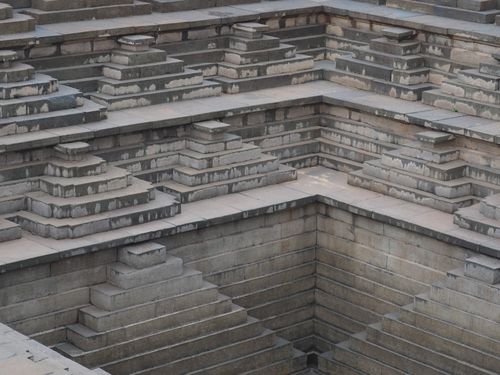
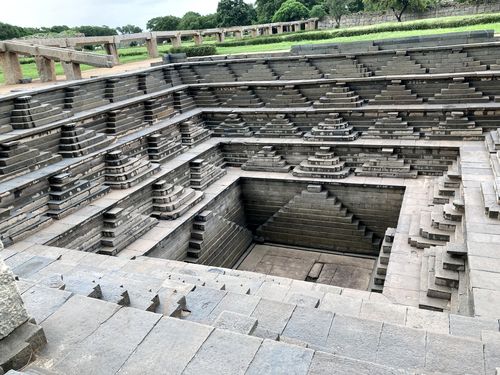
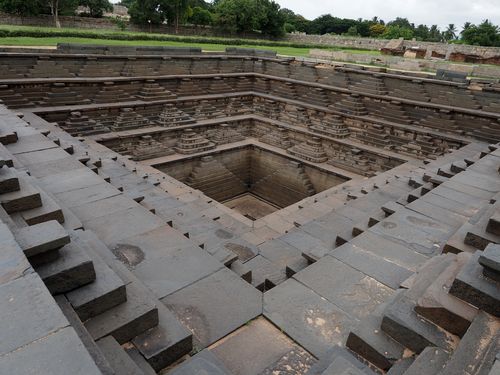
The most striking feature of the structure is its symmetrical, geometric plan. The well is organized in a sequence of receding steps that form a regular, tiered pattern descending toward the central basin. This configuration allowed access to water at different levels, ensuring usability during seasonal fluctuations in the water table. The stepped design represented an effective solution for water management in a region with alternating dry and monsoon periods.
The structure was integrated into a broader hydraulic network composed of canals, reservoirs, and tanks. Water was conveyed through a controlled system of channels, indicating a coordinated approach to urban planning. The stepwell was not an isolated feature but part of a comprehensive strategy for water storage and distribution within the imperial capital.
Structural stability was achieved through the use of a pyramidal, inward-stepping form. As the structure descends, the mass of the walls gradually reduces, distributing pressure and minimizing the risk of collapse. The semi-subterranean layout also protected the water from excessive evaporation and temperature variations, demonstrating a practical understanding of environmental conditions.
Materials and construction methods
Granite was the principal material used in the construction of the stepwell. The rocky landscape surrounding Hampi provided abundant sources of this durable stone, making it a logical choice for large-scale building projects. Granite’s resistance to erosion and weathering made it particularly suitable for hydraulic structures exposed to water and climatic changes.
The walls and steps were constructed from carefully dressed granite blocks. These were assembled using dry masonry techniques, with tightly fitted joints requiring minimal mortar. This method enhanced structural stability and allowed the building to absorb minor shifts in the ground without significant damage.
The precision of the stepped geometry suggests the use of advanced measurement and layout techniques. Builders would have relied on standardized units, alignment tools, and leveling methods to maintain consistent angles and dimensions across the entire structure.
The surfaces of the steps were slightly inclined to facilitate water runoff and prevent stagnation. This detail indicates that the structure was designed not only for durability but also for practical maintenance and long-term use.
Architectural and artistic influences
The stepwell at Hampi belongs to a long tradition of stepped water structures found across the Indian subcontinent. However, it differs from many northern Indian stepwells, particularly those in Gujarat and Rajasthan, which often include elaborate ornamentation, sculpted walls, and pavilion-like superstructures.
At Hampi, the design emphasizes geometric clarity and structural simplicity. The absence of extensive sculptural decoration reflects the utilitarian function of the structure and its location within the royal enclosure. Instead of ornamental detail, the aesthetic impact derives from the repetition of forms and the interplay of horizontal and diagonal lines.
This emphasis on geometry aligns with the broader urban planning principles of Vijayanagara architecture, which favored axial alignments, regular layouts, and clearly defined spatial zones. The stepwell’s design reflects the disciplined planning associated with the royal precinct and its infrastructure.
Although the structure itself remains within the traditional South Indian architectural vocabulary, the wider context of the royal enclosure reveals a synthesis of influences. Other buildings in the same area incorporate features derived from the Islamic architecture of the Deccan, such as domes and arches. This environment of cultural exchange formed the broader architectural setting in which the stepwell was conceived.
Spatial organization and structural features
The stepwell is laid out on a rectangular plan, with steps arranged symmetrically along multiple sides. The stairways descend in successive terraces toward the central water basin, creating a compact and clearly defined spatial composition.
Each level of steps forms a horizontal platform, allowing users to descend gradually as the water level changed. These intermediate terraces may also have functioned as resting points, facilitating collective use of the structure.
The lateral walls are composed of carefully fitted stone blocks. Their inward inclination contributes to the structural stability of the monument, while the stepped arrangement distributes weight evenly across the lower levels.
The structure lacks columns, galleries, or superstructures, emphasizing its purely functional character. This distinguishes it from many elaborately decorated stepwells elsewhere in India.
Partially embedded in the ground, the well benefits from natural insulation. The surrounding earth helps maintain a cooler microclimate near the water, an important consideration in the hot, semi-arid environment of the region.
Access to the stepwell is provided through an opening at the upper level, connecting it to the surrounding royal precinct. This connection confirms its integration into a larger hydraulic and urban system.
Dimensions and notable characteristics
The stepwell occupies a rectangular platform measuring roughly twenty meters by fifteen meters, although exact dimensions vary slightly depending on measurement methods. The depth of the structure depends on the level of the water table and the amount of sediment accumulated over time.
The stepped arrangement consists of several tiers of terraces, forming a regular geometric composition. The repeated alignment of steps and angles creates a visually striking pattern, even in the absence of decorative sculpture.
One of the most notable aspects of the monument is the precision of its geometry. The alignment of the steps and the uniformity of the angles indicate careful planning and the use of standardized construction techniques.
Unlike many stepwells in western India, the Hampi example contains no elaborate sculptural programs, shrines, or pavilions. Its architectural impact is achieved through proportion, symmetry, and structural clarity.
International significance and conservation issues
The architectural importance of the stepwell lies in its role as part of the sophisticated hydraulic system of the Vijayanagara capital. It contributes to the understanding of water management, urban planning, and engineering practices in the imperial city.
The monument forms part of the Hampi complex, which has been recognized as a UNESCO World Heritage Site. Its preservation is therefore linked to broader conservation policies aimed at protecting the archaeological landscape.
Conservation challenges primarily relate to the weathering of the granite surfaces, biological growth, and the effects of visitor traffic. The stepped surfaces, exposed to repeated use, are particularly vulnerable to gradual erosion.
Maintenance efforts include periodic cleaning, vegetation control, and structural monitoring. Visitor access is regulated to minimize damage while allowing public appreciation of the site.
As part of a protected archaeological zone, the stepwell benefits from regulations that limit uncontrolled development in the surrounding area. These measures are intended to preserve both the structure itself and the broader context of the royal enclosure.
In its present condition, the stepwell remains one of the clearest examples of utilitarian architecture within the Vijayanagara capital. Its geometric precision, durable construction, and integration into a larger hydraulic network provide valuable insight into the engineering knowledge and urban planning strategies of the period.