

 Français (France)
  Nederlands (nl-NL)
 The Vittala Temple, located in Hampi in the state of Karnataka, is one of the most remarkable monuments of southern India. It is renowned for the richness of its sculpted decoration, the scale of its enclosure and the quality of its monumental spaces. Linked to the former capital of the Vijayanagara Empire, it reflects the high artistic standards achieved in the region during the late Indian medieval period. The site is especially noted for its famous stone chariot, ceremonial pavilions and carefully planned layout. Today, the Vittala Temple is one of the leading symbols of Hampi’s heritage.
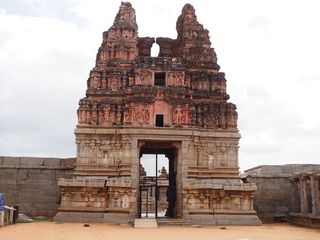
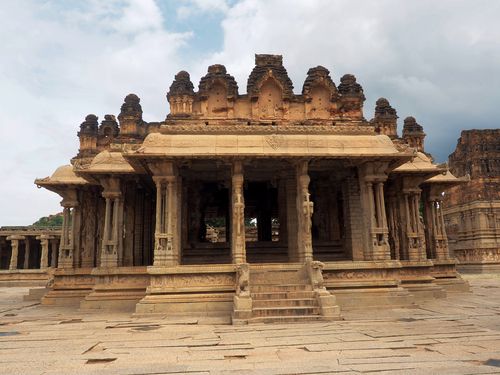
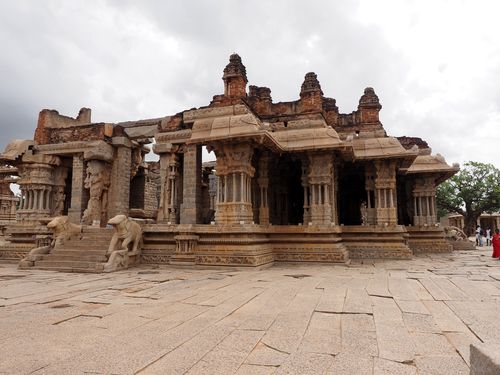
Vittala Temple


Historical Development of the Vittala Temple at Hampi
Foundation and Political Context
The Vittala Temple stands within Hampi, the former capital of the Vijayanagara Empire in present-day Karnataka. It belongs to the most ambitious phase of monumental construction undertaken by that South Indian state between the fifteenth and early sixteenth centuries. Although earlier foundations may have existed on the site, the temple known today was principally developed during the reigns of later Vijayanagara rulers, especially in the period associated with Deva Raya II and, above all, Krishnadevaraya in the early sixteenth century.
The dedication of the monument to Vittala, a regional form of Vishnu widely venerated in the Deccan and western India, reflects both religious devotion and political strategy. By promoting the cult of Vishnu in this form, the court could connect imperial authority with expanding devotional movements and with merchant communities familiar with the deity’s worship. The temple therefore served not only as a sacred institution but also as a visible expression of royal patronage.
Its location in the metropolitan zone of Hampi was significant. The complex stood near ceremonial routes and market areas, indicating that it formed part of the planned urban and ritual landscape of the capital. Monumental temples in Vijayanagara were closely linked to the prestige of the dynasty, public festivals and controlled displays of wealth.
Expansion, Ritual Use and Urban Role
The Vittala Temple was not a single-phase construction. Inscriptions, stylistic evidence and unfinished elements indicate successive enlargements over time. Additional halls, gateways and subsidiary shrines were added as resources and patronage allowed. This gradual growth explains the complexity of the present layout.
The temple functioned as a major Vaishnava center where ritual worship, processions and festival gatherings took place. The famous stone chariot in the courtyard echoes the ceremonial cars used during temple festivals, when divine images were carried through urban streets. Such events linked sacred authority with civic participation and reinforced the connection between temple and capital city.
Large pillared halls suggest the accommodation of assemblies, music, recitations and seasonal ceremonies attended by elites and ordinary worshippers. The surrounding streets and open spaces were likely used for markets and temporary installations during important celebrations. In this sense, the temple operated as both a religious sanctuary and a social institution integrated into the economic life of Hampi.
The monument also expressed imperial order. Its scale, refined carvings and planned setting communicated the resources available to the Vijayanagara state. Royal patronage of temples helped legitimize rule while binding priests, artisans, merchants and local communities to the court.
Crisis, Decline and Later History
The history of the Vittala Temple changed sharply after the defeat of Vijayanagara forces at the Battle of Talikota in 1565. In the aftermath, Hampi was sacked and much of the metropolitan center declined. Although not every structure was destroyed at once, the political system that had sustained monumental ritual life was broken.
The Vittala Temple appears to have lost much of its active ceremonial role during this period. Some structures were damaged, and maintenance of large architectural complexes became increasingly difficult once imperial patronage ended. Roof elements, gateways and upper sections deteriorated gradually through neglect, weathering and stone reuse.
Unlike temples that remained at the center of continuously inhabited cities, the Vittala complex stood within a capital whose urban importance had collapsed. This contributed to partial abandonment. Nevertheless, the monument was never entirely forgotten. Pilgrims, local memory and regional awareness preserved its reputation even when regular large-scale worship had diminished.
During the colonial period, antiquarians and early archaeologists documented Hampi’s ruins. The Vittala Temple attracted particular attention because of its stone chariot and sculpted halls, which came to symbolize the artistic achievement of Vijayanagara.
Global Historical Context
The principal expansion of the Vittala Temple in the fifteenth and early sixteenth centuries coincided with the Renaissance in Europe and the rise of large centralized monarchies. In the Ottoman world, Constantinople became Istanbul after 1453. Ming China was undertaking major state-sponsored building projects. Across the Indian Ocean, maritime trade networks connected South Asia, Arabia and East Africa. Portuguese fleets reached the western coast of India shortly before the reign of Krishnadevaraya.
Modern Preservation and Present Significance
The Vittala Temple is now one of the best-known monuments of Hampi. It forms part of the UNESCO World Heritage property inscribed in 1986 under the official name Group of Monuments at Hampi. This recognition reflects both the importance of the temple itself and its place within the broader urban remains of Vijayanagara.
Modern conservation has focused on stabilizing damaged structures, managing visitor circulation and protecting carved surfaces from erosion. Certain sensitive elements, including the celebrated musical pillars, are no longer subject to direct physical contact in order to limit wear.
Today the temple functions primarily as a heritage monument rather than a fully active ritual center. It remains, however, a powerful symbol of the religious and political culture of Vijayanagara. For visitors and scholars alike, the site offers direct evidence of how imperial power, urban planning and devotional practice were combined in one monumental complex.
The Vittala Temple also holds a wider cultural role in contemporary India. Its stone chariot has become an iconic image associated with Hampi and with the architectural legacy of southern India. Even in ruin, the monument continues to communicate the scale and ambition of one of the subcontinent’s most influential premodern empires.
Architectural Composition of the Vittala Temple at Hampi
Setting, Enclosure and Overall Layout
The Vittala Temple occupies a major ceremonial sector of Hampi, the ruined capital of Vijayanagara, on the northern side of the Tungabhadra River. Its setting is defined by granite outcrops, open ground and planned processional routes linking sacred and urban spaces. The monument forms part of a broader architectural landscape that includes market streets, gateways, tanks, subsidiary shrines and pavilions.
The complex is organized within a spacious rectangular enclosure wall. This perimeter establishes a sacred boundary while controlling access through monumental entrances. The principal eastern gateway, once crowned by a tall gopuram, marked the formal approach to the sanctuary. Though partly ruined, its surviving base still indicates the intended scale. Secondary gateways on other sides assisted circulation within the wider urban setting.
Inside the enclosure, buildings are arranged around open courtyards rather than compressed into a single mass. This creates a sequence of spaces of increasing ceremonial importance. Visitors moved from the entrance court toward the central sacred structures through an ordered progression of platforms, halls and subsidiary elements. The result is an architecture of movement based on axial views, pauses and transitions.
The main shrine occupies the symbolic center, but the surrounding halls and freestanding monuments dominate visually. Large horizontal platforms, generous spacing between buildings and long sightlines distinguish the complex from more compact temple compounds. The plan emphasizes breadth, processional use and the staged revelation of sculptural forms.
Construction Methods, Materials and Structural Logic
The dominant building material is local granite, abundant throughout Hampi. Its hardness influenced both engineering and appearance. Granite permits durability and crisp carving, but it is more difficult to shape than softer stones used elsewhere in India. Its extensive use therefore reflects advanced labor organization and technical skill.
Structural elements were formed from large dressed blocks assembled with precise joints. In many areas, visible mortar is absent or minimal. Foundations and plinths consist of heavy masonry courses capable of supporting dense stone columns and roof slabs. Raised platforms not only elevate the sacred buildings but also stabilize them on uneven ground.
Columns are often monolithic or composed of carefully fitted sections. Massive lintels span between supports, carrying flat stone roofing systems. Roofs rely on stacked beams and slabs rather than arches or domes. This trabeate construction required accurate load distribution and controlled spacing between supports.
Upper gateway towers were likely completed in lighter masonry and plastered brick above the granite base. These higher sections have suffered greater loss over time, leaving the stone substructures as the most durable remains.
Tooling marks, polished surfaces and sharply cut reliefs reveal specialized workshops. Quarrying, transport and erection of granite members on this scale imply coordinated labor and planned sequencing of construction. Unfinished details in parts of the complex suggest a building process interrupted rather than completed in one phase.
Main Buildings and Internal Spatial Organization
The principal shrine follows the established temple sequence of entrance porch, halls and inner sanctum. The garbhagriha, or innermost chamber, originally housed the cult image and represents the most restricted sacred zone. In front of it lie transitional spaces of decreasing sanctity and increasing public accessibility.
One of the most important structures is the maha-mandapa, a large pillared hall raised on a substantial platform. Open on multiple sides, it allowed air circulation, daylight and visibility for gatherings. Broad stairways lead upward from several directions, reinforcing the sense of approach and ceremonial elevation. The hall’s openness contrasts with the enclosed sanctum and creates a clear architectural hierarchy.
Another celebrated structure is the so-called musical hall. Its clustered columns include slender resonant subsidiary shafts carved from the same stone masses as the main supports. These elements became famous for producing different tones when lightly struck. Architecturally, they demonstrate precise stone cutting and an interest in combining structure, ornament and acoustic effect.
The complex also contains subsidiary shrines, detached mandapas and service spaces distributed around the main court. These secondary structures help organize circulation and provide visual balance. Rather than crowding the central axis, they create an articulated field of buildings with changing scales and viewpoints.
The extensive plinths are central to the spatial experience. Their moulded bases define sacred ground, regulate movement and provide surfaces for sculptural friezes. By raising halls and shrines above courtyard level, they make ascent part of the ceremonial sequence.
Distinctive Features: Stone Chariot, Pillars and Sculptural Program
The most iconic feature of the Vittala Temple is the stone chariot positioned prominently within the courtyard. This freestanding monument is a shrine conceived in the form of a ceremonial vehicle. Although it resembles a movable processional car, it is fixed in place. Its wheels, axle forms and body translate wooden festival technology into carved stone.
The chariot’s proportions are compact yet monumental. It is placed on a major visual axis so that it functions as a focal point between entrance and shrine. Its significance lies not only in craftsmanship but also in its role as symbolic architecture representing ritual movement through permanent form.
The temple’s columns rank among the most refined achievements of Vijayanagara carving. Many combine moulded bases, square and octagonal shafts, projecting brackets and sculpted riders, yali creatures, horses or divine figures. Some supports appear as grouped colonettes emerging from one block, creating rhythmic complexity while preserving structural mass.
Surface carving extends across plinths, steps, cornices and wall members. Friezes depict elephants, horses, attendants, dancers, warriors and mythological scenes. Repetition of these bands creates horizontal movement along the platforms, while larger sculptural figures mark vertical accents on columns and brackets.
Stairways often include carved side members and guardian motifs, transforming circulation elements into ornamental architecture. Even thresholds and mouldings are treated as designed visual zones rather than purely functional parts.
Alteration, Ruin and Architectural Conservation
Several upper components of the complex have disappeared, especially gateway superstructures and portions of roofed elements. Causes include the sixteenth-century collapse of Vijayanagara political power, later neglect, stone displacement, weathering and structural stress.
Granite lower structures have survived far better than lighter upper materials. As a result, the surviving architecture often appears horizontally dominant: platforms, halls and columns remain impressive even where towers are lost. This selective survival strongly shapes the monument’s present appearance.
Modern conservation has generally favored stabilization rather than speculative reconstruction. Displaced stones have been reset where original positions were identifiable. Fragile carvings are monitored, and visitor access to sensitive zones has been restricted. Measures around the musical pillars reflect concern for vibration damage and surface wear.
Today the Vittala Temple forms part of the UNESCO World Heritage property known as the Group of Monuments at Hampi, inscribed in 1986. Its preserved remains allow close study of planning, stone technology and ceremonial architecture on an imperial scale.
Even incomplete, the complex retains strong spatial coherence. The sequence from gateway to court, stone chariot, pillared halls and shrine remains legible, allowing the architectural ambition of Vijayanagara to be understood directly through surviving form.