

 Français (France)
  Nederlands (nl-NL)
 Of Hindu tradition, (with additional Jain influence), the Hoysala dynasty ruled for approximately 317 years, ± between 1026 and 1343 over all or part of South India, during the Classical Period and the Medieval Period.
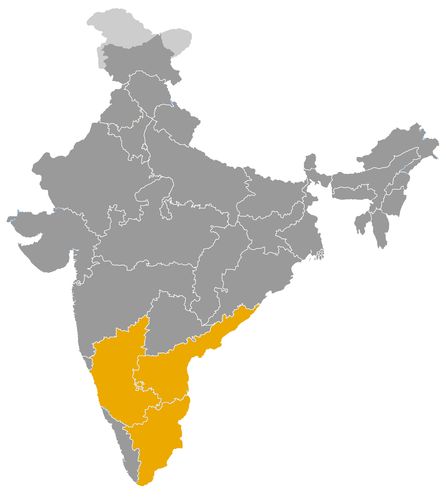
This map illustrates the maximum territory that the Hoysala Dynasty had reached at its height, covering the current regions of Andhra Pradesh, Karnataka and Tamil Nadu in India. Its main purpose is to provide a visual aid to understand the geographical extent of this dynasty. However, it's important to note that the contemporary borders of these regions may not necessarily coincide with the historical territories.
The Hoysala Dynasty and Its Role in the History of Southern India
A regional power that reshaped medieval Karnataka
The Hoysala dynasty occupies a major place in the history of medieval southern India. Active mainly between the eleventh and fourteenth centuries, it ruled large parts of present-day Karnataka and influenced neighbouring regions of Tamil Nadu and the southern Deccan. The dynasty first emerged in the Malenadu region, a hilly and forested zone of western Karnataka, before expanding into the fertile plains and major political corridors of the south.
The early Hoysalas were initially subordinate to the Western Chalukyas of Kalyani. Their rise therefore illustrates a common pattern in medieval India: regional chiefs first gained power as feudatories, then became independent rulers as larger imperial structures weakened. Under Vishnuvardhana and later Veera Ballala II, the Hoysalas became one of the leading powers of southern India.
Political importance between Deccan and Tamil powers
The political role of the Hoysalas was shaped by their position between several major dynasties. To the north were the Western Chalukyas, followed by the Yadavas of Devagiri. To the south and south-east were the Cholas and later the Pandyas. The Hoysalas developed their power in this zone of rivalry, using military campaigns, alliances and changing political loyalties to expand their authority.
Vishnuvardhana’s reign marked a turning point. His victory over the Cholas at Talakad strengthened Hoysala control over southern Karnataka and reduced Chola influence in the region. This success allowed the dynasty to move beyond its earlier subordinate status and claim a more independent political identity.
Veera Ballala II later consolidated the kingdom and gave the Hoysalas a wider regional stature. During his reign, the dynasty became a major force in the southern Deccan. The Hoysalas did not create a pan-Indian empire, but they played a decisive role in the balance of power between Karnataka, the Tamil country and the Deccan.
Belur, Halebidu and the monumental language of kingship
The cultural impact of the Hoysalas is most visible in their architecture. Their temples are among the most refined achievements of medieval Indian art. Belur, Halebidu and Somanathapura remain the best-known centres of this architectural tradition.
The Chennakeshava temple at Belur, begun under Vishnuvardhana, reflects the dynasty’s growing political confidence and religious patronage. Halebidu, known in the medieval period as Dwarasamudra, became a major royal centre and the site of the Hoysaleshvara temple, one of the masterpieces of Hoysala architecture. The Keshava temple at Somanathapura, built later, represents the mature form of this style.
Hoysala temples are noted for their star-shaped plans, sculptural density, richly carved walls and use of soapstone, a material that allowed extremely detailed ornamentation. Their walls display gods, goddesses, dancers, musicians, animals, floral motifs and narrative scenes from the Ramayana, the Mahabharata and the Puranas. These temples were not only religious monuments. They also expressed royal authority, regional identity and the prestige of local elites.
Religious patronage across Jain, Shaiva and Vaishnava traditions
The Hoysalas ruled in a religiously diverse environment. Their patronage included Jainism, Shaivism and Vaishnavism. Some early members of the dynasty and several elites were associated with Jain institutions, while Vishnuvardhana is often linked with a stronger Vaishnava orientation, especially in traditions connected with Ramanuja.
This religious diversity should not be seen as a simple replacement of one faith by another. It was part of a broader pattern of medieval Indian kingship, in which rulers supported multiple religious communities to strengthen legitimacy and social alliances. Temples, Jain basadis, monasteries and religious establishments received land grants, revenues and privileges.
The result was a rich religious landscape in which different traditions coexisted and competed. Hoysala patronage helped shape the sacred geography of Karnataka and strengthened the connection between political authority, temple institutions and local society.
Economic foundations in agriculture, temples and trade routes
The economy of the Hoysala kingdom rested on agriculture, taxation, temple endowments and regional trade. The kingdom included varied landscapes: the wooded highlands of Malenadu, irrigated plains, plateau regions and routes leading toward both the western coast and the Tamil country.
Agriculture provided the main base of revenue. Irrigation works, village organisation and land grants supported the expansion of cultivation. Temples played an important economic role because they received donations, employed artisans, managed land and redistributed resources. Large temple projects mobilised architects, sculptors, stonecutters, bronze workers, musicians, dancers and administrators.
Trade also contributed to Hoysala prosperity. The kingdom’s position connected the interior Deccan with the western coast and southern markets. Access to routes toward the Malabar coast and Tamil regions gave the Hoysalas commercial advantages, even though their power remained mainly inland. The temple economy and artisanal production were therefore closely linked to the broader economic life of the kingdom.
Court culture, language and regional identity
The Hoysala period was also important for literary and linguistic culture. Kannada and Sanskrit both received royal and elite patronage. Kannada literature developed significantly under the Hoysalas, while Sanskrit retained its prestige as a classical and religious language.
The use of inscriptions, temple records and courtly works helped consolidate a regional political identity. The dynasty presented itself through genealogy, religious patronage and military achievement. This cultural production strengthened the connection between kingship and the Kannada-speaking region.
The artistic and literary world of the Hoysalas contributed to the formation of medieval Karnataka as a distinct historical and cultural region. Their temples, inscriptions and patronage networks still form one of the most visible legacies of this process.
A legacy absorbed into the rise of Vijayanagara
The Hoysala kingdom declined in the fourteenth century under pressure from the Delhi Sultanate, the weakening of southern kingdoms and the changing balance of power in the Deccan. Veera Ballala III attempted to preserve the kingdom, but the dynasty gradually disappeared as a major independent force.
Its legacy, however, remained substantial. Politically, the Hoysalas helped structure the medieval Karnataka region and prepared some of the territorial and administrative foundations later inherited by Vijayanagara. Culturally, they left one of the most remarkable temple traditions of India. Economically, their temple-centred patronage supported artisans, agriculture and regional exchange.
The Hoysala dynasty was therefore not merely a regional ruling house. It was a major force in the political, cultural and artistic history of southern India, whose influence continued long after its political decline.
The Geographical Expansion of the Hoysala Dynasty in Southern India
A dynasty rooted in the Malenadu highlands
The Hoysala dynasty first emerged in the Malenadu region of present-day Karnataka, a hilly and forested zone between the western slopes of the Deccan and the routes leading toward the interior plateau. This landscape shaped the early character of Hoysala power. The first rulers were not yet independent monarchs controlling a large kingdom, but regional chiefs whose authority was based on fortified settlements, local agrarian zones and military service.
The early Hoysalas operated within the political sphere of the Western Chalukyas of Kalyani. Their geographical position in western Karnataka gave them both protection and opportunity. The highlands offered defensible terrain, while the nearby plains opened the way toward expansion. From this original base, the dynasty gradually moved eastward and southward, transforming itself from a local lineage into one of the principal powers of medieval southern India.
Belur and Halebidu as centres of territorial consolidation
Belur became one of the first major centres of Hoysala authority. Under Vishnuvardhana, it gained exceptional importance as a royal and religious centre. The construction of the Chennakeshava temple at Belur reflected not only religious devotion, but also the growing confidence of a dynasty that was expanding beyond its early highland base.
Halebidu, known in the medieval period as Dwarasamudra, later became the main capital of the kingdom. Its location in southern Karnataka allowed the Hoysalas to control agricultural districts, trade routes and strategic approaches toward the Tamil country and the Deccan. From these centres, Hoysala authority extended over large parts of present-day Karnataka, including areas corresponding broadly to Hassan, Chikmagalur, Mysore, Mandya, Tumakuru and surrounding regions.
This territorial expansion was not always uniform. Hoysala control combined direct administration, local chiefs, temple networks, military garrisons and revenue rights. Their kingdom was therefore a layered political space, with a strong core in southern Karnataka and wider zones of influence on its northern and southern frontiers.
Expansion toward southern Karnataka and conflict with the Cholas
One of the most important stages in Hoysala expansion was the advance into southern Karnataka, where Chola influence had long been strong. The Cholas, based in the Tamil region, had extended their power into parts of Karnataka, especially around the Kaveri basin. Vishnuvardhana’s victory over the Cholas at Talakad in the twelfth century marked a major turning point.
Talakad and the surrounding Kaveri region had great strategic value. They controlled fertile lands, religious centres and routes between Karnataka and Tamil Nadu. By reducing Chola influence in this area, the Hoysalas strengthened their independence and established themselves as a major regional power.
This success changed the relationship between the Hoysalas and the Cholas. The Hoysalas were no longer merely rising feudatories within the Deccan. They became rivals of one of the most prestigious dynasties of southern India. However, rivalry did not exclude diplomacy. At different times, the Hoysalas intervened in Tamil politics through alliances, military support and dynastic negotiations.
Hoysala influence in Tamil country and the role of Kannanur
During the thirteenth century, Hoysala influence extended more directly into the Tamil region. Under Vira Narasimha II and Vira Someshwara, the dynasty became involved in the struggles between the declining Cholas and the rising Pandyas. A Hoysala centre was established at Kannanur, near Srirangam, showing the dynasty’s attempt to maintain a permanent political presence south of Karnataka.
This southern presence did not mean that the Hoysalas fully annexed Tamil Nadu. Their authority there was more political and military than uniformly administrative. They acted at times as protectors, allies or arbiters in regional conflicts. Kannanur allowed them to influence the balance of power in the Tamil country, but it also exposed them to conflict with the Pandyas, whose expansion became increasingly strong in the thirteenth century.
The Hoysala presence in the Tamil region illustrates the flexible nature of their expansion. Their power was not limited to fixed borders; it also depended on strategic centres, military intervention and alliances with local forces.
Northern limits against the Yadavas and the legacy of the Chalukyas
To the north, the Hoysalas first expanded in the shadow of the Western Chalukyas. As Chalukya authority weakened, the Hoysalas asserted independence and occupied parts of the political space once controlled from Kalyani. This process brought them into contact and conflict with the Yadavas of Devagiri.
The northern frontier of the Hoysala kingdom was unstable and often contested. It involved parts of northern Karnataka and the southern approaches to present-day Maharashtra. Control of forts, revenue districts and routes linking the Deccan with the south was essential. The rivalry with the Yadavas limited Hoysala expansion toward the north and forced the dynasty to balance its northern ambitions with its southern involvement in Tamil affairs.
Pressure from the Delhi Sultanate and the decline of Hoysala territory
In the early fourteenth century, the expansion of the Delhi Sultanate into the Deccan and southern India transformed the political geography of the region. Campaigns from the north weakened several southern powers, including the Yadavas, Kakatiyas, Pandyas and Hoysalas. Veera Ballala III attempted to preserve the Hoysala kingdom, but the dynasty’s territorial base was severely weakened.
The decline of Hoysala power created the conditions for the rise of Vijayanagara. Much of the former Hoysala sphere, especially in Karnataka, was gradually absorbed into this new political order. Vijayanagara inherited parts of the strategic and administrative landscape shaped by the Hoysalas.
A regional expansion with long term historical consequences
The geographical expansion of the Hoysala dynasty remained centred on Karnataka, but its influence reached into Tamil Nadu and the southern Deccan. Its core lay in the Malenadu highlands, Belur, Halebidu and the plains of southern Karnataka. Its wider ambitions brought it into contact with the Chalukyas, Cholas, Pandyas, Yadavas and eventually the Delhi Sultanate.
The Hoysala kingdom was not a pan Indian empire, but it shaped the political geography of medieval southern India. By controlling key regions of Karnataka, contesting the Kaveri basin and intervening in Tamil politics, the Hoysalas created a territorial legacy that continued to matter after their decline. Their expansion helped prepare the regional framework within which Vijayanagara would later rise.
The Hoysala dynasty ruled mainly in present-day Karnataka. Its earliest rulers were first regional chiefs or feudatories connected with the Western Chalukyas, before the dynasty became an independent power in southern India. The early dates remain approximate and may vary according to inscriptions and historical reconstructions.
- Sala (traditional period, before the 11th century) • Legendary founder of the lineage, he belongs more to dynastic memory than to a secure political chronology.
- Nripa Kama II (c. 1026–1047) • Early Hoysala chief, he consolidated the lineage’s presence in the hill region of Malenadu.
- Vinayaditya (c. 1047–1098) • Regional Hoysala king, he strengthened dynastic power under the suzerainty of the Western Chalukyas.
- Ereyanga (c. 1098–1102) • Hoysala king, he continued the policy of regional assertion begun under Vinayaditya.
- Veera Ballala I (c. 1102–1108) • Hoysala king, his reign preceded the major expansion achieved under Vishnuvardhana.
- Vishnuvardhana (c. 1108–1152) • Hoysala king, he greatly expanded the kingdom, defeated the Cholas at Talakad and patronised major temples at Belur and Halebidu.
- Narasimha I (c. 1152–1173) • Hoysala king, he preserved Vishnuvardhana’s territorial legacy amid rivalries with neighbouring powers.
- Veera Ballala II (c. 1173–1220) • Hoysala king and later major sovereign, he asserted the dynasty’s independence and made the Hoysalas a great power of the southern Deccan.
- Vira Narasimha II (c. 1220–1235) • Hoysala king, he intervened in Tamil affairs and maintained the dynasty’s influence south of Karnataka.
- Vira Someshwara (c. 1235–1263) • Hoysala king, he divided or distributed authority between family branches, especially around Halebidu and Kannanur.
- Narasimha III (c. 1263–1292) • Hoysala king, he ruled during a period of growing pressure from the Yadavas, Pandyas and other regional powers.
- Veera Ballala III (c. 1292–1343) • Hoysala king, he tried to preserve the kingdom against the invasions of the Delhi Sultanate and the political changes in the south.
- Virupaksha Ballala (c. 1343–1346) • Last Hoysala ruler mentioned in some traditions, he ruled briefly during the final disappearance of the dynasty.