Français (France)
  Nederlands (nl-NL)
 Of Hindu tradition, (with additional Buddhist and Jain influence), the Kalyani Chalukya dynasty ruled for approximately 216 years, ± between 973 and 1189 over all or part of South India and West India, during the Classical Period.
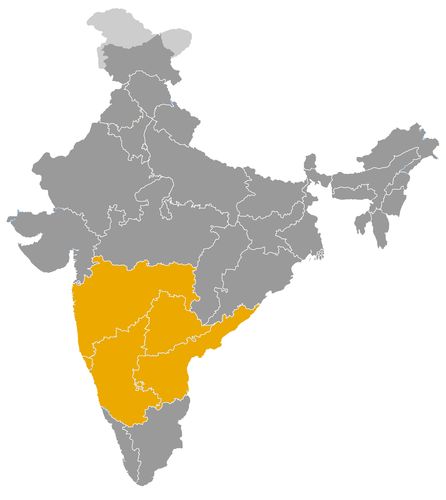
This map illustrates the maximum territory that the Kalyani Chalukya Dynasty had reached at its height, covering the current regions of Andhra Pradesh, Goa, Karnataka, Maharashtra and Telangana in India. Its main purpose is to provide a visual aid to understand the geographical extent of this dynasty. However, it's important to note that the contemporary borders of these regions may not necessarily coincide with the historical territories.
The Chalukya Dynasty of Kalyani and the Political Reordering of the Medieval Deccan
A later Chalukya power rooted in the legacy of the Deccan
The Chalukya dynasty of Kalyani, also known as the Western Chalukyas or Later Chalukyas, played a major role in the history of medieval India between the late tenth and the late twelfth century. Its rise followed the decline of the Rashtrakutas, who had previously dominated much of the Deccan. Tailapa II, a former Rashtrakuta feudatory, restored Chalukya authority in the western Deccan and founded a new phase of dynastic power that eventually became centred on Kalyani, modern Basavakalyan in northern Karnataka.
This dynasty should be distinguished from the earlier Chalukyas of Badami and the Eastern Chalukyas of Vengi. Nevertheless, the rulers of Kalyani drew legitimacy from the prestige of the Chalukya name. They presented themselves as heirs to an older Deccan political tradition while adapting their rule to the conditions of the eleventh and twelfth centuries. Their importance lies in the way they reshaped the balance of power in peninsular India after the Rashtrakutas and before the rise of several regional kingdoms.
A central political force between the Cholas and the Deccan powers
Politically, the Chalukyas of Kalyani were among the most important powers of the medieval Deccan. Their territories included large parts of present-day Karnataka and extended at various times into Maharashtra, Telangana and Andhra regions. Their position placed them between the Tamil country to the south, the eastern coastal zones, and the interior plateau of the Deccan.
Their principal rivalry was with the Cholas of Tamil Nadu. The two dynasties struggled for influence over the eastern Deccan, especially the Vengi region, and over the zones between the Krishna, Tungabhadra and Godavari river systems. This rivalry shaped much of South Indian politics during the eleventh century. It involved military campaigns, dynastic alliances, contested successions and shifting control over strategic territories.
The reign of Vikramaditya VI was the high point of Chalukya authority. He strengthened the kingdom, asserted dominance over rival powers, and inaugurated the Chalukya-Vikrama era. Under his rule, Kalyani became one of the major centres of political power in the Deccan. The dynasty’s role was therefore not merely regional; it influenced the political structure of the whole southern half of the subcontinent.
A state sustained by feudatories and regional elites
The Chalukya kingdom of Kalyani was not a centralized state in the modern sense. Its power depended on a wide network of feudatories, governors, military chiefs and local aristocratic families. This system made it possible to control an extensive territory, but it also created long-term instability. Powerful subordinate houses could gradually acquire their own military and fiscal resources.
Several later dynasties emerged from this political environment. The Hoysalas in southern Karnataka, the Seuna Yadavas in the north-western Deccan, the Kakatiyas in the eastern Deccan and the Kalachuris of Kalyani all developed within or near the Chalukya sphere of influence. Some of them initially acted as subordinates before becoming independent powers.
For this reason, the Chalukyas of Kalyani had a double historical role. They created a large political framework for the medieval Deccan, but that same framework enabled the rise of new regional states. Their decline was therefore not simply a collapse, but part of a wider redistribution of power across the Deccan.
Architectural innovation in the western Deccan
The cultural impact of the Chalukyas of Kalyani is especially visible in temple architecture. Their period saw the development of a distinctive Western Chalukya style, particularly in Karnataka. This style occupies an important position between the earlier architecture of the Badami Chalukyas and the later, more elaborate forms of Hoysala temple design.
Sites such as Lakkundi, Gadag, Itagi, Dambal and Annigeri illustrate the artistic vitality of the period. Western Chalukya temples often display refined stonework, intricate pillars, sculpted doorways, elaborate ceilings and carefully planned shrine layouts. The architecture combines elements associated with northern and southern Indian traditions while developing a regional character of its own.
Temple building served more than a religious purpose. It expressed royal authority, marked control over territory, and strengthened links with local elites and religious communities. By supporting temples, rulers and aristocrats created visible symbols of prestige and helped organize economic and ritual life in the regions under Chalukya influence.
Literary and intellectual production at the Chalukya court
The Chalukya court of Kalyani was also an important centre of learning and literary activity. Someshvara III is associated with the Manasollasa, an encyclopedic Sanskrit work that covers subjects such as administration, music, cuisine, leisure, courtly culture and the arts. This text reflects an image of kingship based not only on military power, but also on knowledge, refinement and cultural order.
The period was also important for Kannada and Sanskrit literary traditions. Inscriptions, court literature and religious writings show a multilingual cultural environment in which regional and classical forms coexisted. Kannada gained increasing prominence as a language of literary and inscriptional expression, while Sanskrit retained its prestige in royal and scholarly contexts.
This cultural production contributed to the long-term importance of Karnataka as a major literary and religious region of medieval India.
Economic structures linked to agriculture, temples and trade routes
The economic foundations of Chalukya power rested on agrarian revenue, regional taxation, land grants and control over routes crossing the Deccan. Their territories connected inland Karnataka and Maharashtra with eastern and southern trade networks. This geographic position enabled the dynasty to mobilize resources for war, administration, court life and religious patronage.
Temples played a significant economic role. They received land grants, employed artisans, managed resources, supported ritual specialists and contributed to the growth of settlements. Monumental construction stimulated the work of sculptors, architects, metalworkers, scribes and merchants. The prosperity reflected in Chalukya temples indicates the capacity of the state and regional elites to mobilize considerable wealth.
A formative dynasty in the medieval history of the Deccan
The Chalukya dynasty of Kalyani declined in the twelfth century as powerful feudatories asserted independence and the Kalachuris temporarily seized power at Kalyani. Someshvara IV attempted to restore Chalukya authority, but the empire could not be permanently reconstructed.
Their historical significance remained substantial. They preserved and renewed the Chalukya political tradition, resisted Chola expansion, shaped the territorial organization of the Deccan, and fostered an architectural and literary culture of lasting importance. The dynasty stands as a pivotal force between the older imperial formations of the Deccan and the later regional kingdoms that would dominate medieval South India.
The Geographic Expansion of the Chalukya Dynasty of Kalyani in Medieval India
A Deccan kingdom centred on Kalyani
The Chalukya dynasty of Kalyani, also known as the Western Chalukyas or Later Chalukyas, ruled over a large part of the Deccan between the late tenth and the late twelfth century. Its political centre eventually became Kalyani, modern Basavakalyan in northern Karnataka. This location gave the dynasty access to the main routes of the Deccan plateau and allowed it to project power toward Karnataka, Maharashtra, Telangana, Andhra and the southern regions of the peninsula.
The Chalukya kingdom did not form a compact, uniformly governed state. Its geographic extent varied according to military success, dynastic strength and the loyalty of feudatories. Some areas were directly controlled from the royal centre, while others were governed through subordinate chiefs, military governors or allied regional houses. The dynasty’s expansion must therefore be understood as a layered political system, combining a core territory, dependent provinces and zones of influence.
Northern Karnataka as the dynastic heartland
Northern Karnataka formed the core of Chalukya power. Cities and temple centres such as Kalyani, Lakkundi, Gadag, Annigeri, Itagi and Dambal belonged to the region where royal authority was most visible. This area provided the dynasty with military bases, agrarian resources, religious legitimacy and a dense network of local elites.
The control of this heartland allowed the Chalukyas to dominate the western Deccan. It also supported one of their most enduring cultural achievements: the development of Western Chalukya temple architecture. The concentration of monuments in Karnataka reflects not only artistic patronage, but also the political importance of the region. The temples marked the presence of power, linked the court with religious institutions and helped organize local society.
Expansion into Maharashtra and the northern Deccan
To the north and north-west, the Chalukyas of Kalyani inherited part of the political space once controlled by the Rashtrakutas. Their influence extended into areas corresponding to southern and central Maharashtra. These territories were important because they connected the Deccan plateau with routes leading toward Malwa, Gujarat and northern India.
The northern frontier brought the Chalukyas into contact and occasional conflict with other regional powers, including the Paramaras of Malwa and local chiefs of the upper Deccan. This zone was rarely fixed. It shifted according to campaigns, alliances and the capacity of the Chalukya kings to maintain the loyalty of powerful feudatories.
Control over the northern Deccan strengthened the prestige of the dynasty, but it also increased the difficulty of governing a wide and diverse territory. The further the kingdom extended from Kalyani, the more it depended on local intermediaries.
The eastern Deccan and the strategic importance of Vengi
The eastern Deccan was one of the most contested areas in Chalukya policy. The region of Vengi, in the coastal Andhra area, was especially important because it linked the interior Deccan to the eastern coast and the Bay of Bengal. It also had major dynastic significance, since the Eastern Chalukyas of Vengi were closely connected with wider Chalukya and Chola politics.
The struggle for influence over Vengi shaped the long rivalry between the Chalukyas of Kalyani and the Cholas of Tamil Nadu. The Cholas sought to extend their influence northward through dynastic alliances and military intervention, while the Chalukyas attempted to prevent Chola dominance over the eastern flank of the Deccan. As a result, Vengi became more than a regional territory. It was a strategic bridge between the Tamil country, the Andhra coast and the Deccan interior.
When the Cholas controlled or influenced Vengi, they could threaten Chalukya interests from the east and south. When the Chalukyas strengthened their position there, they limited Chola expansion and protected access to the eastern routes.
The southern frontier and the rivalry with the Cholas
The southern boundary of Chalukya power was shaped above all by conflict with the Cholas. The disputed regions lay around the Tungabhadra and Krishna river systems and in the zones connecting Karnataka with the Tamil country. These territories were valuable for their agricultural resources, military routes and symbolic importance.
The Chalukya-Chola rivalry dominated much of South Indian politics during the eleventh century. Neither dynasty was able to permanently absorb the other’s core territory, but both repeatedly intervened in borderlands and in the politics of Vengi. Warfare between them was therefore not only territorial. It was also a contest for prestige, dynastic legitimacy and supremacy in peninsular India.
The Chalukyas used the geography of the Deccan to resist Chola pressure. Their control of the plateau gave them strategic depth, while the Cholas relied on the resources of the Kaveri basin and their influence along the eastern coast.
Feudatories as instruments and rivals of expansion
The wide territorial reach of the Chalukyas of Kalyani depended heavily on feudatories. The Hoysalas in southern Karnataka, the Seuna Yadavas in the north-western Deccan, the Kakatiyas in the eastern Deccan and the Kalachuris of Kalyani were all, at different stages, connected to the Chalukya political order.
This system allowed the dynasty to govern a broad region without direct administration everywhere. It also enabled rapid military mobilization through subordinate chiefs. However, it created long-term fragility. As feudatories gained resources, armies and local legitimacy, they became increasingly capable of challenging the authority of Kalyani.
The same territorial structure that supported Chalukya expansion therefore contributed to its decline. The kingdom’s outer regions became the bases from which new powers emerged.
The fragmentation of Chalukya territory in the twelfth century
By the twelfth century, the geographic reach of the Chalukyas had begun to contract. The Kalachuris temporarily seized power at Kalyani, while the Hoysalas, Seuna Yadavas and Kakatiyas consolidated their independence in different parts of the Deccan. Someshvara IV attempted to restore Chalukya authority, but the old imperial framework could not be permanently rebuilt.
The geographic expansion of the Chalukya dynasty of Kalyani left a lasting mark on medieval India. It linked Karnataka, Maharashtra, Andhra and the southern Deccan within a single political sphere. It shaped relations with the Cholas, structured the rise of feudatory powers and prepared the ground for the later regional kingdoms of the Deccan. The dynasty’s territorial history therefore illustrates both the strength of Deccan imperial power and the processes of fragmentation that transformed medieval South India.
This chronology concerns the Chalukyas of Kalyani, also known as the Western Chalukyas or Later Chalukyas, and not the Chalukyas of Badami or the Chalukyas of Vengi. The rulers are generally described as kings in modern historiography, although their inscriptions also use royal and imperial honorific titles. The dates are indicative, especially for the period of Kalachuri domination in the twelfth century, when some Chalukya rulers held reduced or contested authority.
- Tailapa II (c. 973–997 CE) • A former Rashtrakuta feudatory, he overthrew their authority and founded the Chalukya power of Kalyani.
- Satyashraya (c. 997–1008 CE) • He consolidated the kingdom and faced the first major Chola pressures in the southern Deccan.
- Vikramaditya V (c. 1008–1015 CE) • His reign was relatively brief and maintained dynastic continuity after Satyashraya.
- Jayasimha II (c. 1015–1042 CE) • He stabilized the kingdom against the Cholas, the Paramaras and regional powers of the Deccan.
- Someshvara I (c. 1042–1068 CE) • He strengthened Chalukya power and shifted the royal centre to Kalyani, which became the dynasty’s major capital.
- Someshvara II (c. 1068–1076 CE) • His authority was challenged by his brother Vikramaditya VI, causing a succession crisis.
- Vikramaditya VI (c. 1076–1126 CE) • He was the most powerful ruler of the dynasty and inaugurated the Chalukya-Vikrama era.
- Someshvara III (c. 1126–1138 CE) • A learned king, he is associated with the composition of the Manasollasa and a phase of relative stability.
- Jagadhekamalla II (c. 1138–1151 CE) • He ruled during a period of growing pressure from feudatories and neighbouring powers.
- Tailapa III (c. 1151–1164 CE) • His reign saw a marked weakening of Chalukya authority and the rise of the Kalachuris of Kalyani.
- Jagadhekamalla III (c. 1164–1183 CE) • His power appears to have been limited or contested during Kalachuri domination and political fragmentation in the Deccan.
- Someshvara IV (c. 1183–1200 CE) • The last Chalukya ruler of Kalyani, he briefly recovered Kalyani but failed to restore the empire permanently.
 Links to the main sections of the site