Français (France)
  Nederlands (nl-NL)
 Of Animist then Hindu tradition, (with additional Islamic and Buddhist influence), the Kachari dynasty ruled for approximately 904 years, ± between 950 and 1854 over all or part of East India, during the Medieval Period and the Colonial Period.
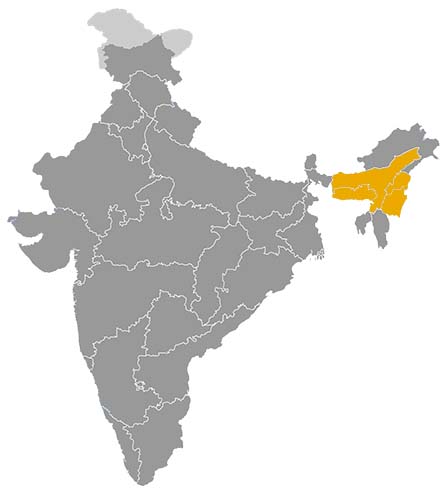
This map illustrates the maximum territory that the Kachari Dynasty had reached at its height, covering the current regions of Assam, Manipur, Meghalaya and Nagaland in India. Its main purpose is to provide a visual aid to understand the geographical extent of this dynasty. However, it's important to note that the contemporary borders of these regions may not necessarily coincide with the historical territories.
The Kachari Dynasty: Cultural, Political, and Economic Influence in Indian History
Introduction
The Kachari dynasty, primarily based in present-day Assam, played a significant role in shaping the political, cultural, and economic landscape of Northeast India. Originating from the Bodo-Kachari ethnic group, this dynasty ruled for centuries, leaving behind a rich heritage that is still evident in the region’s traditions, architecture, and socio-political structures. The Kachari kingdom was a formidable power in its time, influencing the development of the region while interacting with neighboring dynasties, such as the Ahoms and the Chutias.
Historical and Political Context
The Kachari dynasty rose to prominence during the medieval period, with their initial seat of power located in Dimapur. Over time, the capital shifted to Khaspur as the kingdom expanded its influence across the Brahmaputra and Barak valleys. The Kacharis established a sophisticated administration and military system that allowed them to maintain control over their territories despite ongoing conflicts with rival kingdoms.
Politically, the Kachari dynasty managed to thrive in a region characterized by constant power struggles. By balancing diplomacy and military prowess, they formed alliances while defending their borders from external threats, particularly from the Ahoms, who later became dominant in the region. The Kacharis’ political acumen helped them maintain relative independence for a long time before ultimately succumbing to British colonial forces in the early 19th century.
Economic Impact
The Kachari economy was primarily agrarian, with rice cultivation being the backbone of their agricultural production. The fertile lands of Assam, nourished by the rivers Brahmaputra and Barak, made the region ideal for rice farming. The surplus generated by agricultural activities not only sustained the local population but also supported trade with neighboring regions.
In addition to agriculture, the Kachari kingdom was known for its craftsmanship, particularly in textiles and jewelry. The artisans of the Kachari kingdom were skilled in producing unique designs, which became popular trade items. The kingdom's economic prosperity was further bolstered by its role as a trade intermediary between the plains of Assam and the hill tribes of the surrounding regions. The kingdom’s strategic location made it an important hub for the exchange of goods such as rice, cotton, and handicrafts, contributing to its wealth and political stability.
Cultural Influence
Culturally, the Kachari dynasty made lasting contributions to the artistic and religious landscape of Assam. The dynasty’s rulers were initially followers of animist traditions, worshiping local deities and nature spirits. Over time, as Hinduism spread across the region, the Kachari rulers adopted Hindu practices while retaining many aspects of their indigenous faith. This blending of religious traditions created a unique syncretism that shaped the religious life of the Kachari people.
The dynasty's cultural legacy is particularly evident in its architecture. The ruins of Dimapur, once the Kachari capital, stand as a testament to the kingdom’s architectural prowess. The site is famous for its monolithic pillars and stone carvings, which display a mix of indigenous and Hindu artistic styles. These structures, although partially in ruins, reflect the grandeur of the Kachari dynasty and its contribution to the region's cultural heritage.
The Kachari language, a branch of the Tibeto-Burman family, was widely spoken during the dynasty's rule. Although its use has diminished over time, elements of the Kachari language and cultural practices still exist among the Bodo people of Assam. Festivals such as Busu Dima, a harvest festival, continue to be celebrated, preserving the dynasty's cultural identity.
Decline and Legacy
The decline of the Kachari dynasty began in the 18th century, as the kingdom faced increasing pressure from both the Ahom kingdom and British colonial forces. The Ahoms, who had expanded their influence throughout Assam, eventually weakened the Kachari kingdom, leading to its gradual loss of territory. By the early 19th century, the Kachari kingdom was absorbed into British India, marking the end of its political autonomy.
Despite its political decline, the legacy of the Kachari dynasty remains influential in the cultural and historical memory of Assam. The ruins of Dimapur and Khaspur, along with the oral traditions passed down through generations, continue to highlight the dynasty’s contribution to the region’s development. The Kacharis' role in shaping the economic, cultural, and political foundations of Assam has cemented their place in the region's history.
Conclusion
The Kachari dynasty’s significance in Indian history lies in its ability to maintain a powerful and independent kingdom in the northeastern part of the subcontinent for centuries. Through their contributions to agriculture, trade, architecture, and culture, the Kacharis played a vital role in shaping the identity of Assam. Their unique blend of indigenous traditions with Hindu practices created a cultural legacy that continues to influence the region today. Though their political power eventually waned, the Kachari dynasty's impact on the cultural and economic fabric of Assam remains profound.
The Geographical Expansion of the Kachari Dynasty and Its Relations with Neighboring Dynasties
Introduction
The Kachari dynasty, originating from the Bodo-Kachari ethnic group, was a significant power in Northeast India, particularly in the region of Assam. Over the centuries, the Kachari kingdom expanded its territorial reach, playing a crucial role in shaping the political, cultural, and economic landscape of the region. This geographical expansion not only allowed them to exert influence over a large area but also shaped their interactions with neighboring dynasties, such as the Ahoms, Chutias, and Tripuras.
Territorial Expansion
At its peak, the Kachari kingdom controlled vast territories that spanned the valleys of the Brahmaputra and Barak rivers, two of the most fertile regions in Northeast India. Initially, the Kachari capital was located in Dimapur, in present-day Nagaland. Dimapur was strategically important due to its location along key trade routes and its proximity to the Brahmaputra River.
However, as external pressures grew, particularly from the expanding Ahom kingdom, the Kacharis were forced to relocate their capital to Khaspur, in the Barak Valley. This move allowed the Kacharis to maintain control over a large part of southern Assam, parts of present-day Meghalaya, and even areas of Manipur. The strategic positioning of Khaspur further facilitated trade and strengthened the kingdom’s political power, particularly by giving them access to both agricultural lands and trade routes connecting them to other regions of the subcontinent.
The expansion of the Kachari kingdom into these fertile plains and foothills allowed them to establish a strong economic base, driven by agriculture and trade. This geographical dominance made the Kacharis a formidable force in the region, capable of defending their borders and engaging with neighboring powers both diplomatically and militarily.
Relations with Neighboring Dynasties
Relations with the Ahoms:
The Ahoms, who ruled the upper Brahmaputra Valley, were one of the Kachari dynasty’s main rivals. As the Ahom kingdom expanded during the 13th and 14th centuries, clashes between the two powers became frequent. The Ahoms' growing influence in Assam directly threatened Kachari control over Dimapur, ultimately leading to the Kachari retreat to Khaspur. Despite these territorial losses, the Kacharis managed to maintain their independence for centuries, at times allying with the Ahoms to counter common enemies, such as Mughal incursions. However, the rivalry with the Ahoms defined much of Kachari military and political strategy.
Relations with the Chutias:
To the east of the Kachari kingdom, the Chutia dynasty controlled large parts of Assam before being absorbed by the Ahoms. The Chutias and Kacharis often competed for dominance over the fertile agricultural lands in Upper Assam and control of key trade routes. While both dynasties were rivals, they shared cultural and religious similarities, which sometimes allowed for peaceful interactions and the exchange of goods. As the Ahoms eventually defeated the Chutias, this added further pressure on the Kacharis to defend their shrinking borders.
Relations with the Tripura Dynasty:
To the south, the Kacharis shared borders with the Tripura kingdom. The relationship between the two dynasties was more cooperative than with the Ahoms or Chutias, largely due to their common linguistic and ethnic roots. Trade and diplomatic relations flourished between the two kingdoms, with both benefitting from exchanges of goods, particularly agricultural products and textiles. This relationship helped the Kacharis secure their southern borders and focus their military efforts on their northern and eastern rivals.
Impact of Expansion on the Kachari Dynasty
The Kachari dynasty’s territorial expansion had both positive and negative impacts on their kingdom. On one hand, the control of fertile agricultural lands allowed the Kacharis to sustain a strong agrarian economy, providing food surplus and resources for trade. The Barak and Brahmaputra valleys were vital arteries for trade, linking the Kachari kingdom with other regions of India and beyond.
On the other hand, the kingdom’s geographical expansion also brought it into conflict with neighboring powers, particularly the Ahoms. These ongoing conflicts with powerful rivals weakened the Kacharis over time, as they struggled to defend their borders while maintaining control over their territories. The relocation of their capital to Khaspur was both a strategic move and a sign of the growing pressure from external forces.
Nevertheless, the Kachari kingdom’s expansion facilitated a blending of cultures, with influences from neighboring kingdoms and regions shaping the development of Kachari society. The spread of Hinduism, for instance, became more pronounced as the Kacharis interacted with Hindu dynasties. At the same time, they preserved many of their indigenous customs, creating a unique cultural fusion that characterized their kingdom.
Conclusion
The Kachari dynasty’s territorial expansion played a pivotal role in shaping their interactions with neighboring dynasties and their own internal development. The control of fertile river valleys and strategic trade routes allowed the Kacharis to establish a strong economic foundation, while their political and military strategies helped them navigate the complex power dynamics of the region. Although conflicts with neighboring dynasties, particularly the Ahoms, eventually led to the decline of the Kachari kingdom, their territorial influence left a lasting mark on the history and culture of Assam and Northeast India. Today, the legacy of the Kachari dynasty continues to be remembered through the cultural practices, architectural ruins, and historical narratives of the region.
List of rulers
- Bir Kasar (12th century): Legendary founder of the Kachari dynasty, established Dimapur.
- Sutra Kachari (14th century): Expanded the kingdom and consolidated power in Dimapur.
- Tamradhvaja (16th century): Ruled during the rise of the Ahoms, moved the capital to Maibong.
- Govinda Chandra (18th century): Last significant king before British annexation in 1832, moved the capital to Khaspur.
 Links to the main sections of the site