Français (France)
  Nederlands (nl-NL)
 Animism refers to a set of beliefs in which natural elements—trees, stones, rivers, animals—are thought to be inhabited or animated by spirits or invisible forces. Without a single founder, it dates back to prehistoric times and is likely among the earliest forms of human religiosity. Found across all continents, animism has remained most prominent in traditional societies in Africa, Southeast Asia, Oceania, and among certain Indigenous communities in India, Indonesia, and rural Japan. It is based on relationships of respect or exchange with spiritual beings in nature, and is often later integrated into organized religions. Though not typically expressed through monumental architecture, animism has influenced the layout of sacred spaces, domestic altars, forest shrines, and votive objects, playing a foundational role in the cultural and ritual history of many civilizations.

Om Banna temple, Votive offerings such as bangles and bells at a roadside shrine

Om Banna temple, Sacred tree wrapped with prayer threads
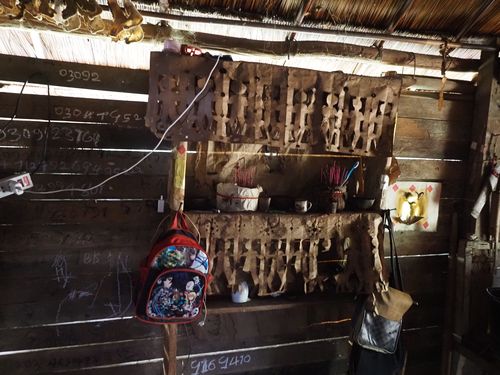
Laos, Domestic altar with incense and carved figures in a shaman’s house
Animism: Origins, Beliefs, and Cultural Role
Historical Background and Definition
Animism refers to a set of religious beliefs in which natural elements—such as animals, trees, rivers, rocks, or weather phenomena—are believed to possess a spiritual essence or conscious agency. The term was coined in the late 19th century by British anthropologist Edward B. Tylor, who identified it as the earliest form of human religiosity. While modern academic perspectives have evolved beyond Tylor’s framework, the concept of animism remains useful in describing worldviews in which the boundary between humans and non-humans is not rigidly defined.
Animism has no single founder, sacred scripture, or centralized dogma. It emerged in prehistoric times, long before the development of organized religions, as a way to interpret and interact with the environment. In animist traditions, spiritual presence is not confined to deities but is widely diffused in nature and everyday life.
Geographic Distribution
Animism is not tied to a specific region or ethnic group; it has historically been present in most early human societies. Today, it remains most visible in certain parts of the world, particularly among indigenous and rural communities. Notable regions include:
- Sub-Saharan Africa, among groups such as the Dogon, Yoruba, or Akan;
- South and Southeast Asia, including the tribal populations of India (Gond, Santhal, Munda), Laos, Myanmar, and Indonesia;
- East Asia, where animist beliefs were integrated into Shinto in Japan and traditional Chinese practices;
- Oceania, especially among Melanesian and Polynesian societies;
- The Americas, among various Indigenous peoples;
- Northern Eurasia, particularly within Siberian and Mongolian shamanic cultures.
In many of these areas, animism continues to coexist with or influence major religions such as Hinduism, Buddhism, Christianity, or Islam.
Main Currents and Variants
Animism is not a unified religion but rather a category encompassing a variety of belief systems. Several broad orientations can be identified:
- Totemic animism, where communities maintain symbolic or ancestral connections with specific animals, plants, or natural features, often regarded as spiritual kin. This is especially common in Australia and parts of Southeast Asia.
- Ancestral animism, focused on the veneration of ancestors who continue to influence the lives of their descendants. This form is prevalent in East and Southeast Asia and West Africa.
- Territorial animism, which emphasizes spirits associated with specific natural sites such as forests, rivers, mountains, or caves. This is particularly notable in island societies like Indonesia or the Philippines.
- Shamanic animism, structured around ritual specialists (shamans) who communicate with the spirit world through trance, possession, or divination. This form is widespread among Arctic, Central Asian, and tribal Southeast Asian populations.
Each of these orientations may be present within the same society, either in parallel or as overlapping practices.
Core Beliefs and Ritual Practices
At the heart of animist belief systems lies the recognition of a spiritual dimension in the non-human world. Spirits are not necessarily deities; they may be guardians, ancestors, elemental forces, or unnamed entities. Relationships between humans and spirits are often reciprocal and governed by respect, taboo, or ritual exchange.
Key features of animist practice include:
- Offerings and sacrifices, typically of food, drink, flowers, or symbolic items placed at sacred locations;
- Seasonal and life-cycle rituals, marking births, puberty, marriage, and death;
- Divination and healing rites, often led by shamans or spiritual mediators;
- Spiritual possession or trance states, facilitating communication with the spirit world;
- Taboos and purity rules, governing behavior in relation to sacred places or times.
Animist rituals are frequently embedded in daily life and tied to environmental rhythms (harvests, monsoons, animal migrations). Rites may take place at household altars, natural shrines, sacred groves, or community gathering spaces.
Objects of religious significance include ritual drums, masks, totems, stones, figurines, and protective charms. These are often handmade and passed down within families or clans.
Political Role and Identity
Although animism is rarely institutionalized as a state religion, it has historically played a crucial role in political organization, especially in non-centralized or clan-based societies. Several aspects illustrate its political relevance:
- Legitimation of authority: Chiefs and rulers may claim spiritual descent or unique relationships with protective spirits.
- Social regulation: Taboos and rituals serve as informal systems of control, reinforcing moral codes and community cohesion.
- Land-based identity: Spirits of place often define the boundaries of clan territories, and rituals may validate claims to land and resources.
In modern contexts, animist traditions have become symbols of cultural identity among marginalized or Indigenous groups. In India, certain tribal communities assert their animist heritage (e.g., the Sarna faith) as distinct from mainstream Hinduism. In Indonesia, some ethnic groups have obtained legal recognition for ancestral belief systems under the category Aliran Kepercayaan. Elsewhere, animism forms the basis for local resistance to religious homogenization or political centralization.
Relationship to Death and the Afterlife
The relationship with the dead is a central pillar of many animist systems. Ancestors are not merely remembered but are considered active participants in family and communal life. Their favor or displeasure can influence fertility, health, prosperity, or misfortune.
Death is often viewed not as an end, but as a transformation. Souls may become protective spirits, require ongoing care, or risk becoming malevolent if neglected. Rituals surrounding death can be elaborate, including:
- Extended funerary rites, sometimes lasting weeks or months;
- Ancestral altars, maintained in homes or sacred enclosures;
- Periodic offerings to ancestors, particularly during seasonal festivals;
- Erection of memorials or effigies, such as carved wooden figures or megalithic stones.
In some cultures (e.g., the Toraja in Sulawesi or the Gonds in India), elaborate funerary architecture and multi-stage burial ceremonies reflect the belief that the dead must be ritually accompanied toward their proper place in the spiritual world.
Spirit possession, ghost appeasement, and exorcism are also common elements in the management of the invisible world. Illness, bad luck, or infertility may be interpreted as signs of ancestral displeasure or spiritual imbalance, prompting intervention from shamans or elders.
The Architectural Influence of Animism: Forms, Functions, and Symbolic Dimensions
Origins and Religious Foundations of Architectural Forms
Animism, broadly defined as the belief that natural entities—trees, rocks, rivers, animals—are inhabited by spirits or possess a form of consciousness, does not typically produce monumental architecture in the same sense as codified religions. Nevertheless, animist worldviews have significantly shaped the ways in which sacred spaces are conceived, delimited, and used across a wide range of societies.
In animist traditions, sacredness is often attributed not to buildings themselves but to specific places or natural features believed to be imbued with spiritual presence. The earliest architectural expressions linked to animism were not temples in the formal sense, but ritual markers—stones, totems, clearings—meant to signal a relationship with the spiritual world. Over time, some of these sites evolved into more permanent structures, though their function remained primarily ceremonial or relational rather than institutional.
Typologies and Ritual Uses of Built Structures
Although animism generally lacks a centralized religious framework, it has produced a diverse range of architectural forms that can be grouped into three main categories:
1. Places of Worship
Animist shrines are typically modest in scale and closely integrated into the natural environment. They may take the form of open-air altars near sacred trees, springs, or stones, or consist of simple enclosures built with local materials. The primary function is not to house a deity but to establish a point of interaction between humans and spiritual forces.
These places may be temporary—constructed for specific festivals or rites—or permanent community spaces maintained by ritual specialists or elders. They rarely follow complex hierarchical plans or architectural codification, emphasizing function over form.
2. Communal Ritual Spaces
Certain spaces are reserved for collective ceremonies such as seasonal festivals, rites of passage, healing rituals, or fertility celebrations. These may include:
- ceremonial clearings in forests,
- stone circles or aligned poles,
- ritual platforms made of wood or earth,
- fenced enclosures used for dance, prayer, or offerings.
Such spaces often follow circular or rectangular layouts and are defined by symbolic boundaries rather than walls. Their use is governed by ritual codes, including rules on purification, entry, spatial arrangement, and timing.
3. Funerary Structures
Animist funerary architecture is highly variable across regions but tends to serve both commemorative and spiritual purposes. Typical features include:
- upright stones or wooden totems marking burial sites,
- earthen mounds or stone-covered tombs,
- carved effigies or ancestral posts,
- raised platforms used for secondary burial rites or ritual exposure of the dead.
These structures often represent a continued dialogue with the deceased, aiming to honor, appease, or guide spirits as they transition into the afterlife.
Symbolic Forms and Spatial Conventions
Animist architecture integrates symbolic elements that reflect cosmological beliefs and relational dynamics between the visible and invisible realms. Although these symbols are rarely standardized, some recurring motifs can be observed:
- Vertical elements such as trees, poles, or pillars often symbolize communication between the earth and the sky or between humans and spirits.
- Circular layouts evoke cyclical time, balance, or community cohesion, and are commonly used in ritual dance grounds or offering spaces.
- Enclosures and thresholds serve to mark transitions from the profane to the sacred, even in open-air settings.
Orientation may follow natural cues—toward sunrise, a sacred mountain, or a source of water—and decoration may include organic materials (feathers, bark, seeds, bones) or painted symbols that hold protective or communicative value.
Unlike the ornamentation in monumental architecture, these elements are functional and contextual rather than aesthetic in intention.
Materials and Building Techniques
Animist constructions rely almost entirely on locally available materials. Wood, stone, bamboo, clay, leaves, and thatch are commonly used. Material selection is often symbolic: some woods are believed to attract benevolent spirits, while others are used to repel harmful influences.
Building techniques prioritize adaptability and temporal relevance. Many structures are intentionally perishable, reflecting the cyclical or event-based nature of ritual space. This impermanence is not seen as a flaw but as an integral part of spiritual renewal or seasonal rhythm.
In areas with megalithic traditions, more durable materials are used. Stone pillars, slabs, and alignment structures may serve as long-term spiritual markers, particularly for ancestral worship or territorial demarcation.
Geographic Spread and Local Adaptations
Animist architectural expressions are found globally, with high concentrations in:
- the forests and highlands of Southeast Asia,
- the savannahs and woodlands of Sub-Saharan Africa,
- the mountainous regions of Oceania,
- tribal zones in India and Central Asia,
- indigenous territories in the Americas.
Each region adapts its architecture to environmental conditions and cosmological beliefs. For example:
- Bamboo and palm materials are prevalent in tropical areas,
- Earth mounds or subterranean tombs are more common in arid regions,
- Wooden effigies and raised platforms appear in wet or mountainous terrains.
Despite regional differences, a shared emphasis exists on ecological integration, ritual functionality, and community participation in construction and use.
Intercultural Interactions and Architectural Syncretism
Animist architecture has frequently intersected with the built traditions of organized religions. In many cultures, as larger religious systems expanded, animist practices and sacred sites were absorbed or reinterpreted rather than eliminated.
Examples of such interactions include:
- the preservation of sacred trees or rocks within temple compounds,
- incorporation of local spirits into religious iconography or shrine layout,
- construction of dual-purpose spaces that serve both animist and institutional religious functions.
In some contexts, animist structures have influenced or been integrated into vernacular temple architecture, especially in frontier or syncretic cultural zones. Objects such as votive poles, ancestral stones, or ritual platforms continue to exist alongside mosques, churches, or pagodas, blurring the boundary between spiritual systems.
These interactions have resulted in hybrid architectural forms where animist elements persist within broader religious and cultural frameworks. The animist approach to space—centered on relational presence, symbolic marking, and functional temporality—has had a lasting impact on regional vernacular traditions.
This page organises the dynasties related to Animist religion, according to a chronological structure based on millennia and centuries. The associated maps indicate the present-day location of the relevant states and link to the detailed pages.
4th millennium BCE
33rd century BCE